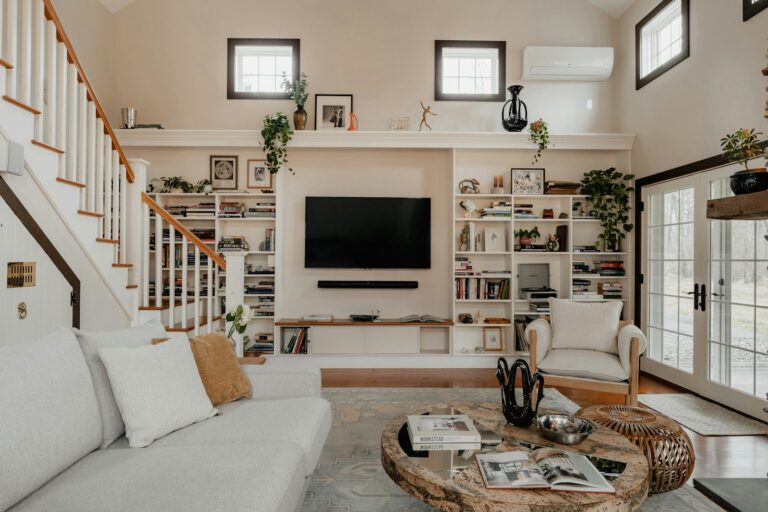
AC3 laminate flooring is the highest abrasion class certified for general residential use. It survives a minimum of 2,500 Taber rotations before initial decorative wear and is engineered for the realistic demands of an occupied family home, including children, pets, kitchen activity, and frequent furniture movement. The wear layer on most AC3 products measures between 0.2 mm and 0.3 mm of aluminum oxide reinforced melamine, deposited over a high-density fiberboard core.
AC3 is the standard rating found in the majority of mid-tier residential laminate sold in the United States. Its strength sits in the active interior of a home: living rooms, dining rooms, bedrooms, hallways, kitchens that see normal cooking traffic, and home offices. The EPLF also classifies AC3 for moderate commercial environments, which means it is acceptable in low-occupancy spaces such as hotel guest rooms, private offices, and small B2B reception areas, although it is not engineered for sustained public traffic.
The advantage of AC3 over a higher-rated plank is not technical but tactile and economic. Because AC3 uses a thinner direct pressure laminate top, the surface remains softer underfoot and quieter to walk on, and the printed décor reads more naturally because the protective layer is less optically dense. AC3 laminate is also typically 15% to 25% cheaper per square foot than equivalent AC4, which is why it dominates new-construction tract homes and budget-conscious renovations.
What Is AC4 Laminate Flooring?
AC4 laminate flooring is the first abrasion class certified for general commercial use. It survives a minimum of 4,000 Taber rotations, which represents a 60% improvement in wear resistance over AC3 and more than four times the roughly 900-rotation AC1 threshold. The wear layer on AC4 products typically ranges from 0.3 mm to 0.5 mm of aluminum oxide melamine, and the décor paper sits over a denser HDF core to support the heavier surface load.
AC4 was originally developed for offices, boutiques, salons, cafés, and other small commercial environments that experience moderate but consistent foot traffic. In the past decade, however, AC4 has become the dominant choice for active North American households. The reason is simple: a busy family home with children, pets, and an open-concept kitchen-to-living-room layout often experiences more daily foot traffic than a small office. AC4 is engineered to absorb that load without showing wear paths along high-use lanes such as the kitchen-to-fridge run or the front-door-to-stairs corridor.
AC4 also delivers stronger collateral benefits beyond pure abrasion resistance. Its denser core improves impact resistance, meaning a dropped pan or a moved chair leg leaves a lighter mark. Its tighter locking system, which manufacturers typically specify on AC4 lines because the higher residential price point justifies the engineering, resists edge separation under localized pressure such as high-heel impact. Many AC4 products also include factory-applied edge sealants that improve short-term moisture protection in kitchens and entryways.
AC3 vs AC4 Laminate Flooring: The Core Differences
The five differences below define the practical separation between AC3 and AC4 laminate flooring. Each one is measurable, certified, and verifiable on the product spec sheet rather than the marketing brochure.
1. Taber Abrasion Resistance
AC3 withstands a minimum of 2,500 Taber rotations before the surface décor shows initial wear. AC4 withstands a minimum of 4,000 rotations. In real-world terms, this 60% gap translates into roughly 8 to 12 additional years of visual lifespan in a hallway-grade traffic lane, assuming identical maintenance. Wear on a laminate floor does not appear uniformly across the room; it concentrates in narrow lanes along furniture legs, doorways, and pivot points. The higher Taber count of AC4 delays the moment those lanes become visible.
2. Intended Use Class
AC3 is rated for Class 23 (heavy residential) and Class 31 (moderate commercial) under EN 13329. AC4 is rated for Class 23 and Class 32 (general commercial). The shift from Class 31 to Class 32 is the boundary at which a laminate becomes commercially insurable for daily public foot traffic. For homeowners, this means AC4 carries a meaningful structural reserve over AC3 even when both are installed in the same residential room.
3. Wear Layer Thickness
AC3 typically carries a wear layer between 0.2 mm and 0.3 mm of aluminum oxide infused melamine. AC4 typically carries a wear layer between 0.3 mm and 0.5 mm. Although the absolute difference looks small, the wear layer is the only barrier between daily abrasion and the printed image beneath. A 0.1 mm increase in protective coating directly extends the period during which the décor stays photographically intact. Detailed coverage of laminate flooring wear layer thickness explains how this dimension governs every other durability outcome.
4. Surface Feel and Acoustic Behavior
AC3 produces a softer, quieter underfoot impression because its thinner top coat transmits less mechanical noise into the subfloor. AC4 sounds slightly firmer and clicks more audibly when walked on without underlay, because the denser surface and core reflect more sound. The difference is subtle on a quality underlayment but noticeable on bare concrete. Households sensitive to acoustic comfort, especially in second-floor bedrooms or apartments above neighbors, often prefer AC3 paired with a premium acoustic pad.
5. Price and Warranty
AC4 typically costs $1.00 to $2.00 more per square foot than AC3 from the same manufacturer line. The warranty extension is more dramatic than the price gap suggests. Most AC3 products carry a 15- to 25-year residential warranty. Most AC4 products carry a 25- to 30-year residential warranty plus a 5- to 10-year light commercial warranty. The warranty is not a marketing decoration; it is the manufacturer’s actuarial estimate of how long the wear layer will protect the décor under normal use.
What Is AC5 Laminate Flooring?
AC5 laminate flooring is a heavy commercial abrasion class that withstands more than 6,500 Taber rotations before initial décor wear, roughly 60% more than the 4,000-rotation AC4 threshold. It is specified for department stores, restaurants, schools, public buildings, retail showrooms, and large corporate offices, and it sits one step below AC6, which requires more than 8,500 rotations.
AC5 wear layers are denser and harder than AC4 wear layers, and they are often produced through the high pressure laminate (HPL) process rather than the direct pressure laminate (DPL) method used for most AC3 and AC4 floors. Bonding under higher pressure produces a tougher but firmer surface that feels rougher underfoot, which suits shoes-on commercial floors but is less pleasant for households that walk barefoot or in socks. AC5 planks are usually 12 mm thick and need balancing layers on both sides of the core to resist warping under the denser top surface, although thickness alone never earns the AC5 rating.
What Is the Difference Between AC4 and AC5 Laminate Flooring?
The difference between AC4 and AC5 laminate flooring is a 2,500-rotation gap in Taber abrasion resistance (4,000 vs 6,500) and a shift from general commercial to heavy commercial use class. The table below places AC5 beside AC3 and AC4.
Attribute
AC3
AC4
AC5
Minimum Taber rotations (IP)
2,500
4,000
6,500
Use class
Heavy residential, moderate commercial
Heavy residential, general commercial
Heavy commercial
Typical construction
DPL
DPL
Often HPL
Surface feel
Softest and quietest
Smooth, slightly firmer
Firmest and most textured
Residential warranty
15–25 years
25–30 years
25–30 years
Commercial warranty
—
5–10 years
10–15 years
Installation labor is identical for all three classes because the same click-lock or glue-down procedures, expansion gaps, transition strips, and underlayment requirements apply, so the entire AC4-to-AC5 price gap sits in the material. On a 1,500 square foot installation that premium can run into thousands of dollars. A commercial space recovers it through avoided replacement and downtime; a home that never reaches heavy commercial abrasion levels rarely does.
How the Taber Test Determines AC3 and AC4 Classification
The Taber abrasion test is the central protocol that separates AC3 from AC4. A 100 mm square sample of finished laminate is mounted on a rotating platform inside a Taber 5135 abraser, and two CS-17 abrasive wheels loaded to 1,000 grams each are lowered onto the surface. The platform spins, and the wheels grind against the décor until two endpoints are recorded. The first is IP, the initial point at which the décor shows breakthrough at any spot. The second is FP, the final point at which 95% of the décor has worn through.
For an AC3 classification, the sample must reach an IP of at least 2,500 revolutions. For AC4, the sample must reach 4,000 revolutions. The sandpaper used in the test is replaced every 500 revolutions to maintain consistent grit, and the test is repeated on multiple samples from the same production batch to confirm reproducibility. The testing laboratory must be ISO 17025 accredited for the result to be eligible for an EPLF or NALFA certification stamp.
This is why a higher AC number is not an opinion. It is a certified, third-party measurement of how many simulated foot-traffic cycles the plank survives, and the gap between AC3 and AC4 is not arbitrary but anchored to a 1,500-revolution difference verified in a laboratory.
Where AC3 Laminate Flooring Performs Best
AC3 is the correct choice when the room load matches its design envelope and the cost saving is meaningful. The five environments below represent the strongest fit for AC3.
Bedrooms experience the lowest sustained foot traffic in any home, often fewer than 20 to 30 footfalls per day per occupant. AC3 covers this load with substantial margin and offers the softer underfoot feel that occupants notice when walking barefoot in the morning.
Formal dining rooms and guest rooms used a few times per month fall well within AC3 territory. The wear concentration is too low to justify the AC4 premium, and the more natural décor depth of AC3 reads better in spaces where lighting is more decorative than functional.
Home offices used by a single occupant for desk-based work see traffic patterns closer to a bedroom than a commercial office. The chair caster wear, which is a real issue, is mitigated more effectively by a polycarbonate chair mat than by upgrading to AC4.
Closets, walk-in pantries, and laundry rooms have low traffic but do require a moisture-resistant locking system. AC3 with edge-sealed planks and a vapor barrier handles these spaces correctly and economically.
Quiet retirement-age households, where two adults occupy the home without children or large dogs, fall comfortably inside AC3’s residential design envelope across the entire floor plan.
Where AC4 Laminate Flooring Performs Best
AC4 is the correct choice when traffic is concentrated, mixed-source, or commercially adjacent. The five environments below justify the price premium.
Open-concept kitchens that flow directly into living areas concentrate the highest household traffic of any single zone. The repeated transition between cooking, eating, and seating creates a defined wear lane that AC3 will visually surrender within five to seven years. AC4 extends that interval significantly.
Hallways and entryways receive the abrasive grit tracked in from outside, which is more damaging to a wear layer than soft footfall. The harder surface of AC4, paired with a quality entry mat, defends against the silica and salt that erode AC3 surfaces fastest.
Households with large dogs, especially breeds with untrimmed nails, experience point-pressure scratching that an AC3 wear layer absorbs but eventually shows. AC4’s denser top coat resists nail scoring more effectively, and the difference is visible at the three-year mark.
Rental properties operate on a cost-per-tenant-cycle calculus rather than a homeowner lifespan calculus. AC4 is the correct grade for most rentals because the warranty span aligns with two to three tenant turnovers, after which the floor still shows acceptable wear at lease-end inspection. The full logic of selecting the best flooring for a rental property reinforces this conclusion.
Small home-based businesses, including private medical practices, consultancies, and boutique studios, fall inside AC4’s commercial envelope and benefit from the stronger insurance posture that a commercially rated floor provides if a slip-and-fall claim ever arises.
Where AC5 Laminate Flooring Performs Best
AC5 laminate flooring performs best where foot traffic is continuous through the working day and abrasive grit is constantly tracked in: full-service restaurants, retail stores, schools and universities, public buildings, hotel lobbies, and high-occupancy corporate offices. Entrance vestibules in high-volume stores may call for AC6.
In a home, AC5 is justified in three specific scenarios:
A home that doubles as a workplace, such as a daycare, salon, or clinic.
A household with multiple large dogs whose claws produce concentrated abrasion.
A homeowner who plans to keep the floor in service for 25 to 30 years and wants the maximum surface life available in laminate.
For most family homes, AC5 is over-specification. The floor is usually replaced for aesthetic reasons long before its wear layer is exhausted, and AC5 still scratches from sharp objects, dents from dropped items, and fades under UV exposure just like lower classes, because the Taber test does not simulate those failure modes.
Which AC Rating Does Each Room Need?
Room
Recommended AC rating
Upgrade to AC5 when
Bedrooms
AC3
Not needed; AC4 is already over-specification
Hallways and entryways
AC4 minimum
Outdoor footwear is consistently worn indoors
Open-concept kitchens
AC4
The kitchen is the central gathering space of the home
Living rooms
AC3 for light use, AC4 for normal family use
Very heavy daily use or large pets
Commercial offices
AC4 for private offices and teams under 20 staff
Open-plan offices with high headcount, conference rooms, reception areas
Retail
AC4 for boutiques with intermittent traffic
Any floor with continuous customer flow (AC6 for high-volume vestibules)
AC Rating vs Plank Thickness vs Wear Layer Thickness
One of the most common mistakes in laminate selection is conflating plank thickness with durability. They are not the same metric. Plank thickness, usually 7 mm, 8 mm, 10 mm, or 12 mm, governs acoustic performance, locking strength, and the perceived solidity underfoot. The AC rating governs surface wear resistance only.
An 8 mm AC4 laminate will outlast a 12 mm AC2 laminate in any traffic lane, even though the AC2 plank feels heavier. Conversely, a 12 mm AC4 laminate will sound and feel more substantial than an 8 mm AC4, but the surface lifespan of both is identical because the wear layer specification is identical. The correct way to read a spec sheet is to check the AC rating first to confirm the plank matches the room’s traffic load, then check the best thickness for laminate flooring to align with acoustic and structural needs.
The wear layer itself is one of four layers of laminate flooring: the wear layer on top, the décor paper beneath it, the HDF core in the middle, and the moisture-resistant backing on the underside. AC ratings test the wear layer alone. The HDF core density of laminate flooring is a separate quality factor that determines impact resistance, edge integrity, and dimensional stability under humidity swings, and it should be checked alongside the AC number.
Cost Comparison: AC3 vs AC4 Laminate Flooring
AC3 laminate flooring in the U.S. retail market typically ranges from $1.50 to $3.00 per square foot for the material alone. AC4 laminate flooring ranges from $2.50 to $4.50 per square foot. Installation labor adds $2.00 to $5.00 per square foot depending on subfloor preparation, layout complexity, and regional labor rates.
For a 1,000 square foot project, the AC4 upgrade costs an additional $1,000 to $2,000 over AC3. Spread over the warranty period of 25 to 30 years, the upgrade equates to roughly $40 to $80 per year, or under $0.25 per square foot per year. In any room where the AC3 floor would be replaced even five years earlier than AC4 due to visible wear, the AC4 upgrade pays for itself before the warranty period expires.
The opposite calculation also matters. In rooms with truly low traffic, AC4 will outlast the décor’s aesthetic relevance. Few homeowners keep the same flooring color and grain for 30 years, so the durability reserve becomes economically inert. Buying AC4 for a guest bedroom is a defensible choice, but it is not a financially optimized one.
How to Choose Between AC3 and AC4 Laminate Flooring
The decision between AC3 and AC4 reduces to four questions, answered honestly about the actual room rather than the aspirational room.
The first question is the daily traffic count. If more than four people, including pets weighing over 25 pounds, will cross the floor every day, AC4 is the safer specification. Below that threshold, AC3 is sufficient.
The second question is the source of abrasion. Tracked-in grit from a garden, beach, or unpaved driveway accelerates wear far more than indoor footfall alone. Homes in coastal San Diego, where fine sand reaches the entryway daily, justify AC4 in the first 10 feet of any floor regardless of indoor traffic levels.
The third question is the intended ownership timeline. A homeowner planning to sell within five years gains less from AC4 than one planning to stay 20 years. Resale value does respond to certified durability ratings, but the responsiveness is asymmetric: the buyer who sees AC4 on a disclosure form values it, while the buyer who sees AC3 rarely penalizes for it.
The fourth question is whether the room shares its envelope with a higher-traffic adjacent space. Open-plan layouts where the kitchen, dining area, and living room share a continuous floor should be specified at the highest required AC level, because the floor must be installed in a single continuous run. The kitchen sets the AC requirement for the entire open zone.
For homeowners who want to compare AC4 against the next commercial grade, the AC5 sections of this guide cover the heavy commercial threshold and the diminishing residential return above AC4.
Does Installation Quality Matter More Than the AC Rating?
Installation quality determines whether any AC rating delivers its tested lifespan. The AC rating is a property of the manufactured plank, not of the finished floor, and even an AC5 wear layer fails prematurely over an uneven subfloor, with inadequate expansion gaps, or on the wrong underlayment for the substrate. A correctly installed AC4 floor outperforms a poorly installed AC5 floor. Every AC class requires the same preparation:
Concrete subfloors need moisture testing and a vapor barrier.
Wood subfloors need leveling and a suitable underlayment.
Existing floors must be assessed for compatibility before laminate is laid over them.
Click-lock systems need a clean, dry, level surface to engage correctly.
Glue-down systems need a porosity-appropriate adhesive.
How Do You Verify a Laminate’s AC Rating?
A laminate’s AC rating is verified only through a current EN 13329 test report issued by an independent accredited laboratory, because Taber testing cannot be reproduced in the field. Treat any AC4 or AC5 claim without a third-party report with caution: labels that exceed actual tested performance are a known issue in low-cost imports.
Common Misconceptions About AC3 and AC4 Laminate Flooring
The first misconception is that AC4 is automatically waterproof. The AC rating measures abrasion, not water resistance. Many AC4 laminates are fully water-resistant or waterproof, but this is a separate certification (typically a 24-hour or 72-hour seal test) and must be verified on the spec sheet independently.
The second misconception is that AC3 is a low-quality grade. AC3 is a certified residential standard that meets EN 13329 requirements; it is not a budget downgrade but a correct specification for a defined use case. Calling AC3 “low quality” is the equivalent of calling a sedan low quality because it is not a truck.
The third misconception is that thicker planks always carry higher AC ratings. Plank thickness and AC rating are independent specifications. A 12 mm AC3 plank exists, and so does an 8 mm AC4 plank. The wear layer alone determines the AC class.
The fourth misconception is that AC4 is inherently noisier than AC3. The acoustic difference between the two grades is small at the surface and is dominated almost entirely by the underlay specification beneath the plank. A premium acoustic underlay neutralizes the difference for the human ear in a typical room.
Final Thoughts
AC3 vs AC4 laminate flooring is not a contest of better and worse. It is a calibration between residential adequacy and commercial reserve. AC3 is the correct grade for ordinary residential rooms with predictable, moderate traffic. AC4 is the correct grade for kitchens, hallways, entryways, rentals, and active multi-pet households where wear concentrates in defined lanes.
The financial difference between the two grades is roughly $1 to $2 per square foot, and the durability difference is a verified 60% increase in Taber abrasion resistance. For most homeowners installing laminate, the most defensible decision is AC3 in bedrooms and low-use rooms, AC4 in the living and circulation zones, with both selected from the same manufacturer line so that décor and plank thickness remain visually continuous across transitions.
If your project is in San Diego County and you want a specification reviewed before purchase, our laminate flooring services include in-home traffic assessments, AC-rating recommendations by room, and installation under the manufacturer’s warranty conditions.
James Miller is a seasoned flooring contractor with years of hands-on experience transforming homes and businesses with high-quality flooring solutions. As the owner of Flooring Contractors San Diego, James specializes in everything from hardwood and laminate to carpet and vinyl installations. Known for his craftsmanship and attention to detail, he takes pride in helping clients choose the right flooring that balances beauty, durability, and budget. When he’s not on the job, James enjoys sharing his expertise through articles and guides that make flooring projects easier for homeowners.
Laminate flooring is a multi-layer synthetic floor covering built on a high-density fiberboard (HDF) core, finished with a printed décor layer and a transparent aluminum-oxide wear layer. In residential rooms, it performs predictably well. In commercial spaces — offices, retail showrooms, restaurants, clinics, salons, and rental units — the same product behaves very differently. The…
Removing vinyl flooring is one of those jobs that looks straightforward until you’re on your knees at hour three, fighting adhesive that has bonded to your subfloor like structural concrete. The removal process is not just about pulling up planks or peeling back sheets — it is about understanding what was installed, how it was…
Most people frame this decision wrong. They ask “which is better” when the real question is “better at what, and for whom.” Carpet and wood flooring are not competing for the same job. One prioritizes sensory comfort, acoustic softness, and upfront affordability. The other trades those qualities for structural permanence, allergen resistance, and long-term financial…
Small rooms have a reputation for being difficult to design, but the truth is that the floor beneath your feet does more heavy lifting than most people realize. Tile, in particular, is one of the most powerful tools available for reshaping how a compact space feels. The right tile can pull walls apart visually, lift…
Dark hardwood flooring is having a genuine moment. After years of pale Scandinavian oak and washed-out grey planks dominating interiors, deep espresso, rich walnut, and dramatic ebony are reclaiming their rightful place as the floor choices that anchor a room with real authority. Interior designers across the country are calling it a return to warmth…
Wood floors transmit noise in two distinct ways, and most people only think about one of them. They buy a thick rug, lay it down, and assume the job is done. It helps, but it does not address what is actually happening inside the floor assembly when someone walks across the room above you. Understanding…