The Short Answer: Water-Resistant, Not Waterproof — And the Difference Matters More Than You Think
Cork flooring is one of the most misunderstood materials in the flooring world. Homeowners either dismiss it entirely as something that belongs in a wine bottle, or they assume its natural properties make it impervious to water. Neither position is accurate — and that gap between “water-resistant” and “waterproof” is exactly where expensive mistakes happen.
The factual answer is this: cork flooring is naturally water-resistant, not waterproof in its standard form. Whether it becomes waterproof depends entirely on the product type, the installation method, and the sealant applied. That nuance is what this article unpacks — because the material science, the product construction, and the room-by-room application all tell different parts of the same story.
What Makes Cork Naturally Water-Resistant: The Role of Suberin
To understand cork’s relationship with moisture, you have to start at the cellular level. Cork comes from the bark of the Quercus suber oak tree, primarily grown in the Mediterranean. The bark’s structure is made up of roughly 40 million cells per cubic centimeter — tiny, hexagonal, air-filled chambers sealed with a naturally occurring waxy substance called suberin.
Suberin is the key compound. It is hydrophobic by nature, meaning it actively repels water and other liquids rather than absorbing them. This is the same property that makes cork an ideal wine bottle stopper — it creates an effective seal against liquids and gases. Research has shown that cork’s composition is roughly 45% suberin, which gives it a non-permeability to liquids that is unusually high for a natural organic material.
This is why cork floats on water, why champagne bottles salvaged from the Titanic still had intact corks, and why cork handles the accidental kitchen spill better than untreated hardwood. The suberin barrier is real and meaningful.
But here is the critical limitation: suberin does not make cork a sealed unit. When cork is processed into tiles or planks, cut edges are exposed, seams are created between panels, and the surface may be sanded or altered during manufacturing. All of those points create pathways for water to bypass the suberin barrier. Immersing a single cubic inch of cork in water for 48 hours results in approximately 3% weight gain from water absorption — modest, but not zero. Prolonged or standing water exposure is where cork’s natural defenses begin to fail.
Water-Resistant vs. Waterproof: Why the Terminology Actually Matters
These two terms get used interchangeably in flooring marketing, which creates a lot of confusion at the point of purchase. The distinction is structurally important.
A waterproof material is completely impervious to water penetration, regardless of duration or volume of exposure. A water-resistant material can handle moderate moisture contact — splashes, brief standing water, high humidity — without suffering damage, but will eventually yield to prolonged or excessive exposure.
Unsealed cork flooring sits in the water-resistant category. It will handle a spilled glass of water if cleaned up promptly. It will not handle a plumbing leak that sits overnight, or a bathroom installation that receives daily shower splash without any protective coating.
Properly sealed cork flooring — particularly glue-down cork tiles sealed with multiple coats of polyurethane — moves meaningfully toward the waterproof end of the spectrum. It still will not survive a full flooding event, but it becomes a viable option in kitchens, bathrooms, and laundry rooms when installed and maintained correctly. This distinction between the two categories of product performance shapes every room-placement decision you will make with cork.
The Construction Variable That Changes Everything: Glue-Down Tiles vs. Floating Planks
Not all cork flooring products have the same relationship with water. The construction of the product itself is the primary variable — more so than the room type or the sealant applied on top.
Glue-Down Cork Tiles
Glue-down cork tiles are made from 100% compressed cork, often called agglomerated cork. Because they contain no engineered wood core, they retain the full benefit of cork’s natural suberin content throughout the thickness of the material. These tiles are adhered directly to the subfloor with a contact adhesive, which eliminates the gap between flooring and substrate that floating floors create.
When properly sealed after installation with a water-based polyurethane topcoat — applied across the seams as well as the surface — glue-down cork tiles become the closest thing to genuinely waterproof cork flooring available. Professionals consistently recommend this product type for bathrooms, laundry rooms, and other high-moisture environments. The same format has been used in ship galleys and commercial spaces like bank lobbies and libraries for decades, precisely because of this durability in wet conditions.
The trade-off is installation complexity. Glue-down cork tiles require a perfectly level subfloor, proper adhesive application, and a site-applied finish — this is not a typical DIY weekend project.
Floating Cork Planks (Engineered Cork)
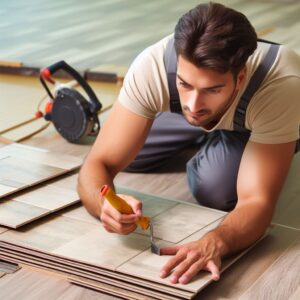
The majority of cork flooring sold in the United States today is engineered floating cork. These planks typically consist of three layers: a compressed cork bottom layer, a High Density Fibreboard (HDF) or Medium Density Fibreboard (MDF) core, and a decorative cork veneer on top. The planks click together like laminate flooring and float above the subfloor without adhesive.
The HDF core is where the water vulnerability lives. HDF and MDF are engineered wood products that are significantly less water-resistant than solid cork. While the cork surface layers repel surface moisture, water that penetrates through seams or around the perimeter expansion gap reaches the core and causes rapid swelling, delamination, and structural failure. When floating cork flooring swells from water damage, the entire installation often needs to be replaced — damaged planks cannot simply be dried and reinstalled the way solid cork tiles sometimes can.
Some manufacturers now produce floating cork planks with moisture-resistant HDF cores, which improves performance but does not eliminate the vulnerability. For rooms where water exposure is genuinely predictable — bathrooms, laundry rooms — floating cork planks remain a risk even with these improvements. This is the same logic that applies to choosing between glued-down and floating laminate: installation method fundamentally determines moisture performance.
The Role of Sealing: What It Does, What It Cannot Do
Sealing is the most controllable variable in cork flooring’s moisture performance. A proper seal does not just add a decorative sheen — it creates an actual physical barrier that prevents liquid from reaching the cork cell structure beneath.
Polyurethane Sealants
Water-based or oil-based polyurethane is the most common and most effective sealant for cork flooring. Applied in multiple coats — typically two to four — polyurethane forms a hard, durable film across the surface. The critical application practice is sealing across seams and at perimeter edges, not just across the face of the planks. Seams are the primary entry point for moisture on any installation.
A polyurethane-sealed floor should be resealed approximately every five to seven years, depending on foot traffic and the severity of moisture exposure. Heavily used kitchens or bathrooms may require resealing on the shorter end of that range. The more coats applied, the greater the protection — and the greater the time before resealing is needed.
Wax Sealants
Natural wax sealants were historically common for cork floors. They provide reasonable short-term protection and a distinctive low-sheen finish. The limitation is longevity: wax sealants need reapplication every six to twelve months, making them significantly more maintenance-intensive than polyurethane. Many homeowners who inherit wax-finished cork floors strip the wax and apply a polyurethane topcoat to reduce long-term maintenance burden.
Factory Pre-Finished Flooring
Most floating cork planks come factory pre-finished with a UV-cured aluminum oxide coating. This finish is durable and provides good surface moisture resistance for everyday use. The limitation is at the seams — factory finishes cannot seal the joints between planks, which is where moisture vulnerability is highest. For living rooms and bedrooms, the factory finish is often adequate. For kitchens and bathrooms, it is not.
What Happens When Cork Flooring Gets Wet: The Damage Sequence
Understanding the damage sequence matters because it dictates how quickly you need to respond to water exposure and what the remediation options are.
When unsealed or under-sealed cork is exposed to water over time, the following sequence typically occurs. First, the surface may show slight darkening or discoloration as moisture begins to penetrate. Second, individual tiles or planks begin to swell slightly, creating an uneven surface with edges that feel raised or soft underfoot. Third, swelling tiles begin to separate from each other or from the subfloor, creating visible gaps or lifted sections. Fourth, if moisture reaches the subfloor beneath glue-down tiles, the adhesive bond begins to weaken and tiles start to loosen. In floating floors with HDF cores, the core itself can delaminate. Finally, sustained moisture presence creates conditions for mold and mildew growth, particularly underneath the flooring where it cannot be seen.
The first two stages are often reversible with prompt drying and professional assessment. Stages three through five typically require partial or full flooring replacement. The window between spill and irreversible damage is shorter for floating planks with engineered cores than for solid glue-down tiles.
For anyone already dealing with moisture issues under flooring, the same intervention logic applies whether the material is cork, hardwood, or laminate — you need to get the water out quickly and assess what can be salvaged versus replaced.
Where Cork Flooring Can and Cannot Be Used Based on Moisture Levels
Living Rooms and Bedrooms
Floating cork planks with factory finishes are well-suited for living rooms and bedrooms. Moisture exposure is low, foot traffic is manageable, and the acoustic and thermal comfort benefits of cork are fully realized. The combination of cork’s natural suberin content and the factory UV-cured finish handles everyday humidity and the occasional spill without issue. If you are interested in how cork performs as a living room material beyond just moisture, our guide on cork flooring for living rooms covers the full picture.
Kitchens
Kitchens occupy the middle ground. Water exposure is regular — sink splashes, dishwasher condensation, occasional spills — but not as extreme as bathrooms. Both floating cork and glue-down tiles can work in kitchens, provided the installation is sealed correctly. For floating planks, two coats of polyurethane at the seams reduce the risk substantially. For glue-down tiles, proper site finishing essentially eliminates it. Some professionals favor floating cork in kitchens specifically because the added cushioning reduces fatigue during long cooking sessions, a benefit that matters on hard subfloor systems.
Bathrooms
Bathrooms require the most deliberate approach. Daily humidity from showers and baths, along with floor-level water exposure near tubs, toilets, and sinks, creates conditions that floating cork with an HDF core should not be expected to handle long-term. Glue-down cork tiles with a full polyurethane site finish are the professional recommendation for bathroom installations. The subfloor must also be assessed — if installing over concrete, a vapor barrier beneath the tiles addresses moisture migration from below the slab. Our full guide on using cork flooring in bathrooms walks through every installation consideration in detail.
Basements
Basements are problematic for cork, not because of surface water but because of below-grade moisture vapor rising through concrete slabs. Even sealed cork tiles can be compromised by chronic vapor pressure from beneath if no vapor barrier is used. A properly installed vapor barrier between the concrete and the tile adhesive is non-negotiable in below-grade cork installations. Floating cork planks should not be used in basements at all — the HDF core is simply too vulnerable to the elevated humidity levels that basement environments typically produce.
This same moisture dynamic affects all wood-based flooring in below-grade applications. If you are weighing cork against other options for a basement, understanding how moisture barriers for concrete floors work will be foundational to any installation decision you make.
Laundry Rooms
Laundry rooms belong in the same category as bathrooms — glue-down cork tiles only, with full site finishing. Washing machines are a specific risk because slow drum leaks or hose failures can produce water that sits for extended periods before being noticed. Only a fully glued, fully sealed installation can tolerate that scenario.
Amorim Waterproof Cork Flooring: When the Product Category Changes
One product category deserves specific mention because it genuinely shifts the waterproof conversation: engineered waterproof cork flooring from manufacturers like Amorim. These products are engineered with a stone polymer composite (SPC) or similar waterproof core instead of HDF, with a cork surface layer providing the thermal and acoustic properties the material is known for.
The SPC core is inherently waterproof — it does not swell or delaminate when exposed to water. This means the product can be used in bathrooms and high-moisture environments without the same installation restrictions that apply to HDF-core floating cork. The cork surface layer still benefits from sealing or pre-applied factory finishes, but the core failure mode that affects standard floating cork is eliminated.
These products represent a meaningful technical advance and are worth considering for anyone who wants the comfort and sustainability credentials of cork in a room where standard floating cork is not appropriate. For more on this specific product category, our piece on Amorim waterproof cork flooring covers the product construction and performance in depth.
Comparing Cork to Other Flooring Materials on Moisture Performance
Placing cork in context helps clarify where it actually sits on the moisture-resistance spectrum relative to alternatives.
Standard hardwood flooring is more vulnerable to water than unsealed cork. Wood’s open grain structure absorbs moisture readily, and there is no equivalent to suberin providing baseline protection. This is why solid hardwood is almost never recommended for bathrooms or below-grade installations at all. Cork’s suberin content gives it a meaningful advantage over hardwood for moisture-adjacent applications.
Bamboo flooring occupies a similar position to cork — naturally more moisture-resistant than hardwood, but not waterproof, and vulnerable to prolonged exposure. The question of whether bamboo flooring is truly waterproof follows almost the same logical structure as the cork question: the natural material has resistance, but installation method and sealing determine whether it is appropriate for wet rooms.
Luxury vinyl plank (LVP) and SPC flooring are genuinely waterproof — their polymer construction is impervious to water throughout the full thickness of the plank. These materials are the correct choice for rooms where plumbing failures or standing water are realistic scenarios. Cork’s advantage over LVP is thermal comfort, acoustics, and natural material credentials — not moisture performance.
Porcelain and ceramic tile are also genuinely waterproof at the tile level, though grout lines remain a vulnerability without proper sealing. For bathrooms and heavy-use kitchens, tile and waterproof LVP are the lower-risk alternatives to cork if installation and maintenance protocols cannot be reliably maintained.
Maintenance Practices That Protect Cork’s Moisture Resistance Over Time
The water resistance of a cork floor degrades over time without active maintenance. The sealant wears under foot traffic, cleaning products, and UV exposure. Maintaining the protective layer is not optional — it is what keeps a correctly installed cork floor performing correctly throughout its service life.
Clean spills immediately, without exception. The suberin barrier handles brief contact well; prolonged standing water on any cork surface is where damage begins. Use a damp mop rather than a wet mop for routine cleaning — excess water from cleaning itself is a chronic source of damage to cork seams. Avoid harsh chemical cleaners that can degrade polyurethane coatings over time.
Do not use rubber-backed rugs directly on cork flooring. Rubber traps moisture against the cork surface and prevents it from evaporating, creating exactly the sustained moisture contact the sealant is designed to protect against. Fabric-backed mats are a safer choice in kitchens near sinks and in entryways.
Maintain indoor humidity between approximately 35% and 55%. Cork is a natural organic material that expands with moisture uptake and contracts in dry conditions. Chronic humidity above 65% accelerates both sealant degradation and the risk of mold development at seams. This is particularly relevant in coastal climates or homes without HVAC humidity control.
Reseal on schedule. For polyurethane-finished floors, five to seven years is the standard interval under normal household use. Floors in kitchens or bathrooms may need attention sooner. A simple water bead test — drop water on the surface and watch whether it beads up or is absorbed — tells you whether the sealant is still performing. If water no longer beads, the floor needs resealing before moisture damage begins.
How to Tell If Cork Flooring Is a Good Fit for Your Room
The decision framework is actually straightforward once you understand the variables. Ask three questions.
First: what is the realistic moisture exposure in this room? Living rooms and bedrooms have incidental exposure — suitable for floating cork with factory finish. Kitchens have regular but manageable exposure — suitable for floating or glue-down cork with proper sealing. Bathrooms, laundry rooms, and basements have high or chronic exposure — suitable only for glue-down cork tiles with full site finishing, or for waterproof-core cork products.
Second: what product type am I installing? If the answer is floating cork with an HDF core, do not install it in any high-moisture environment regardless of what the marketing says about water resistance. The seams and the core are the vulnerabilities, and no amount of surface sealing fully eliminates them.
Third: can I commit to the maintenance protocol? Cork’s moisture performance is not set-and-forget. It requires prompt spill cleanup, appropriate cleaning practices, and periodic resealing. If that maintenance discipline is not realistic for your household — particularly with young children or pets — a genuinely waterproof material like SPC or porcelain tile may be the more honest choice for wet rooms.
For homeowners with active families where moisture resilience is a top priority across multiple room types, comparing how different flooring materials hold up in real conditions is worth doing carefully. The tradeoffs between cork, luxury vinyl, and tile each have specific room-type implications that a broader comparison of flooring for moisture-prone homes can help clarify — particularly relevant in San Diego’s coastal neighborhoods where humidity and salt air are ongoing factors.
Summary: What Cork Flooring’s Water Resistance Actually Means in Practice
Cork flooring contains suberin — a waxy, hydrophobic substance that gives it genuine and meaningful water resistance that exceeds untreated wood. That resistance is real, but it is not infinite, and it does not make standard cork flooring waterproof.
Whether cork flooring is appropriate for a given room comes down to product construction and sealing. Glue-down cork tiles, properly sealed with polyurethane at the surface and seams, come close enough to waterproof for bathroom and kitchen applications when installation and maintenance protocols are followed. Floating cork planks with HDF cores have a meaningful vulnerability at seams and should be treated as water-resistant but not bathroom-grade without a waterproof core upgrade. Waterproof-core cork products from manufacturers like Amorim remove the core vulnerability entirely.
The material itself is not a binary pass or fail on waterproofing. It is a system — natural suberin plus product construction plus sealant plus maintenance — and the performance of that system is what the question is actually asking about. Understanding each component lets you make a decision that holds up over the service life of the floor, rather than one that looks good on paper until the first dishwasher leak arrives.