Wool consists of natural hypoallergenic properties, and its fibres are coil-shaped, which makes it inhospitable to dust mites. It is resistant to mould, mildew, and bacteria, and can absorb contaminants in the air so you do not have to breathe them in. This last property is particularly interesting: wool acts as a passive air filter, pulling chemical contaminants from the environment into its fiber structure where they remain bound until the carpet is cleaned.
Independent testing has shown that wool carpeting supports 50 to 70 percent fewer dust mites than synthetic alternatives. The protein structure of the fiber creates conditions that dust mites simply cannot exploit — they need warmth, moisture, and a food source, and wool’s naturally dry composition denies them the humidity they require.
From a VOC perspective, wool is unmatched. It emits no synthetic chemicals during or after installation. Wool’s natural fibres absorb pollutants like cooking fumes, cleaning chemicals, and deodorants, actively improving indoor air quality rather than merely failing to degrade it.
The tradeoffs are cost and care. Wool carpet is significantly more expensive than any synthetic option, requires gentler cleaning methods, and is more sensitive to moisture — if it gets wet and does not dry completely, you lose the mold resistance advantage. For severe allergy sufferers who can meet those requirements, wool is the premium answer.
Nylon: The Practical Workhorse
Nylon carpets are an excellent choice for allergy sufferers. Their ability to resist dirt, moisture, and mildew prevents pollen and allergens from thriving, as they dry out quickly. Low-pile nylon carpets are particularly effective at minimising allergens, making them a practical solution for those with sensitivities.
Nylon’s durability advantage is relevant to allergy management in a way that is easy to overlook. A carpet that flattens quickly under foot traffic develops micro-pockets in compressed fibers where allergens accumulate out of reach of vacuum heads. High-quality nylon resists this compaction, maintaining an even surface that stays accessible to regular cleaning. The advantage of nylon carpets is that they are generally cheaper than wool, and also resist substances like moisture, mildew and dirt.
Many nylon products also carry antimicrobial treatments that inhibit bacterial growth. When selecting nylon, look for the CRI Green Label Plus certification to ensure the off-gassing burden is minimized — nylon is a synthetic polymer, and lower-quality products can emit chemical compounds during the new-carpet period after installation.
Polyester: The Budget-Accessible Option
Polyester offers genuine hypoallergenic properties at a lower price point than both wool and nylon. Polyester carpets are lower in off-gassing since they contain fewer chemical treatments. They are naturally mold-resistant and their fiber structure does not attract or hold dander and dust in the same way older-generation carpets did.
One brand worth mentioning specifically is Air.o by Mohawk, which is constructed from 100% PET polyester with perforations in the backing that allow airflow between carpet and pad, reducing the conditions that promote mold and mildew growth at the subfloor level. It carries a VOC-free claim and a 15-year warranty — an unusual combination for a product in its price category.
The limitation with polyester is durability under sustained foot traffic. In high-traffic areas, polyester fibers tend to mat and compress faster than nylon, which creates the uneven surface texture described above that complicates thorough vacuuming. For bedrooms, home offices, or living rooms with moderate use, polyester delivers strong allergy-management performance at an accessible cost. For hallways or household routes that see constant movement, nylon holds up better over time.
Triexta: The Newer Contender
Triexta carpet fiber is high performing, easy to clean, and less likely to mat down. With its short, tightly woven strands, there is less space for allergens to become trapped, and it will be easier to vacuum thoroughly. Triexta is also notable for its stain resistance — SmartStrand by Mohawk is the most widely recognized brand — which matters for allergy households because stains and moisture absorption create the conditions where microbial growth begins.
Triexta shares polyester’s low VOC profile while improving on polyester’s durability limitations. It has not accumulated the same long-term performance data that nylon and wool have, but for families managing pet dander specifically, the comparison between triexta and nylon is worth working through carefully, because the two fibers have genuinely different strengths depending on the allergen type you are most concerned about.
Pile Height and Weave Density: The Structural Variables
Fiber type is the most important variable in hypoallergenic carpet selection, but it does not operate in isolation. The same nylon fiber can perform completely differently depending on how it is constructed into a carpet. Pile height and weave density are the structural properties that determine how much space allergens have to accumulate, and how accessible those spaces are to vacuum suction.
The best hypoallergenic carpets have low pile height — shorter fibres trap fewer allergens compared to high-pile or shag carpets — and tightly woven fibres, as dense weaves prevent dust and pet dander from becoming embedded.
In practical terms, this means:
Low-pile carpet (pile height under approximately 1/4 inch) presents less surface area for particle accumulation and allows vacuum heads to reach the base of the fiber more effectively.
Loop pile constructions — Berber being the most common — offer a tight, dense surface that resists allergen penetration, though the loops must be tightly woven rather than loosely constructed to deliver this benefit.
Cut pile at medium density works well if the face weight is high enough that the fibers stand upright rather than falling flat. Flat, dense cut pile is easier to vacuum than open, upright cut pile.
Shag and high-pile constructions, regardless of fiber type, are poor choices for allergy households. The long, loose fibers create the exact environment — protected deep spaces with limited airflow — that allergens prefer.
Frieze carpet, which has tightly twisted fibers that curl at the tips, sits in an interesting middle ground. The pros and cons of frieze carpet for allergy management depend heavily on the twist level and face weight — higher twist counts produce a more durable surface that resists allergen accumulation better than lower-twist versions.
VOC Emissions and Certifications: What to Look For on the Label
VOC emissions from carpet are a separate allergy concern from fiber-based allergens. They primarily affect people with chemical sensitivities, respiratory conditions, or asthma, and they peak in the days immediately following installation before tapering off over weeks to months. The question is not whether any given carpet emits VOCs — most do at some level — but whether those emissions fall below thresholds associated with health effects.
The main third-party certifications to look for are CRI Green Label Plus, GreenGuard, and GreenGuard Gold. CRI Green Label Plus is an indoor air quality testing program run by the Carpet and Rug Institute that verifies carpets, cushion, and adhesives meet strict low-emission standards.
GreenGuard Gold certification is recognized as representing a stricter standard for indoor air quality. Green Label Plus from the CRI ensures very low chemical emissions, and FloorScore is another recognized standard for indoor air quality compliance.
When you are reviewing carpet for purchase, the certification label should appear on the product specification sheet or the manufacturer’s website. Do not rely on a retailer’s verbal claim that a product is “low VOC” — the certification body should be identifiable and the test results accessible. You can also request Material Safety Data Sheets or VOC test reports from manufacturers to compare emissions data quantitatively between products you are considering.
One aspect of VOC management that is easy to overlook is the adhesive used during installation. A VOC-free carpet installed with a high-VOC adhesive produces a high-VOC floor. If you are installing carpet in a glue-down configuration, ask specifically for a low-VOC adhesive and ensure it carries its own certification. Floating and stretch-in installations avoid the adhesive variable entirely, though they introduce their own moisture management considerations depending on the subfloor type.
The Padding Problem: What Sits Under the Carpet Matters
Carpet padding contributes to allergen management in ways that are underappreciated at the point of purchase. The padding is where moisture migrates when it cannot escape upward through the carpet face, and where mold begins to grow long before it becomes visible or detectable by smell. It is also where dust and debris accumulate when vacuuming removes them from the carpet surface but cannot pull them all the way out of the system.
For allergy management, look for padding that has anti-microbial properties to help prevent mold and bacteria from growing beneath the carpet, and that is made from synthetic foam or rubber rather than natural fiber pads, which can absorb moisture and become breeding grounds for allergens.
Moisture-barrier padding — which has a film applied to the top surface that prevents liquid from penetrating down into the pad — is worth considering seriously for households with pets, children, or any history of humidity issues. When a liquid is contained in the carpet layer rather than absorbed into the pad, it is far easier to extract cleanly and prevents the long-term microbial accumulation that undermines everything else you are trying to achieve with a hypoallergenic fiber choice.
Dense, low-profile padding also helps maintain the dimensional stability of the carpet surface over time, which keeps the pile structure even and continues to present a surface that can be vacuumed effectively. Thick, soft padding feels luxurious underfoot but allows carpet to flex and compress in ways that eventually flatten the pile structure and open up spaces where allergens accumulate beyond the reach of standard vacuum equipment.
Room-by-Room Considerations
Not all rooms present the same allergen challenges, and a fiber type that is the right answer for one space may be a poor choice for another. Consider removing carpet from bedrooms first, as you spend roughly one-third of your life there — and for dust mite allergen exposure specifically, this is the highest-risk room in most homes. That said, if you want carpet in the bedroom, wool or high-quality nylon with antimicrobial treatment and low pile height is the most defensible choice.
Whether carpet works for bedrooms ultimately comes down to the maintenance commitment you can sustain — because a well-maintained hypoallergenic carpet in a bedroom will outperform a dusty hard floor in the same space.
For living rooms and family rooms, the higher foot traffic argues for nylon or triexta over polyester, and the aesthetic flexibility of nylon means you do not have to sacrifice design options to get allergy performance. Choosing carpet for the living room involves balancing foot traffic, pile height, and the specific allergens most relevant to your household — pet dander, for instance, behaves differently than seasonal pollen, and the fiber that handles one best may not be optimal for the other.
For children’s rooms and playrooms, the combination of a low-VOC certified carpet, low-pile construction, and moisture-barrier padding is the right framework. Children’s breathing rates run faster than adults, meaning they cycle a greater volume of air relative to their body weight. This increased air intake concentrates whatever VOCs exist in their environment, making material selection for nurseries and children’s rooms more critical than anywhere else in your home. The benefits of carpet in children’s spaces — cushioning, sound absorption, warmth — are real, but the certification and emissions standards should be held to the highest available level.
For basements, the moisture variable dominates everything else. Dust mites and mold both thrive in humid environments, and basement carpet selection requires addressing subfloor moisture management before the fiber choice is even meaningful. In a controlled, conditioned basement, nylon or polypropylene with moisture-barrier padding is the most defensible approach. In a basement with any history of moisture intrusion, carpet is a difficult recommendation regardless of fiber type.
Maintenance: The Variable That Determines Whether Any of This Works
The research finding that well-maintained carpet can outperform hard floors for allergy sufferers is real and replicable, but it hinges entirely on the phrase “well-maintained.” Studies have shown that the levels of allergens, including cat and dust mite allergens, were lower in the air over all of the carpets than over the hardwood flooring, even after both flooring types were repeatedly disturbed — but that the positive benefits of carpet are reduced when carpets become saturated with contaminants.
The minimum maintenance framework for a hypoallergenic carpet includes:
Vacuuming with a HEPA-filter vacuum at least once or twice per week. Research has shown that intensive carpet cleaning resulted in a 50% reduction in airborne fine particles, similar to levels seen outdoors. The HEPA filter is non-negotiable — a standard vacuum filter allows fine allergen particles to pass through the exhaust and redistribute into the air.
Hot water extraction (steam cleaning) at least once or twice per year, conducted by professional equipment or a high-quality rental unit. This process reaches beyond the surface into the carpet base and padding interface where standard vacuuming does not penetrate.
Immediate response to any liquid spill. Moisture that reaches the padding and is not fully extracted within 24 to 48 hours creates conditions for mold and bacterial growth that are extremely difficult to reverse.
Maintaining indoor humidity below 50 percent. This is the single most effective environmental intervention for dust mite control, regardless of flooring type. A dehumidifier in high-humidity rooms, combined with consistent carpet maintenance, delivers compound benefits.
The padding and subfloor condition should also be inspected at any professional cleaning appointment. If padding has absorbed moisture over time and is showing any discoloration or odor, replacement is more cost-effective than continued maintenance on a compromised underlayer.
When Carpet Is Not the Right Answer
Hypoallergenic carpet is not a universally correct solution for every allergy sufferer, and it is worth being direct about when a different flooring category serves the goal better. If the primary allergen is mold — which is the case in homes with a history of moisture intrusion, plumbing leaks, or high ambient humidity — a hard flooring surface with no padding layer eliminates the most favorable environment for mold colonization. Vinyl flooring and its implications for allergy sufferers is a relevant comparison here: waterproof core vinyl products over a sealed concrete subfloor can deliver a genuinely mold-resistant floor system in a way that no carpet, however well constructed, can match.
Similarly, if the household includes someone with latex sensitivity, certain rubber-based paddings are contraindicated, and the selection process needs to account for the full material stack rather than just the carpet face fiber.
The practical summary: with the right materials, proper installation, and consistent maintenance habits, carpet can be part of an allergy-friendly home. The right carpet paired with the right maintenance can actually improve indoor air conditions over hard flooring, since allergens are trapped until removed rather than remaining disturbed and airborne. That outcome, however, requires treating carpet selection and maintenance as a system rather than a one-time purchase decision.
Summary: How to Choose
If you are navigating a purchase decision, the practical framework reduces to a short set of questions:
Which allergens are the primary concern in your household? Dust mites argue for wool or low-pile nylon with moisture management. Pet dander argues for tight-weave, low-pile nylon or triexta that can be vacuumed thoroughly. Mold argues for moisture-barrier padding, low-pile construction, and a serious look at whether hard flooring is the better answer. Chemical sensitivity argues for wool (zero VOC) or a certified low-emission synthetic with GreenGuard Gold.
What is the room’s foot traffic level? High traffic means nylon or triexta to maintain pile integrity over time. Low-to-moderate traffic opens the door to polyester at a lower cost with comparable allergen performance.
What maintenance can you realistically commit to? Weekly HEPA vacuuming and annual professional extraction is the baseline for any hypoallergenic carpet to deliver on its material properties. Below that threshold, the fiber type matters far less than you think.
What certifications does the product carry? CRI Green Label Plus and GreenGuard Gold are the verification standards worth trusting for emission claims. Do not rely on marketing language without a named certification body behind it.
The carpet flooring services decision is ultimately about aligning the fiber, the construction, the padding, and the maintenance regime into a system that fits both your specific allergen profile and your household’s actual daily life. Get all four right, and carpet is a genuine asset for indoor air quality rather than the liability it is so often assumed to be.
James Miller is a seasoned flooring contractor with years of hands-on experience transforming homes and businesses with high-quality flooring solutions. As the owner of Flooring Contractors San Diego, James specializes in everything from hardwood and laminate to carpet and vinyl installations. Known for his craftsmanship and attention to detail, he takes pride in helping clients choose the right flooring that balances beauty, durability, and budget. When he’s not on the job, James enjoys sharing his expertise through articles and guides that make flooring projects easier for homeowners.
Bamboo flooring sits in an interesting position in the market. It is neither the cheapest option on the shelf nor the most expensive, yet it gets misquoted constantly because buyers compare the material price alone without accounting for what actually drives the total project cost. The number you see on the box rarely reflects what…
Pet stains on carpet are not simply a surface problem. When a dog or cat has an accident on carpet, the liquid does not sit on top of the fibers — it travels downward under the force of gravity, passing through the pile, soaking into the backing, saturating the padding beneath, and in cases of…
Yes — but the answer changes depending on what type of vinyl plank you have, how thick its core is, and whether you’re using a mat between the machine and the floor. A blanket “yes” ignores the mechanical reality of what a treadmill actually does to flooring over time, which is not just about weight….
The short answer is: it depends on which layer of the product you are asking about. Vinyl flooring is routinely marketed as the hypoallergenic hard-floor choice, and on the surface — literally — that claim holds up. The wear layer is non-porous, it does not trap dust mites, pet dander, or pollen the way carpet…
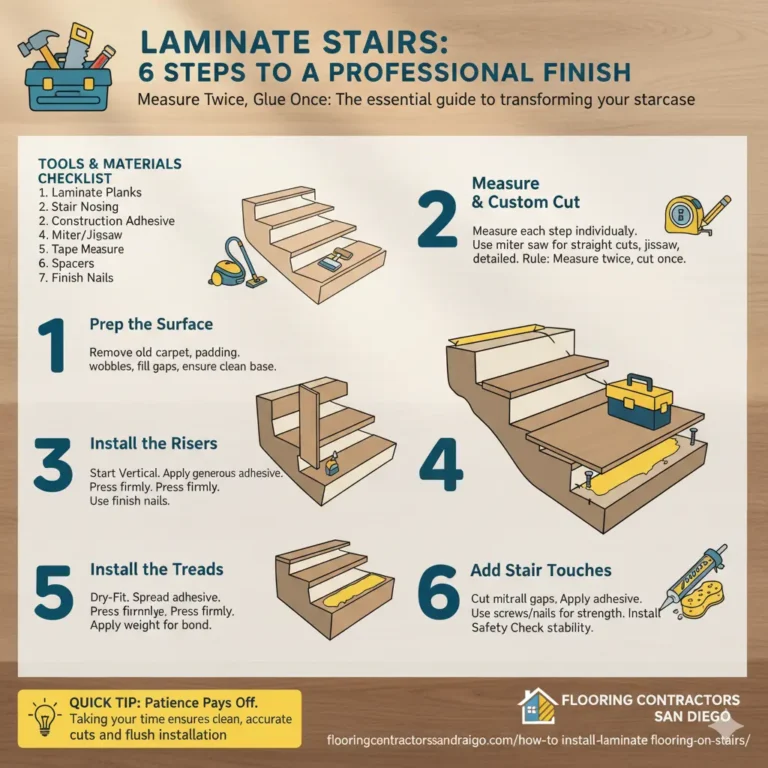
Stairs are the hardest surface in your house to floor. They take more weight per square inch than any other surface, they get used more often than the kitchen, and one loose plank turns into a slip hazard before the week is out. Laminate works on stairs, but only if you stop treating it like…
Small rooms have a way of making even confident decorators second-guess every decision. Furniture gets rearranged, walls get repainted, curtains get swapped out — and yet the space still feels tight. What most people overlook is the floor. The surface beneath your feet shapes every perception of a room: how wide it reads, how tall…