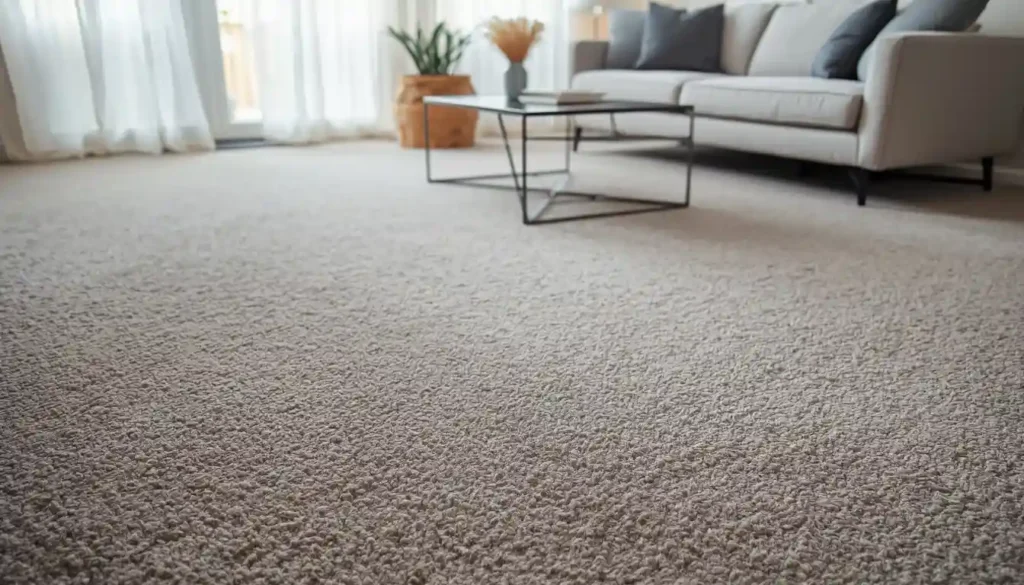
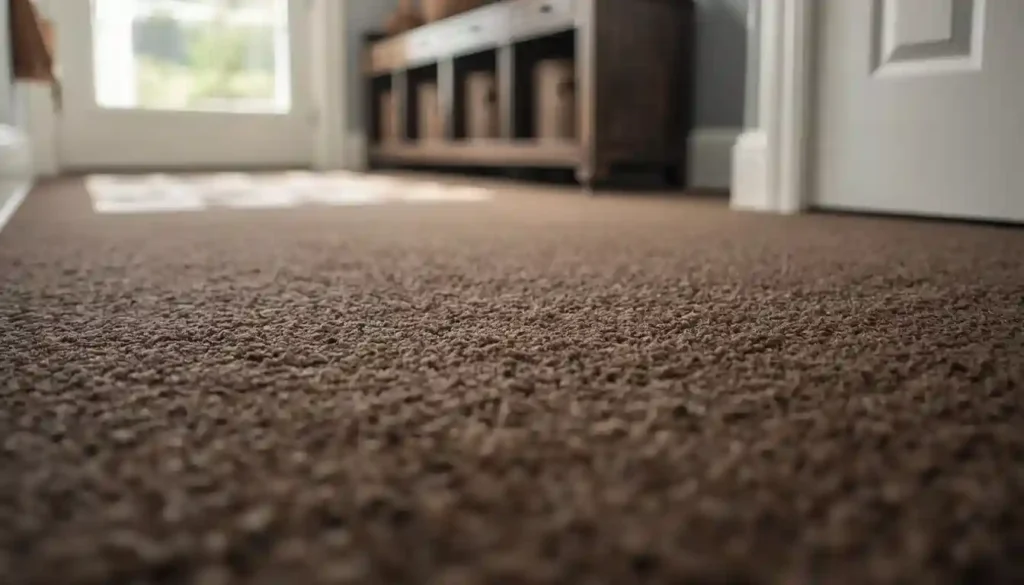
Nylon in a warm gray wears gracefully. The warm undertone keeps the room from reading as cold or clinical while the gray itself is genuinely neutral — it works with brown furniture, cream walls, charcoal accents, or nearly any other palette. Stains that dry to a brown or beige tone, which most pet-related stains do, become far less visible against gray than they would against an ivory or champagne background.
For living rooms specifically, choose a density rating that feels firm underfoot rather than cushy. Dense, tightly packed fibers resist matting under the repeated pressure of paws and people. A face weight of at least 40 ounces per square yard is a reasonable starting point for a high-traffic pet household. Pair this with a quality 7/16-inch moisture-barrier pad rather than the thickest padding available — thicker is not always better, as extremely soft padding can actually accelerate fiber wear at the surface.
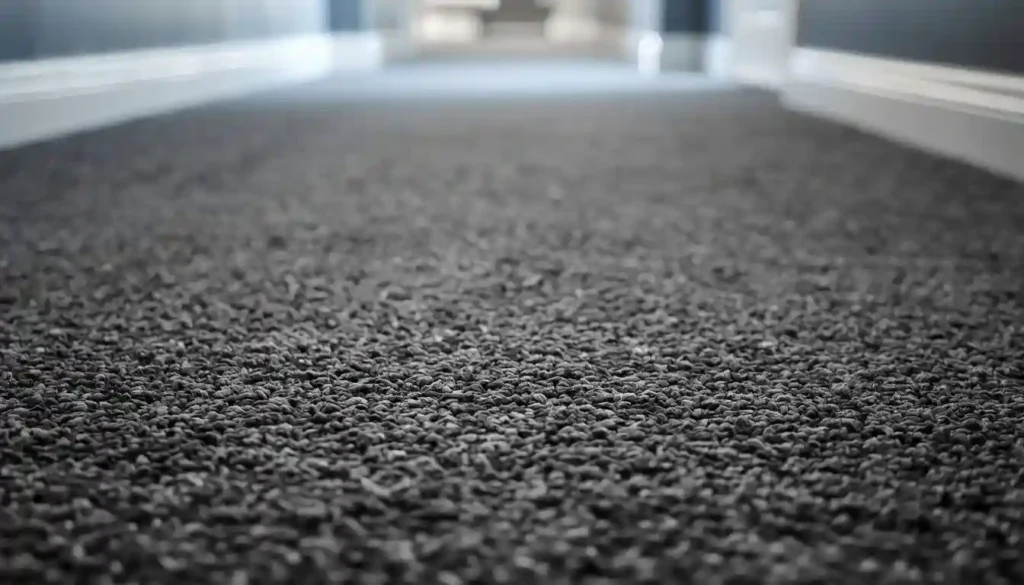
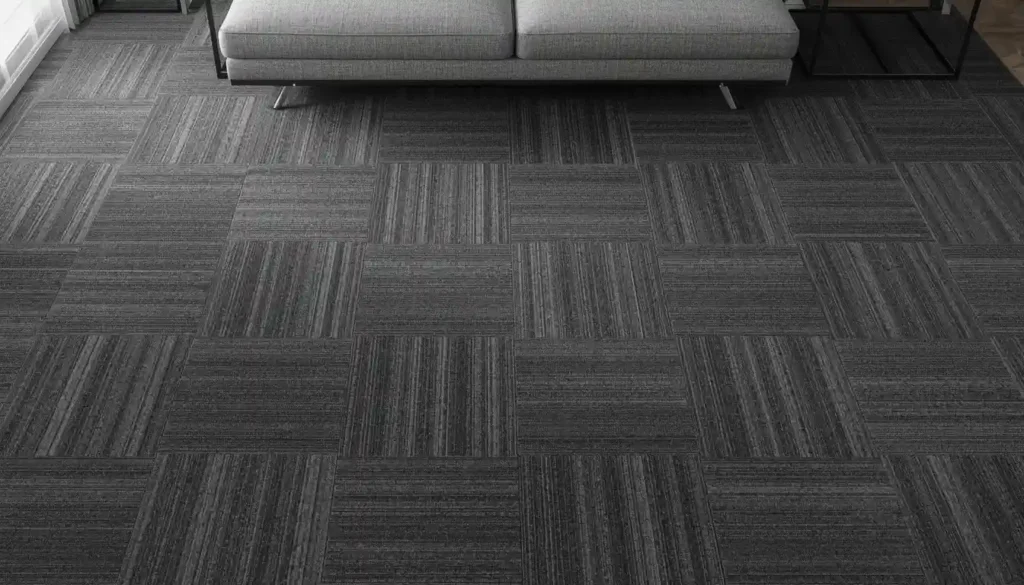
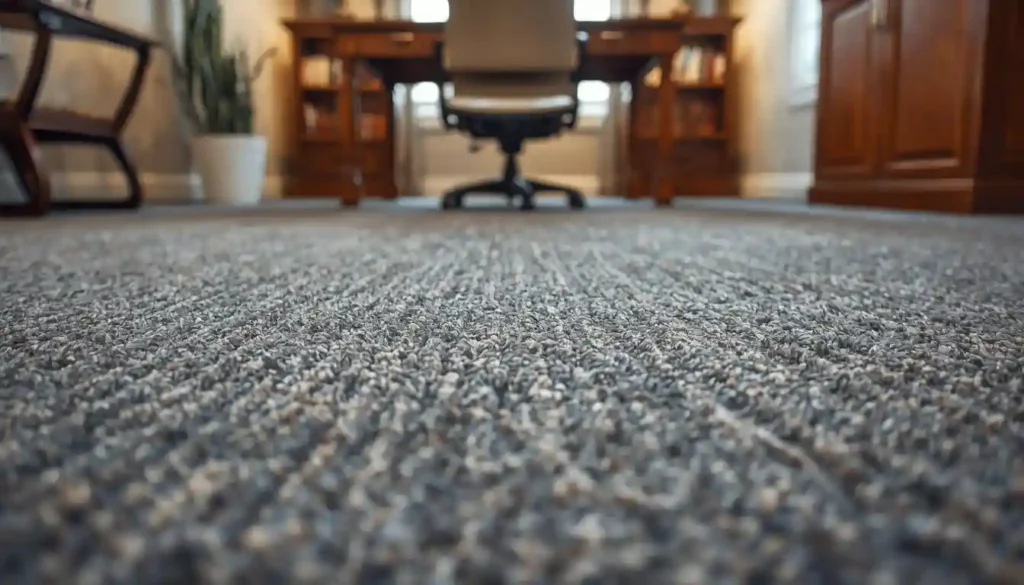
Idea 2: Frieze Carpet in a Multi-Tonal Charcoal for High-Traffic Hallways
Frieze carpet — sometimes called twist carpet — features tightly twisted fiber bundles that curl slightly at the tip rather than standing straight up. The resulting surface looks slightly informal and textural, almost shaggy without the actual depth of shag. That construction turns out to be exceptionally practical for pet households, particularly in hallways where animals run at full speed and the traffic concentration is intense.
The twisted fibers in frieze resist matting far better than smoother pile styles. When a dog charges down a hallway fifty times a day, a standard Saxony pile will begin to flatten along that traffic lane within months. Frieze bounces back. The wiry, curled surface also scatters light irregularly, which is the physical mechanism behind its remarkable ability to hide stains and soil. Dirt particles settle into the twist rather than sitting visibly on top of fiber tips.
Multi-tonal charcoal takes this camouflage effect further. Rather than a single solid dark color, a multi-tonal charcoal frieze includes flecks of dark gray, mid-gray, and occasionally a nearly black strand woven throughout. Pet hair from darker-coated animals disappears entirely. Even light-colored pet hair is less obvious than it would be on a pale carpet because the dark background creates visual competition. The variegated coloring means that as the carpet wears and develops slightly different shading in high-traffic zones, that variation reads as intentional pattern rather than damage.
Hallways also benefit from this approach because frieze’s casual aesthetic pairs naturally with the transitional nature of the space — it does not need to match a specific furniture arrangement and works as a connective element between rooms with different design vocabularies.
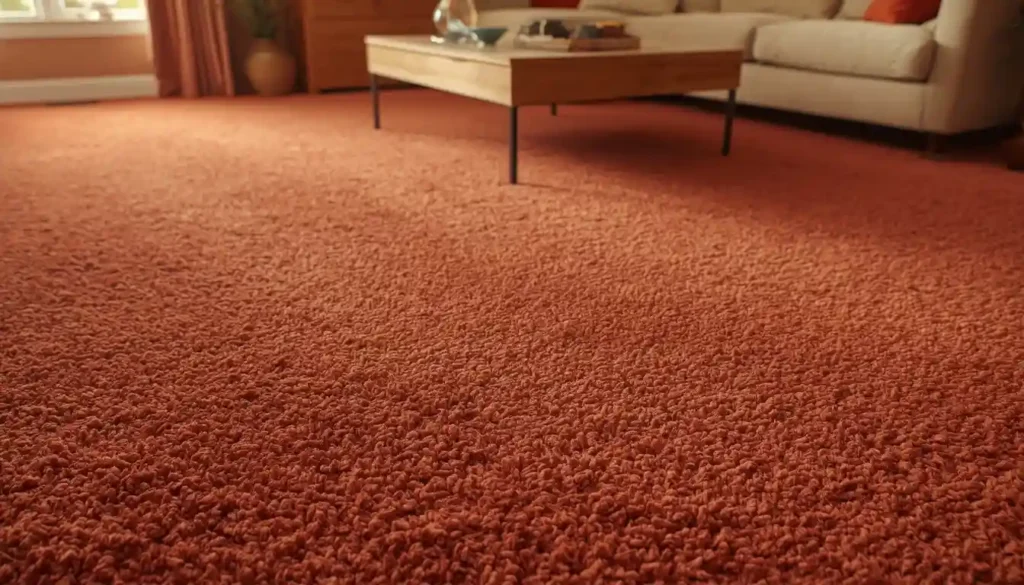
Idea 3: Solution-Dyed Polyester in Deep Earth Tones for the Family Room
Solution dyeing is a manufacturing process that embeds color directly into the fiber during production rather than dyeing the fiber after it has been formed. The practical consequence is that the color goes all the way through the strand — if a fiber is abraded, bleached, or exposed to sunlight, the color beneath is identical to the color on top. Standard dyed carpet can fade or bleach unevenly, especially in pet households where enzymatic cleaners and occasional accident-related bleaching are a regular reality. Solution-dyed fiber is essentially immune to this problem.
Polyester is naturally resistant to water-based stains because its fiber structure is hydrophobic — it repels moisture at the fiber surface rather than absorbing it. This makes polyester an underappreciated option for family rooms where the risk of accidents is moderate and the desire for softness and comfort is high. Polyester carpet fiber has a distinctly soft hand feel that nylon typically does not match, and that softness matters in a family room where pets and people alike spend time on the floor.
Earth tones — think warm terracotta-influenced browns, deep olive greens, rich cognac, and warm rust — are deeply practical in pet households. They share a similar value and undertone with the dried residue of most pet-related organic matter. Muddy paw prints, dried food tracking, and general soil all tend toward warm brown tones. A carpet in cognac or warm sienna simply does not show these marks the same way a beige or cream surface does.
Beyond the practical benefit, earth tones are currently a strong design choice. They complement natural wood furniture, rattan and wicker accents, and the layered, organic aesthetic that has dominated residential interiors for the past several years. A deep rust-colored polyester carpet in a family room reads as both intentional and warm — nothing about it says “stain hiding” to a visitor; it simply looks like a confident color choice.
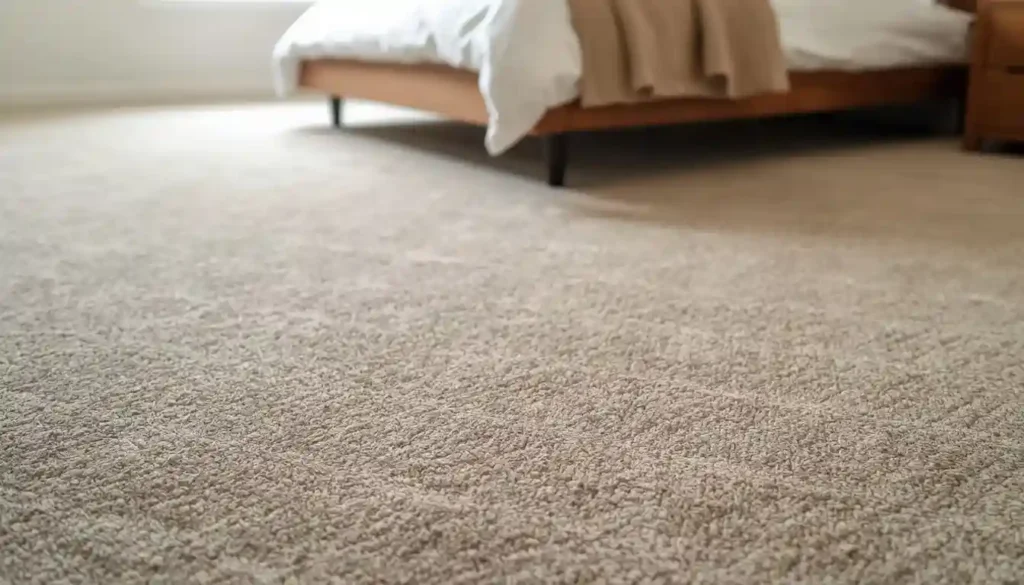
Idea 4: Cut-and-Loop Patterned Carpet for the Bedroom Where Cats Sleep
Cats and bedrooms present a specific set of carpet requirements that differ from other rooms. Cats spend enormous portions of their day sleeping on carpet surfaces, kneading fibers with their claws, and occasionally using carpet as a scratching material. They shed seasonally and sometimes dramatically. The bedroom is also a space where comfort is paramount — it needs to feel good underfoot at any hour.
Cut-and-loop carpet, sometimes abbreviated as CnL or called level-cut-loop, combines sheared fiber tips with intact loops in a single surface. This construction creates a dimensional, patterned appearance even in solid-color versions, as the variation in height catches light differently and creates geometric or organic patterns across the floor. From a practical standpoint, the loops provide durability while the cut sections provide softness. Crucially, the loop elements in a CnL carpet are typically low enough and surrounded tightly enough by cut fiber that they do not present the same claw-snagging risk as a pure loop pile Berber.
For a cat-heavy bedroom, choose a CnL carpet with a subtle geometric pattern — a tone-on-tone diamond, chevron, or organic repeat works well. Pattern reduces the visual impact of cat hair accumulation and shows tracking less than a smooth solid surface. A mid-tone dusty blue, sage, or warm taupe in a tone-on-tone pattern gives the bedroom a curated, intentional look that reads as design rather than practicality. These colors also tend to match or blend with common cat coat colors, which reduces the visual presence of shed fur between vacuuming sessions.
Idea 5: Mohawk SmartStrand Triexta for a Dog-Friendly Mudroom or Entryway Zone
The entryway and mudroom are arguably the most punishing zones in a pet household. This is where dogs arrive from walks with wet, muddy paws; where wet coats drip; where the physical transition between outdoor and indoor worlds occurs multiple times daily. Most homeowners assume hard flooring is the only rational choice for this zone. Carpet in the entryway sounds counterintuitive, but there is a version of this idea that works — and works well.
Mohawk SmartStrand, constructed from DuPont Sorona triexta fiber, offers stain resistance built into the chemistry of the fiber itself rather than applied as a topical coating that wears off. The fiber structure is inherently hydrophobic and resists both water-based and oil-based stains. This matters specifically in entryways because topical stain treatments on standard nylon or polyester can degrade with repeated wet cleaning, which happens constantly in a mudroom context.
The practical approach here is to use SmartStrand in a very low, dense pile height — a commercial-style cut pile or a short textured cut pile in a dark, multi-tonal tone such as deep charcoal-brown or espresso. This keeps dirt from migrating deep into the pile while maintaining enough fiber to cushion the space and absorb sound. An olefin-based option in the same color range can also perform well in this zone given its inherent moisture resistance and its ability to repel odor.
Pairing this entryway carpet with a quality moisture-barrier pad — not simply a standard foam pad — provides additional protection. The right padding choice creates a layer of defense between pet accidents and the subfloor, and prevents moisture migration that leads to mold and subfloor damage over time.
Idea 6: Patterned Area Carpet Tiles with Moisture-Blocking Backing for Multi-Pet Homes
Carpet tiles have evolved far beyond the utilitarian gray squares associated with commercial office buildings. Today, residential carpet tiles are available in sophisticated patterns — geometric designs, subtle abstract motifs, tone-on-tone textures — and in the kind of quality fiber constructions that perform in demanding home environments. For multi-pet households, they represent a genuinely clever solution to a problem that traditional broadloom cannot address: targeted replacement.
When a section of broadloom sustains permanent damage — a stain that resists cleaning, a zone that a pet has scratched to the backing, or an area that has simply worn beyond recovery — the only option is replacing the entire room or accepting the damage. With carpet tiles, the affected section can be pulled up and replaced with matching tiles. This modularity transforms carpet from a permanent commitment into a practical, maintainable system.
For pet households, select tiles with a moisture-blocking, hard-back or closed-cell foam backing rather than an open-cell backing. The backing prevents liquids from wicking through to the subfloor. Tiles in a patterned design — particularly geometric patterns with multiple colors — hide the variation in wear that inevitably develops in high-traffic zones and disguise pet hair accumulation between cleanings. A charcoal-and-cream geometric tile, a dark navy-and-gray abstract, or a warm terracotta-and-beige pattern all work well in living and family spaces.
For an in-depth look at everything the pros and cons of carpet flooring entail before committing to any format, it is worth reviewing the full picture — especially if you are weighing carpet tiles against other pet-tolerant options.
Idea 7: Shaw Pet Perfect in a Mid-Tone Earthy Beige for Formal Spaces
Shaw’s Pet Perfect and Pet Perfect+ lines represent manufacturer engineering explicitly focused on the realities of pet ownership. The Pet Perfect collection uses high-performance Anso nylon fiber treated with R2X stain and soil resistance technology. The Pet Perfect+ line adds LifeGuard spill-proof technology at the backing level, which prevents liquids from penetrating through to the subfloor even if a spill is not cleaned immediately.
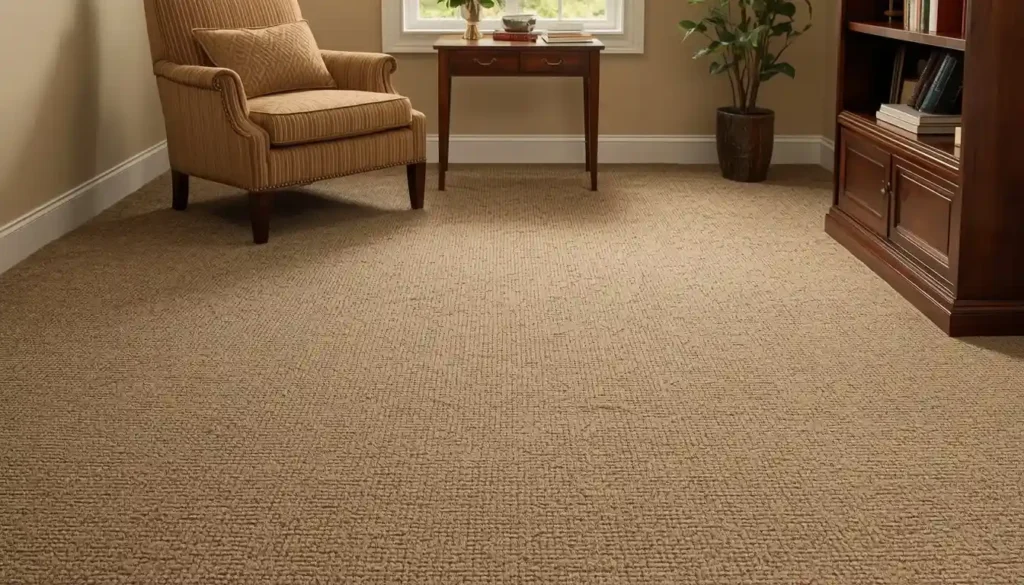
For formal dining rooms, home offices, or sitting rooms where design standards are higher and the desire for a carpet that does not read as purely utilitarian is stronger, mid-tone earthy beige in a Pet Perfect style achieves something genuinely difficult: a carpet that looks like a design choice and performs like an engineered product. A warm tan, sandy beige, or mushroom tone in a textured cut pile gives formal spaces the warmer, quieter floor presence they need while concealing the soil and tracking that inevitably arrives via pets.
The key distinction in formal spaces is avoiding the temptation to go too light. A cream, ivory, or pale champagne Pet Perfect carpet will still show pet hair and tracking because the contrast between the hair and the carpet surface is simply too high. Moving one or two steps deeper on the beige spectrum — from cream toward wheat or from champagne toward honey — dramatically reduces visible pet-related soil without losing the sense of warmth and openness that lighter colors provide.
For those weighing carpet against harder flooring options in spaces where pets are present, understanding what makes a carpet truly suitable for pet households provides context that goes beyond color and into the structural characteristics that determine long-term performance.
Idea 8: Dark Navy or Forest Green Low-Pile Nylon for a Dog Bedroom or Crate Room
Dedicated pet rooms — spaces designed specifically around where a dog sleeps, where crates are kept, or where animals are given their own territory — represent a design opportunity that many pet owners overlook. These rooms can be treated differently than shared human-pet spaces because the function is singular and the aesthetic can be purely practical without needing to serve multiple purposes.
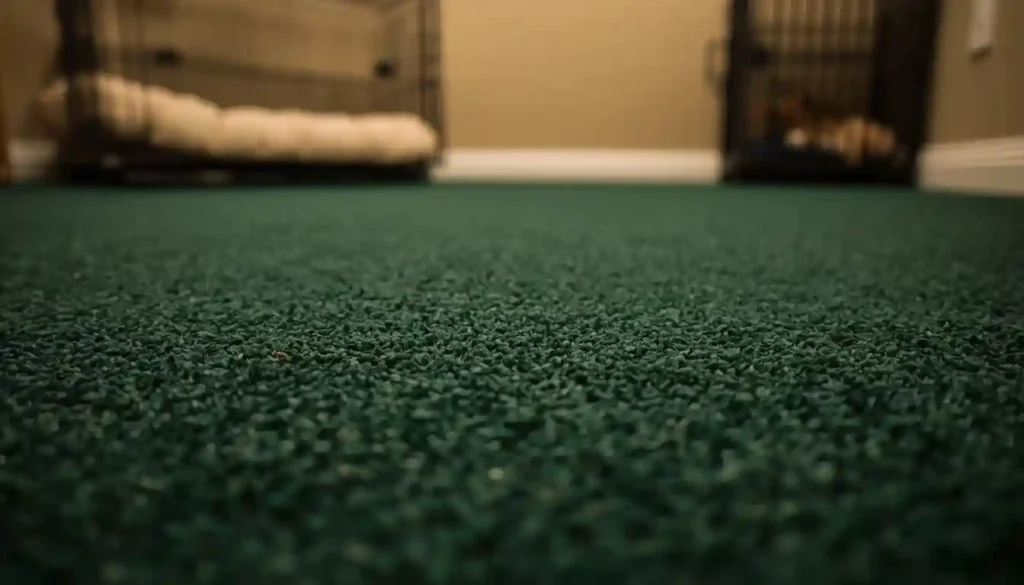
In a dedicated dog room or crate area, very dark carpet colors — deep navy, forest green, charcoal, or even a very dark espresso brown — make practical sense in a way they might not in a shared living space. At this depth of color, almost all pet hair from any coat color blends or at least becomes significantly less visible. Lighter hair reads as texture variation rather than accumulation. Darker hair disappears entirely. Accident spots, which are the most concerning stain category in any pet room, are significantly less visible against a dark background than against a light or medium one.
The pile construction should be low — a short, dense commercial-style cut pile or a low-profile textured cut pile. Low pile in a dedicated pet space is easier to sanitize, dries faster after cleaning, and does not trap allergens as deeply as longer pile constructions. Nylon in a dark color with a quality moisture-barrier pad creates a surface that can handle repeated spot cleaning with enzymatic cleaners without degrading the fiber or causing color variation.
Dark carpet in a dedicated pet space also photographs well — the room looks intentional and designed rather than neglected, which matters if you ever use the space for social media documentation of your pets or if the room doubles as a laundry or utility space during certain times of the day.
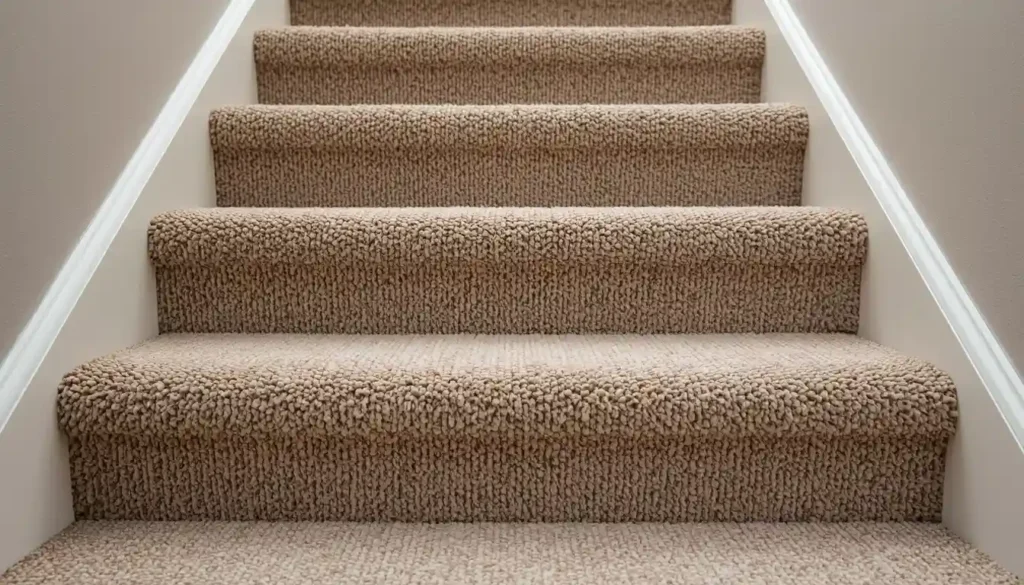
Idea 9: Textured Saxony in Warm Taupe for Stairs and Landing Areas
Stairs present a unique challenge in pet households. Dogs descend stairs at high speed, placing extraordinary lateral and vertical force on each tread. Cats drag their claws across vertical risers. The geometric surfaces of each tread edge receive concentrated wear that would shred a standard carpet within a few years. At the same time, bare hard stairs create a safety risk for older pets and puppies — the slick surface contributes to slips and joint stress that can cause real long-term harm.
Carpet on stairs solves the safety problem and, when chosen correctly, manages the durability challenge. Textured Saxony — a cut pile with a slightly uneven surface that hides tracking and paw prints — in a warm taupe or warm greige is among the most practical choices for stair carpet. The warm tone conceals the dirt that inevitably accumulates on treads from paws coming from outdoor areas. The textured surface hides the directional wear patterns that develop when animals always ascend and descend in the same motion.
The installation method matters here. Waterfall installation, where the carpet folds over the tread edge without being wrapped tightly around the nose, is the most common stair carpet technique. For pet households, a wrapping or French cap installation — which brings the carpet tightly over the nose and tucks it neatly at the back — provides better durability at the highest-wear point. Using a separate pad on each tread rather than a single continuous pad provides more consistent cushion and is the recommended approach for pet households. Installing carpet on stairs involves specific tacking and padding considerations that differ meaningfully from flat-surface installation.
Idea 10: Multi-Tonal Geometric Patterned Carpet for Open-Plan Spaces
Open-plan living areas — where the kitchen transitions into a dining area and then into a living space with few or no dividing walls — require carpet that can perform in an enormous footprint and read as coherent across the whole space. In pet households with large open plans, the challenge compounds: a single carpet covering a vast area must hide pet evidence that arrives from multiple directions and multiple activities simultaneously.
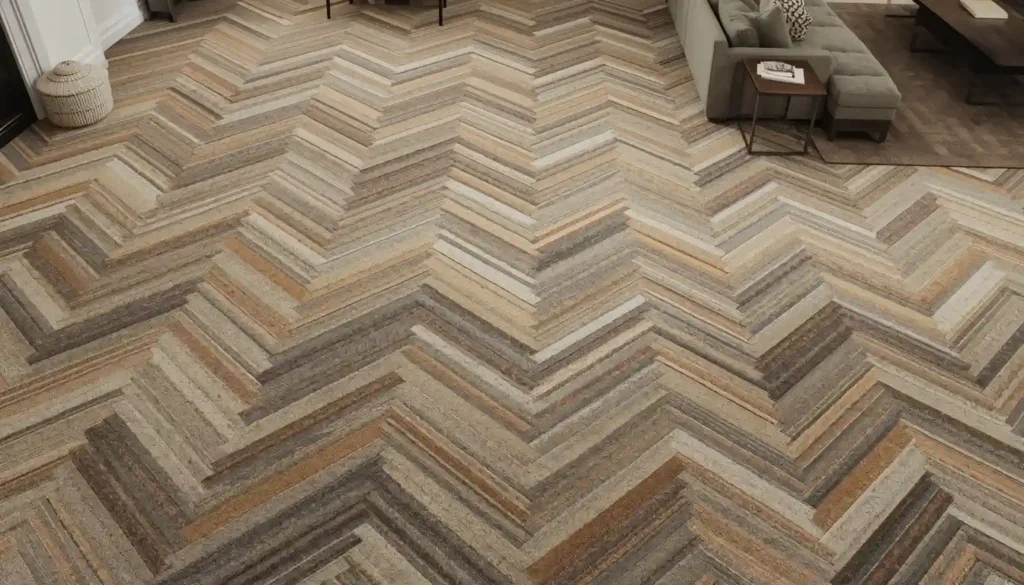
Multi-tonal geometric patterned carpet is the design solution that addresses this most comprehensively. The pattern creates visual noise that defeats stain visibility through color competition rather than color camouflage alone. A geometric that incorporates three or four tones — for example, warm cream, warm gray, medium taupe, and a dark charcoal accent — means that virtually any organic stain or hair accumulation will visually dissolve against at least one element of the pattern.
The geometric itself, whether a repeated diamond, chevron, hexagonal lattice, or abstract linear design, gives the open plan floor a sense of intentional design that solid carpet cannot achieve in the same way. In large open plans, visual interest at the floor level anchors the space and prevents it from reading as simply blank. This is the same principle that leads designers to recommend area rugs in large open-plan rooms, but applied to broadloom carpet across the entire surface.
For fiber, nylon or triexta in a patterned construction is the preferred choice. Polyester is somewhat more prone to matting over time in very large open-plan areas with sustained pet traffic, while nylon maintains pile resilience through years of use. A face weight of 45 ounces or higher is appropriate for a large open-plan installation in a pet household.
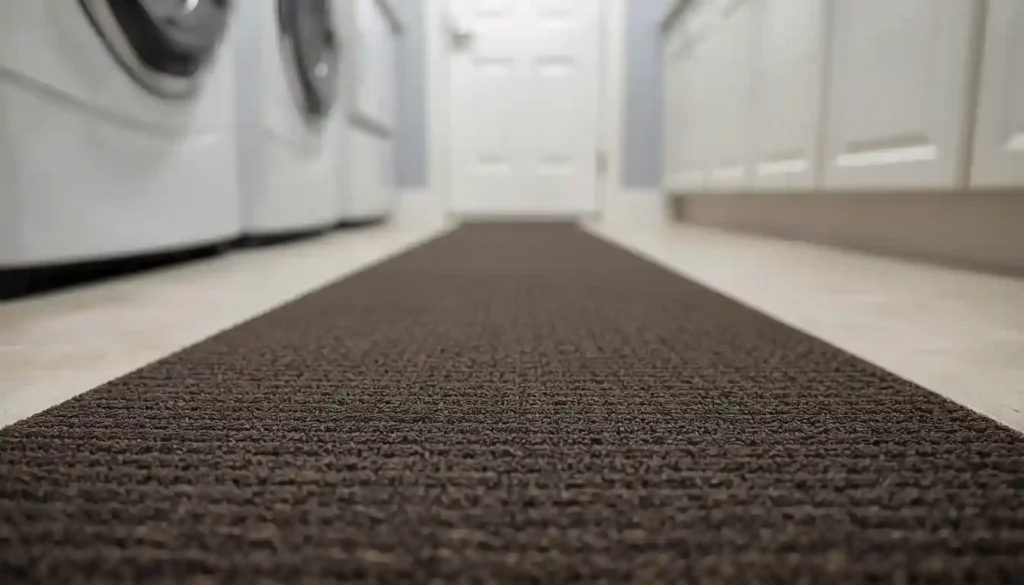
Idea 11: Olefin Carpet Runner for Pet-Friendly Laundry Rooms and Utility Spaces
Utility spaces — laundry rooms, basements converted to living space, mudrooms, or bonus rooms where pets spend time unsupervised — are often finished with hard flooring because they are considered too dirty for carpet. The assumption is reasonable but misses an important nuance: pets benefit from softer surfaces even in utility areas because hard floors, particularly concrete, accelerate joint wear in active dogs and can cause real discomfort over time.
Olefin carpet in a utility context makes sense specifically because of its inherent moisture resistance and odor-repelling properties. Olefin fiber is hydrophobic at the molecular level — it does not absorb water or urine the way nylon or polyester can. Stains that penetrate olefin carpet can be extracted more completely than from absorptive fiber types. Olefin is also significantly less expensive than nylon or triexta, which matters in a utility context where replacing the carpet more frequently is a reasonable expectation.
A runner format — a narrow carpet strip down the center of a laundry room or along the primary path of pet traffic in a utility space — rather than wall-to-wall installation makes replacement even easier and more affordable. Olefin runner carpet in a dark tone like deep charcoal or espresso, in a low-pile flatweave or level loop construction, gives utility spaces enough softness to be comfortable for resting pets while tolerating the abuse that comes with heavy cleaning traffic.
The difference between nylon, polyester, and olefin carpet fibers has real consequences in pet-heavy utility spaces, and understanding the specific strength and weakness of each fiber clarifies why olefin earns its place in these secondary zones even though it would not be the first choice for a high-profile living space.
Idea 12: Soft Polyester in a Warm Cream for Older Pets’ Designated Rest Areas
Senior dogs and cats have specific physical needs that younger animals do not: joint cushioning, warmth retention, and grip for weaker muscles. A cold, hard floor provides none of these things. Softer carpet, particularly in a deeper pile with a quality cushion pad, addresses the comfort and joint-health concerns of older pets in a way that no hard flooring surface can fully replicate.
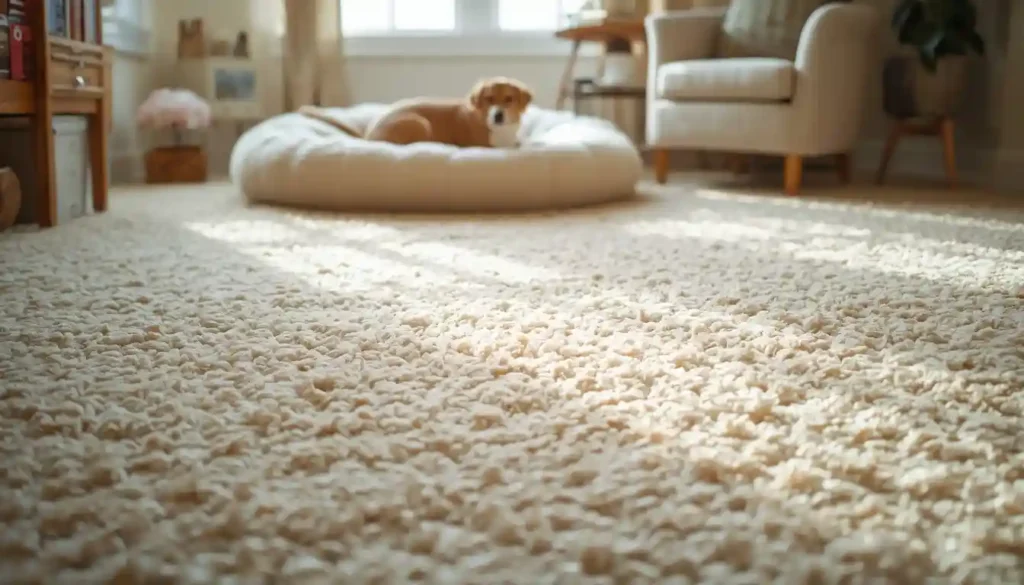
Polyester carpet has the softest hand feel of any synthetic fiber category. Its naturally silky texture is something older pets gravitate toward instinctively — it mimics the warmth and softness that makes a cozy surface restorative for animals with arthritis or muscle weakness. A soft polyester carpet in a warm cream or ivory tone, installed specifically in a room designated as a senior pet’s primary rest area, creates an environment suited to their comfort.
The decision to use cream in a senior pet room rather than a darker tone is somewhat counterintuitive from a stain-hiding perspective, but it is intentional here. Senior pets have typically moved past the accidents-and-destruction phase of their lives. The risk of heavy staining from an older, house-trained dog or a well-established cat is substantially lower than with a young animal. The warmth and psychological comfort of a lighter, softer-looking room is worth more in this specific context than aggressive stain camouflage.
Install the softest, thickest quality pad available under this carpet — a plush 7/16-inch or even 1/2-inch foam pad provides the maximum joint cushioning at floor level. The combination of deep-pile polyester and a thick pad creates essentially a continuous cushioning surface that supports older pets the way a quality mattress supports a tired body.
Understanding how carpet benefits those who spend time on the floor — a principle that applies equally to pets and young children — reinforces why soft flooring is not merely an aesthetic preference but a practical comfort and health choice.
Idea 13: Wool-Blend Carpet in Heather Tones for an Upscale Pet-Friendly Home Office
The home office represents a specific paradox in pet-friendly flooring: it needs to look professional and intentional, because many people now conduct video calls from their home workspaces, yet it is a room where pets frequently spend long hours. Dogs sleep under desks. Cats patrol keyboards. The carpet in a home office will experience consistent low-level pet traffic throughout the workday.
Wool-blend carpet — typically a combination of 80% wool and 20% nylon or similar ratios — achieves the aesthetic standard that a professional home office requires while gaining practical durability from the synthetic component. Pure wool is too expensive and too absorbent for a pet-heavy space. But a wool-nylon blend retains wool’s naturally beautiful appearance, its exceptional acoustic properties (important in a home office), and its inherent stain resistance from the lanolin content, while gaining nylon’s abrasion resistance and resilience.
Heather tones — the multi-strand blended colors that evoke the marled appearance of natural wool textiles — are aesthetically sophisticated and practically brilliant. A heather gray, heather blue-gray, or heather green incorporates several colors within each yarn strand, creating a surface that is genuinely difficult to read stain against. The visual complexity of the heather pattern diffuses attention across the surface rather than concentrating it on any individual spot.
A wool-blend carpet in a home office also manages sound in a way that matters for video call quality. Carpet absorbs room reverb and reduces the echo that hard surfaces create — an acoustic benefit that is invisible to the eye but immediately apparent in call audio quality. Pair this with a medium-density pad, not a thick one, which provides the firmness appropriate for office chair wheels to roll without damaging the pile. Using a proper chair mat over the carpet in the specific area beneath a rolling desk chair prevents the localized pile wear that desk chairs inevitably cause.
Looking across these thirteen ideas, several consistent principles emerge. Cut pile construction appears in the majority of recommendations because it eliminates the claw-snagging risk that makes loop pile potentially dangerous and damaging in pet households. Mid-to-dark color ranges appear because they genuinely conceal the organic matter that pets introduce to flooring — and concealing it is not the same as ignoring it; it simply reduces the visual anxiety of daily life with animals. High-performance fibers — nylon and triexta specifically — appear in high-traffic zones because the investment in durable fiber pays back over a longer carpet lifespan that is not cut short by matting, pilling, or fiber degradation.
Quality padding is a constant that runs beneath all of these ideas. The pad under a pet-friendly carpet is not an afterthought. A moisture-barrier pad with a closed-cell structure prevents pet accidents from reaching the subfloor, which prevents the subfloor damage, mold growth, and persistent odor that can make a carpeted room feel permanently contaminated even after the surface carpet has been cleaned. Choosing the right carpet padding is as important as choosing the right fiber and pile construction.
Maintenance strategy matters as much as the initial product choice. Even the most technically advanced pet carpet — SmartStrand, Pet Perfect, STAINMASTER PetProtect — will deteriorate faster than necessary without consistent vacuuming, prompt spot treatment, and periodic professional deep cleaning. Enzymatic cleaners formulated for pet stains are the correct choice for biological accidents; standard carpet cleaners do not break down the protein components of urine and can actually set stains rather than removing them.
The most important insight across all thirteen ideas is that pet-friendly carpet is not a separate, lesser category of flooring — it is carpet engineered and selected with honesty about how the space will actually be used. Choosing carpet that matches real life, rather than an idealized version of life without animals, produces a home that is simultaneously more beautiful and more livable. The carpet that survives five years of dogs and cats with its appearance intact is a better investment and a better-looking floor than the pristine showroom sample that begins showing wear within the first year of pet ownership.
James Miller is a seasoned flooring contractor with years of hands-on experience transforming homes and businesses with high-quality flooring solutions. As the owner of Flooring Contractors San Diego, James specializes in everything from hardwood and laminate to carpet and vinyl installations. Known for his craftsmanship and attention to detail, he takes pride in helping clients choose the right flooring that balances beauty, durability, and budget. When he’s not on the job, James enjoys sharing his expertise through articles and guides that make flooring projects easier for homeowners.
Every carpet buying decision eventually arrives at one question: is the yarn looped or cut? That single manufacturing step — whether the fiber tips are sheared off or left intact — determines how your floor performs for the next decade. It affects softness, durability, maintenance, pet suitability, sound, and cost. Yet most people pick carpet…
Most people assume the difference between commercial and residential carpet comes down to aesthetics — darker patterns for offices, softer textures for homes. That is part of the picture, but it misses the deeper engineering logic that drives every decision: fiber selection, pile architecture, backing systems, installation method, and maintenance cycles. When you understand how…
No, you should not install cushion floor (sheet vinyl) over laminate flooring. While it is physically possible, laminate is a floating floor that expands and contracts with temperature and humidity. This causes three specific failure modes when vinyl is installed on top: telegraphing of plank joints through the vinyl surface, moisture trapping between the two…
Carpet is the quietest flooring among vinyl, hardwood, and laminate. In controlled acoustic testing, carpet with a standard pad scores between IIC 60 and IIC 75 for impact noise and between STC 55 and STC 65 for airborne noise. Vinyl ranks second, with luxury vinyl plank averaging IIC 50–70. Hardwood follows at IIC 45–55. Laminate…
Beach homes face four constant attacks on flooring: salt-laden air, atmospheric humidity above 60%, abrasive sand tracked from the shore, and frequent water exposure from wet swimsuits and towels. The right flooring resists all four. The wrong choice warps, dulls, and grows mildew within a single coastal season. This guide identifies the flooring materials that…
Laminate flooring goes slippery when its melamine wear layer loses friction against the sole of a shoe. The cause is almost always one of five things: cleaning-product residue, a wax or polish coating, moisture sitting on the surface, a worn wear layer, or a glossy factory finish that was slick from day one. None of…