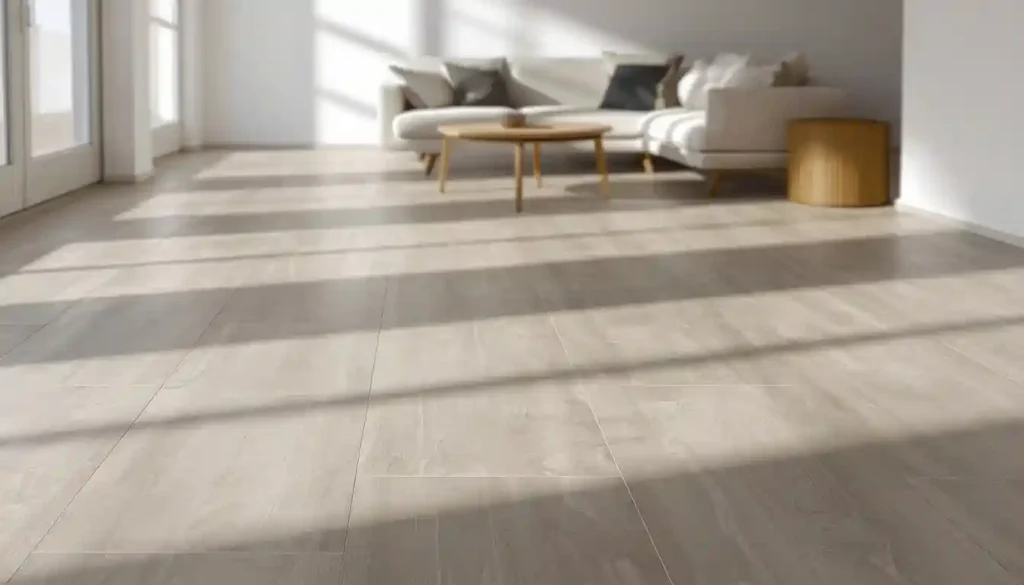
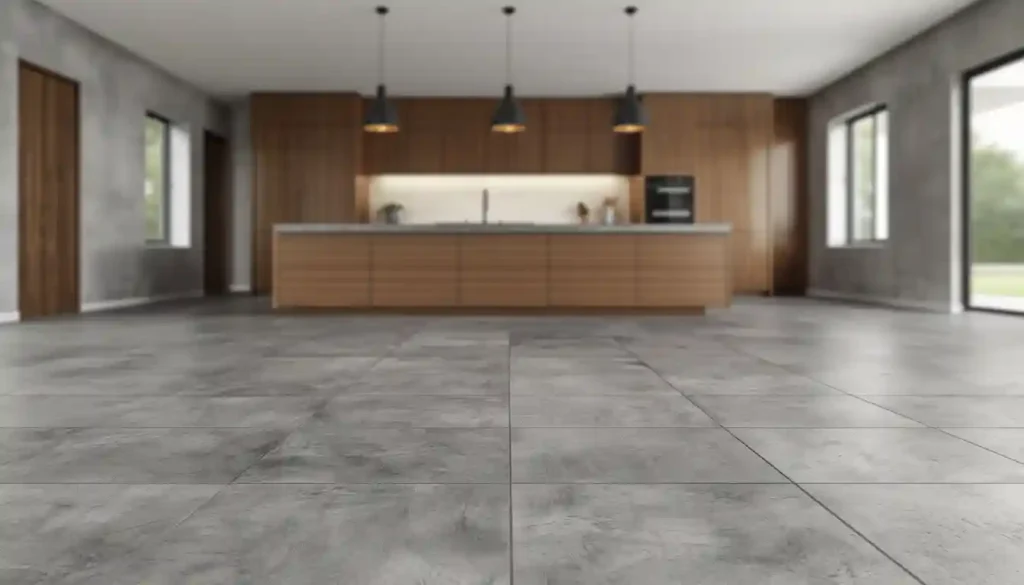
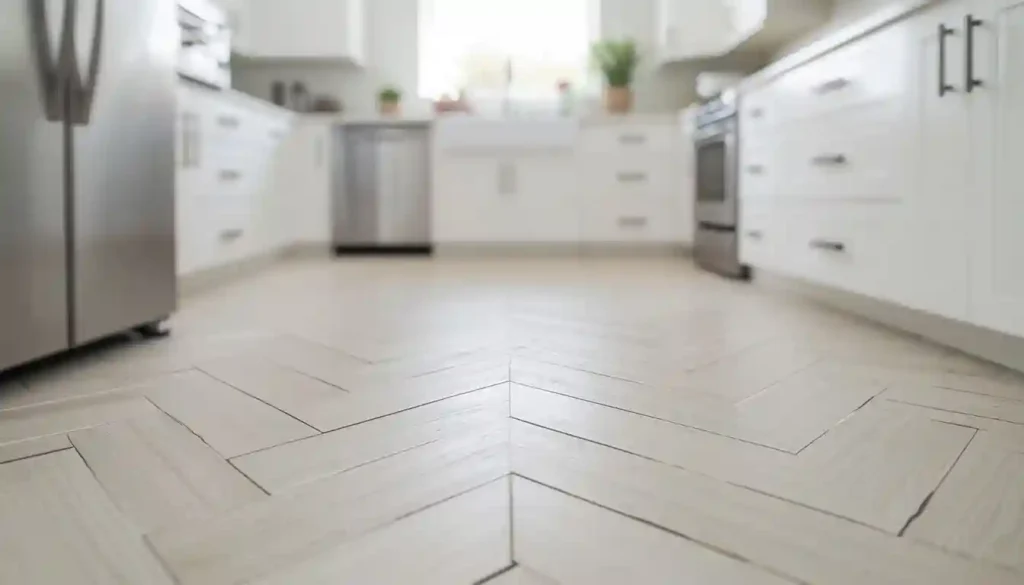
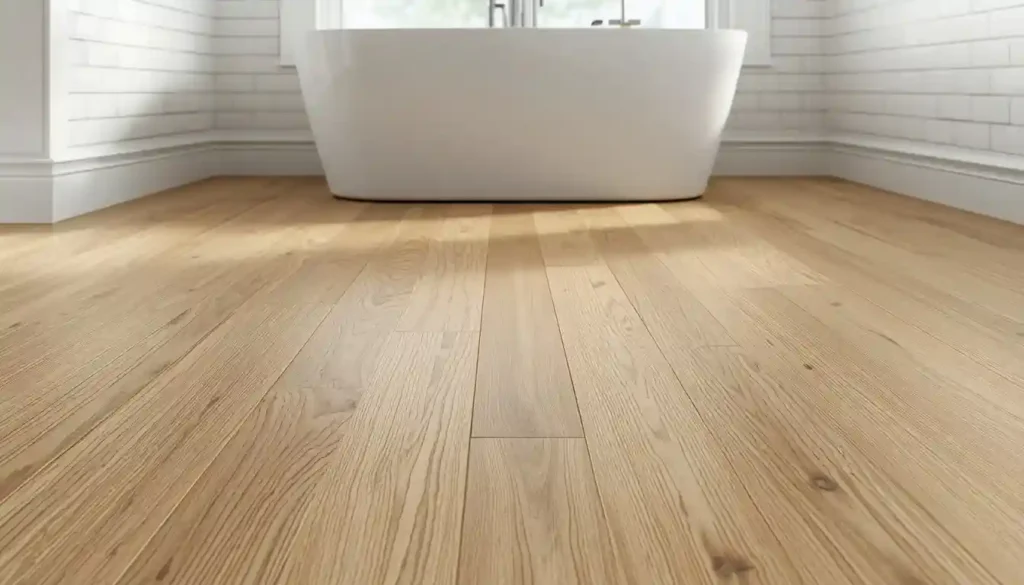
In living rooms, large-format slabs in light greige or linen tones create a calm, gallery-like foundation that lets furniture groupings define the space. In kitchens, they work particularly well when run continuously from the floor through a matching backsplash, a technique called tile-drenching that is gaining significant traction in contemporary kitchen design. In bathrooms, the reduced grout lines translate directly to easier cleaning and a more spa-like visual rhythm.
Idea 2: Concrete-Look Porcelain in Industrial-Modern Spaces
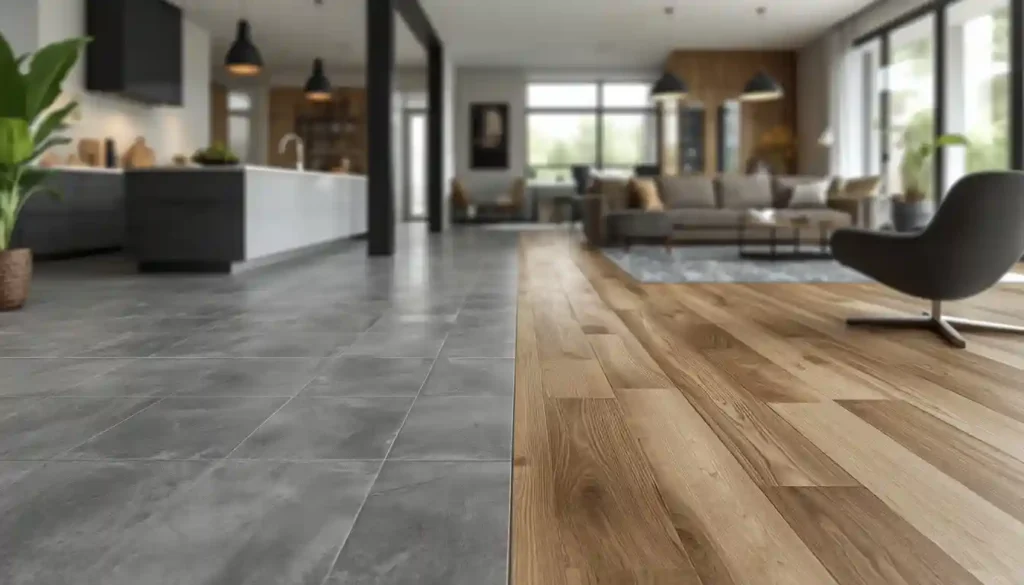
Real polished concrete flooring is genuinely beautiful — but it is also porous, prone to staining, cold underfoot, and surprisingly difficult to maintain. Modern porcelain tile technology has addressed nearly all of those drawbacks by producing concrete-look tiles that are visually indistinguishable from the real thing in most residential settings, while offering the hardness, stain resistance, and moisture performance that porcelain naturally provides.
Concrete-look porcelain comes in matte and semi-polished finishes. The matte version reads more authentically like raw industrial concrete and suits minimalist or loft-inspired interiors where raw materials like exposed steel, brushed metal, and natural wood are also present. The semi-polished version leans slightly warmer and more refined, making it a good bridge between an industrial aesthetic and a more livable, residential interior.
One of the smartest applications for this material is in open-plan spaces where you want the floor to unify multiple zones without asserting a strong decorative presence. Because concrete-look tile is visually neutral, it does not compete with bold kitchen cabinetry, statement lighting, or gallery walls. It simply holds the room together.
Pair this floor with warm wood tones — walnut cabinetry, oak furniture, raw timber shelving — to prevent the space from reading as cold. The contrast between the cool gray of the tile and the warm amber of wood is one of the most satisfying material pairings in contemporary interior design. You also get the bonus that porcelain tile is entirely waterproof, which matters in kitchens and mudrooms where spills are frequent.
Idea 3: Herringbone Pattern Tile Floors
The herringbone pattern — rectangular tiles laid at 90-degree angles to one another so that each tile end meets the midpoint of the next — has been used in floors for centuries, but it is experiencing one of its strongest periods of popularity in modern interiors right now. What was once associated almost exclusively with narrow wood strips and traditional European townhouses has expanded into an enormous range of materials and scales.
Porcelain and ceramic tiles in herringbone arrangements work particularly well in entryways, hallways, and kitchens. The zigzag geometry creates a sense of movement and directional energy that makes rectangular spaces feel more dynamic without requiring any unusual color or pattern on the tile itself. You can use a simple ivory or pale gray tile in herringbone and the pattern alone does the design work.
In terms of scale, larger plank-style tiles (3×12 or 4×16 inches) in a herringbone pattern feel contemporary and bold — they suit modern kitchens with clean-lined cabinetry and minimal ornamentation. Smaller mosaic tiles in herringbone read as more traditional or artisanal, which can work beautifully in bathrooms and mudrooms. Marble tiles in herringbone, particularly Carrara or Bianco, are among the most elegant floor treatments available for master bathroom renovations.
One practical consideration worth mentioning: herringbone requires significantly more cuts than a standard straight-lay installation, which means more material waste (typically 10–15% more) and more skilled labor time. Factor this into your budget when comparing options. The tile flooring installation cost guide gives a solid breakdown of what labor complexity adds to the total price.
Idea 4: Wood-Look Porcelain Tile
The desire for the warmth and natural character of wood flooring combined with the moisture resistance and durability of tile has driven the development of wood-look porcelain into one of the most technically sophisticated categories in the flooring industry. Today’s wood-look porcelain is produced using high-resolution digital printing directly onto the tile body, resulting in grain patterns, knot structures, and surface texture that are convincingly close to real timber.
The key visual elements to look for when selecting wood-look tile are plank proportion, grain repetition, and surface texture. Tiles with longer plank lengths (36 to 48 inches) and more realistic variation in the grain pattern between tiles tend to read as more convincing. Shorter, more repetitive tiles can appear obviously artificial once you are looking at a full floor installation.
Wood-look tile is most valuable in rooms where real hardwood would struggle: bathrooms, laundry rooms, basements, and kitchens. In a bathroom, you gain the warmth and visual softness of wood with none of the moisture-related warping, swelling, or mold risk that genuine timber faces. In a basement, where humidity levels tend to be higher and concrete subfloors are common, wood-look porcelain performs exceptionally well. It can be installed directly over a properly prepared concrete slab — something real hardwood cannot reliably do without significant additional preparation.
For kitchen floors where durability is paramount, wood-look tile in a warm oak or light ash tone pairs beautifully with both white and gray cabinetry. The matte finish versions are most practical because they hide small scratches, footprints, and everyday kitchen dust better than polished alternatives. Those looking at the comparison between tile and other kitchen flooring materials will find useful context in the tile flooring vs laminate breakdown, which addresses the practical differences that matter in high-use rooms.
Idea 5: Terrazzo Tile Floors
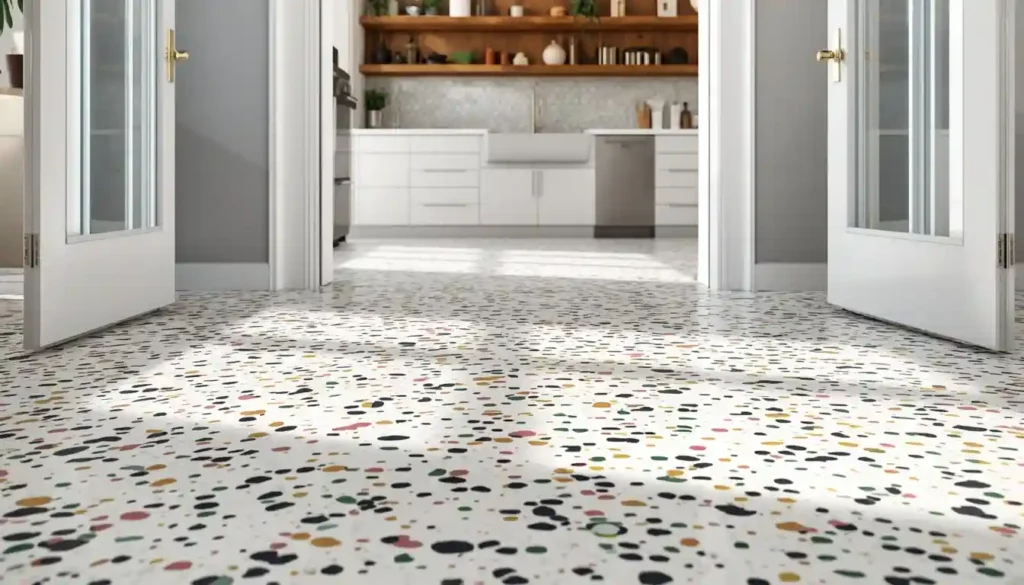
Terrazzo has completed a full design cycle — from mid-century institutional flooring in schools and hospitals, through a long period of being considered dated, and now arriving at its current status as one of the most sought-after floor materials in contemporary residential design. The revival is partly aesthetic and partly practical: terrazzo in porcelain tile form delivers the speckled, multicolored character of traditional poured terrazzo without the cost, installation complexity, or sealing requirements of the real thing.
Modern terrazzo tiles come in a range of base tones — white, gray, blush, black, sage green, navy — with chip sizes and chip colors that can be calibrated to feel subtle or bold depending on the design intent. Fine chips in a soft white base read as restrained and elegant, appropriate for contemporary living rooms or bathroom floors. Large, colorful chips in a mid-gray or black base make a strong design statement that works well in entryways, powder rooms, and kitchens where you want the floor itself to be the focal point.
One of the design advantages of terrazzo tile is that it carries pattern through its entire body, meaning the appearance does not wear down over time the way a printed surface can. This makes it an excellent choice for high-traffic areas. In retail and hospitality contexts, terrazzo floors frequently last decades with minimal maintenance. In homes, that same durability translates into a floor that holds its appearance through years of family life.
Terrazzo also pairs exceptionally well with other natural materials. A terrazzo floor in pale gray with white and black chips, set against warm wood furniture and brass lighting fixtures, is one of the most balanced and current interior looks available today.
Idea 6: Marble-Look Porcelain for Luxury Without the Maintenance
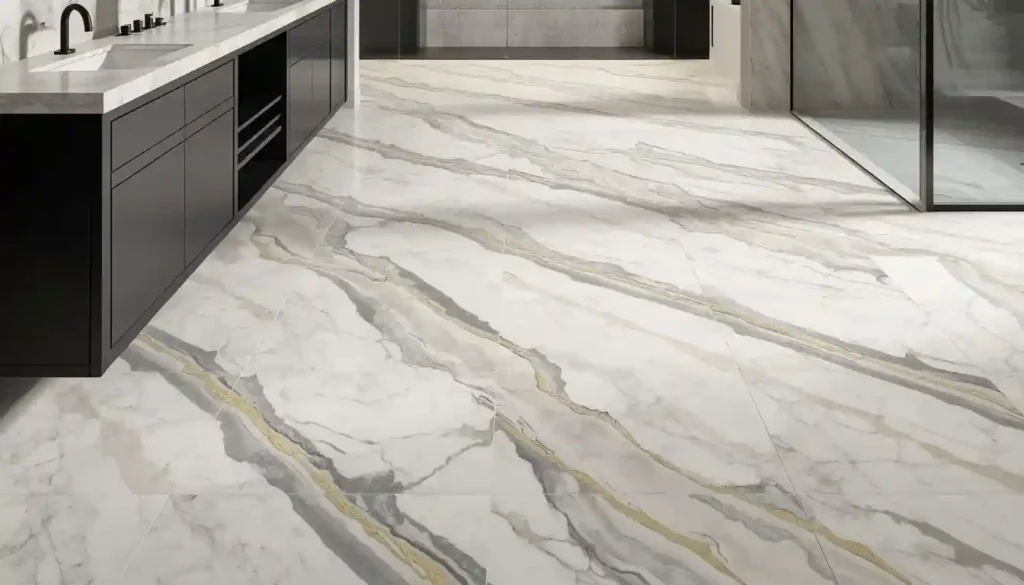
Natural marble is one of the most visually compelling materials in architecture. The veining, the translucency, the sense that no two slabs are identical — these qualities are difficult to replicate. But natural marble also demands significant maintenance: it scratches, stains from acidic liquids like wine and lemon juice, requires periodic sealing, and is expensive to purchase and install. Marble-look porcelain addresses all of these drawbacks while delivering a floor that, in many design contexts, achieves the same visual impact.
The most popular marble looks in porcelain reproduction are Calacatta (white with bold, warm-toned veining), Carrara (white with soft gray veining), and Nero Marquina (black with white veining). Calacatta-look tiles are particularly in demand for kitchen floors paired with waterfall-edge islands and white cabinetry — the veining adds warmth and movement to what might otherwise be an all-white, overly sterile space. Nero Marquina reproductions in large-format slabs create extraordinarily dramatic floors in powder rooms and entryways, where the contrast between the black base and white veining commands immediate attention.
When comparing porcelain to the real stone, the porcelain vs marble tile page gives a thorough breakdown of where each material excels and where it falls short. For most modern kitchens and bathrooms, porcelain wins on practical grounds while remaining entirely competitive visually.
Large-format marble-look tiles — 24×48 or 32×32 — with bookmatched veining patterns (where adjacent tiles are oriented to mirror each other’s veining) represent the highest-end version of this idea. The bookmatching requires careful planning during tile layout but produces a floor that genuinely rivals the appearance of real stone.
Idea 7: Black and White Checkerboard Tile
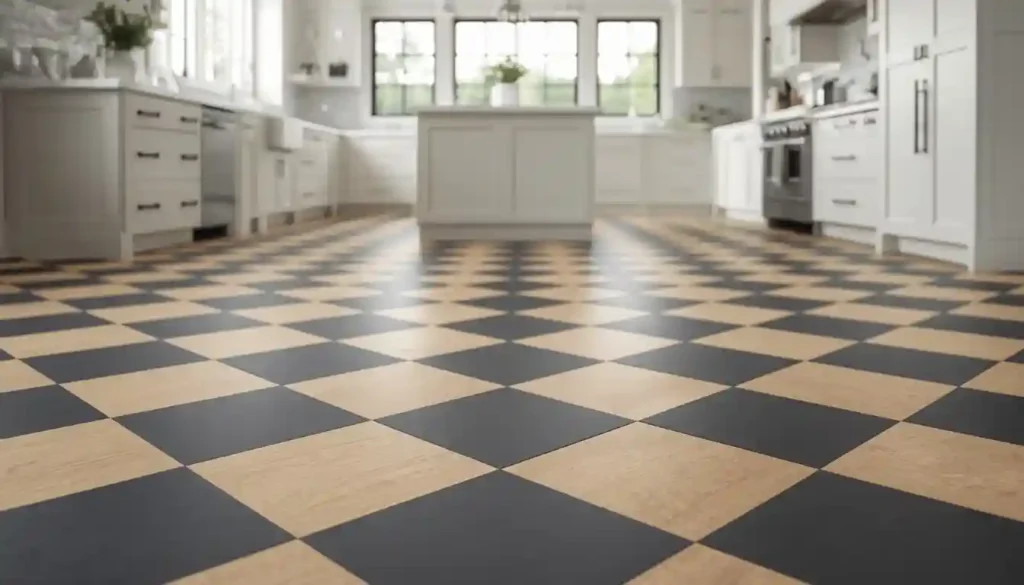
The black and white checkerboard floor is one of the most enduring tile patterns in design history, and its current revival in modern interiors has given it a genuinely fresh energy. The reason it keeps coming back is that it does something few other floor treatments can: it provides strong visual character while pairing with almost any wall color, cabinet finish, or furniture style. It is bold without being demanding.
The modern interpretation has shifted away from the small, traditional 4×4 inch squares of vintage kitchens and bathrooms toward larger format squares — 12×12, 18×18, even 24×24 — which make the pattern feel more architectural and contemporary. The matte finish has also replaced the high-gloss tiles more commonly seen in older installations, and this shift in finish significantly changes the mood: matte checkerboard reads as more casual, livable, and current; glossy checkerboard reads as more vintage or theatrical.
Color variations beyond strict black and white are also contributing to the pattern’s modern resurgence. Charcoal and cream, forest green and off-white, terracotta and ivory — these combinations keep the graphic energy of the checkerboard while adding warmth or personality that pure black and white does not always provide. In a kitchen or entryway with warm wood tones, a terracotta-and-cream checkerboard floor can be more harmonious than a stark black-and-white version without sacrificing any of the pattern’s visual punch.
Setting the tiles on the diagonal — at 45 degrees — is a simple installation variation that makes the pattern feel slightly more dynamic and has the added perceptual effect of making the space appear wider. This diagonal approach is particularly effective in narrow hallways and entryways.
Idea 8: Terracotta and Warm Earthen Tiles
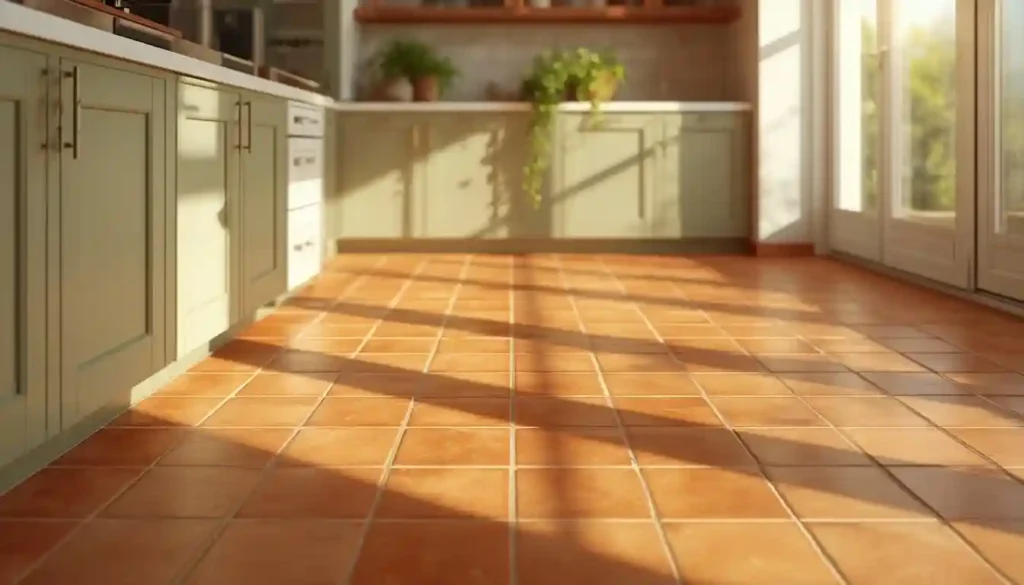
The shift toward warmer, earthier color palettes in interior design — driven partly by a broader reaction against the cool-gray minimalism that dominated the 2010s — has brought terracotta tile back into mainstream residential design with considerable force. And unlike previous terracotta trends, the current one is not purely nostalgic. It is being applied in decidedly contemporary ways: large-format terracotta-look porcelain in open-plan living rooms, glazed terracotta in geometric layouts, and handmade-look terracotta squares with intentional imperfections used as statement kitchen or bathroom floors.
Real terracotta tiles have a distinctive quality that porcelain reproductions cannot fully capture — the slight variation in color from tile to tile, the subtle surface irregularity, the sense of something made by hand. When used in a modern interior, this natural variation adds life and warmth that engineered materials can struggle to match. The trade-off is that real terracotta requires sealing and more careful maintenance than porcelain, particularly in kitchens where oil and acidic liquids are common.
Terracotta-look porcelain solves the maintenance challenge while keeping much of the visual warmth. The best versions use digital printing to introduce the slight color variation and surface texture that makes terracotta feel authentic rather than industrial. Laid in a straightforward grid with matching warm-toned grout, these tiles create a floor that works exceptionally well in Mediterranean-inspired kitchens, biophilic living rooms, and earthy bathrooms with plaster walls and rattan furniture.
The warm reddish-orange of terracotta pairs naturally with green — sage cabinets, olive walls, trailing plants — as well as with white, cream, and natural wood. It is a color-forward choice that deserves careful consideration of the room’s other materials, but when it works, it creates a warmth that is genuinely difficult to achieve with cooler floor materials.
Idea 9: Zellige and Handmade-Look Tiles
Zellige is a traditional Moroccan tilework made from hand-cut pieces of fired clay with a glazed surface. The defining characteristic of zellige tiles is their deliberate irregularity — the slight variations in glaze thickness, the small imperfections in surface flatness, and the unique color depth that comes from the way handmade glazes pool and shift during firing. These are not flaws; they are the source of zellige’s distinctive visual richness.
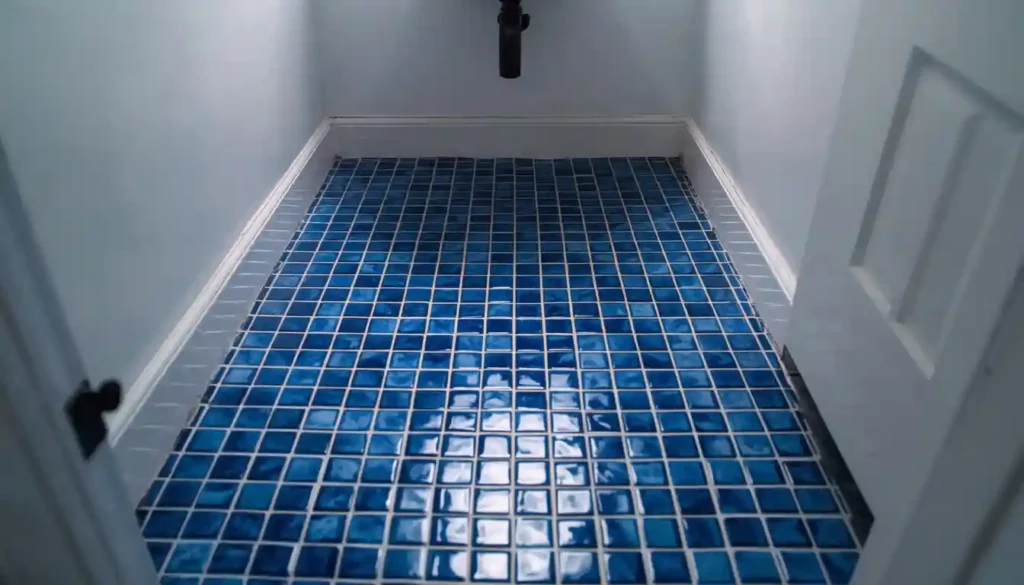
In contemporary interior design, zellige and zellige-look tiles have moved well beyond their expected application in Moroccan or bohemian-style spaces into clean, minimal, and even industrial modern interiors. A bathroom floor in matte zellige tiles in a warm white or pale sand tone brings an organic, handcrafted quality to an otherwise restrained space. A kitchen floor in zellige cobalt or deep forest green creates an intense, jewel-like surface that works unexpectedly well against white cabinetry and brass hardware.
The installation of zellige floors requires an experienced tile setter. Because the tiles are genuinely handmade, their thickness varies, and getting them flat requires skill and patience. The grout lines also need careful planning — wider joints (often 1/8 to 3/16 inch) are typically more appropriate for zellige than the tight rectified joints used with machine-cut porcelain. Those unfamiliar with grout line planning will find the grout line size guide useful for understanding how joint width affects the final appearance of different tile types.
For homeowners who want the zellige aesthetic without the cost of authentic Moroccan tiles, high-quality pressed ceramic and porcelain versions are now available that convincingly capture the dimensional variation and glaze depth of the original while being more consistent in thickness and easier to install.
Idea 10: Hexagon Tile Floors
Hexagon tiles occupy a unique position in modern flooring design: they are geometric and structured, yet they also have a natural quality — honeycomb formations appear in nature, and the shape carries that organic association into architectural settings. This dual character makes hexagon tiles work in a wide variety of modern spaces, from minimal bathrooms to maximalist kitchen floors.
The size of the hexagon dramatically changes the effect. Small hexagons (1 to 2 inch) create a mosaic-like density that reads as vintage or artisanal, particularly appropriate in bathrooms, mudrooms, and entryways where the floor area is relatively small. Medium hexagons (4 to 6 inch) sit in a versatile middle range that reads as contemporary without being either precious or overtly graphic. Large hexagons (10 inch or more) make a bold geometric statement that works well in spacious modern bathrooms, open-plan kitchens, or commercial spaces where the scale of the pattern matches the scale of the room.
In terms of material, hexagon tiles are available in porcelain, ceramic, natural stone, marble, and encaustic cement. White penny-round marble hexagons in a bathroom are a perennial classic. Matte black hexagons in a kitchen or entryway bring a graphic, modern edge. Two-tone hexagon patterns — alternating black and white, or navy and cream — create an entirely different dynamic that rewards the eye without requiring any additional design complexity from the walls or furniture.
Grout selection matters more with hexagon tiles than with most other shapes because the grout lines themselves become part of the visual pattern. A contrasting grout (white tile with charcoal grout, or black tile with white grout) emphasizes the hexagon geometry boldly. A matching grout quiets the pattern and lets the tile material and finish take precedence. Both approaches are valid, but they produce very different results.
Idea 11: Geometric Pattern Tiles
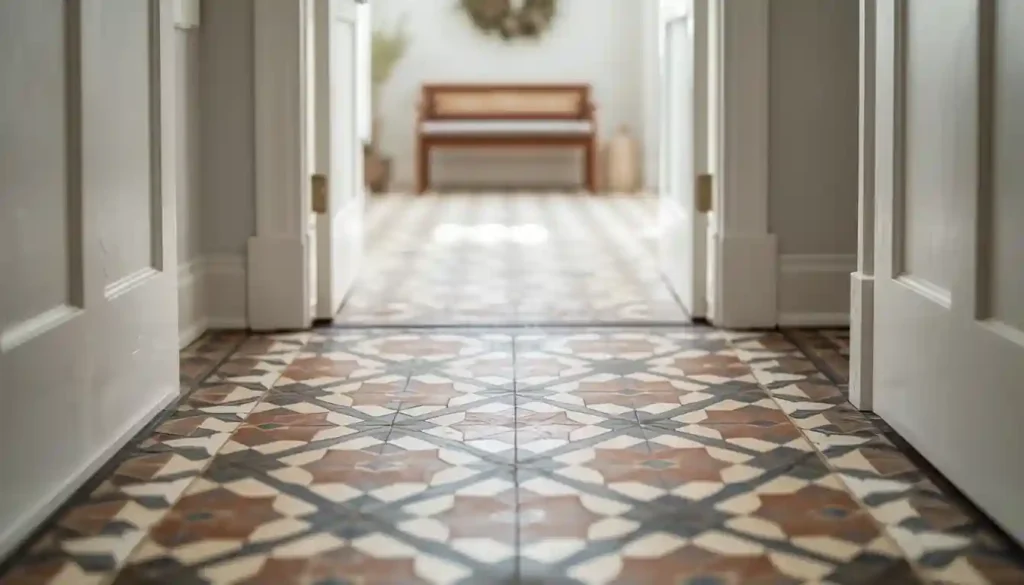
Beyond checkerboard and hexagon, the broader category of geometric patterned tiles has become one of the most creatively active areas in contemporary flooring design. Encaustic cement tiles with geometric motifs — diamonds, stars, interlocking squares, Moorish patterns — bring graphic complexity to floors that might otherwise feel underdressed. Modern porcelain production has made it possible to achieve this level of patterning at price points that were previously available only in handmade encaustic tile.
The most important principle when using geometric patterned tiles is restraint in the rest of the room. A bold floor with an intricate geometric pattern is a design statement, and the walls, furniture, and textiles should step back and let the floor lead. Plain white or plaster walls, simple furniture profiles, and minimal window treatments allow the floor pattern to breathe and be appreciated. When a complex geometric floor competes with equally complex walls and furniture, the space tends to feel chaotic rather than intentional.
Scale of pattern relative to room size is also critical. A small diamond pattern that works beautifully in a powder room may disappear in a large open-plan kitchen and living area. Large-scale geometric patterns — oversized diamonds, wide chevrons, bold star patterns — are more appropriate when the floor area is substantial. Interior designers generally recommend getting samples and laying them on the actual floor to check scale before committing to full installation.
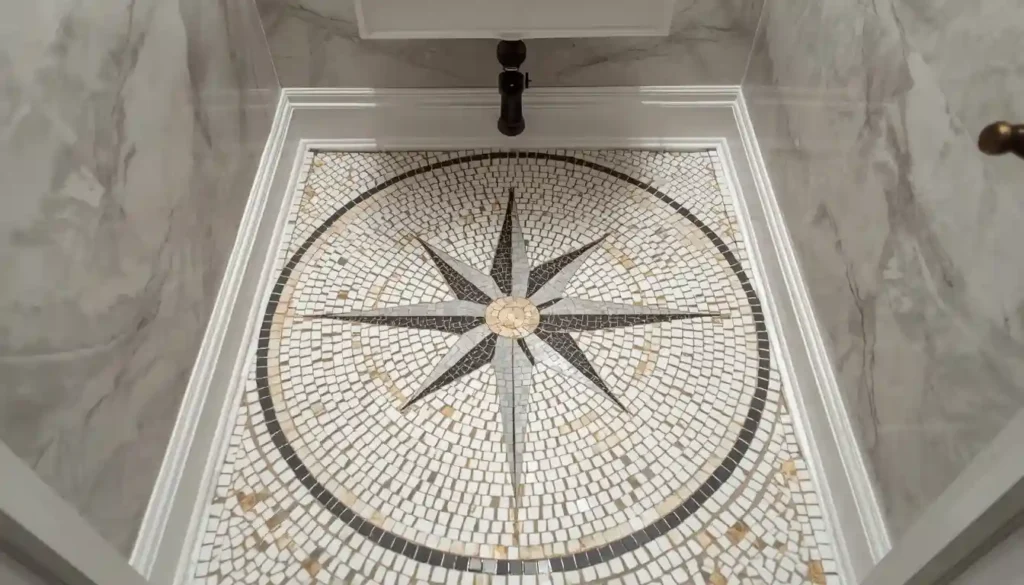
Geometric patterned tiles are especially popular in entryways, where the floor functions as the first impression of a home. A bold compass rose, a radiating star pattern, or a simple contrasting diamond inset in the center of the entryway creates a memorable arrival moment that sets the tone for the entire house.
Idea 12: Slate and Stone-Look Tile in Earthy Tones
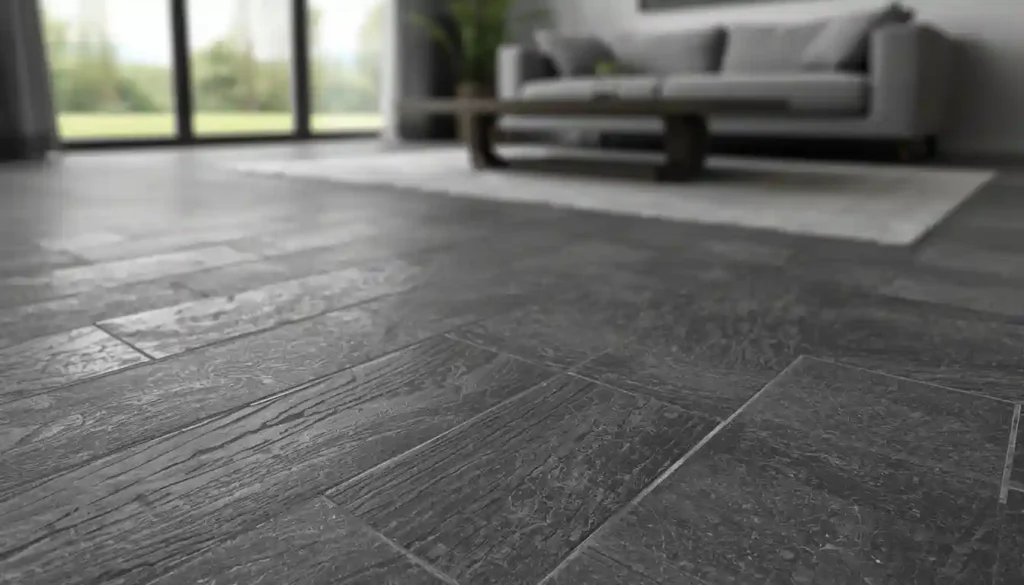
Natural slate and stone have a texture and dimensional quality that no other flooring material replicates. The slightly uneven surface of real slate, the way it fractures and cleaves into irregular planes, the colors that shift from charcoal to green to rust within a single tile — these qualities create floors that feel deeply connected to the physical world. In modern interiors that are deliberately incorporating natural materials and organic textures, stone-look tile and genuine stone tile are experiencing strong demand.
Real slate and stone floors require sealing and periodic maintenance, and they can be uncomfortable underfoot in cold climates unless paired with underfloor heating. Porcelain reproductions in slate and stone looks address the maintenance and comfort challenges while delivering convincing surface texture through digital embossing and printing techniques. The best stone-look porcelain tiles have surface relief — actual dimensional variation across the tile face — that creates genuine tactile texture rather than just a printed appearance.
In design terms, slate and stone-look tiles in charcoal, graphite, rust, and brown tones are particularly at home in contemporary spaces that incorporate raw or industrial materials: exposed brick, raw timber beams, cast iron radiators, oxidized metal. They also translate beautifully into outdoor-to-indoor transitions, where extending the same stone-look tile from an interior living space through glass doors to an outdoor terrace creates seamless continuity.
One consideration for those exploring whether tile or other flooring types make more sense in a specific room: the tile flooring vs hardwood comparison is worth reading because it addresses the conditions — moisture, traffic, climate — under which each material genuinely outperforms the other.
Idea 13: Skinny Plank Tile in Modern Wet Rooms
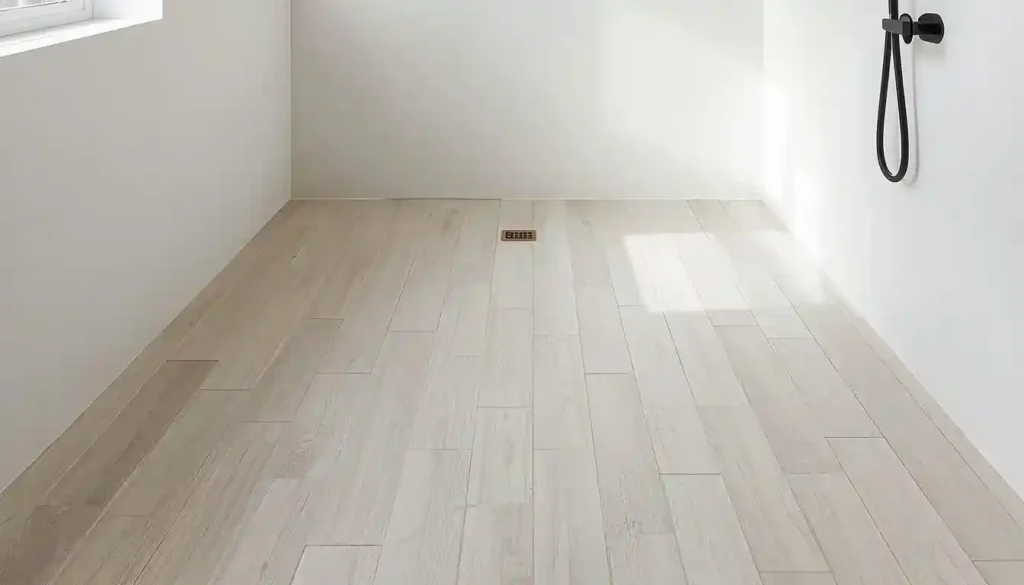
The wet room — a fully waterproofed bathroom where the shower has no enclosure and water is managed through floor drainage — has moved from high-end hotel design into contemporary residential renovation, and a specific tile format has emerged as particularly suited to this application: skinny plank tiles. These are long, narrow tiles, typically in the range of 4×24 or 3×36 inches, that are laid in a staggered brick pattern or herringbone arrangement across the entire floor of the wet room, including the shower zone.
The long, linear format of skinny plank tiles serves both an aesthetic and a practical function in wet rooms. Aesthetically, the elongated planks emphasize the length and width of the room, making spaces feel larger and more architectural. Practically, the higher number of grout lines in a skinny plank floor provides more surface grip than a large-format tile installation, which is an important safety consideration in a floor that will regularly be wet.
Skinny plank tiles in natural stone looks — particularly those mimicking light travertine, pale limestone, or washed-out linen-toned porcelain — create an extraordinarily serene wet room environment. The subtle texture of the tile, the gentle linear pattern, and the continuity of the material from wall to floor (in full wet room designs) combine to produce a spa-like experience that is among the most sought-after upgrades in modern bathroom renovation.
The key technical requirement is a floor with a proper continuous gradient toward the drain. In a wet room, there is no threshold or shower tray to contain water — the entire floor must slope subtly and consistently toward a linear or central drain. This requires precise installation and a well-planned subfloor preparation before any tile goes down.
Idea 14: Mosaic Accent Floors
Mosaic tile floors — composed of small individual tesserae or tiles assembled into a larger pattern — have been a feature of important architectural spaces for thousands of years, from Roman villas to Byzantine churches to mid-century modernist residential buildings. Their current popularity in contemporary residential design draws on this history while translating it into formats that are practical for modern homeowners: pre-sheeted mosaic panels that allow intricate patterns to be installed at reasonable cost and without specialty craftsmanship.
In modern interiors, mosaic floors are most often used as accent applications rather than covering entire rooms. A mosaic inset at the center of an entryway, surrounded by large-format porcelain tiles, creates a focal point that feels custom and site-specific. A mosaic border running around the perimeter of a bathroom floor adds a layer of detail and visual rhythm to an otherwise straightforward installation. A full mosaic floor in a small powder room — where the limited area makes an intricate pattern feasible in terms of cost and material — creates one of the most striking rooms in the house.
The material choices for contemporary mosaic floors are broad: glass mosaic tiles catch and play with light in a way that no other material does, creating an almost luminous floor surface in spaces with good natural or artificial lighting. Marble mosaic tiles bring the refinement of natural stone at a scale that allows pattern work that would be prohibitively expensive in full-size marble. Porcelain mosaic in a concrete or stone look provides durability and consistency while still delivering the graphic richness that mosaic is known for.
Idea 15: Mixed-Material Tile Floors
The most sophisticated direction in contemporary tile design is one that resists simple categorization: floors that deliberately combine two or more tile types, sizes, or materials within a single space to create zones, transitions, or visual interest that a single material cannot provide on its own. This is not the same as mixing patterns indiscriminately — it is a purposeful design strategy that uses material change as an architectural tool.
One of the most current examples is pairing large-format porcelain with a contrasting mosaic or patterned tile border or inset. The large tiles carry the expanse of the room in a clean, contemporary way, while the mosaic or patterned element at the threshold, center, or perimeter adds a layer of craft and detail that elevates the overall design. This is exactly how many historic floor installations were organized — a field tile, a border, and an inset — and it is being reinterpreted through modern materials and aesthetic sensibilities.
Another strong contemporary application is using different tile materials to define different zones in an open-plan space. A wood-look tile in the living zone transitions to a concrete-look porcelain in the kitchen zone, with the material boundary reinforcing the functional separation of the two areas. This approach works particularly well in open-plan homes where walls cannot do the spatial work of defining separate rooms, as detailed further in the discussion of tile flooring patterns and how pattern and material work together to organize space.
Combining a warm-toned material — terracotta, wood-look, warm stone — with a cooler one — concrete gray, white marble, charcoal slate — in the same floor allows a space to feel both grounded and airy, both warm and calm. It is a harder design balance to achieve than a single material approach, but when executed well it produces floors that genuinely feel designed rather than simply chosen.
Understanding the practical side of working with multiple tile types — how different adhesives, grout types, and subfloor requirements interact — is important before committing to a mixed installation. The resources on best adhesive for tile flooring and on choosing the right grout are worth reviewing because the interface between two different tile materials needs careful technical planning to prevent cracking, lippage, or grout failure over time.
What to Consider Before Choosing a Modern Tile Floor
After reviewing fifteen distinct ideas, a few practical principles are worth drawing together before you make final decisions.
Room size and ceiling height are the starting point for tile selection. Large-format tiles scale well with large rooms and high ceilings, but they can overwhelm small spaces. In a bathroom under 60 square feet, a 24×48 inch tile may have fewer than ten full tiles across the entire floor, which can look oddly sparse. Conversely, a 4×4 inch mosaic in a 400 square foot open-plan living area will disappear visually and make the space feel busier without adding genuine beauty. Matching tile scale to room scale is one of the most reliable principles in floor design.
Finish choice affects both appearance and safety. Polished and high-gloss finishes reflect light beautifully and make spaces feel larger and more luxurious, but they show every footprint, water mark, and scratch more than matte or textured finishes do. In bathrooms, polished tile floors require careful attention to slip resistance — this is not a minor concern. The guide on tile flooring slipperiness covers coefficient of friction ratings, anti-slip finishes, and practical approaches to making beautiful tile floors safe for bathrooms and wet rooms.
Grout color and width shape the character of any tile installation as much as the tile itself does. A tile that reads as warm and natural with a sand-colored grout can look cold and clinical with a gray grout. A tile that appears as a seamless surface with a matching grout becomes a pattern-forward design statement with a contrasting color. Looking at completed installations with the specific tile and grout combination you are considering — not just the tile in isolation — is essential before finalizing a choice.
Finally, the long-term picture matters. Tile is a permanent floor material. It does not need to be replaced when trends shift, and the most durable tile installations last the lifetime of the building. Choosing a floor you can live with across design cycles — one that has genuine material quality, not just a trendy surface treatment — is the single most important investment decision in the tile selection process. The how long does tile flooring last resource gives realistic expectations for different tile types and installation methods, which is useful context when comparing the upfront cost of quality materials against the long-term value they deliver.
James Miller is a seasoned flooring contractor with years of hands-on experience transforming homes and businesses with high-quality flooring solutions. As the owner of Flooring Contractors San Diego, James specializes in everything from hardwood and laminate to carpet and vinyl installations. Known for his craftsmanship and attention to detail, he takes pride in helping clients choose the right flooring that balances beauty, durability, and budget. When he’s not on the job, James enjoys sharing his expertise through articles and guides that make flooring projects easier for homeowners.
Carpet tiles — also called modular carpet or carpet squares — are pre-cut sections of carpet, typically 18×18 inches or 24×24 inches, designed to interlock across a floor without the need for seaming, stretching, or tack strips. Unlike broadloom carpet that arrives in a roll and requires a professional to cut and stretch it wall…
The bathroom is the one room where flooring decisions carry real consequences. Get it wrong and you are not just looking at cosmetic damage — you are dealing with swollen cores, subfloor rot, mold colonies, and a floor that fails in under five years. Laminate flooring in the bathroom sits right at the center of…
Vinyl plank flooring gets sold as a simple weekend project. Pull the planks out of the box, click them together, done. That framing collapses the moment you encounter a subfloor with 3/16 inches of high spot variance, a concrete slab that tested positive for moisture, or a room where the walls are so far out…
Pros and Cons of SPC Flooring: What the Specs Actually Tell You Before You Buy SPC flooring gets recommended constantly — and for mostly the right reasons. But the way it gets explained online does buyers a disservice. “Durable, waterproof, easy to maintain” describes half the products on the market. What you actually need to…
Your dog just skidded across the hallway and left a fresh trail of muddy paw prints. Your cat has been using the corner of the living room floor as a scratching post. Sound familiar? If you share your home with pets, you already know that not every floor is built to survive them. The good…
When someone asks whether wool or polypropylene is the better carpet, they are usually asking the wrong question. The more useful question is: better for what, and better for whom? These two fibers sit at opposite ends of the carpet material spectrum — one is a natural protein fiber that has been used in textiles…