What Are the Benefits of Beveled Edge Laminate Flooring?
Beveled edge laminate flooring has seven main benefits. Each one is the result of a specific physical property of the V-groove rather than a general aesthetic claim.
1. Realistic Hardwood Appearance
The V-groove casts a continuous shadow line between every plank. This shadow is what separates hardwood-look laminate from sheet-look laminate. Solid hardwood floors have a small natural gap between boards because real wood expands and contracts, and the eye reads that gap as a sign of authentic material. Beveled laminate reproduces the same visual cue at the manufacturing stage.
The depth of the bevel controls the strength of the shadow. Deeper bevels (closer to 2mm) produce sharper shadows and read as more rustic or reclaimed in style. Shallower bevels (closer to 1mm) produce softer shadows and read as more refined or contemporary. Wide planks benefit more from beveled edges than narrow planks because the larger plank surface needs the boundary line to break up the visual mass.
The effect interacts with finish type. High-gloss finishes reflect more light off the surface and intensify the contrast at the bevel, which can make the floor look more dramatic but also more obviously artificial under bright light. Matte finishes scatter light and produce a softer shadow that more closely resembles oiled hardwood. Texture also matters: embossed-in-register (EIR) wear layers, where the surface texture aligns with the printed wood grain, combine with beveled edges to produce the closest possible visual match to real hardwood.
2. Installation Tolerance and Subfloor Forgiveness
The industry-standard subfloor flatness tolerance for laminate is 3/16 of an inch over 10 feet, or about 3mm over 3 meters. Subfloors that meet this tolerance still have small height variations between adjacent planks. Square-edge laminate exposes those variations as visible ridges where the planks meet. Beveled edge laminate hides them inside the V-groove, where the eye reads the height difference as part of the design.
This tolerance is meaningful in real installations. New construction subfloors often need leveling compound to meet flatness specs. Older homes with plywood or OSB subfloors rarely meet the spec without preparation. Beveled edges do not eliminate the need for proper subfloor preparation, but they reduce the visual cost of small remaining imperfections. A subfloor that is 1 to 2mm out of flatness across a plank will still produce a visible ridge under square-edge laminate. The same subfloor under beveled laminate produces no visible ridge because the bevel is deeper than the variation.
The installation method itself is unaffected by edge type. Floating, glue-down, and click-lock installation all work the same way regardless of whether the planks have beveled or square edges. The locking mechanism is on the side of the plank, below the bevel, and the bevel only affects the visible top surface.
3. Concealment of Seasonal Movement
Laminate flooring expands and contracts with humidity. A typical 8-foot run of laminate can move 1 to 3mm between dry winter conditions and humid summer conditions. This movement opens and closes small gaps at the seams across the year.
On square-edge laminate, those seasonal gaps appear as flat lines on a flat surface and stand out clearly, especially under raking light from windows. On beveled laminate, the seasonal gap sits inside the existing groove. The total groove depth absorbs the movement, so the floor looks the same in winter as in summer. This is one of the reasons beveled laminate is preferred in regions with strong seasonal humidity swings, including most of the United States outside coastal California.
The same concealment applies to permanent gaps that develop from incorrect installation, such as undersized expansion gaps at the wall or improperly acclimated planks. The bevel does not fix the underlying problem, but it delays the cosmetic consequences.
4. Seam Durability Under Foot Traffic
Square-edge laminate concentrates mechanical stress at the top corner of every plank joint. When two planks shift slightly under foot traffic, the top corners rub against each other. This is where chipping, fraying, and the characteristic white edge wear of old laminate begin.
Beveled edges remove the sharp top corner from the contact zone. The angled cut sets the top edge back from the joint, so the contact point between two planks is below the visible surface. The result is fewer chips at the seam and a longer cosmetic lifespan. Combined with a high AC rating — AC3 for residential and AC4 or AC5 for high-traffic and light commercial use — beveled edges extend the visible service life of the floor by years.
The benefit is largest in heavy-traffic zones: hallways, entryways, kitchens used as walkways, and the path between common rooms. In a low-traffic guest room, square-edge laminate may show no edge wear for 20 years. In a hallway, the same floor can show edge wear in 5 to 7 years. Beveled edges shift those numbers significantly upward.
5. Maintenance Trade-offs
Beveled edges have both an advantage and a small disadvantage in maintenance. The advantage is that settled dust falls into the grooves and reads as part of the floor pattern rather than as a visible film, so the floor looks clean longer between sweepings. The disadvantage is that the grooves collect more debris than a flat surface, and the debris must actually be removed during cleaning.
Standard cleaning tools handle both sides of this trade-off. A vacuum with a hard-floor setting or a soft brush attachment pulls debris out of the V-groove without scratching the surface. A microfiber dust mop catches fine dust along the bevel line. For wet cleaning, a barely-damp microfiber mop is the correct tool — wet-mopping that puts standing water on the floor can drive moisture into the grooves and toward the seam, which is the weakest point of any laminate plank.
One practical caution: grit trapped in the V-groove can scratch the bevel surface if it is dragged across the floor by foot traffic. The fix is regular dry cleaning, not avoidance of beveled edges. In sandy or gritty environments — coastal homes, entryways without mats, homes with construction nearby — sweeping or vacuuming once or twice a week is enough to prevent scratching.
6. Acoustic Behavior
Beveled edge laminate produces a slightly different sound under foot than square-edge laminate. The angled top edge means the contact between two planks is below the surface, which changes how impact noise travels through the joint. Square-edge planks can produce a sharper “click” sound when the top corners contact each other under footfall. Beveled edges soften this contact and reduce the high-frequency component of the sound.
The difference is small and is overshadowed by the underlayment choice and the subfloor type. A floor with proper acoustic underlayment will sound quiet regardless of edge type. A floor with thin or no underlayment will sound loud regardless of edge type. Beveled edges contribute at the margin, not as a primary acoustic feature.
7. Resale Value
Buyers evaluate flooring within seconds of entering a room. Beveled edge laminate reads as wood-like at a glance because the V-groove is the visual signal the brain associates with hardwood. This raises the perceived quality of the floor without raising the project budget to hardwood levels — the cost difference between square-edge and beveled-edge laminate is usually under 10 percent at the same plank specification, while the cost difference between laminate and hardwood is often 200 to 400 percent.
This makes beveled edges the highest-leverage upgrade in resale-driven renovations and rental property upgrades. The same is true of rental property flooring decisions, where the goal is the strongest visual outcome per dollar of capital expenditure.
What Are the Disadvantages of Beveled Edge Laminate Flooring?
Beveled edge laminate has three real disadvantages that most articles skip. Understanding them is necessary before choosing the edge type.
The first disadvantage is grit and debris collection in the grooves. The same V-groove that hides dust also holds onto sand, pet hair, and food crumbs. In homes with heavy pet shedding or in households where children eat throughout the house, the grooves require active cleaning rather than passive sweeping.
The second disadvantage is the wet-mopping risk. Standing water poured directly onto a beveled floor will pool in the grooves and migrate toward the seams. The seam is the most moisture-vulnerable part of a laminate plank because it is where the HDF core is exposed under the wear layer. Square-edge laminate sheds water across its surface; beveled laminate channels water along its grooves. In bathrooms and kitchens, this is a real consideration even with waterproof laminate products.
The third disadvantage applies only to pressed or painted bevels. The visual bevel on these products is not a real cut — it is a surface effect printed or embossed onto the wear layer. Over time, foot traffic wears the printed bevel away at the joint, and the floor begins to look uneven and worn in a way that real beveled laminate does not. If the goal is a beveled appearance, true cut bevels last longer than pressed bevels in any room with traffic.
What Are the Types of Laminate Flooring Edges?
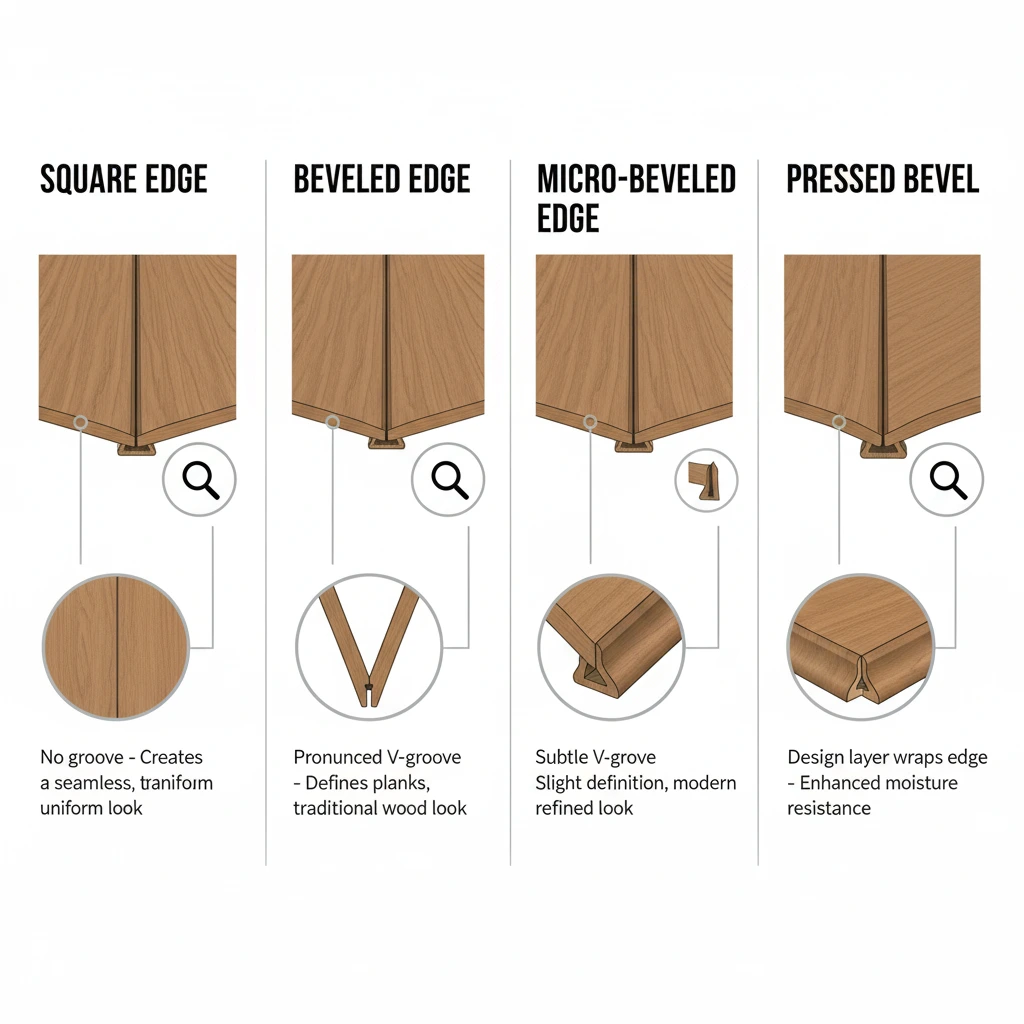
Laminate flooring has four edge types: square edge, beveled edge, micro-beveled edge, and pressed or painted bevel. Each one produces a different surface effect, has a different manufacturing cost, and matches a different use case.
Edge Type
Bevel Angle
Groove Depth
Visual Effect
Hides Imperfections
Best Use Case
Square Edge
0°
None
Flat, seamless surface
No
Modern interiors with level subfloors, small rooms
Square-edge planks meet flush with no groove between them. The surface is continuous and reads as a single sheet from a distance. This style requires a flat subfloor — within the 3/16-inch-over-10-feet tolerance — because any height variation between planks shows immediately as a ridge. Square edges work in modern, minimalist interiors and in smaller rooms where a continuous floor visually expands the space. They are the wrong choice in older homes with imperfect subfloors and in rooms intended to look hardwood-like.
Beveled Edge
Beveled-edge planks have a clear angled cut along two or four edges. The V-groove is large enough to read as a board boundary from standing height. This is the standard option when the design goal is hardwood imitation. Beveled edges work in nearly every room except small modern bathrooms and minimalist studio spaces, and they are the default choice for living rooms, dining rooms, hallways, bedrooms, and entryways.
Micro-Beveled Edge
Micro-beveled planks have a smaller, shallower angle than standard beveled planks. The groove exists but is subtle, typically less than 1mm deep. Micro-bevels keep some board definition without producing strong shadow lines. This makes them suitable for transitional interiors that mix modern and traditional elements, for medium-traffic rooms where some seam protection is wanted but a strong rustic look is not, and for narrow-plank installations where a deep bevel would feel busy.
Pressed or Painted Bevel
A pressed or painted bevel is not a physical cut. The bevel effect is printed or embossed onto the surface layer of the plank. It is cheaper to manufacture and gives a similar visual at a lower price point. The trade-off is durability: the printed bevel can wear off over time, especially at the joint where foot traffic concentrates. Pressed bevels suit budget projects and short-cycle rentals where the floor will be replaced before the bevel wears, but they are a poor choice for long-term primary residences.
When Should You Choose Beveled Edge Laminate Flooring?
Beveled edge laminate flooring is the correct choice in four situations. First, when the design goal is a hardwood look at a laminate price. The V-groove is the single feature that separates wood-look laminate from sheet-look laminate, and no amount of grain printing or texturing replaces it. Second, when the room takes high foot traffic. Beveled edges hold up better at the seams and hide the cosmetic effects of expansion, minor wear, and seasonal movement. Third, when the subfloor is acceptable but not perfectly level. Most subfloors in real homes fall into this category. Fourth, when the planks are wide — anything over 7 inches wide benefits visually from the boundary line a bevel provides.
Room-by-Room Recommendations
Living rooms, dining rooms, family rooms, and bedrooms are all good candidates for beveled edge laminate. The traffic is moderate to high, the rooms are large enough that the visual benefit of the bevel matters, and the subfloors in most homes need the forgiveness the bevel provides.
Hallways and entryways are the strongest case for beveled edges. Traffic is concentrated, edge wear accumulates fastest, and the visual benefit of breaking up a long narrow floor into individual planks is highest. Pair beveled edges with AC4 or AC5 ratings in these zones.
Kitchens are a mixed case. The traffic and durability arguments favor beveled edges. The wet-mopping and standing-water risk pushes toward square edges or away from laminate entirely. If laminate is the chosen material, beveled edges with strict damp-only cleaning and immediate spill response are workable.
Bathrooms and laundry rooms are the wrong room for any laminate edge type, beveled or not. The rooms where laminate should not be used are determined by moisture exposure rather than edge profile, and no edge type changes that decision.
Small modern bathrooms aside, the only common case where square edges beat beveled edges is in small rooms — under 100 square feet — with strong modern design intent and a perfectly level subfloor. In every other residential scenario, beveled or micro-beveled edges produce a better result.
How Does Edge Type Interact With Other Laminate Specifications?
Edge type sits on top of the structural specifications of the plank. It does not replace them. The most important structural decisions are plank thickness, wear layer thickness, AC rating, and core density.
Plank thickness affects how the bevel feels under foot. Thinner planks (6 to 8mm) with deep bevels can feel slightly hollow at the groove if the underlayment is thin. Thicker planks (10 to 12mm) absorb the bevel without any underfoot effect. The recommended plank thickness for residential use is 10 to 12mm, which pairs well with any edge type.
Wear layer thickness matters at the bevel because the bevel is cut into the wear layer. Thicker wear layers leave more material at the angled edge, which improves long-term resistance to chipping and color fade at the groove. Pair beveled edges with the highest wear layer specification available in the product line.
AC rating and edge type are independent but should be matched to the same use case. Beveled edges in a high-traffic room with an AC3 plank will still see surface wear because the AC rating governs surface durability, not edge geometry. Match AC4 or AC5 with beveled edges in high-traffic zones for the longest service life.
James Miller is a seasoned flooring contractor with years of hands-on experience transforming homes and businesses with high-quality flooring solutions. As the owner of Flooring Contractors San Diego, James specializes in everything from hardwood and laminate to carpet and vinyl installations. Known for his craftsmanship and attention to detail, he takes pride in helping clients choose the right flooring that balances beauty, durability, and budget. When he’s not on the job, James enjoys sharing his expertise through articles and guides that make flooring projects easier for homeowners.
Most people assume the difference between commercial and residential carpet comes down to aesthetics — darker patterns for offices, softer textures for homes. That is part of the picture, but it misses the deeper engineering logic that drives every decision: fiber selection, pile architecture, backing systems, installation method, and maintenance cycles. When you understand how…
The cost to install hardwood flooring in 2026 runs anywhere from $6 to $25+ per square foot installed, combining both materials and labor. For a typical 1,000 square foot project, most homeowners land between $10,000 and $16,000 when you fold in normal subfloor prep, standard transitions, and a domestic species like oak or maple. Budget…
Loose lay vinyl flooring is a type of luxury vinyl plank (LVP) that relies entirely on friction and weight — not adhesive, nails, staples, or interlocking click-lock tabs — to stay in position on the subfloor. Each plank sits directly on the subfloor surface, held in place by a specialized rubber or fiberglass backing combined…
Most people buy laminate flooring, glance at the warranty length on the box, and assume they’re protected. “Lifetime warranty” sounds comprehensive. “25-year residential” sounds serious. But the length of a laminate flooring warranty is one of the least informative things about it. What matters is the architecture of the document — what it covers, under…
Vinyl plank flooring gets sold as a simple weekend project. Pull the planks out of the box, click them together, done. That framing collapses the moment you encounter a subfloor with 3/16 inches of high spot variance, a concrete slab that tested positive for moisture, or a room where the walls are so far out…
Installing laminate flooring over a plank subfloor is possible when the plank subfloor is at least 3/4 inch thick, structurally sound, flat within 3/16 inch over a 10-foot radius, and dry. The laminate flooring must be installed using the floating method, the planks must run perpendicular to the direction of the subfloor planks, and a…