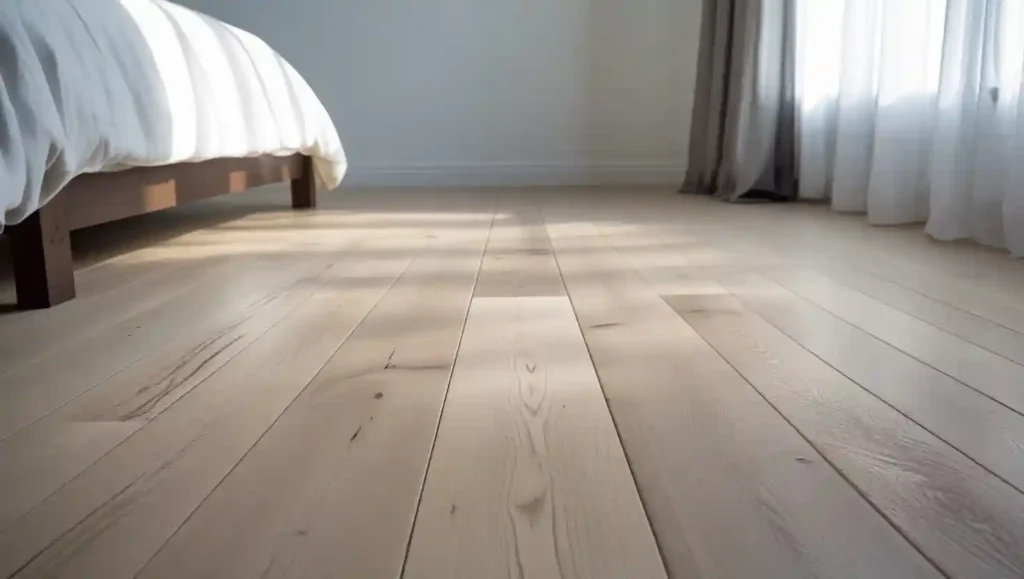
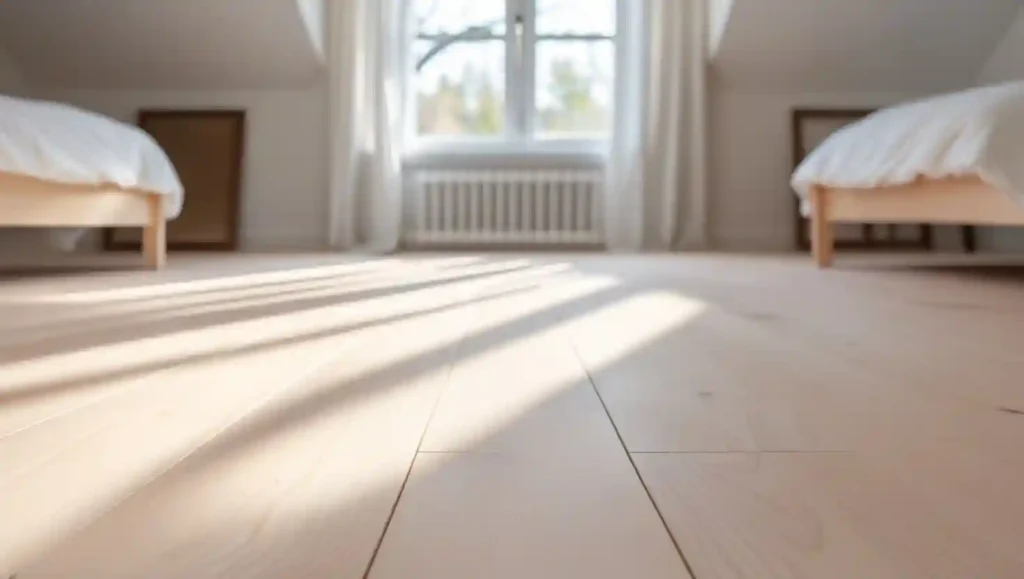
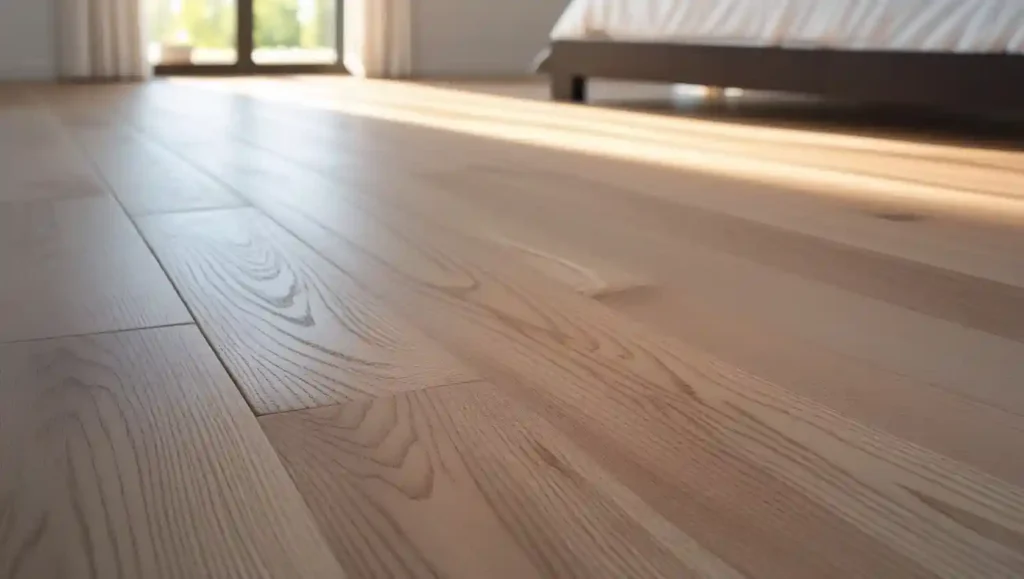
For the bedroom, pair this floor with linen bedding in oat, sand, or warm white. Wall colors in the warm neutral range — greige, soft clay, aged plaster — lean into the organic quality of the wood rather than working against it. This is not a statement floor. It is a foundation that makes everything placed on top of it look considered.
2. Dark Espresso-Stained Oak for a High-Contrast Bedroom
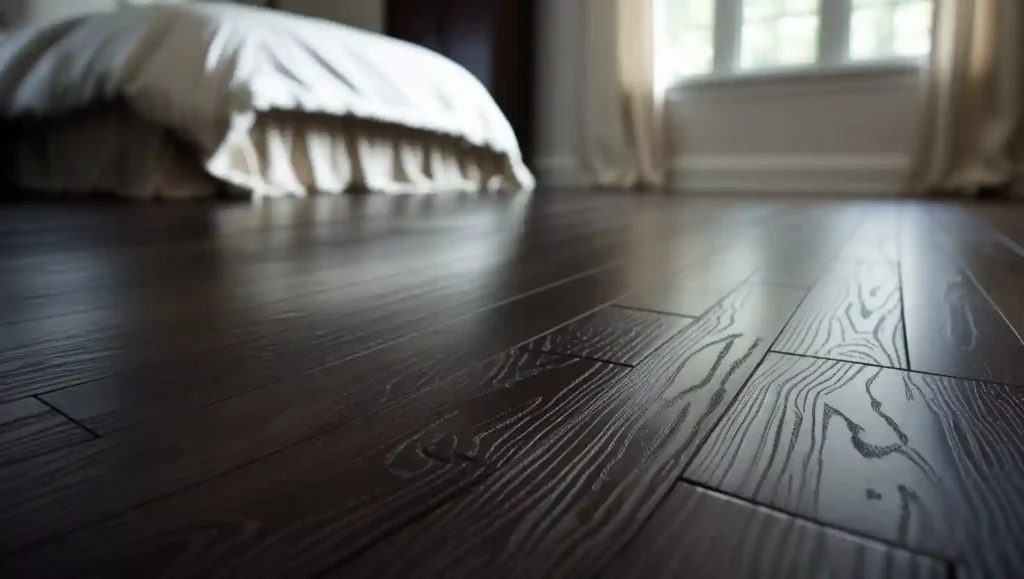
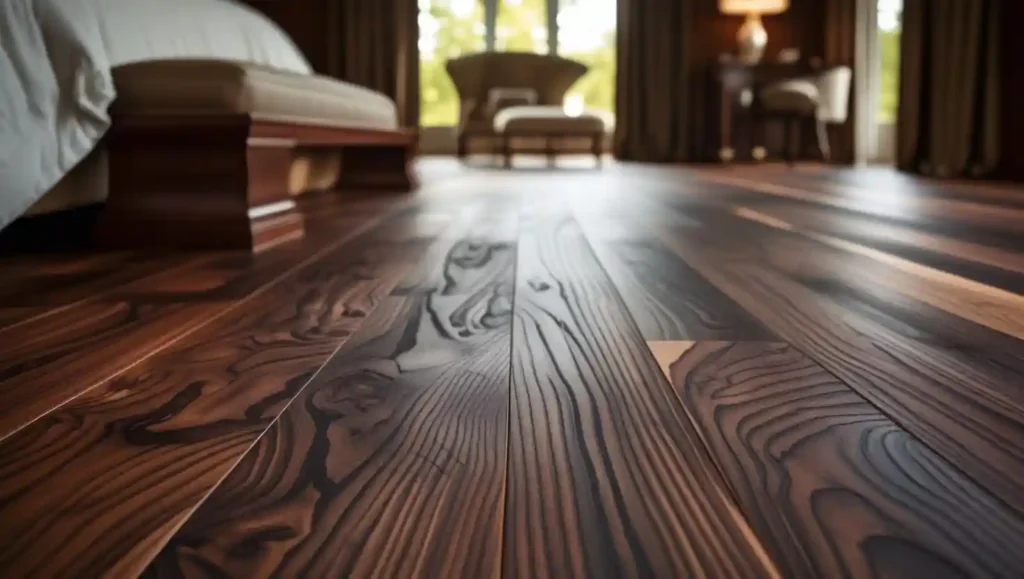
Dark hardwood floors are having a sustained moment that shows no sign of slowing. Deep espresso, near-black ebony stains, and rich walnut tones are among the most searched bedroom flooring combinations right now — and in person, the effect is immediately understood. A dark floor grounds the room, adds drama, and makes light furniture, pale walls, and white bedding feel more intentional by comparison.
The key design principle with a dark bedroom floor is contrast management. The floor anchors the room, so everything above it needs to breathe. Pale or white walls — warm white, not bright white — prevent the floor from making the room feel smaller. Light-colored bedding in cream or ivory keeps the eye moving. Bedside lamps matter more here than in any other floor scenario because dark floors absorb light rather than reflecting it; you need layered lighting sources to keep the room from reading as heavy.
One important technical note: espresso-stained floors show dust, pet hair, and fine scratches more readily than medium-toned floors. This is not a reason to avoid them — it is a reason to understand maintenance expectations before choosing them. A matte finish on a dark-stained floor reduces the visibility of fine scratches significantly compared to a semi-gloss surface.
For the species, oak takes dark stains well. Maple resists deep stain penetration and can look blotchy when stained very dark, making it a less reliable choice for this particular look. If you want to understand how different species behave under stain, the breakdown in our hardwood flooring services overview walks through species characteristics in practical terms.
3. Herringbone Pattern in White Oak
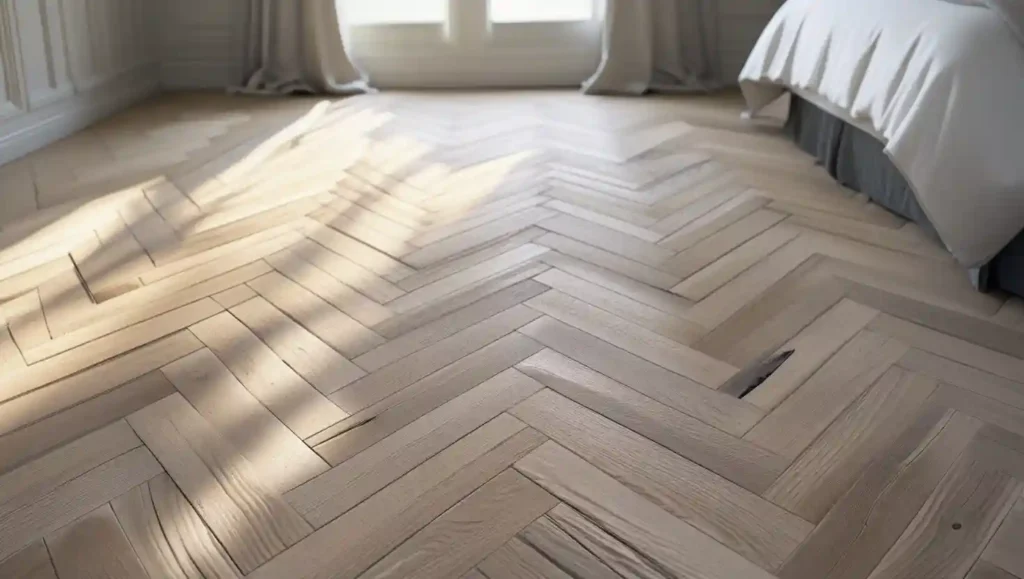
Herringbone is the pattern that separates floors designed to be walked on from floors designed to be noticed. Each rectangular plank is laid at 90 degrees to its neighbor, creating a continuous zigzag that builds geometry across the surface. The result is architectural in a way that straight-lay plank flooring simply cannot replicate.
In a bedroom, herringbone works best when the rest of the room allows it room to be the central visual element. A bed with a clean-lined upholstered headboard, nightstands that sit close to the floor, minimal wall décor — these choices let the floor assert itself. Herringbone demands more of the eye, so the surrounding space should ask less.
White oak is the species most commonly chosen for bedroom herringbone because its straight grain and medium hardness translate the pattern’s geometry with precision. The width of the individual plank matters significantly: narrower boards (around 2.5 to 3 inches) create a fine, dense pattern that reads traditional and European. Wider boards (4 to 5 inches) produce a bolder, more contemporary version of the same pattern. For a primary bedroom, wider planks in herringbone often read as more current without losing the pattern’s inherent sophistication.
Installation is more complex and labor-intensive than straight-lay, which is reflected in the cost. Expect to pay more for installation when herringbone is specified — but in a bedroom, where the footage is typically lower than a living room or open-plan space, the premium is often more manageable than homeowners expect.
4. Reclaimed Wood Planks for a Bedroom With Character
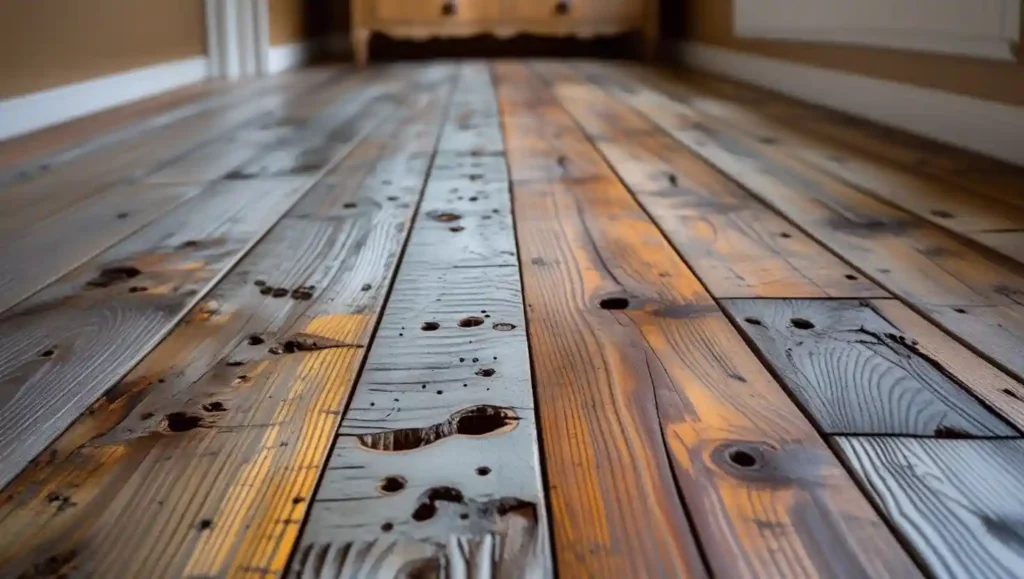
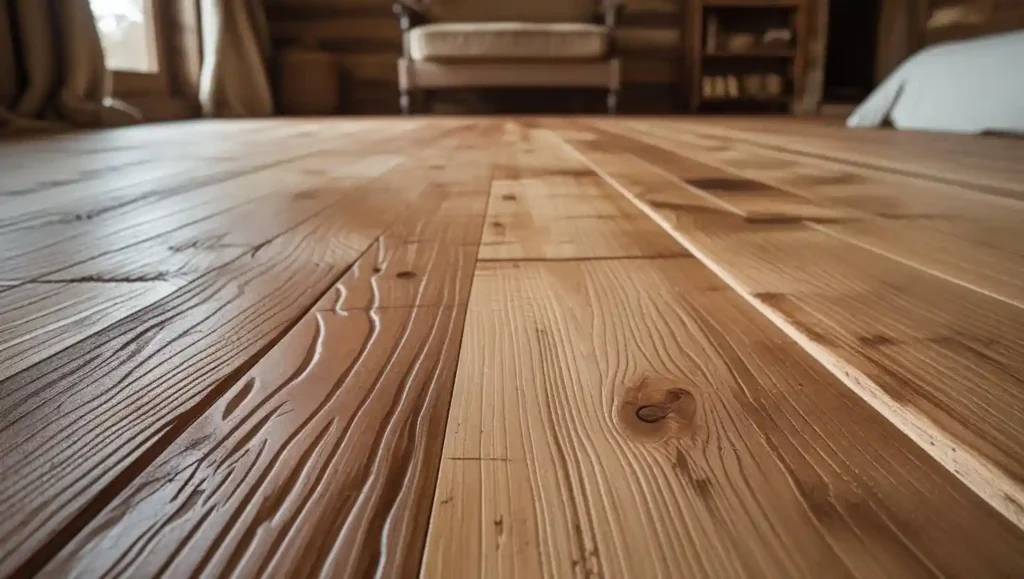
Reclaimed hardwood flooring brings something into a bedroom that cannot be manufactured: actual history. These are boards that may have come from industrial warehouse floors, old barns, decommissioned factories, or demolished historic structures. They carry saw marks, nail holes, color variation, and dimensional imperfection that is the result of decades of use — and all of that history becomes the texture of the room.
In a bedroom, reclaimed wood floor creates an immediate sense of warmth that new flooring cannot replicate. The aged patina absorbs light softly. The variation in color across planks — from silver-gray to deep amber to near-black in knot areas — means the floor has visual depth at different times of day. Morning light reads differently across those boards than evening lamp light does.
The practical considerations are real. Reclaimed wood must be properly kiln-dried before installation to kill any pests that may be present in older boards. Dimensional variation between planks means subfloor preparation is critical — uneven planks over a rough subfloor will create squeaks and movement. Working with a flooring contractor who has specific experience with reclaimed material is strongly recommended, not just because of installation complexity but because sourcing quality reclaimed wood requires knowledge of what to look for and what to reject.
This floor pairs exceptionally well with iron or blackened-steel bed frames, vintage textiles, and natural materials like linen, jute, and raw wool. It does not need much help looking interesting. The quieter the furniture, the better the floor reads.
5. Light Maple With a Clear Satin Finish for a Scandinavian Bedroom
Maple is one of the hardest domestic hardwood species available for residential flooring — second only to hickory on the Janka hardness scale among common choices — and its very fine, consistent grain gives it a particular visual quality when finished with a clear or near-clear coat. The result is a floor that reads clean and pale, almost luminous in rooms with good natural light.
This look is strongly associated with Scandinavian and Japanese-influenced design: minimal furniture, low profiles, an emphasis on natural light, textile softness against hard surfaces. The maple floor is not the focal point in this concept — it is the ground condition that makes the entire room feel light, spacious, and calm. Against very light walls, pale maple can almost disappear, which is exactly the intention in Japandi-style bedrooms.
One important property of maple worth knowing: it is significantly harder to stain than oak due to its tight, closed grain. If you want maple and you want a tone other than natural or very light honey, work with an experienced finisher who has applied stain to maple specifically. Blotching is a real risk with untested techniques. For a natural, clear-finished maple, there is no such concern.
A satin finish rather than a high-gloss poly is the right choice for this look. High gloss on maple reads commercial or dated. A satin sheen preserves the lightness while keeping the surface protected. If you’re comparing species side by side, the article on whether maple makes a good hardwood floor goes into the durability and grain characteristics in more detail.
6. Walnut Floors for a Warm, Luxurious Bedroom
American black walnut is the premium choice for homeowners who want warmth, richness, and a color that cannot quite be replicated by staining a lesser species. Unlike an oak that has been dark-stained to look like walnut, actual walnut has a chocolate-to-espresso color that runs through the wood itself, with grain variation that produces subtle figuring — swirls, ribbons, and shifts in tone across individual boards.
In a bedroom, walnut floor creates an atmosphere of quiet luxury. It pairs naturally with soft gold lighting, warm-toned textiles, and furniture in lighter natural woods or upholstered pieces that contrast against the richness of the floor. Walnut and cream is one of the most reliably successful bedroom combinations in contemporary interior design — the floor contributes warmth and depth; the pale elements above it contribute lightness and softness.
Walnut is softer than oak on the Janka scale, which means it is more susceptible to dents from furniture legs. In a bedroom, where foot traffic is low and furniture rarely moves, this is rarely a practical concern. Where it matters: if you plan to move large pieces of furniture across the floor during cleaning or redecorating, felt pads are not optional — they are essential. The article on how to clean walnut floors covers both day-to-day maintenance and the longer-term care that keeps walnut looking its best.
Because walnut is among the more expensive domestic hardwood species, it is sometimes used selectively — as a feature floor in a primary bedroom suite, for instance, while other rooms use more economical species. This is a practical approach that allows the material to land where it will have the most visual impact.
7. Gray-Stained Ash for a Contemporary Neutral Bedroom
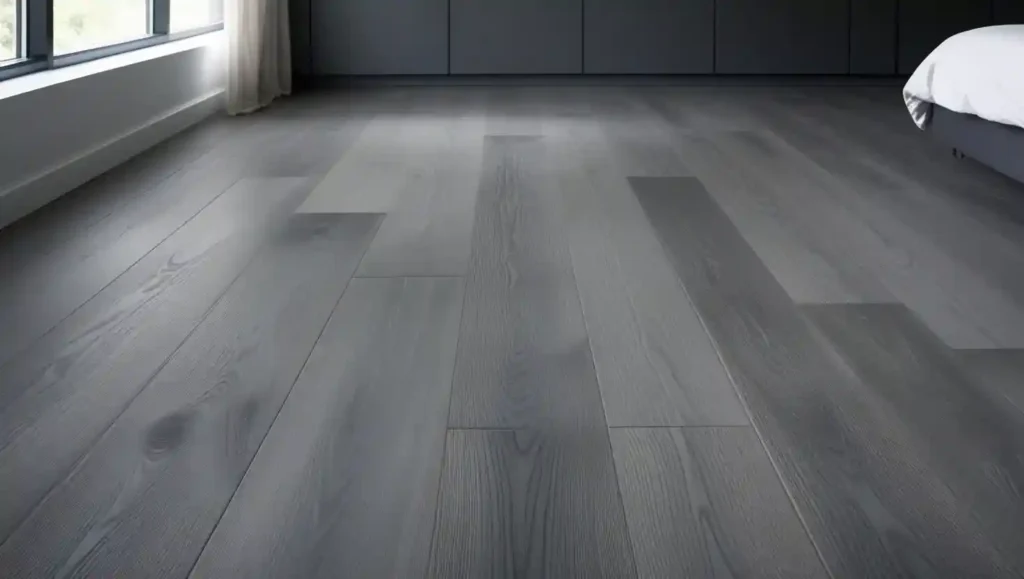
Gray-stained hardwood floors reached a peak of popularity during the previous design decade and then experienced a period of backlash — dismissed as trendy and soon-to-be-dated. But gray flooring done well is a different proposition from the silver-toned, almost lavender-tinged floors that defined the early 2010s. A matte gray ash floor with a warm undertone is neither cold nor dated. It is simply a sophisticated neutral that reads contemporary without announcing itself.
Ash is a particularly good species for gray staining because its open grain absorbs stain in a way that creates dimension — the early wood and late wood within each growth ring take the stain at slightly different rates, producing a two-toned effect within the gray palette that gives the floor visual depth rather than the flat, painted look that gray stain can sometimes produce on tighter-grained species.
For a bedroom, gray ash flooring supports virtually any wall color without creating visual competition. It pairs well with warm whites, soft greens, dusty blues, and charcoal. The neutrality is genuine — gray is one of the few floor colors that does not push the palette of the room in a predetermined direction. If you want full design flexibility in the bedroom, this is the most accommodating floor color available.
The caveat: gray floors, like dark floors, show fine dust and light-colored pet hair more readily than medium-toned warm floors. A matte finish helps substantially — it scatters light in a way that makes surface-level debris less visible than a glossy surface would.
8. Chevron Pattern for a Bedroom That Commands Attention
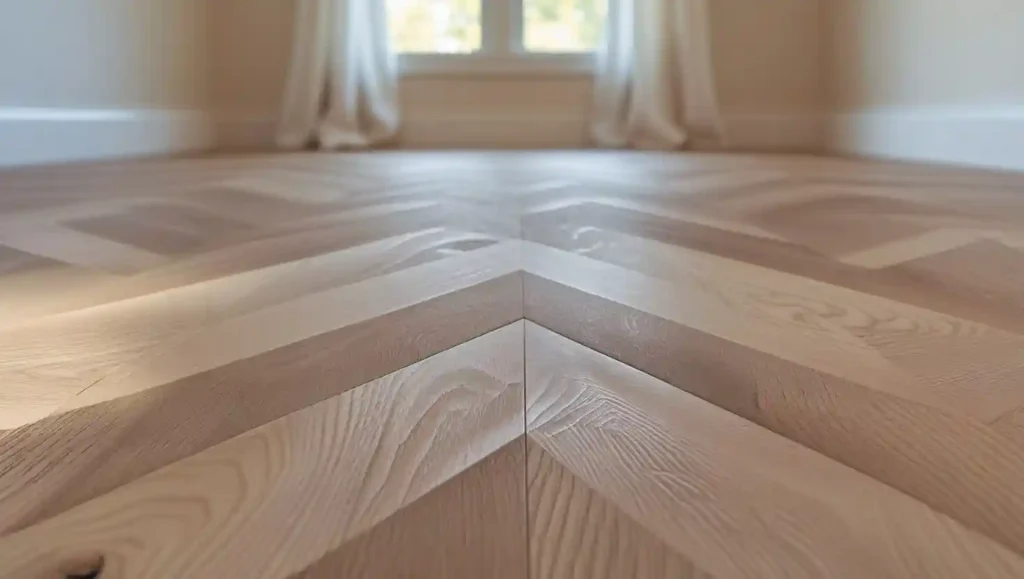
Chevron and herringbone are often confused but they are not the same pattern. In herringbone, rectangular planks are laid at 90 degrees to each other, creating a zigzag where the ends of the boards butt up against the sides of adjacent boards. In chevron, each board is cut at an angle — typically 45 degrees — so that the ends of boards in adjacent rows meet at a point, creating a continuous V-shape that marches across the floor in one direction.
The result is more directional than herringbone and more overtly architectural. Chevron creates a strong visual axis that, in a bedroom, can be used deliberately: laid along the length of the room, it draws the eye toward a focal wall. Laid across the room, it emphasizes width. This is a floor where the installation direction is a design decision, not an afterthought.
Because every board must be cut at a precise angle, there is significant waste in a chevron installation — typically 15 to 20 percent more material than a straight-lay installation covering the same square footage. This needs to be accounted for in material budgeting. The installation is also more labor-intensive than both straight-lay and herringbone, making professional installation essentially non-negotiable for most homeowners.
Oak is the most common species choice for chevron, with white oak producing cleaner pattern geometry than red oak due to its tighter grain. For a bedroom, a matte or satin finish keeps the pattern reading as modern rather than formal. A high-gloss chevron floor is a very specific aesthetic choice — dramatic and deliberate — that requires everything else in the room to respond to it.
9. Hand-Scraped Hardwood for a Rustic Bedroom
Hand-scraped hardwood floors have a surface that has been textured — either by hand tools or by machine processes that replicate the look of hand-tooling — to produce subtle ridges, dips, and variation across each plank. The effect is the opposite of a smooth, flat floor: it is a surface that looks like it was made by people rather than machines, with the slight imperfection that implies.
In a bedroom, hand-scraped flooring functions as a material anchor for rustic, farmhouse, or transitional design schemes. It pairs naturally with exposed beam details, linen drapery, cotton bedding, and furniture in distressed or limed finishes. The textured surface softens the reading of the room in a way that smooth flooring cannot — there is an inherent warmth to irregular surfaces that smooth surfaces do not replicate.
From a practical standpoint, the textured surface actually has an advantage: it hides fine scratches and surface wear more effectively than smooth flooring because the existing texture provides visual camouflage. The disadvantage is that textured surfaces are more difficult to clean thoroughly — debris can settle into the surface variations and require more deliberate sweeping or vacuuming to remove.
Species choices for hand-scraped flooring tend toward those with pronounced grain — hickory, oak, and pine all translate well. Hickory in particular has natural color variation from light tan to deep brown that complements the rustic hand-scraped aesthetic without any staining required. The contrast between hickory’s light and dark tones gives each plank its own visual identity, which suits the hand-crafted character of the surface treatment. For a deeper look at species options with character, the comparison of hickory versus oak flooring covers the key differences in appearance and performance.
10. Bleached or Whitewashed Oak for a Coastal Bedroom
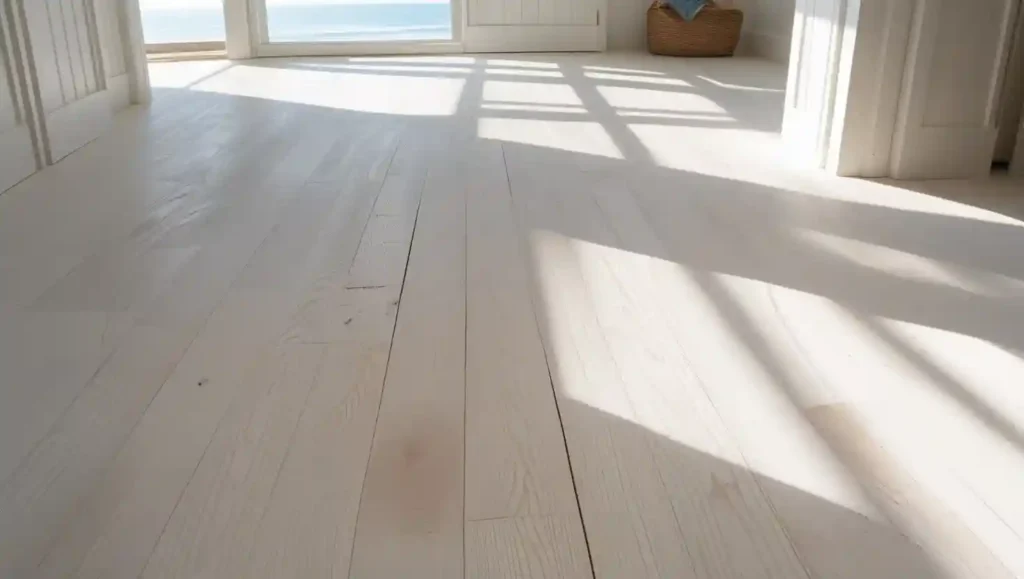
Bleached and whitewashed oak floors share an aesthetic — both are pale, light-reflective, and evocative of sun-bleached driftwood or the bare wood of a coastal building — but they achieve their effect through different processes. Bleached oak has had the natural tannins chemically lightened to produce a very pale, almost white tone. Whitewashed floors use a white-pigmented oil or diluted paint wash that partially fills the grain, creating a milky, semi-opaque effect while still allowing the wood’s underlying grain to show through.
Both effects work extremely well in bedrooms oriented toward natural light. In a south or west-facing room that receives significant direct sunlight, a pale floor bounces that light further into the space and prevents the room from ever feeling dim. The coastal, Hamptons-influenced bedroom aesthetic that has remained consistently popular relies heavily on this kind of floor: pale, reflective, and textured without being busy.
One technical note about bleached floors specifically: the bleaching process can slightly soften the surface wood fibers, making the finished floor marginally more susceptible to surface abrasion than unbleached stock. A good topcoat sealer applied over the bleached surface addresses this. Whitewashed floors finished with a hardwax oil are among the most durable options in this color range and allow for easy spot repair if the surface is damaged.
Furniture pairings that work particularly well: natural linen, sea-grass or jute textiles, rattan and bamboo accent pieces, painted furniture in soft white or driftwood gray. The entire palette should stay within a tonal range of pale to mid-tone — this floor does not pair well with dark, heavy furniture because the floor’s delicacy reads as fragile against strong contrast.
11. Mixed-Width Plank Installation for an Organic, Custom Look
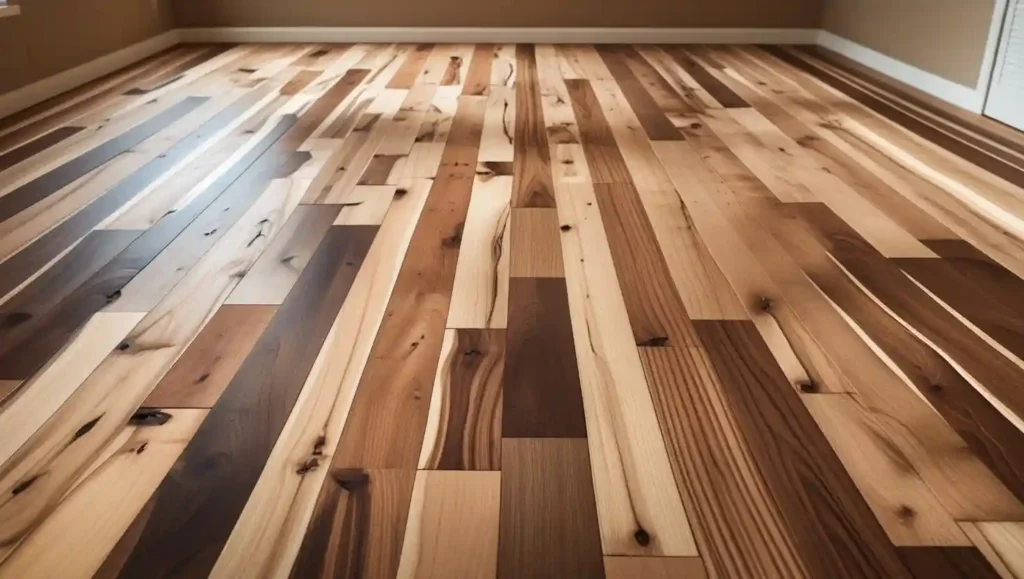
Mixed-width plank flooring uses boards of varying widths within a single installation — typically two or three different widths combined in a repeating or randomized pattern across the floor. The effect is the opposite of uniform plank flooring: each row has a different width, creating a floor that looks more like natural wood construction from a pre-industrial era than a contemporary manufactured product.
In interior design terms, mixed-width flooring adds movement and organic complexity to a floor without the labor cost of a patterned installation like herringbone or chevron. It disrupts the visual predictability of uniform planks while remaining a relatively straightforward installation technique. The floor draws the eye across it rather than directing the eye in a single direction, which suits larger bedrooms where you want the floor to read as a rich surface rather than a directional element.
Common width combinations are 3-inch, 5-inch, and 7-inch boards used in a repeating sequence, or random-width specifications where the mill ships boards in varying widths and the installer sequences them as they are laid. Random-width installations look more genuinely antique; sequential mixed-width installations look more deliberate and contemporary. Either can work in a bedroom depending on the overall design direction.
White oak, red oak, and pine are all well-suited to mixed-width installation. For antique or farmhouse-influenced bedrooms, mixed-width pine with a clear or lightly stained finish in widths from 6 to 12 inches is one of the more historically authentic flooring approaches available. The variation in plank width also means minor color and grain variation between boards reads as intentional rather than inconsistent.
12. Red Oak With a Traditional Strip Installation for a Classic Bedroom
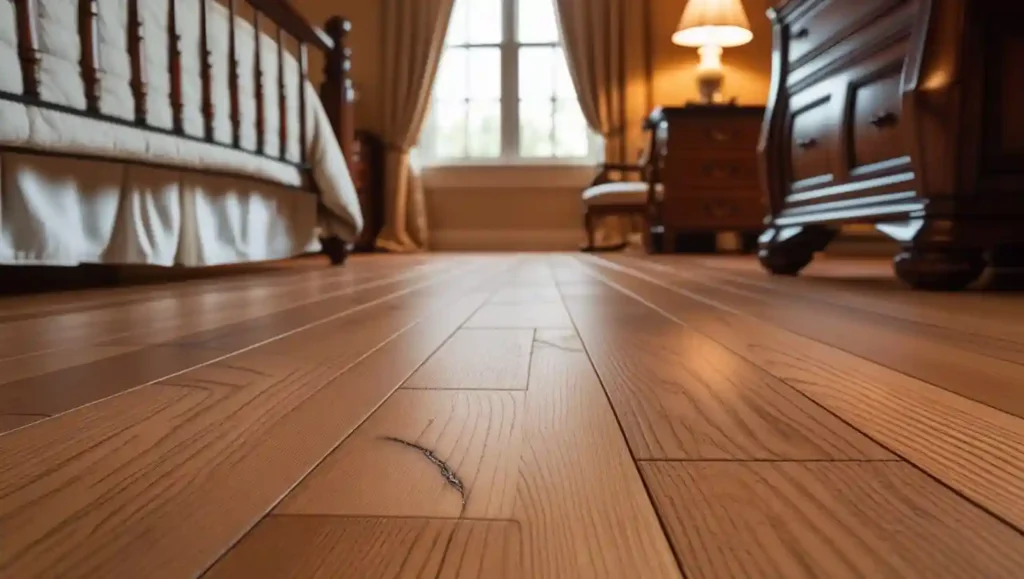
Red oak strip flooring — 2.25-inch-wide planks in a straight-lay installation — is the classic American hardwood floor. It is what most people picture when they think of hardwood flooring in a traditional home. And while design conversations tend to focus on newer directions, there is a genuine argument for choosing this format in a bedroom where the design intent is traditional, timeless, and unambiguously American.
Red oak has a warm, pink-adjacent undertone in its natural state, with a more open, pronounced grain than white oak. Stained to a medium walnut, honey, or golden oak tone, it produces the warm, lived-in floor that has defined the comfortable traditional bedroom for generations. Stained dark or left very light, red oak reads differently — and it is worth understanding how red oak’s warm base tone interacts with different stain colors before specifying a stain. Stains with cool or gray undertones often look unexpected on red oak because the wood’s natural warmth pushes through.
The 2.25-inch strip format creates a finer-grained surface texture than wide-plank flooring, which suits smaller bedrooms where wide planks might look oversized. It also suits detailed traditional woodwork — crown molding, paneled doors, carved furniture — because the fine-scaled floor reads as architecturally consistent with the surrounding detail level.
For finish, traditional red oak floors look best in a satin or semi-gloss oil-modified urethane. The slight sheen of a semi-gloss picks up the red-gold tones in the wood and gives the floor its characteristic warmth. Understanding how red and white oak differ in appearance and character is worth spending time on before specifying — the comparison of red oak versus white oak is a useful reference.
13. Engineered Hardwood for Bedrooms Over Concrete or With Radiant Heat
Engineered hardwood belongs in this list not as a compromise or budget alternative but as the correct structural choice in specific installation conditions — and those conditions come up regularly in bedrooms. If your bedroom is on a slab-on-grade foundation, over a basement, or is served by radiant floor heating, engineered hardwood is not just acceptable — it is often the superior choice over solid wood.
Solid wood expands and contracts significantly with changes in temperature and humidity. Over radiant heating systems, this movement can cause cupping, gapping, and surface distortion. Engineered hardwood, with its cross-ply construction, is dimensionally more stable under temperature cycling and can be specified for use over radiant heat systems in ways that solid wood typically cannot. For bedrooms over concrete slabs — common in California construction, including San Diego — engineered hardwood can be glued or floated directly over the concrete, while solid wood over concrete requires a more complex installation approach or may be contraindicated entirely. The article on solid wood flooring over concrete details the challenges involved and helps clarify when engineered is genuinely the right call.
The visual result of a well-chosen engineered hardwood floor is indistinguishable from solid wood to all but the closest inspection. Modern engineered hardwood products are available with wear layers thick enough to be sanded and refinished multiple times, making longevity comparable to solid in most residential applications. The same species, grain patterns, and finishes available in solid hardwood are available in engineered format — wide-plank white oak, walnut, hickory, and more are all produced in high-quality engineered construction.
For a bedroom over concrete or with underfloor heating, this is the idea that actually solves your installation problem while delivering the hardwood floor you wanted in the first place.
Choosing the Right Hardwood for Your Bedroom: What Actually Matters
After reviewing these 13 ideas, the choosing process usually comes down to four practical variables that need to align before you commit to a floor.
The first is installation condition. Is the room over a slab, over a crawlspace or basement, or over an existing wood subfloor? Does it have radiant heating? These structural factors may determine whether solid or engineered wood is appropriate, and getting this wrong is expensive. Subfloor preparation is the unglamorous part of a flooring project that determines whether the finished floor performs well — the guidance on how to prepare a subfloor for wood flooring is a useful primer on what this involves.
The second is room size and ceiling height. Small bedrooms read differently with different plank widths. A 3-inch strip floor makes a small room look consistent and appropriately detailed. A wide-plank floor in a very small room can look oversized. Large bedrooms with high ceilings are the natural habitat of wide-plank floors, herringbone, and chevron — the scale of the room allows the floor to breathe. Matching floor scale to room scale is a judgment call, but it is an important one.
The third is light. How a floor reads is substantially determined by the light available to it. A dark walnut floor in a north-facing room with limited natural light will require deliberate artificial lighting strategy. The same floor in a south-facing room with large windows will look rich and warm rather than heavy. Before committing to a floor tone, observe how the room receives and holds natural light at different times of day.
The fourth is maintenance reality. Every floor on this list is beautiful. Some require more maintenance discipline than others. Reclaimed wood, dark stained floors, and high-gloss finishes show surface condition more readily than medium-toned matte floors. If you have pets, children, or simply prefer low-maintenance surfaces, the species and finish choice should account for your actual household rather than an idealized version of it.
With those four variables clear, the right floor from this list tends to identify itself. For help navigating any of these decisions with a specific bedroom in mind, the team at Flooring Contractors San Diego has worked with all of these materials and installation conditions — and that kind of on-the-ground knowledge is often more useful than any amount of online research when the decision gets specific.
James Miller is a seasoned flooring contractor with years of hands-on experience transforming homes and businesses with high-quality flooring solutions. As the owner of Flooring Contractors San Diego, James specializes in everything from hardwood and laminate to carpet and vinyl installations. Known for his craftsmanship and attention to detail, he takes pride in helping clients choose the right flooring that balances beauty, durability, and budget. When he’s not on the job, James enjoys sharing his expertise through articles and guides that make flooring projects easier for homeowners.
Every flooring decision in a pet household eventually runs into the same three problems: claw marks that deepen over time, urine that seeps into seams before you can wipe it, and surfaces that become genuinely dangerous when a wet dog decides to sprint across them. Most flooring categories fail at one of these three points….
Quick-Step is a Belgian flooring brand founded in 1994 under the Unilin Group, which is itself owned by Mohawk Industries — the largest flooring manufacturer in the world. That corporate lineage matters because it explains something important: Quick-Step does not manufacture laminate the way most brands do. It manufactures the machinery, the raw board, the…
Parquetry flooring is not a flooring type. It is an installation method — one where short wood blocks or strips are arranged into repeating geometric patterns to create a floor that carries visual weight no plank flooring can replicate. Herringbone, chevron, basketweave, Versailles: every one of these patterns makes alignment the job. Get the geometry…
Both are vinyl. Both are waterproof. Both sit at the affordable end of the flooring market. So why do so many homeowners end up unhappy with whichever one they chose? The answer is almost never about the product itself. It is about a mismatch between what the product does structurally and what the room demands…
Hardwood flooring over radiant heating is possible. But “possible” and “problem-free” are two very different things — and most of the damage homeowners see years after installation traces back to decisions made before a single plank was laid. The combination works when three conditions align: the right wood product is selected, the floor surface temperature…
When you walk into a carpet showroom, the salesperson will almost certainly ask two questions before anything else: what room is this for, and what is your budget? Both answers feed directly into one decision that shapes everything downstream — whether you choose nylon or polyester as your carpet fiber. These are the two synthetic…