There is also a practical construction difference. Most wide plank vinyl today uses a rigid core — either SPC (stone polymer composite) or WPC (wood polymer composite). SPC cores are denser and made from limestone powder and stabilizers, making them virtually indestructible underfoot and ideal for basements, high-traffic areas, and commercial environments. WPC cores incorporate a foamed wood-flour and polymer layer that makes the plank softer underfoot and slightly warmer. For a home office where you stand for hours, or a playroom, WPC’s give underfoot is a genuine comfort advantage. Understanding which core suits your room is just as important as choosing the right color.
The wear layer thickness also matters more on wide planks because each plank covers more surface area — so every scratch or scuff is more visible. For residential use, aim for a 12-mil wear layer at minimum; for households with pets, children, or high traffic, 20 mil is the reliable threshold.
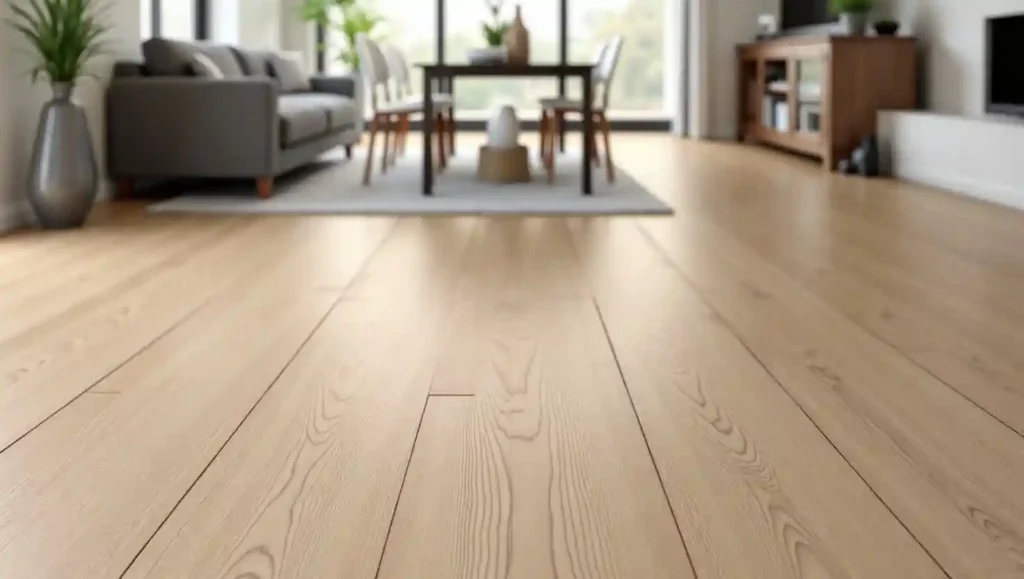
Idea 1: Warm Greige in an Open-Plan Living and Dining Space
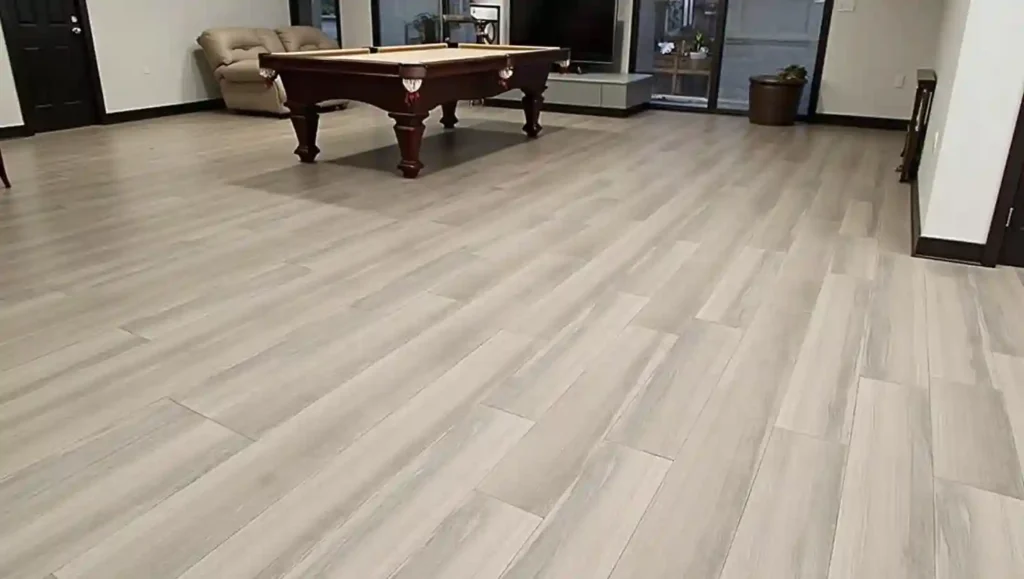
Greige — the name given to the gray-beige middle ground that dominates transitional interiors right now — works extraordinarily well in wide plank form. The blended tone sits neutral enough to work with both warm and cool furniture palettes, and in a wide plank the depth of the tone’s variation becomes genuinely interesting: some boards read slightly cooler, others pull warmer, and together they create a floor that looks custom rather than off-the-shelf.
In an open-plan living and dining space, install the planks lengthwise along the longest wall. The long lines draw the eye toward the horizon of the room and amplify the sense of depth. Pair a warm greige floor with linen-textured sofas, matte white cabinetry, and brushed brass hardware. The floor becomes the quiet unifier — it does not compete with any single element, it holds everything together.
From a practical standpoint, greige also conceals everyday dust and pet hair better than a pure gray or pure beige, which is one reason it has become the go-to choice for family rooms with heavy foot traffic. Wider planks mean fewer grout lines where debris collects, making the floor genuinely easier to maintain.
Idea 2: Whitewashed Wide Planks for Coastal Bedrooms
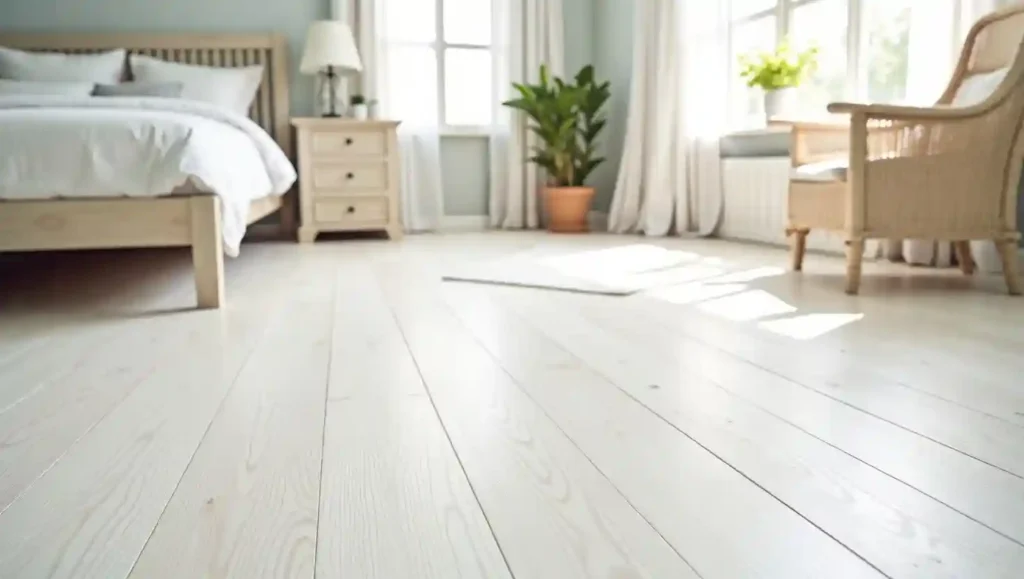
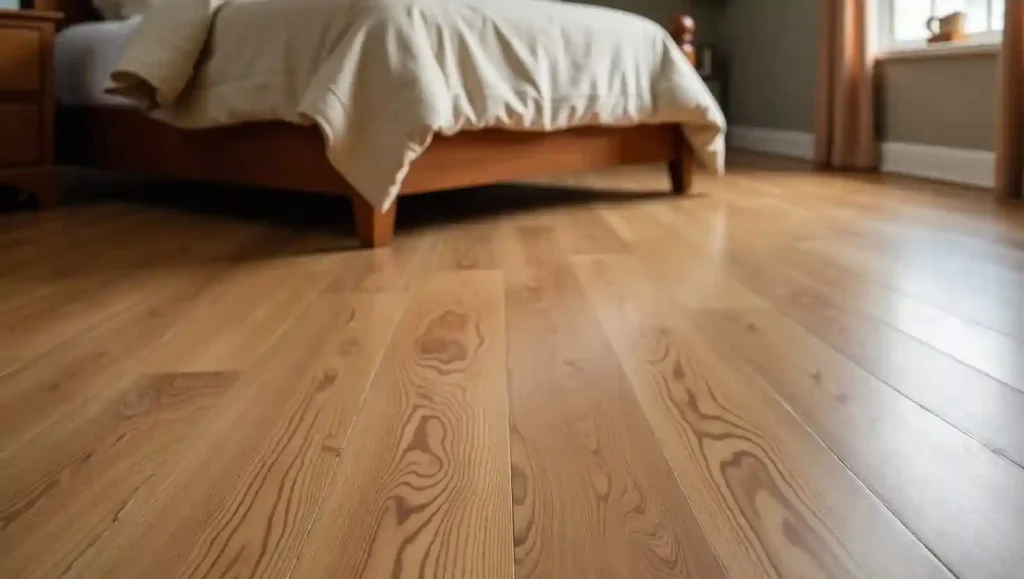
San Diego homeowners — especially those within a few miles of the coast — have embraced whitewashed finishes with good reason. A bleached, sun-worn tone in a wide plank format communicates ease and light in a way that darker floors simply cannot. The plank width is critical here: narrow whitewashed boards can feel almost clinical, while a 7-to-9-inch whitewashed plank has a driftwood quality that is unmistakably coastal without leaning into kitsch.
In a master bedroom, pair whitewashed wide plank vinyl with shiplap walls, natural rattan furniture, and linen bedding in sandy or pale blue tones. The floor anchors the room without demanding attention. Morning light bouncing off a whitewashed floor creates a quality of illumination that makes a bedroom feel bigger and more peaceful than any light fixture could achieve on its own.
If you are concerned about showing footprints, choose a matte or low-sheen finish rather than a high-gloss one. Matte finishes on whitewashed vinyl are also far more forgiving with texture variations and subfloor imperfections — a genuine practical benefit that aligns perfectly with the relaxed coastal aesthetic you are going for. For more on how vinyl performs in moisture-prone spaces near the coast, it is worth reading about vinyl flooring for bathrooms and kitchens to understand what separation the material creates between the flooring surface and ambient humidity.
Idea 3: Dark Espresso Wide Planks Against White Walls
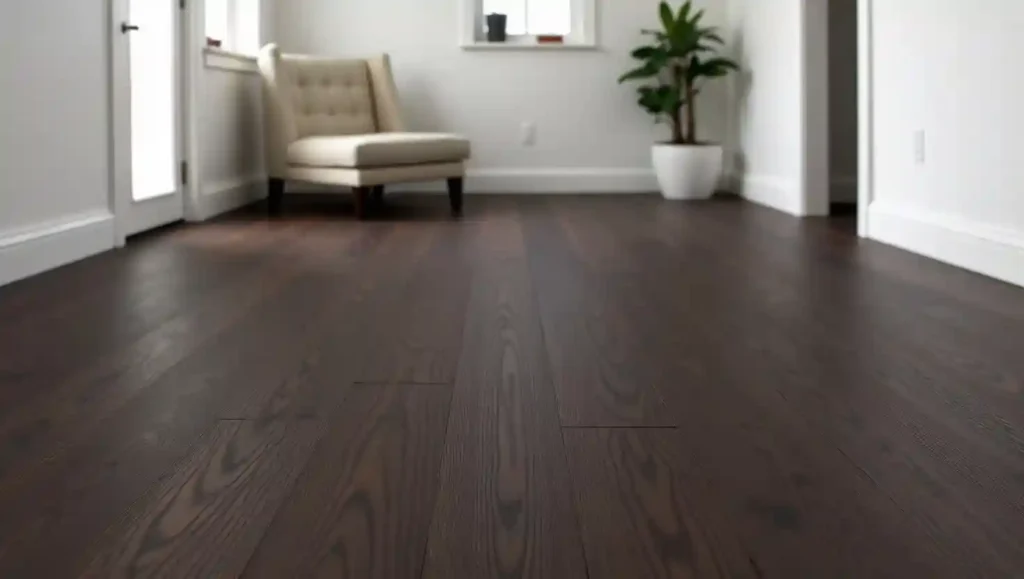
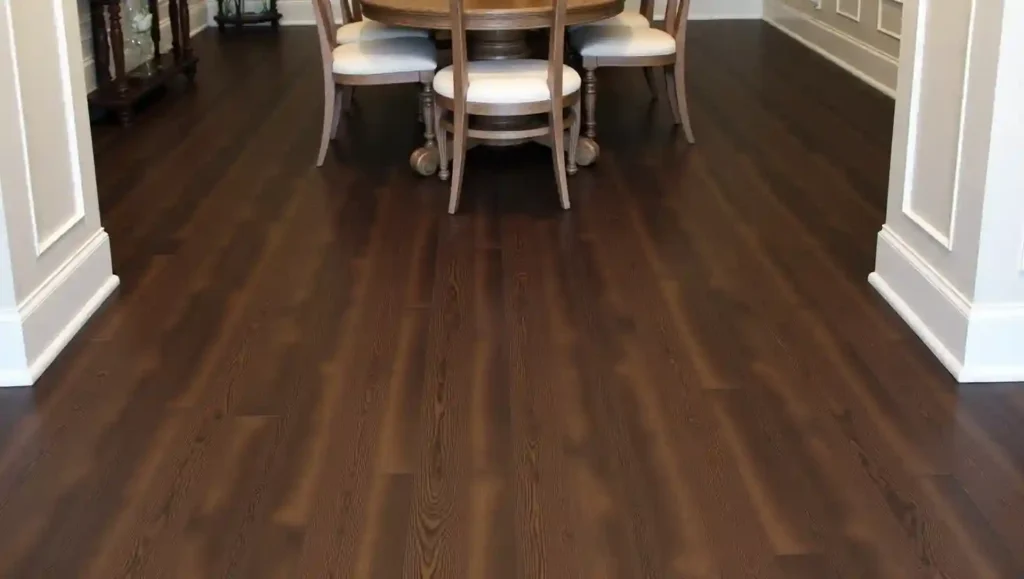
The contrast between a very dark floor and white walls is one of the most reliable moves in contemporary interior design. When executed with wide planks, the effect becomes genuinely dramatic. Dark espresso or charcoal wide plank vinyl — with grain lines running in fine parallel channels across each wide board — reads like a luxury hardwood from across the room. Up close, the texture of a quality embossed vinyl finish in a dark tone reveals remarkable depth.
This combination works especially well in open-plan spaces where you want the floor to ground the room without the weight that dark paint on the walls would create. White walls bounce light downward onto the floor, the espresso planks absorb it and return a warm glow, and the high-contrast reading makes the architecture of the space feel more intentional and resolved.
Be aware that very dark floors show fine dust, hair, and minor surface scratches more readily than mid-toned options. If your home has pets or children, the trade-off is real: the visual payoff is high but maintenance frequency increases. Choosing a registered embossed surface — where the texture pressed into the wear layer matches the printed grain lines beneath — adds enough visual texture to break up the flatness that makes scratches obvious on polished dark surfaces.
Idea 4: Honey Oak Wide Planks in the Kitchen
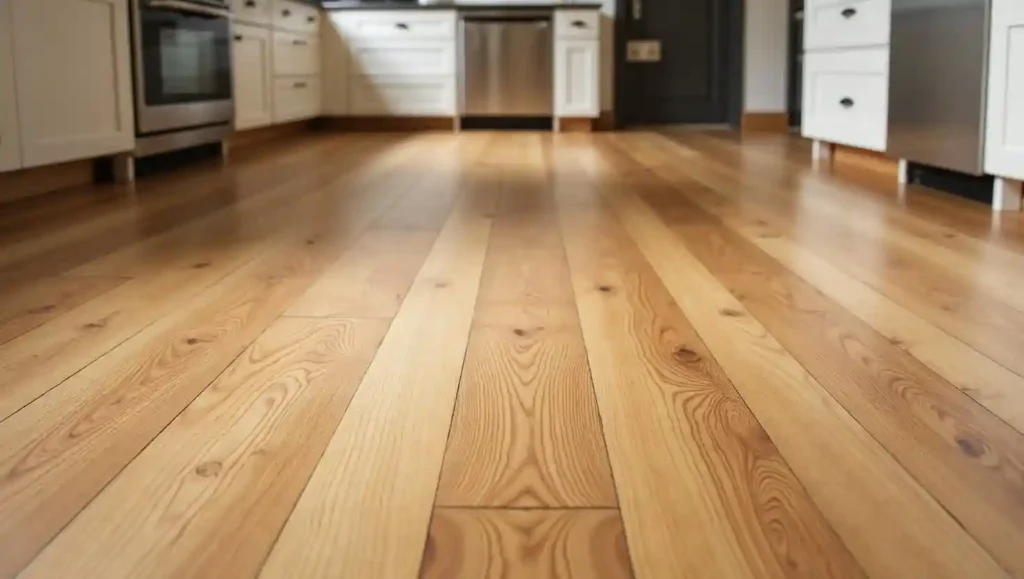
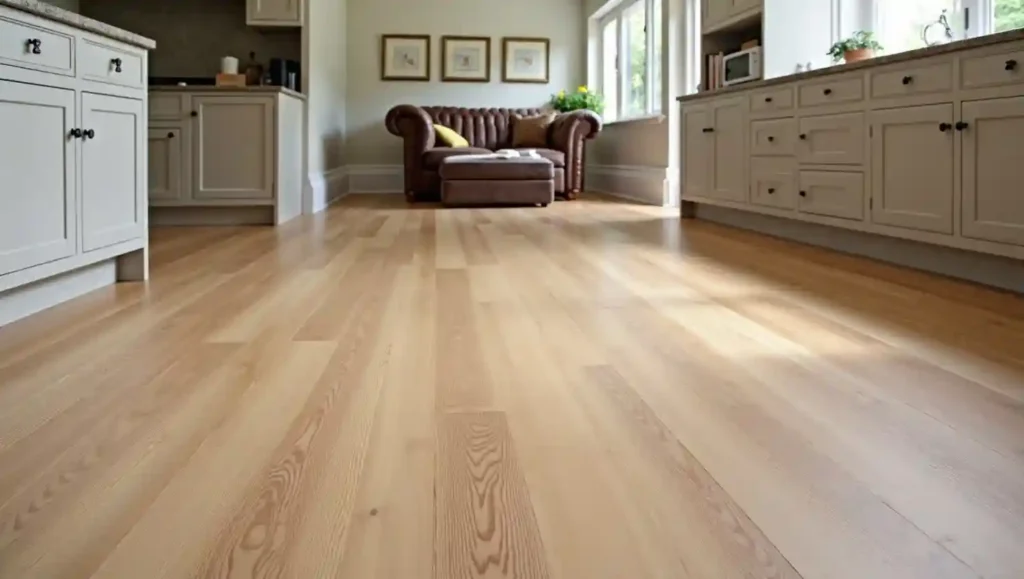
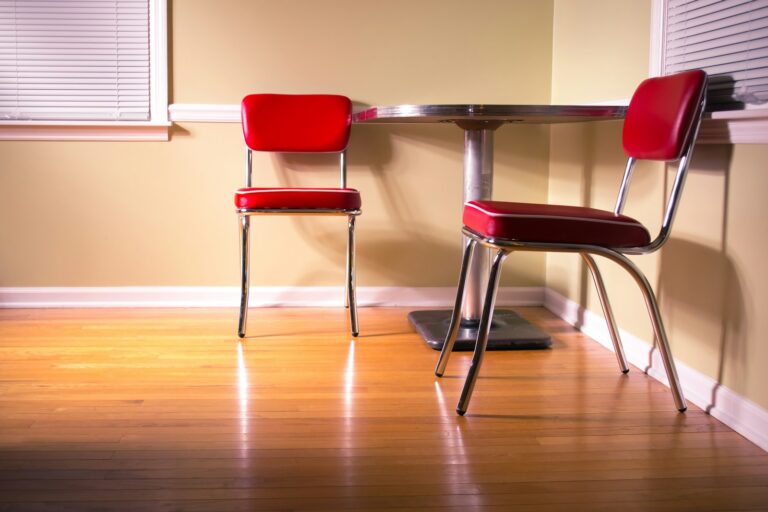
Kitchens are one of the most demanding environments for flooring — standing water, dropped utensils, grease, high foot traffic — and one of the rooms where flooring has the greatest visual impact because so much of it is visible at once. Wide plank vinyl in a honey oak finish handles the demands while delivering warmth that white porcelain tile and gray concrete-look floors cannot.
Honey oak is a golden mid-tone that pairs naturally with cream-colored or white cabinetry, quartz countertops in pale tones, and brushed brass or unlacquered brass hardware. In wide plank format, the floor reads as a single warm canvas rather than a patchwork of small tiles. The planks installed perpendicular to the kitchen’s long axis draw the eye across the width of the space, making galley-style kitchens feel less tunnel-like.
For kitchens in particular, the waterproof qualities of SPC-core wide plank vinyl matter enormously. Unlike laminate, there is no HDF core to swell if water sits at the seams for any period of time. This is one of the key reasons vinyl is among the best choices for kitchens when compared to wood-based alternatives.
Idea 5: High-Variation Reclaimed Wood Look in an Industrial Loft
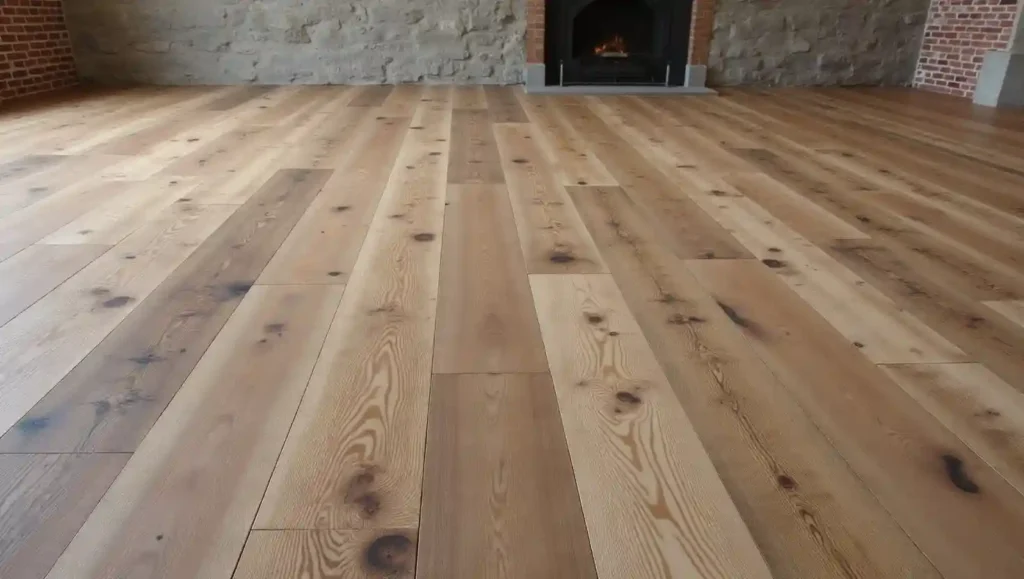
If greige and honey oak represent the broad middle of wide plank vinyl design, the reclaimed or high-variation wood-look sits at the more characterful, expressive end of the spectrum. These are planks printed with aged textures — saw-mark details, color variations across the face of each board, faint streaks of weathering — that mimic the look of barn wood or salvaged timber.
In an industrial loft or a home with exposed brick, open ductwork, or raw concrete ceilings, this kind of floor is the right answer. The textural richness of a high-variation wide plank vinyl creates visual interest at floor level that balances the visual weight of rough overhead materials. Without this kind of floor, industrial interiors can feel unfinished. With it, the rawness reads as deliberate.
High-variation wide planks work best in large open spaces where the full range of color and tone across multiple planks can be appreciated together. In a small room, the variation can feel chaotic. In a 600-square-foot open plan, it reads as complexity and depth. Mix planks from several cartons during installation to ensure the variation is distributed randomly rather than clustering similar boards together.
Idea 6: Wire-Brushed Gray Wide Planks in a Home Office
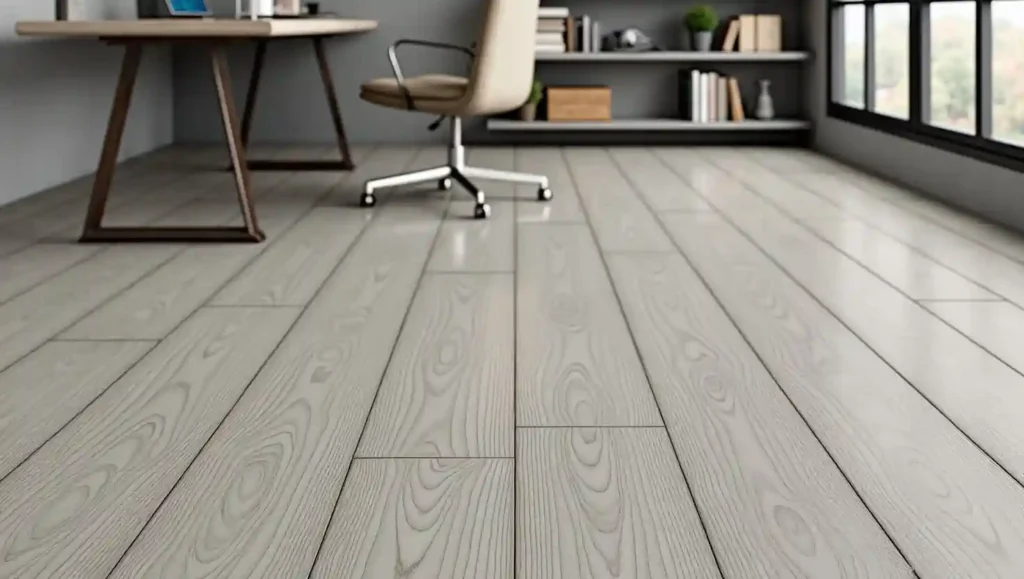
Gray is not a single color in the vinyl flooring world — it is a family of choices that ranges from cool blue-tinged silver tones to warm mid-grays with definite brown undertones. The wire-brushed finishes in this family are particularly effective in wide plank form. Wire brushing creates fine parallel channels in the surface that add texture and make the grain stand out, turning what could be a flat, bland gray into something that has real visual movement.
In a home office, a wire-brushed gray wide plank floor creates a professional, composed backdrop that does not distract from work. It pairs well with dark desk furniture, white walls, and task lighting. The gray tone is also forgiving with cable management — dark cables running along a gray floor are far less visually intrusive than they would be against a pale or warm-toned floor.
WPC-core wide planks are worth considering specifically for a home office if you plan to use a rolling chair directly on the floor. WPC’s slightly softer feel reduces noise from chair wheels and is gentler on the floor surface over time. Combined with a quality chair mat, it creates a workspace floor that holds up well for years.
Idea 7: Long Wide Planks Laid Diagonally in an Entryway
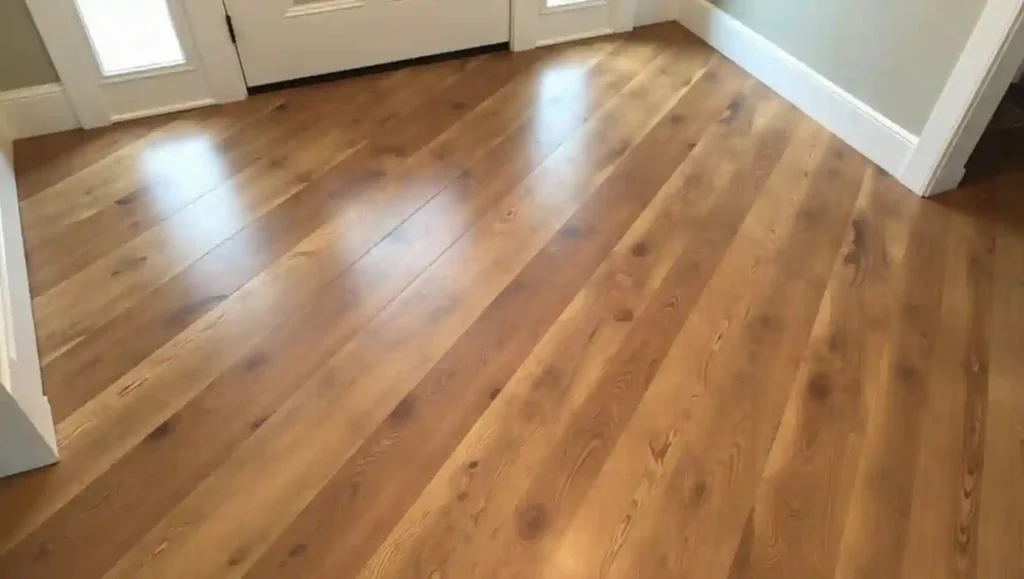
The entryway is the first surface every visitor walks across, which means it carries a disproportionate responsibility for setting the tone of your home. Laying wide plank vinyl at a 45-degree diagonal in an entryway transforms the floor from background to statement. The diagonal orientation creates a dynamic energy that square-to-the-wall installation simply cannot match, and with wide planks, the geometry is bolder and more intentional-looking than it would be with narrow boards.
A medium-toned warm brown or a warm walnut finish works particularly well for diagonal entryways. The angle of the planks draws the eye toward the interior of the home, creating an implied path that feels welcoming. The wide format means the pattern resolves at a scale appropriate to the space — you get perhaps 12 to 15 full plank widths across a standard hallway, which is enough for the diagonal to register as a design choice rather than a quirk.
One practical note: diagonal installation produces more offcuts than standard installation, which means you should calculate approximately 15% material waste rather than the usual 10%. If your entryway connects to a hallway or adjacent room, consider whether the diagonal continues into those spaces or terminates with a threshold strip. Either can work, but the decision should be intentional.
Idea 8: Pale Ash Wide Planks in a Scandinavian-Inspired Living Room
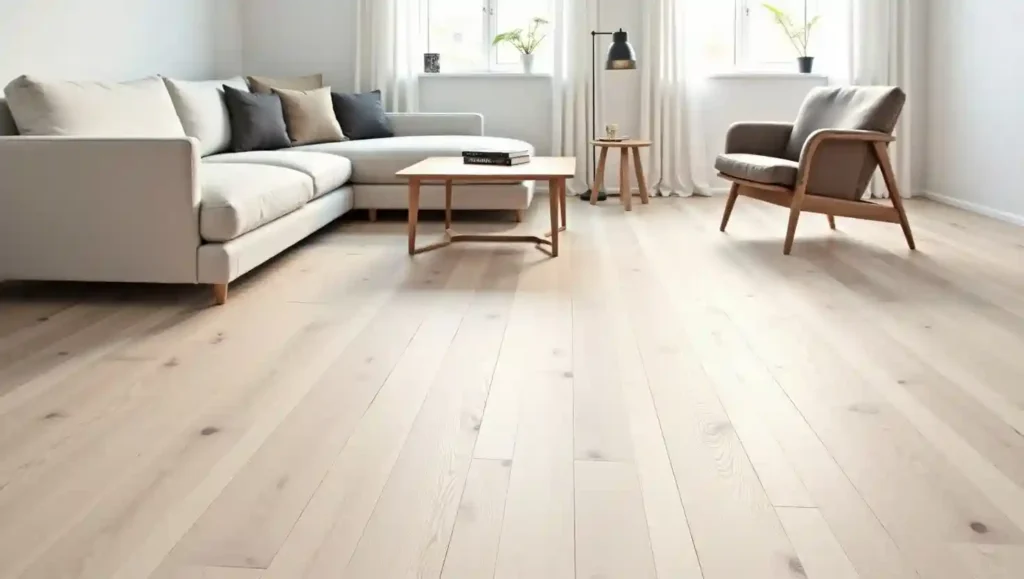
Scandinavian interiors operate on a principle of lightness: pale walls, natural materials, minimal clutter, and floors that reflect rather than absorb natural light. Wide plank vinyl in a pale ash or light birch tone is almost tailor-made for this aesthetic. The light color prevents the floor from visually lowering the ceiling, the width of each plank gives the floor substance and intention, and the fine grain of an ash-look finish is clean and contemporary without being cold.
Pair a pale ash wide plank floor with white oak furniture, soft wool textiles in cream and dusty pink, and pendant lighting in brass or brushed copper. The floor becomes the largest single surface in the room and it earns its prominence by working harmoniously with everything above it rather than competing.
For rooms that receive limited natural light — north-facing living rooms in particular — this kind of floor makes a measurable difference to perceived brightness. Pale reflective floors effectively double the reach of whatever light enters the room from windows and artificial sources combined.
Idea 9: Deep Walnut Wide Planks for a Formal Dining Room
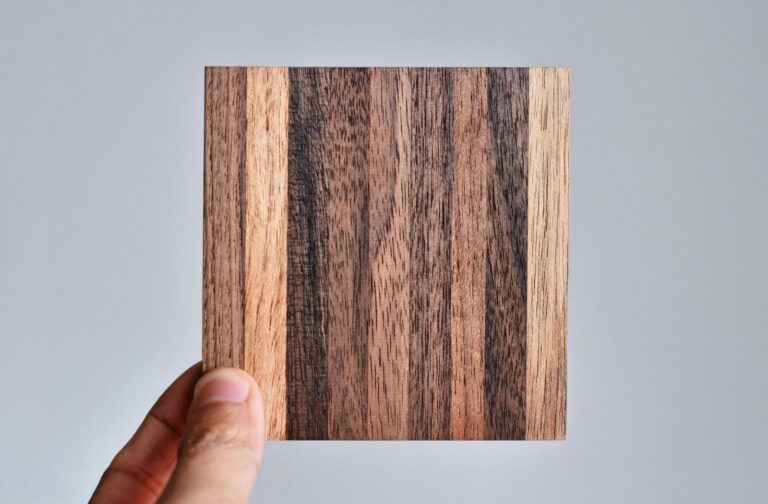
A formal dining room is one of the spaces where flooring contributes directly to a sense of occasion. Deep walnut-toned wide plank vinyl delivers a richness that you would typically associate with solid hardwood, but with the dimensional stability that comes from a rigid vinyl core — meaning no cupping, no seasonal gapping, and no anxiety about red wine finding its way to the floor during a dinner party.
Wide planks in a walnut finish have an inherent formality that narrow planks do not. The broad boards read as premium and considered. Lay them parallel to the dining table’s long axis to emphasize the length of the room and the table itself. A large area rug under the table defines the dining zone without breaking up the floor visually — the walnut planks extend visibly beyond the rug to the walls, framing the space rather than disappearing under it.
Dark walnut tones also pair beautifully with upholstered dining chairs in velvet or bouclé fabrics, brass or aged bronze light fixtures, and statement wall art. The floor grounds all of those elements and prevents the room from feeling too precious or light. For guidance on how to choose the right floor tone relative to your furniture, the comparison between dark vinyl flooring design directions provides useful framing for these decisions.
Idea 10: Waterproof Wide Plank Vinyl in a Basement Recreation Room
Basements present one of the most challenging environments for flooring: they sit at or below grade, they are prone to moisture vapor transmission through the concrete slab, temperature variations can be significant, and they are often used for high-impact activities that demand a durable surface. Wide plank vinyl — specifically SPC-core wide plank vinyl — handles all of these conditions better than nearly any other flooring type at a comparable price point.
SPC’s stone polymer composite core is 100% inorganic, which means moisture vapor from below cannot cause it to swell or buckle the way HDF-core laminate does. It floats over the concrete slab, accommodating minor imperfections, and the wide plank format makes the space feel finished and intentional rather than provisional. A medium-toned floor — something in the range of warm gray, greige, or a light weathered brown — is generally a better choice for a basement than very dark tones, because basements typically receive less natural light and dark floors compound that dimness.
For recreation rooms that will see exercise equipment, game tables, and heavy furniture movement, the density and dent resistance of SPC-core wide planks is a meaningful practical advantage over WPC alternatives. The floor will not indent where a heavy equipment foot sits for extended periods. Understanding the differences between SPC and WPC flooring helps clarify why rigid core vinyl is the right choice for below-grade applications.
Idea 11: Two-Tone Wide Plank Mix in an Open-Plan Kitchen and Living Area
One of the more sophisticated wide plank vinyl design approaches involves using a single plank product that carries genuine color variation within its print — boards that shift from lighter to medium tones across the face — rather than uniform one-note coloring. When a wide plank carries this kind of internal tonal variation, the floor as a whole develops an almost hand-laid quality. It looks less like a manufactured product and more like a floor assembled from carefully selected individual boards.
This approach is particularly effective in large open-plan kitchen and living areas where a floor needs to read well at both close range (standing in the kitchen) and at a distance (viewing the living room from across the space). At close range, the variation is interesting and detailed. At distance, the variation averages out into a rich, complex tone that reads as a single unified floor rather than a patchwork.
When choosing a two-tone or high-variation wide plank product, always order enough material from a single production run and mix boards from multiple cartons during installation. Color variation between production runs is a known issue in vinyl manufacturing; boards from different runs may not blend seamlessly.
Idea 12: Wide Plank Vinyl on a Staircase With Matching Landing
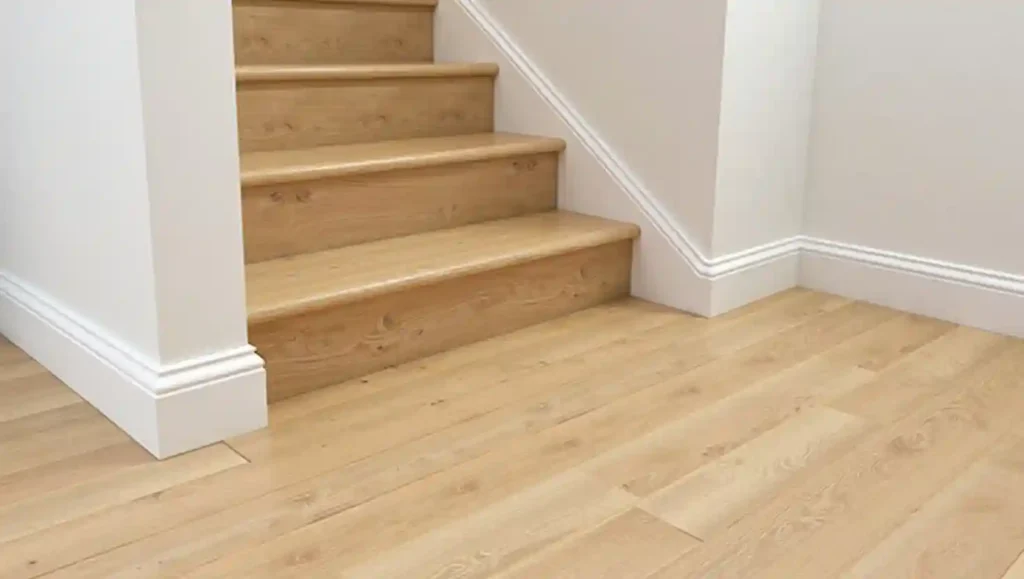
Extending wide plank vinyl from a room up and over a staircase with a continuous landing creates one of the most unified floor transitions available in residential renovation. When the floor you have chosen for your living area or hallway continues up the stair treads and wraps the risers, the staircase stops reading as a separate element and becomes a natural continuation of the floor plane. The visual result is a home that feels more architecturally resolved.
Wide planks on stair treads require adhesive installation rather than a floating method — the planks are bonded directly to each tread without underlayment beneath them. SPC-core wide planks are particularly well-suited for this because their rigidity prevents them from flexing under step loads, and the dense core bonds firmly to the tread substrate. Risers are cut from the same plank material and adhered to the vertical face of each step.
The tread nosing — the front lip of each step — is the most critical detail. A matching stair nose profile in the same finish as the plank creates a clean, safe edge. This is one installation where professional fitting genuinely earns its cost; the precision required for nosings and the consequence of poor fit (both safety and aesthetic) make it worth involving experienced installers. For context on full staircase installation with vinyl materials, the approach covered in vinyl flooring installation on stairs outlines the key steps involved.
Idea 13: Warm Toffee Wide Planks in a Master Suite With Radiant Heat Compatibility
Radiant floor heating and wide plank vinyl are now fully compatible, provided the right core construction and thickness are chosen — a pairing that has opened up a genuinely luxurious design option for master bedrooms. Wide plank vinyl in a warm toffee or caramel tone over radiant heat creates one of the most appealing sleeping environments available: a floor that is visually warm, genuinely warm to bare feet, completely silent underfoot, and fully waterproof.
Warm toffee tones — mid-brown with caramel and amber undertones — work exceptionally well in master bedrooms because they create a sense of enclosure and comfort that cooler or lighter floors do not. Combined with warm lighting, textile layering on the bed, and wood furniture in complementary tones, a toffee wide plank floor makes a bedroom feel like a retreat rather than just a place to sleep.
For radiant heating compatibility, total flooring thickness is the key variable. Most wide plank vinyl products in the 6mm-to-8mm range are suitable for radiant systems, but always check the manufacturer’s maximum surface temperature specification. The subfloor surface should not exceed approximately 85°F. Thinner is generally better for heat transfer efficiency — this is one application where choosing a high-quality 6mm SPC product outperforms a thicker 12mm WPC option. The thinner SPC transmits heat more efficiently while still delivering the rigid, stable platform needed over the radiant system. For a broader look at how wide plank vinyl fits into the luxury vinyl category, the overview of LVP flooring types provides helpful context on construction differences.
Choosing the Right Wide Plank Width for Your Room
Not every room suits every plank width equally. The relationship between plank width and room dimensions is one that experienced flooring installers understand immediately but that homeowners often overlook when selecting product at a showroom.
As a general principle, plank width should not exceed approximately one-tenth of the room’s narrowest dimension. In a 10-foot-wide room, a 9-inch plank is at the upper edge of what works proportionally. In a 7-foot-wide hallway, 7 inches is about the maximum before planks start to feel oversized relative to the space. In a 20-foot-wide open-plan living room, you could comfortably use a 12-inch plank and still have it feel appropriate.
Longer plank lengths also interact with room dimensions. When planks run parallel to a room’s short wall, the room can feel visually shortened. When they run parallel to the long wall, the room opens up. This is why most designers default to running planks lengthwise in rectangular rooms — it is the orientation that maximizes the spatial illusion that wide planks deliver.
For bathrooms and laundry rooms specifically, the combination of a smaller room footprint and a desire for maximum waterproofing makes standard-width LVP more common, but wide plank vinyl can work in bathrooms if the room is reasonably sized and if the plank is a true rigid-core SPC product with a quality seam profile. Understanding the full range of waterproof vinyl options for bathrooms helps clarify where wide plank vinyl fits within the broader set of decisions for wet-area installations.
Installation Considerations for Wide Plank Vinyl
Wide plank vinyl is installed as a floating floor in the vast majority of residential applications. The click-lock or angle-drop locking mechanisms used in modern wide plank products are engineered to handle the slightly greater stress that a wider plank places on the locking edge — you should not use a standard narrow-plank product and simply try to find wide options, because the locking profile specifications differ between width categories.
Expansion gaps remain important. Wide plank vinyl, like all floating floors, needs a 1/4-inch gap at all perimeter walls and fixed obstacles. Because wide planks cover more floor area per linear foot of plank laid, any errors in the expansion gap are proportionally more consequential — a gap that is slightly too tight on a 9-inch plank will cause buckling across a larger zone than the same gap error on a 5-inch plank.
Subfloor flatness matters significantly for wide plank performance. Because each plank is wider, it bridges any subfloor irregularity across a greater distance. The industry standard for subfloor flatness under LVP is typically no more than 3/16 of an inch variance over 10 feet. Wide planks are sometimes slightly more forgiving in this regard because their rigidity helps them bridge minor dips, but pronounced subfloor waves will telegraph through even the most rigid SPC core over time.
Acclimation requirements for rigid-core wide plank vinyl are generally shorter than for wood-based products — 24 to 48 hours in the installation environment is typically sufficient. This is because SPC and WPC cores are dimensionally more stable than HDF or solid wood and do not absorb ambient humidity in the way those materials do. The complete process for vinyl installation — from subfloor preparation to expansion gap management — is covered in detail in the guide to installing vinyl plank flooring.
Underlayment and Wide Plank Vinyl
One question that comes up consistently with wide plank vinyl selection is whether additional underlayment is necessary or helpful. The answer depends heavily on the specific product and the subfloor beneath it.
Many wide plank vinyl products — particularly premium SPC and WPC options — come with a pre-attached underlayment pad, usually IXPE foam or cork. This attached pad serves three functions: it absorbs minor subfloor irregularities, provides acoustic dampening, and adds a small amount of thermal insulation. For most residential applications over concrete slabs or plywood subfloors, an attached pad is sufficient.
Where additional underlayment becomes genuinely valuable is in applications over concrete slabs where moisture vapor transmission is a concern, where the pre-attached pad has been removed (as in staircase installations), or where acoustic performance is a priority — for instance, in a second-floor room above a living space. In those cases, selecting the right acoustic underlayment for the specific rigid-core product matters, because too much total cushion thickness under a floating wide plank floor can actually compromise the lock joint performance. Understanding which underlayment types work best under vinyl flooring — and when you need one versus when the pre-attached option is sufficient — is covered thoroughly in the guide to underlayment for vinyl plank flooring.
Maintaining Wide Plank Vinyl Flooring
One of the practical advantages that frequently tips the decision toward wide plank vinyl over wide plank hardwood is maintenance simplicity. Vinyl does not need refinishing, does not react to spilled liquids when cleaned promptly, and does not require periodic sealing or conditioning. Daily maintenance is straightforward: a dry microfiber mop for dust and debris, and a damp mop with a pH-neutral cleaner for heavier cleaning.
On wide planks specifically, the larger board surface makes cleaning faster — fewer seam lines means fewer areas where mop heads need to change direction, and fewer joints where grime can accumulate. This efficiency advantage is proportionally greater in large open-plan spaces, where maintaining a wide plank floor is meaningfully less labor-intensive than maintaining a tile floor of equivalent size with its many grout lines.
The one maintenance behavior to avoid consistently is standing water. Despite vinyl’s waterproof properties, allowing water to stand at seam lines and expansion gaps — particularly near walls — over an extended period can eventually work its way to the subfloor below and cause subfloor-level moisture issues. Prompt cleanup of spills, particularly near walls and thresholds, is the single most important maintenance habit for any floating vinyl floor.
Final Thoughts
Wide plank vinyl flooring represents one of the most effective ways to elevate the perceived quality of a space without the cost or maintenance demands of natural hardwood. The 13 ideas covered here span the full range of style directions — from the quiet versatility of warm greige in a family living room to the dramatic confidence of deep espresso against white walls, from the casual ease of whitewashed coastal bedrooms to the formal richness of deep walnut in a dining room.
The common thread across all thirteen is intentionality: wide planks reward careful selection. The right tone, the right core construction, the right plank width relative to room dimensions, and the right installation direction together produce a result that looks far more considered and expensive than the material’s cost would suggest. That is ultimately the proposition that makes wide plank luxury vinyl plank flooring one of the dominant flooring choices for both renovators and new builds today.
If you are weighing wide plank vinyl against other premium flooring options or want to understand how vinyl cost compares across different room sizes and configurations, the vinyl flooring cost guide provides a detailed breakdown of material and installation pricing that helps put the decision in full financial context.
James Miller is a seasoned flooring contractor with years of hands-on experience transforming homes and businesses with high-quality flooring solutions. As the owner of Flooring Contractors San Diego, James specializes in everything from hardwood and laminate to carpet and vinyl installations. Known for his craftsmanship and attention to detail, he takes pride in helping clients choose the right flooring that balances beauty, durability, and budget. When he’s not on the job, James enjoys sharing his expertise through articles and guides that make flooring projects easier for homeowners.
You bought the vinyl flooring. It is sitting in your garage. The installation is scheduled for Saturday. And somewhere in the back of your mind, you remember reading something about letting it “sit” before you install it — but nobody explained exactly what that means, why it matters, or what happens if you skip it….
When most people say they want to pick a carpet type, they are really picking three separate things at once: the pile construction, the fiber material, and the surface style that results from those two choices. Miss the distinction and you end up comparing a Berber to a frieze without realizing one is a construction…
The vinyl flooring market has become genuinely crowded. There are hundreds of brand names on store shelves and even more floating around online, and most of them use the same language: waterproof, durable, easy install, realistic wood look. That uniformity makes the brand comparison problem harder than it looks. You are not comparing apples to…
What Makes a Subfloor “Good” for Vinyl Flooring? The subfloor is the structural panel layer that sits on top of your floor joists and beneath the finished flooring. It is not the same as the underlayment, which is a thin cushioning layer placed directly under the vinyl. The subfloor is load-bearing. It determines how much…
Beveled edge laminate flooring is a type of laminate plank where the top edges are cut at a downward angle, forming a small V-shaped groove between planks once installed. The bevel typically sits between 30 and 45 degrees and runs 1 to 2 millimeters deep, depending on the manufacturer. This edge profile changes three things…
What Is Solid Hardwood Flooring? Solid hardwood flooring is exactly what the name says: a single, full-thickness plank of real wood, milled from one piece of lumber. There are no layers, no composites, no filler cores. Every plank runs the same species from top to bottom — typically ¾ inch (18–22 mm) thick — and…