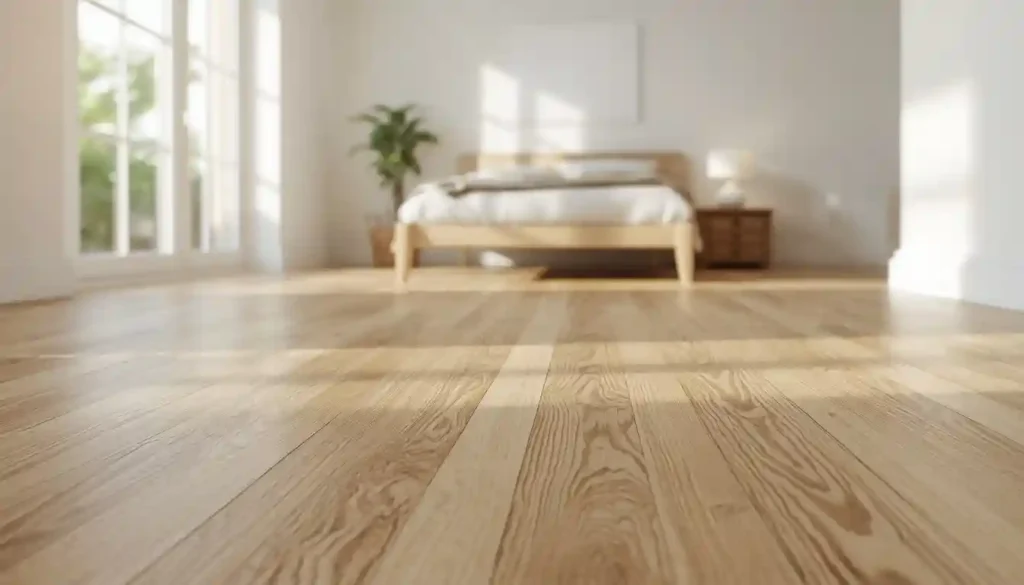
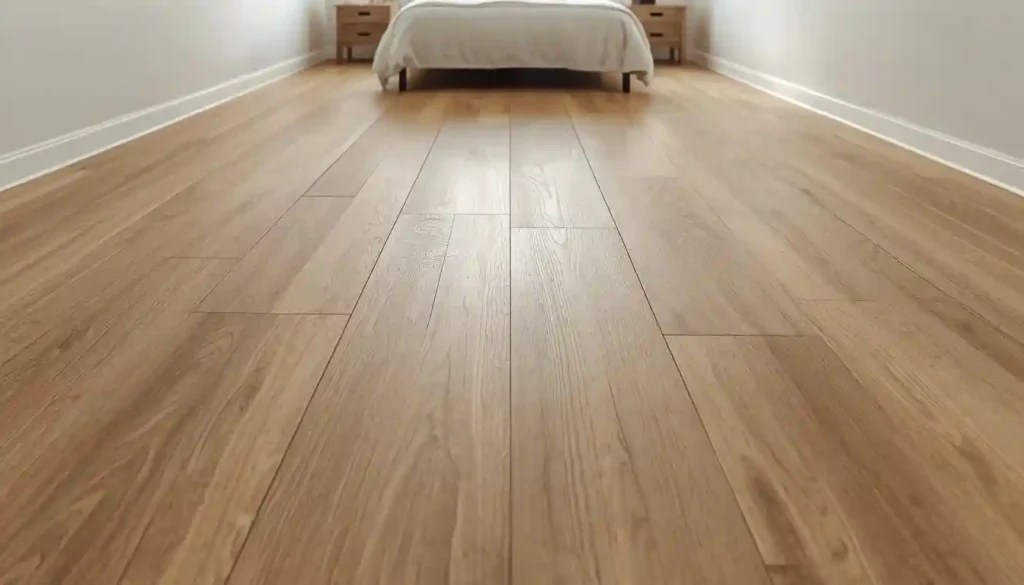
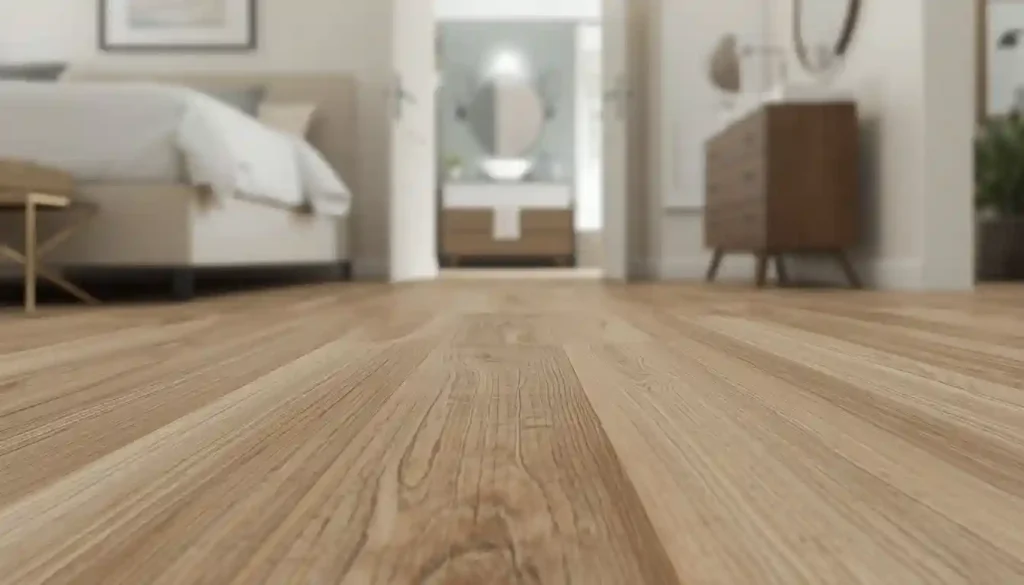
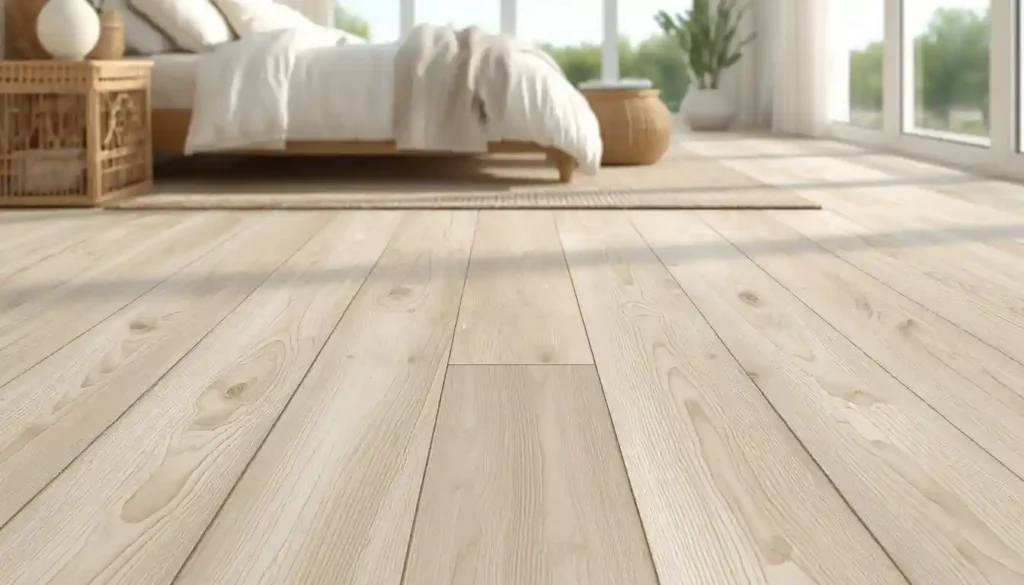
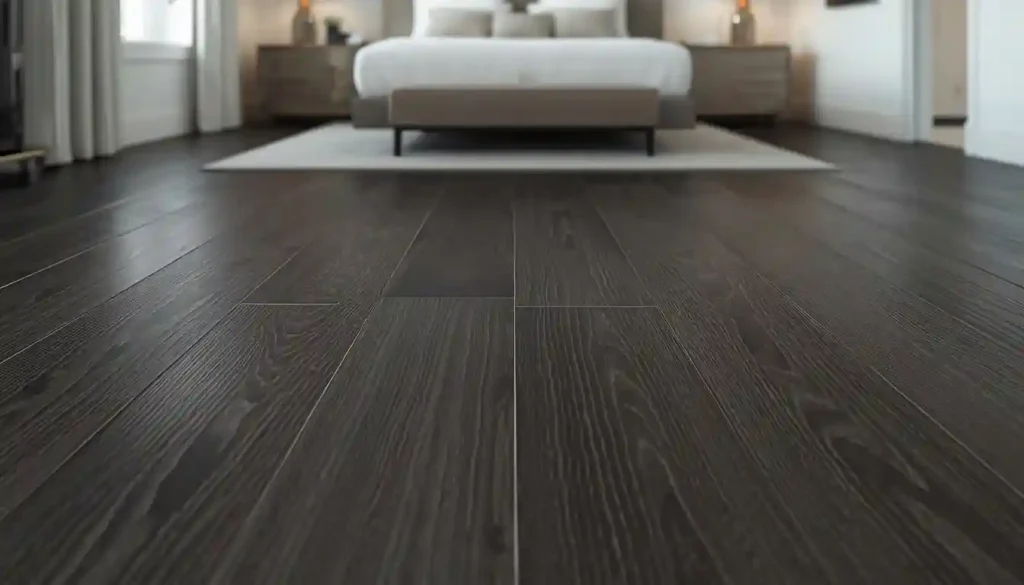
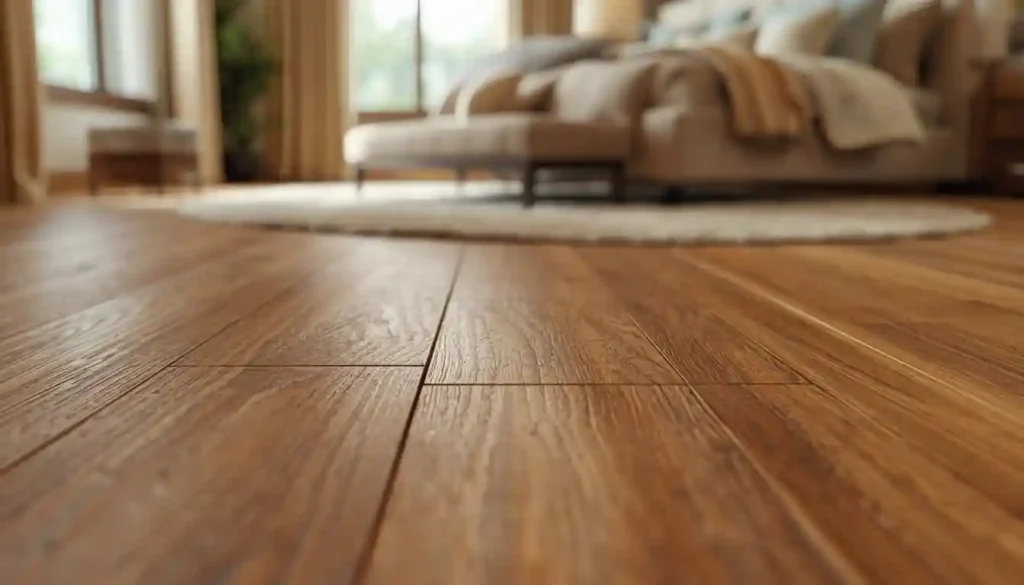
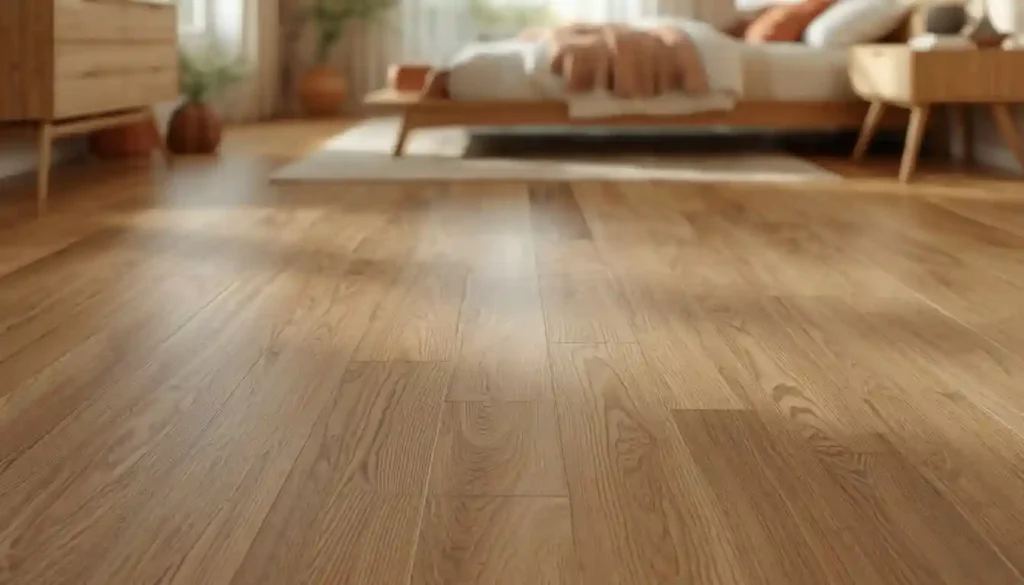
Light oak vinyl works especially well in rooms with south or west-facing windows. The warm tone does not shift color as much as a grey-based plank when light rakes across it in the afternoon, which means the floor looks intentional at all hours rather than reading differently depending on time of day.
2. Wide-Plank Grey Vinyl for a Calm, Minimalist Retreat
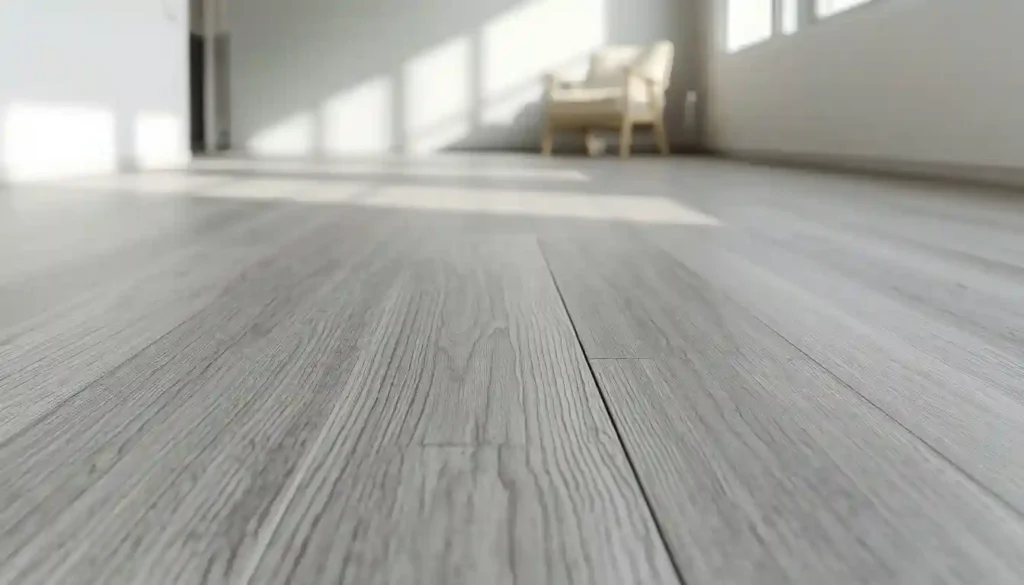
Grey vinyl plank has moved from a passing trend into a permanent category because it satisfies something specific: it provides a neutral floor that does not compete with bedding, wall color, or furniture, while still feeling considered and intentional rather than generic. The key distinction within grey LVP is undertone. Cool grey with a faint blue or purple cast reads as very modern and works in rooms leaning toward Scandinavian minimalism or industrial style. Greige — the greyed-brown middle ground — reads warmer and pairs naturally with earthy tones, natural wood furniture, and textural fabrics.
Wide plank format, typically 7 inches or wider, benefits grey tones in particular because it reduces the number of visible seams across the floor. Fewer seams mean the floor reads as a continuous tonal plane, which amplifies the calm, uninterrupted quality that grey is valued for in a bedroom setting. When the eye is not being broken up by dozens of tight joints, the floor recedes into a background role and lets the room’s other elements — the bed, the textiles, the art — carry visual weight.
Matte finish grey vinyl is a strong choice for bedrooms specifically because bedrooms are viewed from a low vantage point more often than most rooms. When you are in bed and looking across the floor, gloss finishes pick up reflections and distractions. A matte finish in grey simply holds its color evenly and reads cleaner across the span of the room.
Grey LVP also hides fine dust and pet hair better than either very dark or very light tones, which is a practical benefit in a room that is not swept or vacuumed as frequently as shared living areas. You can read more about how different vinyl formats and colors affect maintenance in the guide to cleaning vinyl plank flooring.
3. Herringbone Vinyl Plank for Visual Texture and Perceived Space
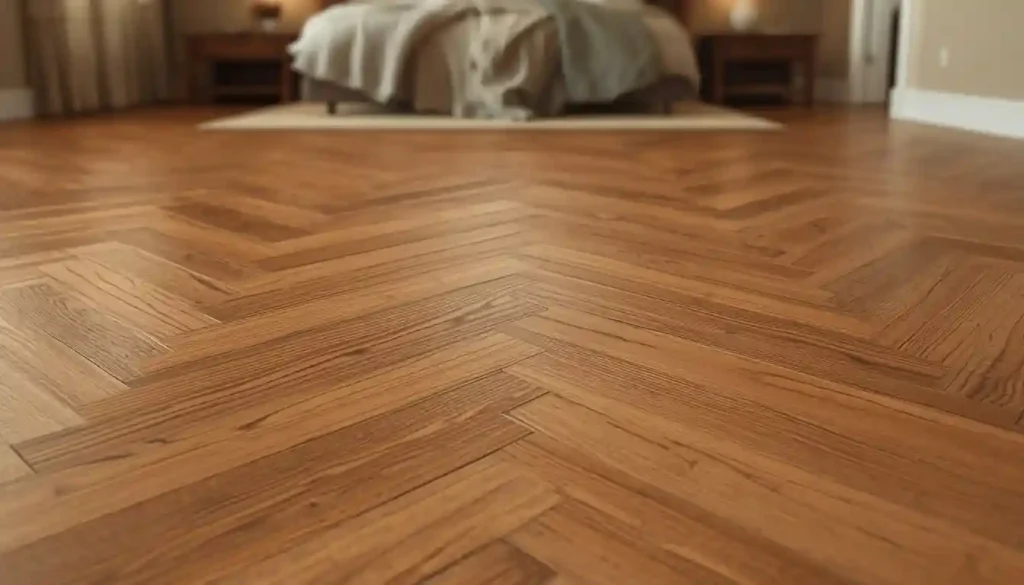
Herringbone is one of the few installation patterns that does meaningful spatial work in a bedroom. Because the V-shaped zigzag draws the eye outward toward both walls simultaneously, it creates a sense of width that a straight-laid floor simply does not produce. In a bedroom that is narrower than it is long — a common proportion — a herringbone floor makes the room feel more balanced and less like a corridor.
The pattern also adds enough visual complexity that the floor becomes a genuine design feature rather than a backdrop. This matters in bedroom settings where the furniture arrangement is relatively fixed and the floor is the largest uninterrupted visual surface in the room. A herringbone floor gives the room visual activity from above — including from the perspective of lying in bed — that a straight-plank floor simply cannot replicate.
Luxury vinyl plank in herringbone requires specific product selection. Standard click-lock planks are designed for straight installation, and forcing them into a herringbone pattern creates angle-cut edges that can fail structurally. Look specifically for LVP herringbone collections, or glue-down LVT (luxury vinyl tile) products that are sold in herringbone-specific dimensions. The planks in a true herringbone product have matching proportions — typically two-to-one length-to-width ratio — so the visual effect is clean and tight rather than uneven.
Light and medium tones work best for herringbone vinyl in a bedroom. Dark herringbone is a bold statement but can make a bedroom feel intense rather than restful. Medium warm tones — honeyed oak, blond maple — deliver the geometric interest of the pattern while keeping the room’s mood settled and easy.
4. Dark Walnut Vinyl Plank for a Moody, Sophisticated Master Bedroom
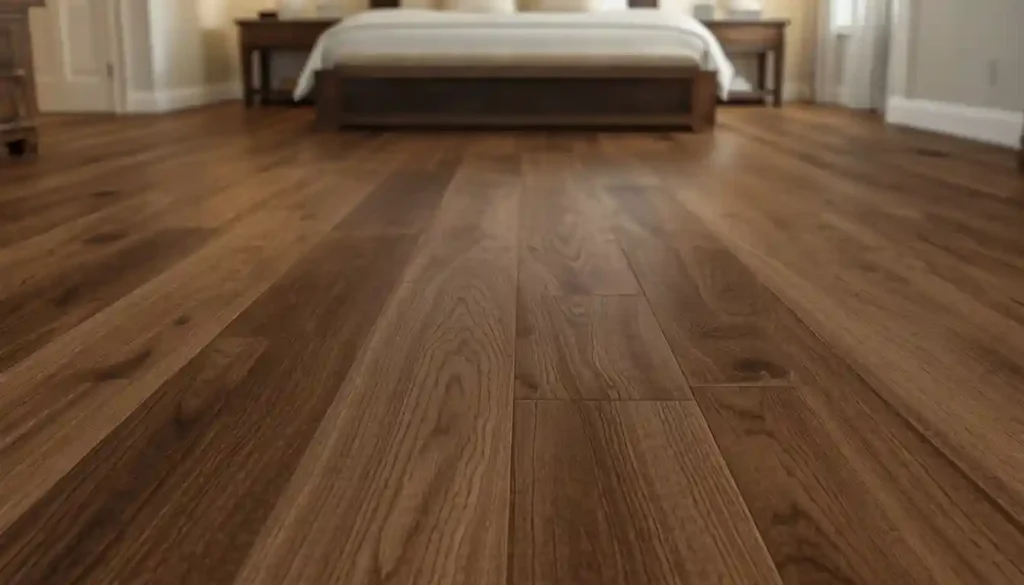
Dark vinyl planks in walnut, espresso, or ebonized tones shift a bedroom from restful toward dramatic — and in the right context, that is exactly what a master bedroom should be. The visual effect of a dark floor is to anchor the room, drawing the eye down and making furniture, bedding, and walls feel more intentional and composed against it. Rooms with dark floors tend to read as curated rather than assembled.
The challenge with dark vinyl in a bedroom is managing light. Dark floors absorb light rather than bouncing it around the room, which means the room needs either abundant natural light or thoughtful layered artificial lighting to avoid reading as dim rather than atmospheric. Bedrooms with tall ceilings, large windows, or south-facing orientation handle dark floors most effectively. In smaller rooms or those with limited natural light, balance dark flooring with light walls and pale textiles rather than doubling down on dark tones throughout.
Dark vinyl plank also makes an expressive foundation for color-forward bedroom schemes. A deep charcoal or midnight blue feature wall over dark walnut vinyl reads as intensely stylish. Jewel-toned bedding — emerald, sapphire, burgundy — comes forward powerfully against a dark floor in a way it simply does not over light wood tones. If you enjoy a room that feels enveloping rather than open, dark vinyl plank is one of the most effective tools for achieving that quality.
From a maintenance perspective, dark vinyl does show fine dust and light footprints more readily than mid-tones. Opting for a surface texture with some visual variation — a lightly brushed or wire-brushed surface effect — camouflages this considerably better than a smooth, flat dark plank. You might also want to explore the full range of dark vinyl flooring ideas to see how different shades and textures perform across various room styles.
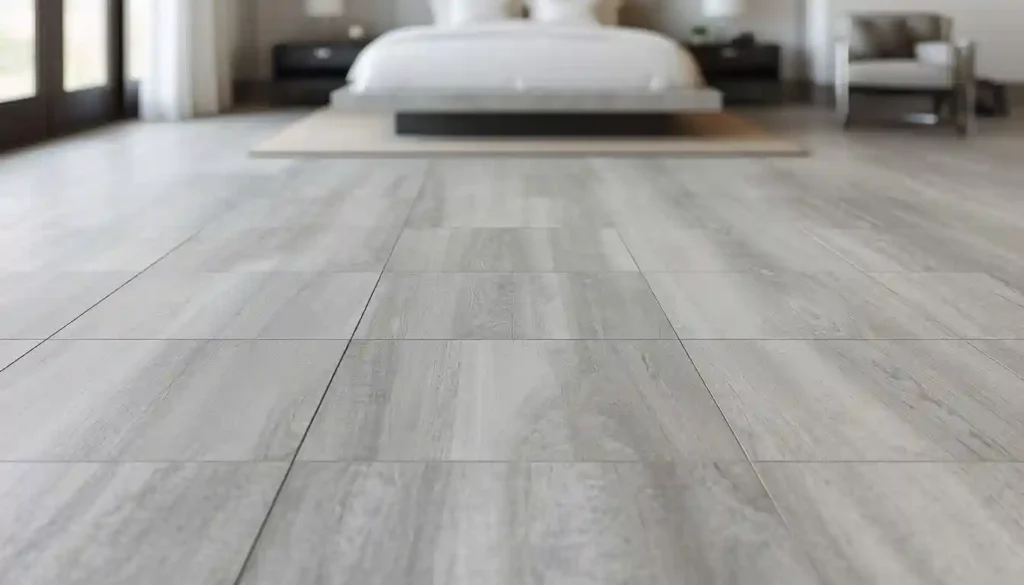
5. Light Grey Stone-Look LVT for a Contemporary Bedroom
Stone-look luxury vinyl tile offers a look that reads as refined and considered in a bedroom — the visual language of natural stone without the cold surface temperature, weight, or installation complexity. Contemporary bedroom design has embraced large-format stone-look LVT because it delivers the kind of clean, seamless floor that tile designers have long used in luxury master suites, but with vinyl’s warm underfoot feel and ease of floating installation.
The most effective stone-look LVT for bedrooms uses large formats — 18×18 inches or 12×24 inches — that minimize grout lines and let the surface read as a continuous plane. In stone visuals, grout lines interrupt the natural stone illusion; fewer, thinner lines maintain the premium aesthetic better. With LVT, there are no actual grout joints, just tight tile seams, which makes the illusion considerably more convincing than sheet vinyl with a printed stone pattern.
Light grey and warm ivory stone tones work well in bedroom settings because they share the same tonal neutrality as the most successful light wood vinyls while bringing a different material narrative — one that speaks to spa aesthetics, luxury hotels, and clean Mediterranean architecture. This makes stone-look LVT a natural choice for master bedrooms that connect to an ensuite bathroom, since continuing the same floor through both spaces creates a flowing, cohesive suite-like atmosphere.
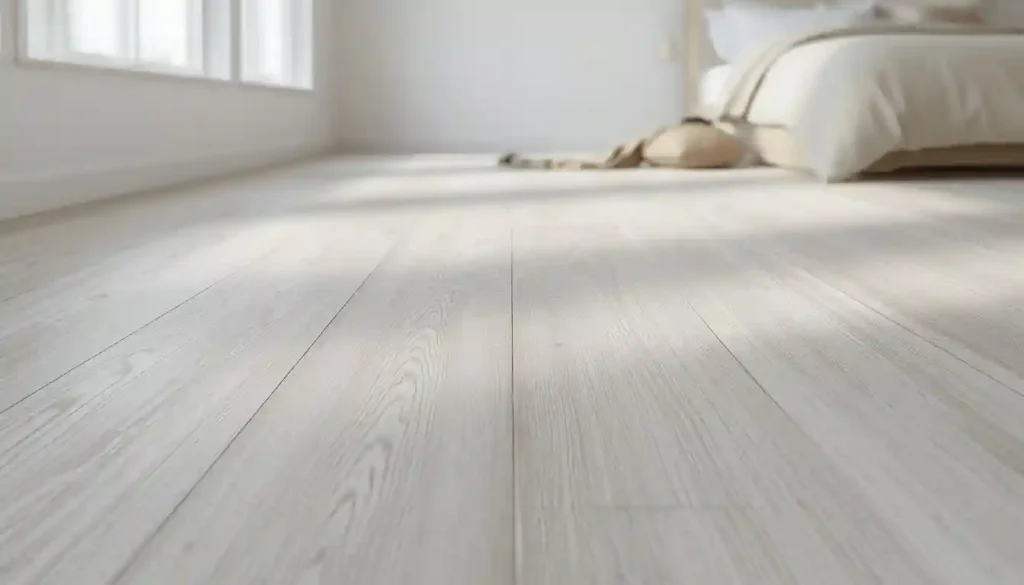
6. Blonde Scandinavian Vinyl Plank for a Light-Filled, Serene Space
Blonde wood tones — palest ash, whitewashed birch, natural spruce — produce a floor that feels almost radiantly light. This is a distinct quality from simply being light-coloured: the whitish-golden undertone of blonde vinyl planks bounces daylight around a room in a way that amplifies the sense of space and airiness beyond what the room’s actual dimensions would suggest. In Scandinavian interior design, this quality is central — the floor is selected to work with natural light as an active participant rather than a passive surface.
Blonde vinyl plank is especially effective in north-facing bedrooms that receive cool, indirect light throughout the day. The warm golden undertone of a true blonde plank compensates for the blue-green quality of north light, keeping the room feeling warm despite limited direct sun. A cool grey in the same situation reads increasingly cold and flat as the day wears on.
The Scandinavian approach to using blonde floors involves keeping everything else in the room light and textural rather than color-heavy. White painted walls, natural linen or cotton textiles, unfinished wood furniture, and plants against a blonde floor creates a cohesive interior logic that feels calm and resolved without requiring careful coordination of specific shades. The floor does the tonal heavy-lifting and everything else simply belongs.
Short plank lengths — 24 to 36 inches — feel more Nordic than long planks in this color range, echoing traditional Nordic timber construction. If the room permits, laying the planks diagonally introduces enough visual activity to keep the floor interesting without contradicting the serene palette.
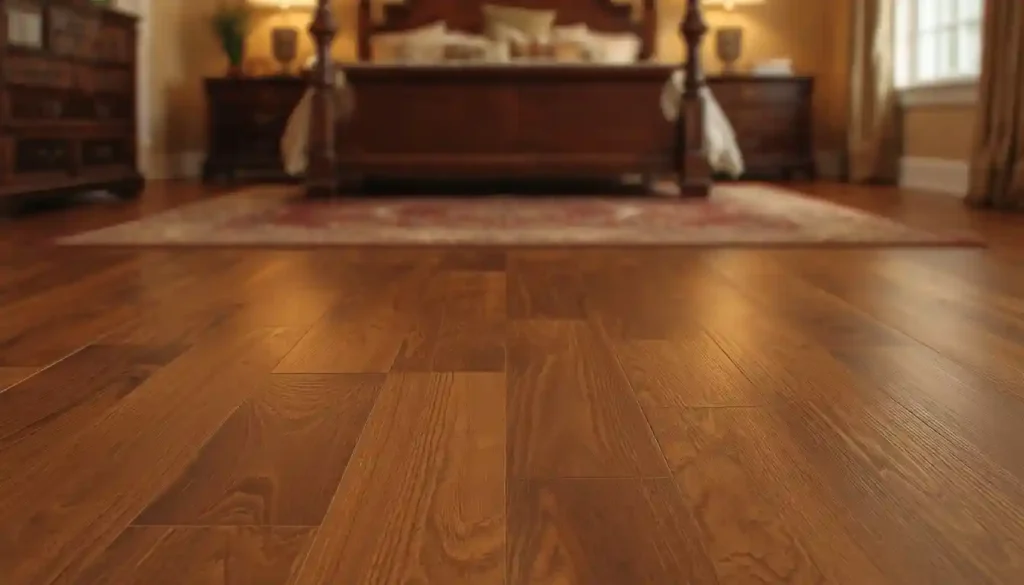
7. Warm Honey Vinyl Plank for a Cozy, Traditional Bedroom
There is a broad category of bedroom aesthetic that does not want to be modern or minimal — it wants to be warm, familiar, and deeply comfortable. Honey-toned vinyl plank, in amber, butterscotch, or medium caramel tones, is the flooring foundation for this kind of room. It echoes the visual warmth of traditional hardwood species like cherry and heart pine without the maintenance demands or cost of real wood, and it pairs naturally with the furniture styles and textile choices that define warm traditional interiors.
Honey vinyl plank works best with furniture in dark espresso, mahogany, or rich walnut tones — the contrast between the warm mid-tone floor and darker furniture creates the same satisfying visual relationship that traditional hardwood floors have with antique and vintage pieces. The floor reads rich without being heavy, and the warm tone acts as a unifying element that ties together different wood tones in furniture without requiring them to match.
For bedroom installations in this color range, plank lengths of 48 inches or longer help sell the hardwood illusion, since traditional solid hardwood floors tend toward longer boards rather than the shorter lengths sometimes seen in budget engineered products. Many LVP collections now offer planks in 60-inch and even 72-inch lengths, which produce a floor that looks convincingly like solid hardwood from any distance, including from across the room.
Rugs in this type of bedroom can be used generously. A large area rug in jewel tones, deep red, or pattern-heavy traditional design sits beautifully over honey vinyl plank and adds the soft sound absorption that hard floors benefit from in sleeping spaces. Understanding how rugs interact with different vinyl tones is part of getting this room type right, and the guide to selecting the right vinyl for bedrooms covers the full material and visual considerations in more depth.
8. Vinyl Plank in a Diagonal Layout to Maximize a Small Bedroom
When a bedroom is small or awkwardly proportioned, the direction of the floor’s plank pattern becomes one of the most powerful spatial tools available. A diagonal installation — planks running at 45 degrees to the walls — creates optical movement that distracts the eye from the room’s actual boundaries. Instead of measuring the room from wall to wall in a straight line, the eye follows the diagonal and perceives the room as more expansive than its square footage would suggest.
This effect is most pronounced in small square rooms, which can feel static and box-like with a straight-lay floor. Diagonal vinyl plank breaks the symmetry and introduces a dynamic quality that reads as deliberate and considered. It also draws attention away from corner-to-corner measurements, which is where small rooms most painfully reveal their limitations.
The practical trade-off of diagonal installation is waste. Because planks must be cut at the perimeter to maintain the 45-degree angle, you will cut more material and generate more offcuts than with a straight installation. Budget for approximately 10 to 15 percent more material than your room’s square footage to account for diagonal waste rather than the 5 to 7 percent that a straight installation typically requires.
Medium-toned, narrow planks — 4 to 5 inches wide — tend to produce the most convincing diagonal effect because the lines are fine enough to create the optical vibration without any single plank being wide enough to interrupt it. This is one situation where a narrower plank can outperform a wide plank in visual terms, even though wide planks are generally preferred for modern aesthetics. If working with a small bedroom is something you are thinking through, there is good additional context in the related article on vinyl flooring ideas for small spaces.
9. Waterproof Vinyl Plank for a Bedroom with an En-Suite Bathroom
Bedrooms that connect directly to an en-suite bathroom have a specific challenge: the floor that starts in the bedroom crosses through the doorway into a wet zone. Using two different flooring materials produces a transition line that interrupts the flow of the space, visually reducing both rooms. Luxury vinyl plank, being 100 percent waterproof, is the cleanest solution to this problem because the same plank can run continuously from the dry bedroom into the wet bathroom without any change of material, transition strip, or surface treatment.
This continuity is a genuine design advantage beyond just convenience. When a floor runs uninterrupted from a large bedroom through into an ensuite, the two spaces read as one extended suite rather than two separate rooms. The visual expanse of a single continuous floor makes both spaces feel larger, and the cohesion reads as intentional and architecturally considered — the kind of quality seen in luxury hotel rooms and high-end residential renovations.
For this application, select a vinyl that specifically markets waterproof performance through its core, not just its surface. SPC (Stone Plastic Composite) core and WPC (Wood Plastic Composite) core LVP products are 100 percent waterproof throughout their thickness, meaning moisture from a wet bathroom floor cannot work its way through the plank and affect the subfloor below. Standard vinyl with only a waterproof wear layer is not sufficient for sustained wet-zone exposure. You can find a thorough breakdown of vinyl waterproofing properties in the dedicated article on whether vinyl flooring is truly waterproof.
In terms of appearance, stone-look LVT is an especially natural choice for this bedroom-to-bathroom transition, since stone has long been the default material for spa-style bathrooms. Continuing a large-format stone-look LVT from the bedroom through the bathroom creates a seamless hotel-suite effect that is difficult to achieve with any other material at vinyl’s price point.
10. Light Wood Vinyl Plank for a Coastal or Relaxed Beach Bedroom
Coastal bedroom design has a flooring vocabulary of its own: bleached driftwood, sun-faded teak, weathered pine, white-lime washed boards. All of these naturally aged wood tones share a quality of having been softened by exposure — they are warm but pale, with open grain and visible character marks that read as organic and unhurried. Light wood vinyl plank in the right tones captures this visual language precisely, and without the actual maintenance that aged or bleached real wood requires.
The key attribute to look for in a vinyl plank targeting this aesthetic is surface variation. Planks where every board looks nearly identical produce a floor that reads as a printout rather than timber. The coastal wood look depends on visible differences from plank to plank — varying grain density, subtle knots, slight tonal shifts between boards. Collections with four to six surface designs in rotation handle this well; lower-quality products may only have one or two designs cycling and the repetition is visible even to untrained eyes.
Plank width in this aesthetic can go wide — 7 to 8 inches — because the casualness of the coastal look actually benefits from the informality of wide boards. Unlike in more formal traditional or contemporary settings where plank proportions are carefully managed, coastal bedrooms read better with a certain generosity and looseness of scale. Wider planks, fewer joints, and a slightly varied tone across the floor gives the room the relaxed quality that a beach aesthetic requires.
Pair this floor with natural fiber rugs, woven rattan furniture, and plenty of white and natural linen. Keep window treatments lightweight to allow maximum daylight, which is what activates the bleached wood quality in the vinyl’s surface. The complementary guide on light wood vinyl flooring ideas explores a full range of similar tones and their design pairings.
11. Dark Grey or Charcoal Vinyl Plank for a Dramatic, Contemporary Bedroom
Charcoal and deep grey vinyl plank occupies a different visual category from both dark walnut and standard mid-grey. Where walnut reads as warm and organic, and mid-grey reads as neutral, charcoal reads as deliberate and strong — a floor that makes an argument about the room’s character rather than simply providing a backdrop. This makes it well-suited to contemporary master bedrooms where the intent is to create a room with real visual authority.
Charcoal vinyl works best when the rest of the room does not try to compete with its intensity. White or very pale walls keep the room from feeling closed in while letting the dark floor do its spatial anchoring work. Metallic accents — brushed steel, matte black hardware, gold light fixtures — pick up the industrial undertone that charcoal tones carry and produce a room that reads as design-considered rather than simply dark.
The surface texture of charcoal vinyl is more critical than for lighter tones because at this value, every surface characteristic is amplified. Smooth charcoal planks can look like painted plywood from a distance. Brushed or hand-scraped textures in charcoal read as genuine plank material and produce the depth of surface that justifies using a dark tone in the first place. Look for collections with heavy embossing and a micro-bevel edge, which defines each plank individually and prevents the floor from reading as a single flat dark surface.
One practical note: charcoal vinyl shows pet hair, dust, and lint more readily than almost any other color category. If the bedroom houses pets, a mid-grey or salt-and-pepper grey — slightly lighter and with visible grain variation — maintains much of the dramatic quality while hiding day-to-day debris considerably better. The full examination of dark vinyl’s practical and aesthetic considerations is worth reading in the collection of dark vinyl flooring ideas.
12. WPC Vinyl Plank for Maximum Comfort in a Master Bedroom
Most bedroom vinyl flooring conversations focus on color and pattern, but for a master bedroom where you spend significant time on your feet — dressing, pacing, standing at a vanity — the core construction of the vinyl matters as much as its appearance. WPC (Wood Plastic Composite) core luxury vinyl plank is specifically worth calling out for master bedrooms because its foamed composite core provides measurably better underfoot comfort and sound absorption than the denser SPC (Stone Plastic Composite) core products.
WPC planks are thicker — typically 6mm to 8mm total compared to SPC’s 4mm to 6mm — and the foamed core introduces a small amount of give when you step on them. This is not softness in the sense of a cushion floor; the plank is still rigid and stable. But there is a perceptible difference between standing on WPC vinyl and standing on SPC vinyl that many people describe as the difference between standing on a wood deck and standing on a concrete patio. Both are hard, but one has an inherent quality of warmth and slight absorption that the other lacks.
Sound transmission is the other significant WPC advantage for bedrooms. Because the foamed core absorbs rather than transmits vibration, footfall sound is quieter both in the room itself and in any rooms below. In a two-story home where the master bedroom is on the upper floor, this matters considerably. You can investigate the acoustic differences between vinyl types in more depth through the article on whether luxury vinyl flooring is noisy, which walks through both product selection and underlayment options for noise control.
WPC vinyl is available in all the same visual categories as SPC — light oak, grey, herringbone, wide plank, stone look — so choosing WPC is not a visual compromise. It is simply a structural upgrade that makes a meaningful difference in how the bedroom actually feels to live in. For bedrooms specifically, it is almost always the right choice between the two core types.
13. Mixed-Width Vinyl Plank for a Custom, Handcrafted Bedroom Floor
Traditional timber floors were not laid with uniform plank widths. Older homes and reclaimed wood floors combine multiple widths — perhaps 3-inch, 5-inch, and 7-inch planks in a single floor — creating a visual richness and apparent individuality that uniform-width modern flooring does not replicate. Mixed-width vinyl plank collections bring this quality to luxury vinyl without the sourcing challenge or cost of actual reclaimed timber.
The visual effect of mixed-width planks is a floor that looks as though it was assembled from individual pieces with their own character rather than manufactured to a single specification. Horizontal movement across the floor is more complex and interesting — the eye traces different plank widths and responds to the variation as a kind of texture. In a bedroom, where the floor is often viewed from a resting position at an angle, this textural quality is especially legible and rewarding.
Not all mixed-width vinyl products are equally convincing. The best ones combine genuine surface variation between planks — different grain density, slight color shifts — with the width variation, so that each plank reads as an individual element. Products where the surface printing is the same regardless of plank width partially defeat the purpose, since the repeat pattern becomes more obvious across the variety of widths.
This idea pairs most naturally with warm wood tones — medium oak, honey walnut, warm brown — and with bedroom styles that lean toward organic modern, farmhouse, or artisanal aesthetics. It is not the right choice for a minimalist or very contemporary bedroom, where the irregularity of multiple widths can read as unresolved rather than character-rich. In those settings, the discipline of a single wide plank in a clean color is more appropriate. For a broader view of plank formats and how they interact with room styles, the overview of LVP flooring types provides useful context on construction and format options.
Choosing the Right Vinyl for Your Bedroom: Practical Considerations Beyond Color
The ideas above cover a wide range of aesthetics, but the floor that actually performs best in a bedroom depends on a few practical decisions that run underneath the visual choices. Wear layer thickness is one of them. Bedrooms receive lighter foot traffic than living rooms or kitchens, so the argument for ultra-thick commercial wear layers is weaker here. A 12-mil wear layer is sufficient for most residential bedrooms; stepping up to 20-mil makes sense if the bedroom houses pets with claws or if you have children who use the bedroom as a play space as well.
Underlayment matters more in a bedroom than in most other rooms for two reasons: sound and warmth. A bedroom above a lower level benefits from an underlayment with good IIC (Impact Isolation Class) performance, which directly reduces the sound of footfall traveling downward. Cork underlayment and dense foam underlayment both perform well on this dimension. Thermal comfort also matters in a bedroom since you are likely to be walking barefoot on this floor regularly. Some vinyl products include an attached underlayment with a cork or foam backer; these typically provide meaningfully better comfort than vinyl over a thin foam sheet separately installed.
The question of click-lock versus glue-down installation is worth considering for bedrooms specifically. Click-lock floating installation is faster, more DIY-friendly, and simpler to repair if a section is damaged. Glue-down installation produces a floor that does not flex at the seams when walked upon and performs better acoustically because there is no hollow space beneath the plank. For a bedroom on a concrete slab where sound transmission is less of a concern, click-lock is typically the right choice. For a bedroom on an upper floor where footfall sound is a significant issue, glue-down or a full-spread adhesive over a separate acoustical underlayment can make a noticeable difference. The differences between these installation approaches are laid out in the dedicated comparison of click-lock versus glue-down vinyl flooring.
Color and tone selection in a bedroom should account for the lighting conditions specific to that room rather than how a plank looked under showroom lighting. Bring large samples home and live with them for a day or two, observing how they look in the morning, at midday, and in the evening under artificial light. A floor that looks perfect at noon in cool natural light may read very differently at 10 PM under warm incandescent bulbs. This simple step eliminates the most common source of dissatisfaction with vinyl flooring choices.
The thirteen ideas in this article represent the range of what vinyl flooring can do in a bedroom, from the quietest and most understated light oak plank to the most expressive herringbone or charcoal statement floor. The right choice depends on the room’s dimensions, light, and the mood you want to live in — but within each of those categories, luxury vinyl delivers performance and authenticity that has genuinely narrowed the gap with much more expensive flooring materials.
James Miller is a seasoned flooring contractor with years of hands-on experience transforming homes and businesses with high-quality flooring solutions. As the owner of Flooring Contractors San Diego, James specializes in everything from hardwood and laminate to carpet and vinyl installations. Known for his craftsmanship and attention to detail, he takes pride in helping clients choose the right flooring that balances beauty, durability, and budget. When he’s not on the job, James enjoys sharing his expertise through articles and guides that make flooring projects easier for homeowners.
The idea of parquet flooring in a bathroom divides people. Tile advocates call it reckless. Design enthusiasts call it the boldest upgrade a bathroom can get. The truth, as usual, sits somewhere in the middle — but it leans further toward “yes, it can work” than most flooring guides let on. What most articles skip…
Most people walk into a flooring showroom, see thirty shades of oak, and leave more confused than when they arrived. That is not a buying problem. That is an information architecture problem. You have not been given the right framework yet. This guide fixes that. It builds the decision tree from the structural level up…
Light hardwood floors have quietly become the defining feature of modern interior design. Walk into almost any newly remodeled home, and you will likely find wide-plank blonde oak stretching from the entryway all the way into the kitchen, or creamy maple running through bedrooms that feel twice as spacious as they actually are. That is…
Small rooms have a reputation for being difficult to design, but the truth is that the floor beneath your feet does more heavy lifting than most people realize. Tile, in particular, is one of the most powerful tools available for reshaping how a compact space feels. The right tile can pull walls apart visually, lift…
Why Choosing the Right Wood Flooring for Pets Actually Matters Most pet owners discover the problem the hard way — a beautiful new floor reduced to a network of surface scratches within the first year of ownership. The issue is rarely that the floor was low quality. The issue is that the floor was never…
There is something about a dark floor that changes the entire personality of a room. Walls feel taller. Furniture looks more intentional. The whole space settles into itself with a quiet confidence that lighter floors rarely achieve. For a long time, dark flooring meant dark hardwood, which meant high cost, moisture sensitivity, and years of…