What are the pros and cons of laminate with attached underlayment?
Laminate with attached underlayment has a foam or cork pad bonded to the backing layer, which adds sound reduction, thermal insulation and walking comfort and removes the separate underlayment step, cutting installation time and labor. The trade-off is that the pad is fixed: you cannot swap to a denser acoustic underlayment without stacking two layers under a floating floor, and over a concrete slab you still have to confirm whether the manufacturer requires a separate moisture barrier, because a missing barrier is one of the installation conditions that voids the warranty.
What Is the Wear Layer in Laminate Flooring?
The wear layer is the topmost transparent layer of a laminate plank. It sits above the decorative print (the layer that mimics wood, stone, or tile) and is the surface your foot touches.
It is made primarily from melamine resin — a thermoset plastic that hardens permanently under heat and pressure during the lamination process. To make the layer abrasion-resistant, manufacturers infuse it with aluminum oxide particles, a ceramic compound second only to diamond on the Mohs hardness scale. Higher-end laminates also add corundum or silicon carbide for additional scratch resistance.
Within the four-layer stack described above, the wear layer is the top layer. From top to bottom: the wear layer, the decorative layer, the HDF core, and the backing/balancing layer. Each layer has a job, but the wear layer is the only one that interacts with daily life. The decorative layer gives the floor its looks; the wear layer is what keeps those looks intact.
Without a wear layer, the printed design would scuff off within weeks. A thin wear layer protects the print from light scratches but wears through under heavy traffic. A thick wear layer absorbs years of abuse before the design beneath it ever shows wear.
How Wear Layer Thickness Is Measured
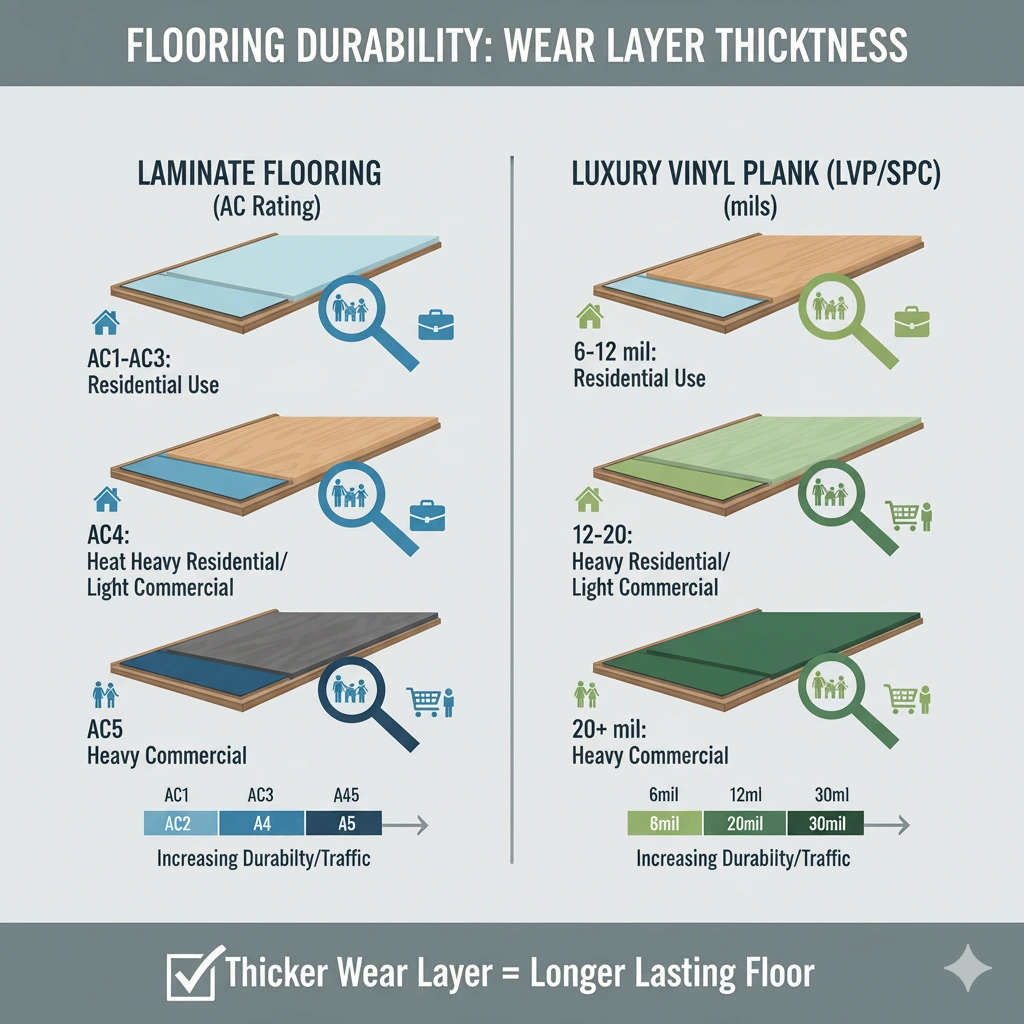
Wear layer thickness is measured in mils, not millimeters. This is where most homeowners get tripped up, because plank thickness is given in millimeters (8mm, 12mm) and the wear layer is given in mils — and the two numbers are not interchangeable.
1 mil = 0.001 inch = 0.0254 mm
6 mil = 0.006 inch ≈ 0.15 mm
12 mil = 0.012 inch ≈ 0.30 mm
20 mil = 0.020 inch ≈ 0.50 mm
30 mil = 0.030 inch ≈ 0.76 mm
So when a spec sheet says “12 mil wear layer,” the protective topcoat is roughly 0.3 mm thick — about three sheets of standard printer paper stacked. That sounds thin, but because aluminum oxide is so hard, even a 12 mil layer can take years of foot traffic before it wears through.
The same mil unit is used for vinyl plank wear layers, which is why this number is often confused between the two products. The materials are completely different — laminate uses melamine and aluminum oxide; vinyl uses urethane — but the unit of measurement is shared.
Common Wear Layer Thicknesses and Real Lifespan Expectations
Laminate wear layers fall into a few standard ranges. Each range maps onto a use case and a realistic lifespan if you actually use the floor as intended.
6 mil (0.15 mm) — Light Residential
The entry-level thickness, found on budget laminates sold in big-box stores. A 6 mil wear layer holds up for 8–10 years in a low-traffic bedroom or formal dining room, but only 12–24 months in a hallway with kids and pets before traffic lanes appear. AC2 rated, on average.
8–10 mil (0.20–0.25 mm) — Standard Residential
The most common thickness in mid-range residential laminate. Realistic lifespan is 10–15 years in a normal living room with a couple, kids, and one pet. Drops to 5–7 years in heavy-use kitchens or hallways. AC3 rated.
12 mil (0.30 mm) — Heavy Residential
The sweet spot for busy households. 15–20 years in living rooms, 10–12 years in hallways and kitchens, even with active children and dogs. This is the thickness most flooring contractors recommend for the main living areas of a family home. Typically AC4 rated.
15–20 mil (0.38–0.50 mm) — Heavy Residential / Light Commercial
Rated for both a busy household and light commercial use — a home office that sees client visits, a small boutique, a hair salon. 20–25 years in residential use, 10–15 years in light commercial. AC4–AC5.
20–30 mil (0.50–0.76 mm) — Commercial
Built for retail floors, restaurants, hotel lobbies, and offices with rolling chairs. 15–25 years under heavy commercial abuse. Overkill for a typical home, but appropriate for a basement gym, a workshop, or a home with five kids and three large dogs. AC5–AC6.
Thickness is not the whole story, though. A poorly manufactured 20 mil layer can wear faster than a well-made 12 mil layer, which is why the AC rating exists.
AC stands for Abrasion Class. The test, conducted by the European Producers of Laminate Flooring (EPLF), uses an abrasive wheel rotating against the surface until the wear layer is breached. The number of rotations the surface withstands determines the rating.
AC1 — Light residential. Bedrooms, closets.
AC2 — Moderate residential. Dining rooms, low-traffic living rooms.
AC3 — General residential / light commercial. The minimum for any actively-used room.
AC4 — Heavy residential / general commercial. Hallways, kitchens, small offices.
AC5 — Heavy commercial. Department stores, public buildings.
AC6 — Extra heavy commercial. Airports, train stations.
The relationship between AC rating and wear layer thickness is not one-to-one. A laminate with a thick wear layer but cheap aluminum oxide content can rate AC3, while a laminate with a thinner but premium-grade wear layer can hit AC4. Practical comparisons most buyers face are AC3 vs AC4 laminate flooring for residential and AC4 vs AC5 laminate flooring for commercial-leaning spaces.
The shortcut: look at thickness and AC rating together. If a laminate brags about a thick wear layer but does not list an AC rating, that is a red flag. Reputable manufacturers publish both.
Why Laminate Wear Layers Cannot Be Refinished
This is the single most important difference between laminate and hardwood, and it is rarely explained in product brochures. Once the wear layer is gone, the floor is gone.
Hardwood floors have a solid wood surface that can be sanded and refinished 4–10 times over their lifespan. Laminate has a thin printed paper for its decorative layer — sanding through the wear layer destroys the print underneath. There is no recovery. The plank has to be replaced.
This has three practical consequences:
Buy thicker than you think you need. With hardwood, you can correct for underbuying by refinishing later. With laminate, the wear layer thickness you install is the wear layer you live with until replacement.
Spot replacement is harder than it sounds. When a single plank wears through, you need an identical replacement. Manufacturers discontinue colors regularly. Buying 10–15% extra at installation and storing it is the only reliable way to handle future repairs. Surface scratches above the print can sometimes be repaired, but anything that has cut into the decorative layer cannot.
The whole-floor replacement clock starts at install. When a laminate floor “wears out,” it is the wear layer that has failed. Plan the replacement budget around the realistic lifespan numbers above, not the marketing copy.
Wear Layer Thickness and Manufacturer Warranties
Manufacturer warranties are tied directly to wear layer thickness, even when the spec sheet does not say so explicitly. Walk into a flooring store and you will see warranties ranging from 10 years to “lifetime” — and the variation is almost entirely a function of wear layer.
10–15 year warranties — typically 6–8 mil wear layers, AC2–AC3.
20–25 year warranties — typically 10–12 mil wear layers, AC3–AC4.
30-year to lifetime residential warranties — typically 12–20 mil wear layers, AC4+.
Commercial warranties (5–10 years) — 20+ mil wear layers, AC5–AC6.
Two things to watch for in the warranty fine print:
The warranty covers wear-through, not surface scratches. A claim has to show the decorative layer has been exposed — meaning the wear layer is fully gone. Surface scratches, dents, water damage, and fading are usually excluded.
Installation conditions void the warranty fast. Improper acclimation, missing moisture barriers on concrete, and incorrect underlayment can all void coverage. If you are installing over concrete, the moisture barrier specification is non-negotiable for keeping the warranty valid.
The math: if the warranty length is dramatically out of proportion with the wear layer thickness — for example, a “lifetime” warranty on a 6 mil floor — read the exclusions carefully. There is almost certainly a clause that makes a successful claim nearly impossible.
What Specifically Damages the Wear Layer
The wear layer is engineered to resist abrasion, but different damage vectors stress it differently. Knowing what actually attacks the surface helps match thickness to lifestyle.
Pet Claws
Dogs are the most common cause of premature wear layer failure in residential settings. Untrimmed claws concentrate weight on tiny contact points and create directional scratching as the dog accelerates or stops on the surface. Large dogs on 6–8 mil wear layers will wear through in 3–5 years. Minimum recommendation for dog households: 12 mil, AC4.
Furniture Casters and Rolling Chairs
Hard plastic casters under office chairs are deceptively destructive. The small wheel diameter concentrates body weight onto roughly a quarter-inch contact patch, and the rolling motion grinds at the wear layer in a fixed area. A home office with a roller chair and an 8 mil wear layer will show a worn arc within 2–3 years. Use a chair mat or specify 15+ mil for office areas.
Tracked-In Grit and Sand
Counterintuitively, the most damaging thing on a laminate floor is not anything heavy — it is the small abrasive particles tracked in on shoe soles. Sand and grit act like sandpaper underfoot. This is why entryways and the first 6–8 feet inside a door wear faster than the rest of the floor. Walk-off mats inside and outside the entry double the practical lifespan of the entryway floor.
Furniture Drag
A single dragged dining chair leg can cut through a 6 mil wear layer in a single pass. Felt pads on furniture feet are not optional — they are part of the maintenance plan that keeps the warranty valid. Quality furniture pads for laminate floors are a $10 investment that protect a $5,000 floor.
UV Exposure
Direct sunlight degrades the melamine resin over time, making the wear layer brittle and prone to micro-cracking. Floors near south-facing windows wear faster than the rest of the room. The UV resistance rating matters as much as raw thickness in sun-exposed spaces.
High Heels and Hard-Soled Shoes
Stiletto heels concentrate body weight onto a contact area smaller than a dime. Even thick wear layers can be dented or punctured by a heel landing wrong. This is one form of damage thickness alone cannot fully prevent — the HDF core under the wear layer is what matters for impact resistance.
What Affects Wear Layer Performance Beyond Thickness
Two laminates with identical 12 mil wear layers can perform differently. Three factors explain why.
Aluminum oxide concentration. The more aluminum oxide particles per square inch, the harder the surface. Premium laminates pack in significantly more particles than budget ones, even at the same wear layer thickness.
Resin quality. The melamine resin holding the aluminum oxide in place varies in formulation. Higher-grade resins resist yellowing, hold the abrasive particles more securely, and stand up to UV exposure better. Cheap resins yellow over time even before the layer wears through.
Surface texture. Embossed or textured wear layers — especially embossed-in-register, where the texture matches the printed grain — hide micro-scratches better than glossy, smooth surfaces. This is one reason high-gloss vs matte laminate finishes matters for long-term appearance, not just initial looks. A matte 10 mil floor will visually outlast a high-gloss 12 mil floor in most homes.
The wear layer is also tied to overall plank thickness. A 12mm plank with a 12 mil wear layer feels and behaves differently from an 8mm plank with the same wear layer because the core under it absorbs impact differently. If you are still deciding on plank thickness, work through the 8mm vs 12mm laminate question alongside the wear layer choice.
Wear Layer vs. Click-Lock Joint Integrity
A laminate floor can fail in two ways: the wear layer wears through, or the click-lock joints fail. These are independent failure modes, and the one that gives out first is what drives replacement.
Cheap laminates often pair a decent wear layer with a flimsy locking system. The joints chip during installation, separate over time, or fail to re-engage after a board is lifted. The wear layer can still look fine while the floor is becoming unusable. Premium laminates use stronger HDF cores and more precisely milled joint profiles, so the locking system tends to outlast the wear layer.
For high-traffic installations, prioritize a manufacturer with a strong track record on both fronts. The cheapest floor with a 20 mil wear layer is a bad bet if the joints fail at year 5.
Signs Your Wear Layer Is Failing
Wear-through is gradual. Catching it early lets you address the cause before more planks are affected. Watch for:
Dull patches in traffic lanes. The first sign is usually a loss of sheen along walking paths — in front of the kitchen sink, between the couch and the door, at the foot of the stairs. The wear layer is thinning but the print is still intact.
Color change in worn areas. As the wear layer thins, light reflects differently and the printed color appears slightly faded. Compare a high-traffic spot to an area under furniture — if the color looks off, the wear layer is on its way out.
Visible printed pattern wear. When you can see the printed grain pattern looking “smudged” or interrupted, the wear layer has breached and the print itself is being abraded. The plank cannot be saved at this point.
Gray or white scuffs that won’t clean off. Surface scuffs that resist cleaning are usually scratches into the wear layer rather than dirt on top of it. The right cleaning products for laminate floors can confirm whether a mark is dirt or damage — if it doesn’t come up with appropriate cleaner, it’s damage.
Roughness underfoot. A smooth wear layer that starts to feel slightly rough or “grippy” in worn areas is showing micro-pitting in the surface — early-stage failure.
Choosing the Right Thickness for Your Home
Match the wear layer to the room, not the other way around. Buying premium-grade laminate for the entire house is wasteful — bedrooms do not need the same armor as the kitchen.
Bedrooms and Guest Rooms
6–8 mil (AC2–AC3) is plenty. These rooms see slippered feet, not muddy boots. Spending more is throwing money at a problem that does not exist.
Living Rooms, Dining Rooms, and Family Rooms
10–12 mil (AC3–AC4). Daily use, furniture moves, occasional parties. A 12 mil floor will outlast a 6 mil floor in these spaces by a factor of two or three.
Hallways and Stairs
12 mil minimum (AC4). Hallways are traffic funnels — every person walks through them every day, often in shoes. Stairs face even more concentrated wear on the nosing of each step.
Kitchens and Entryways
12–15 mil (AC4) at minimum. Wet zones with constant traffic and dropped objects. Some homeowners weigh waterproof laminate against waterproof vinyl for these rooms specifically because of the water exposure issue.
Home Offices and Light Commercial
15–20 mil (AC4–AC5). Rolling chairs are surprisingly destructive — small caster wheels concentrate weight on tiny surface areas. A thicker wear layer is non-negotiable if you spend eight hours a day rolling around on the floor.
Commercial Spaces
20–30 mil (AC5–AC6). Anything less and you will be replacing the floor inside the warranty period. Many flooring pros also flag the disadvantages of laminate flooring in commercial spaces regardless of wear layer — worth reading before committing.
Laminate Wear Layer vs. Vinyl and Hardwood
Buyers comparing flooring types often confuse wear layer specs across product categories. They are not equivalent.
Laminate wear layer (melamine + aluminum oxide): Extremely hard, highly scratch-resistant, but cannot be refinished. Brittle under impact. Vulnerable to water at edges and joints.
Vinyl wear layer (urethane): Softer, more flexible, more impact-resistant. Less scratch-resistant against hard objects but better with point loads. Fully waterproof. The wear layer thickness for LVP flooring is measured in the same mil units but the material behaves differently — a 12 mil vinyl wear layer is not directly comparable to a 12 mil laminate wear layer.
Hardwood “wear layer” (urethane or oil finish): The finish itself is much thinner than laminate’s wear layer, but the wood underneath can be sanded and refinished multiple times. Total surface life over multiple refinishes can exceed any laminate.
The trade-off: laminate gives you the hardest scratch-resistant surface for the least money, but no recovery option when it wears through.
Frequently Asked Questions
Can you replace just the wear layer?
No. The wear layer is fused to the decorative layer during manufacturing. There is no aftermarket coating that restores it. Some products claim to refresh the surface, but they sit on top of the existing wear layer rather than replacing it, and they typically wear off within 6–12 months.
Does plank thickness affect wear layer performance?
Indirectly. A thicker plank has a sturdier HDF core that absorbs impact better, which reduces stress on the wear layer above. Two floors with identical 12 mil wear layers — one on an 8mm plank, one on a 12mm plank — will perform measurably differently in homes with kids, pets, or high foot traffic.
Is a thicker wear layer always worth the cost?
Up to 12 mil for residential use, yes. Beyond 12 mil, you are paying for commercial-grade durability that most homes never stress. The exception is high-impact rooms — kitchens, entryways, home offices with rolling chairs — where 15–20 mil pays back through extended lifespan.
Does the wear layer affect water resistance?
Slightly. The wear layer is non-porous and protects the printed layer from surface moisture. But laminate’s water vulnerability is at the joints and edges, not the surface, so a thicker wear layer does not meaningfully change waterproof performance.
Can the wear layer be polished or buffed back to new?
No. Polishing removes more wear layer rather than restoring it. Cleaning products labeled as “shine restorers” deposit a thin coating on top of the wear layer that mimics gloss but wears off with normal mopping.
Why do some laminates list both wear layer thickness and overall thickness?
Because they measure different things. Overall thickness (8mm, 10mm, 12mm) is the total plank thickness including the core. Wear layer thickness (in mils) is just the protective topcoat. Both matter for different reasons — the core handles impact, the wear layer handles abrasion.
Does wear layer thickness affect installation?
Not directly, but installation conditions affect how well the wear layer performs over time. Improper acclimation causes plank movement that stresses joints and surface. The acclimation step before installation is part of getting the warranted lifespan from your wear layer.
Bottom Line
Wear layer thickness is the single most predictive spec for how long your laminate floor will look new. For a typical family home, a 12 mil wear layer with an AC4 rating will outlive most lifestyle changes — kids growing up, pets coming and going, furniture being rearranged.
Three rules cover most decisions:
Read the spec sheet, not the marketing. If a product brags about durability without giving a mil rating and an AC rating, walk away.
Buy thicker than you think you need. Laminate cannot be refinished. The wear layer you install is the wear layer you live with until replacement.
Match thickness to room, not to whole house. A 6 mil bedroom floor and a 15 mil kitchen floor in the same house is the right call, not a compromise.
James Miller is a seasoned flooring contractor with years of hands-on experience transforming homes and businesses with high-quality flooring solutions. As the owner of Flooring Contractors San Diego, James specializes in everything from hardwood and laminate to carpet and vinyl installations. Known for his craftsmanship and attention to detail, he takes pride in helping clients choose the right flooring that balances beauty, durability, and budget. When he’s not on the job, James enjoys sharing his expertise through articles and guides that make flooring projects easier for homeowners.
When you’re standing in front of a room that needs bamboo flooring, the installation method question hits differently than most flooring decisions. It’s not about aesthetics — it’s about physics, subfloor chemistry, and what that particular space will demand from the floor for the next decade. Gluing down bamboo and floating it are not interchangeable…
An open plan layout is one of the most demanding environments for flooring. When walls disappear and the kitchen bleeds into the dining area, which flows directly into the living room, the floor becomes the single largest visual surface holding the entire space together. Get it right, and the room breathes. Get it wrong, and…
Installing laminate flooring is one of the most consequential decisions a homeowner makes about their interior. Get it right and you have a floor that lasts 15–25 years. Get the preparation wrong and no amount of careful plank placement saves you from buckling, gaps, and noise inside six months. This guide covers every phase —…
Luxury vinyl flooring is one of the most genuinely waterproof hard floor coverings you can install in a humid space. That is not marketing language — it reflects how the product is actually engineered. The core of a luxury vinyl plank or tile is either a rigid stone-plastic composite (SPC) or a wood-plastic composite (WPC),…
When you walk into a carpet showroom, the salesperson will almost certainly ask two questions before anything else: what room is this for, and what is your budget? Both answers feed directly into one decision that shapes everything downstream — whether you choose nylon or polyester as your carpet fiber. These are the two synthetic…
A teak shower floor sits at an interesting crossroads between practical engineering and bathroom aesthetics. It is not simply a flooring choice — it is a system decision, one that touches subfloor preparation, waterproofing assemblies, drain geometry, wood species behavior under constant moisture, and long-term maintenance chemistry. Most guides collapse all of that into a…