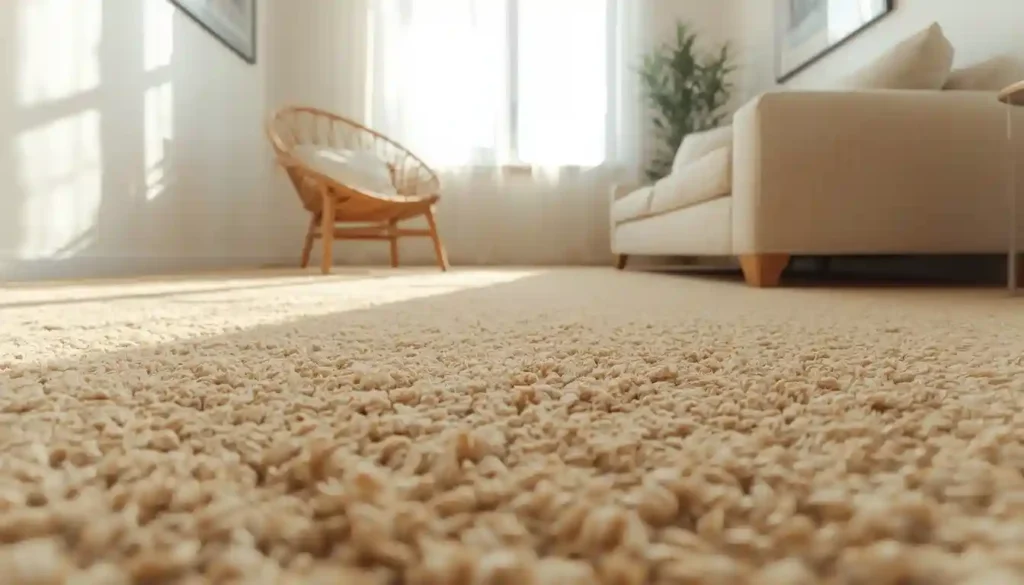
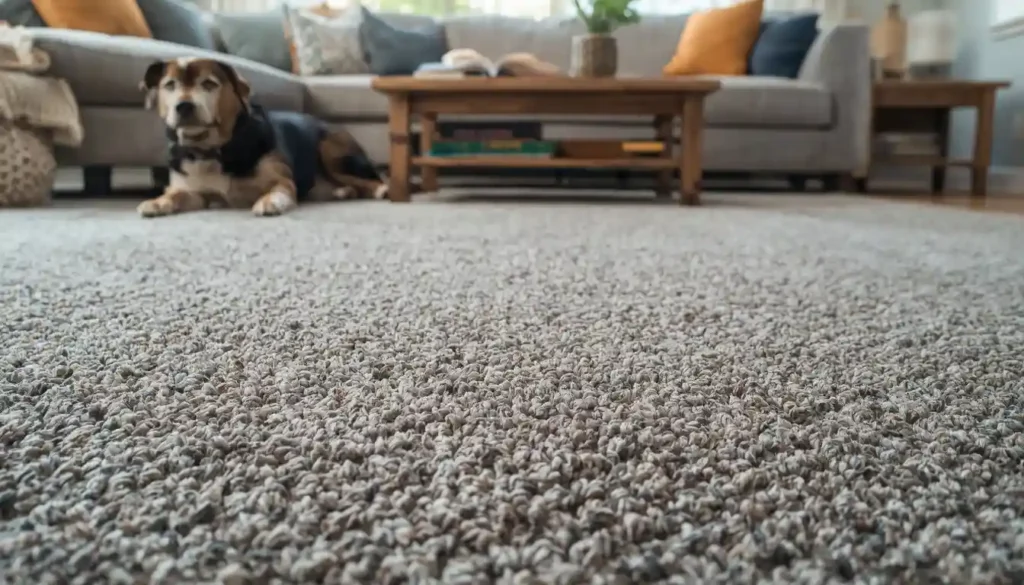
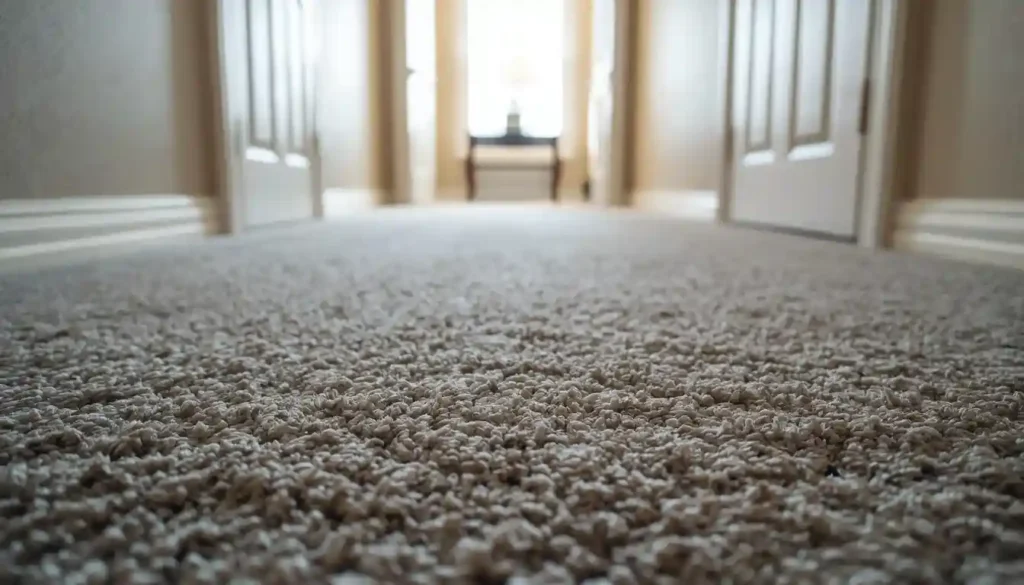
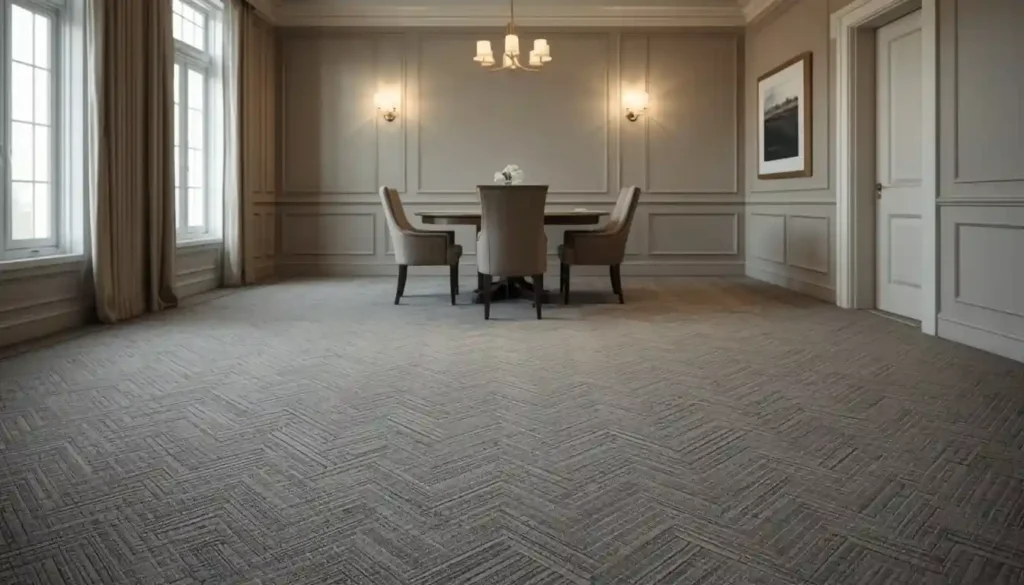
Room orientation matters more than most people expect. A north-facing room receives a cooler, bluish light that can push a cool grey carpet toward icy. A south-facing room floods with warm light that pulls out any yellow undertones hiding in the yarn. The practical fix is to test physical samples in the actual room at multiple times of day before committing — not by looking at swatches on your phone or trusting a screen rendering.
Pile construction determines both comfort and durability. Cut pile, which includes plush, Saxony, and frieze varieties, produces soft, upright fibers that feel luxurious underfoot. Loop pile, including Berber and level loop, keeps fibers attached at both ends, creating a surface that resists crushing and hides traffic patterns far better. For grey carpet specifically, a heathered texture — made by twisting two slightly different yarn shades together — hides surface lint and daily debris significantly better than a solid, flat velvet pile. If your grey carpet is going in a busy family area, the heathered or multi-tonal construction is not a design preference, it is a practical necessity.
With that foundation in place, here are thirteen grey carpet ideas worth actually considering.
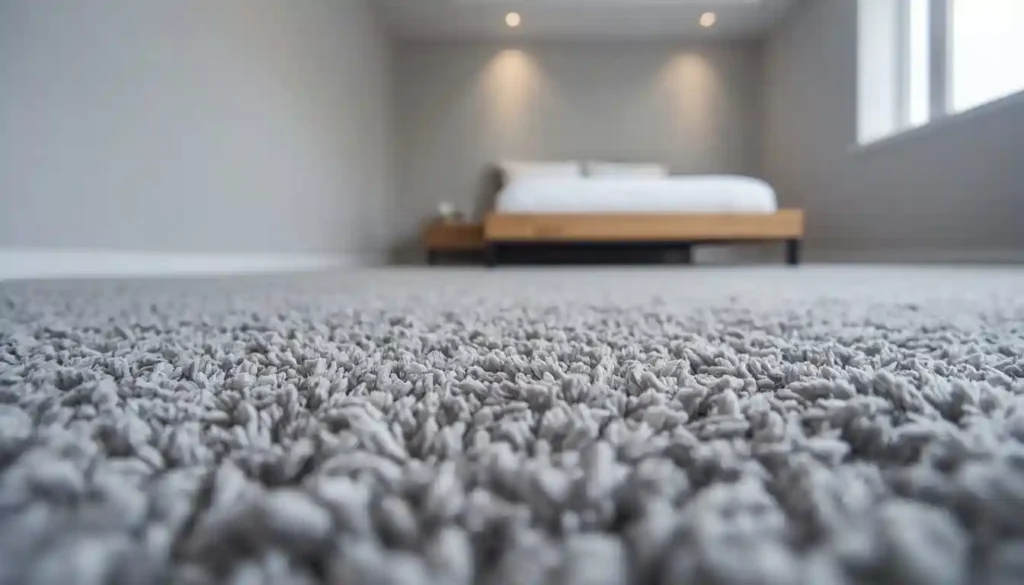
Idea 1: Silver-Grey Plush Carpet in a Minimalist Bedroom
The minimalist bedroom asks a lot of its flooring. Every surface is exposed, every texture is scrutinized, and there is no clutter to hide a bad carpet choice. Silver-grey plush carpet handles this brief well because its flat, even pile reflects light uniformly and reinforces the clean geometry that minimalist spaces depend on.
In this application, the carpet tone should sit slightly lighter than the walls. If the walls are white or a very pale grey, a silver-grey with cool blue undertones creates a soft tonal shift that separates floor from wall without competing. The bed frame should be low-profile — a platform base in natural oak, white lacquer, or matte black all work without disrupting the palette. Bedding in white, cloud grey, or very pale blue extends the calm register of the floor into the room’s main textile surface.
The practical note here: plush cut pile shows footprints and vacuum marks more readily than textured alternatives. In a minimalist space where the floor is always visible, this is worth managing by choosing a medium-density plush rather than an ultra-soft velvet. A medium face weight keeps the soft feel while reducing the shading that causes the carpet to look patchy when viewed at different angles.
Lighting is the finishing variable. Recessed ceiling lights at low intensity, paired with a bedside lamp in a warm kelvin range (around 2700K), prevent the silver-grey from tipping into clinical territory after dark. The contrast between the cooler floor and the warmer ambient light is exactly what gives a minimalist grey bedroom its evening character.
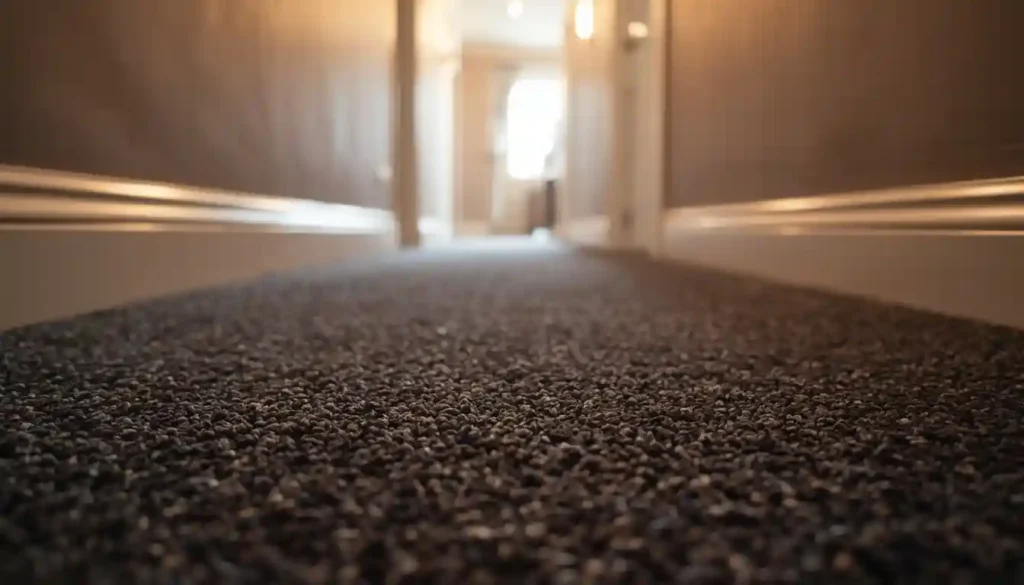
Idea 2: Charcoal Berber Carpet in a High-Traffic Hallway
Hallways are where most carpet choices fail. They take daily punishment from shoes, foot traffic concentrated in a narrow path, and they receive very little natural light. Light-colored carpet in a hallway is almost always a mistake that reveals itself within months. Charcoal Berber is the answer that holds up.
Berber’s looped construction — fibers attached at both ends without cutting — distributes wear across a larger surface area than cut pile. This means the carpet holds its appearance under heavy use far longer. The flecked patterns typical of Berber yarn (small light flecks woven into the dark ground color) break up the surface visually and mask surface lint that would read clearly on a solid, flat pile. In charcoal, this construction produces a floor that looks intentional and maintained with minimal effort.
The wall treatment in a charcoal Berber hallway should go light to maintain proportion. Walls in warm white or soft cream prevent the dark floor from closing in the space. Skirting boards in crisp white create a clean boundary between carpet and wall, and a slim-profile runner rug placed over the Berber at the entrance — in a geometric pattern with the charcoal already present in the design — adds a layer that takes the worst of the entry-point wear.
One caution specific to Berber in homes with cats: loop pile creates a snag risk for claws. If cats are part of the household, opt for a cut pile alternative or a very tight, low-profile loop where the loops are small enough to resist snagging. For dogs and general family traffic with no cats, Berber charcoal is nearly ideal in a hallway context. You can read more about how different types of carpet construction perform in demanding spaces before making a final decision.
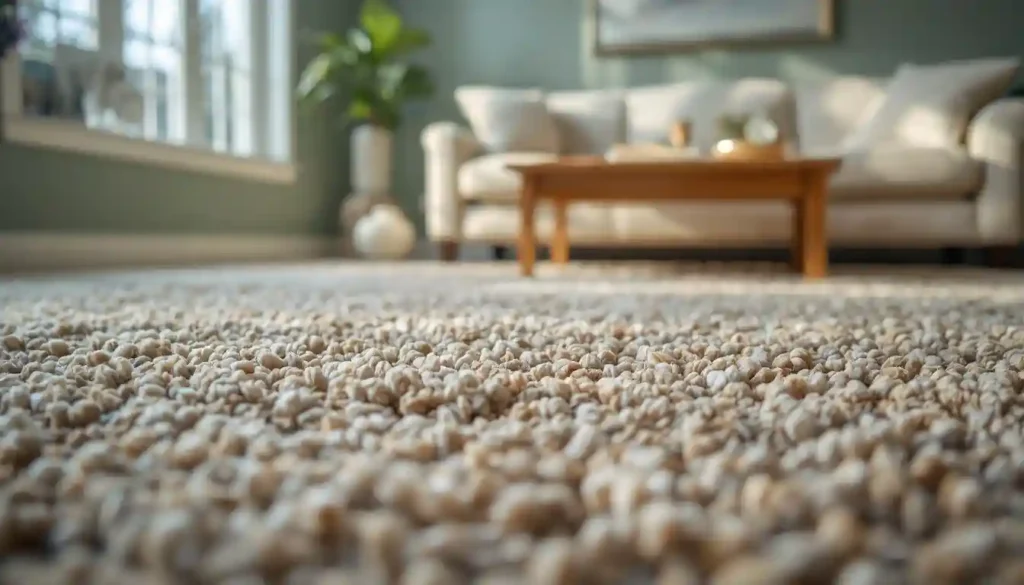
Idea 3: Warm Greige Carpet with Sage Green Walls in a Living Room
Greige carpet — the grey-beige blend that straddles both families — is the natural starting point for living rooms where the furniture is already mixed in tone or inherited rather than purchased as a set. Its warm undertones pull from the beige side under lamplight and lean cooler in daylight, which gives it unusual versatility through the day.
Sage green walls are the pairing that has overtaken the grey-on-grey trend of the previous decade, and for good reason. The combination works because sage green sits in the muted, grayed-down end of the green spectrum, which means its own grey content connects it to the carpet without the two fighting. The green injects just enough of a natural reference into the room to lift the palette beyond pure neutral without demanding that furniture and accessories coordinate tightly.
In the living room, a greige carpet with sage walls creates an anchor that allows for significant furniture flexibility. A cream linen sofa reads warm and soft against both. A dark navy velvet chair introduces contrast without clashing. Natural oak or walnut coffee tables carry the organic warmth of the carpet into the furniture level. The carpet itself should ideally have a low-pile textured cut — Saxony or lightly textured cut pile — so the surface interest comes from the weave rather than requiring bold patterns.
For the textile layering that every carpet-based living room benefits from, add a rug in a slightly deeper greige or a warm ivory over the carpet. The rug defines the seating zone and introduces another texture. Keep window treatments in linen or cotton in a shade close to the wall color to keep the layering from becoming busy.
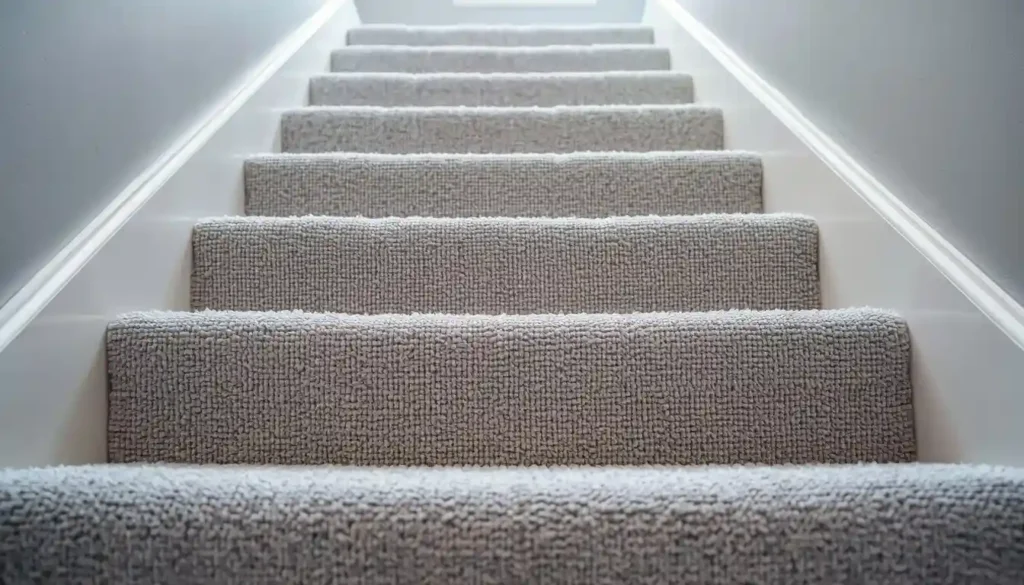
Idea 4: Light Grey Frieze Carpet on Stairs
Stairs present a different engineering problem than flat floors. The tread edge — the front lip of each step where the foot lands — concentrates wear at a single point. Plush carpet on stairs tends to show that wear within a year or two as a visible crush line across each tread. Frieze carpet, with its tightly twisted, slightly curled fibers, distributes this point pressure differently and holds its shape far longer on stairs than any flat-pile alternative.
Light grey frieze on stairs works particularly well when the ground floor has a darker grey carpet or a hard floor in a mid-tone. The lighter staircase creates visual lift and makes the staircase feel like it draws you upward rather than into shadow. The twisted, slightly shaggy surface of frieze also breaks up the regularity of the stair geometry — each riser and tread becomes an individual textured element rather than a flat repetition.
The practical installation note for stair carpet: it should be fitted using the waterfall or the Hollywood method (wrapped tightly around the nose of each tread) rather than cap-and-band if the stairs have a distinctive tread edge you want to show. Gripper rods at each riser base are the installation standard that keeps the carpet taut and prevents it from riding up with foot traffic. A flat-weave stair rod can be added as an aesthetic detail, though it is not structurally necessary in a modern fitted installation. Those who are planning to install carpet on stairs should understand both fitting methods before committing to a style.
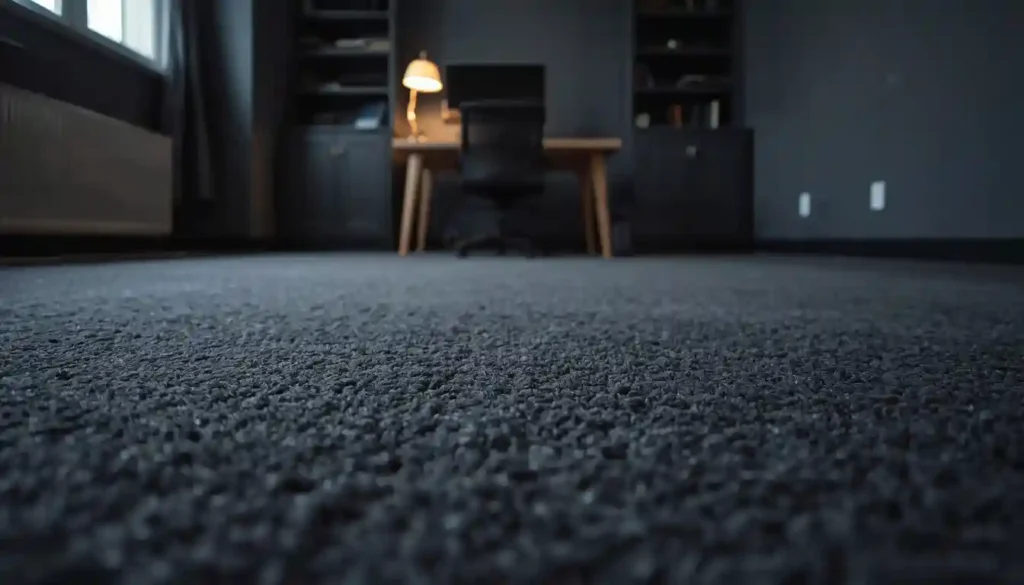
Idea 5: Dark Slate Grey Carpet in a Moody Home Office
The home office has become a room that deserves genuine design consideration rather than the leftover carpet from a bedroom renovation. A dark slate grey carpet — sitting between mid-grey and charcoal, with a subtle blue-purple undertone — sets a register for a work environment that feels focused, quiet, and separated from the rest of the home.
Dark carpet in a home office does something that lighter options cannot: it absorbs rather than reflects visual noise. The floor disappears in your peripheral vision, which leaves the work surface as the dominant element. Combined with deep-colored walls — slate blue, forest green, or even a near-black navy — the effect is a room that reads as a serious, contained space rather than an extension of the living area.
The furniture strategy in this room should avoid matching the carpet’s darkness too closely. A light oak desk or a white lacquered surface stands out clearly against the dark grey floor. A midtone leather chair in tan or cognac introduces a warm accent that the slate grey contains rather than fights. Shelving on the walls in a contrasting color keeps the books and objects readable rather than merging into the dark background.
Acoustically, dark cut pile carpet in a home office delivers genuine benefit. The mass of the pile absorbs mid-frequency sound — keyboard clicks, phone audio, general room echo — in a way that hard floors cannot. The office becomes a quieter space to work in, which matters more than most people expect until they have experienced it. If sound performance across your whole home is a priority, understanding the broader silent flooring options available for different rooms helps you choose strategically.
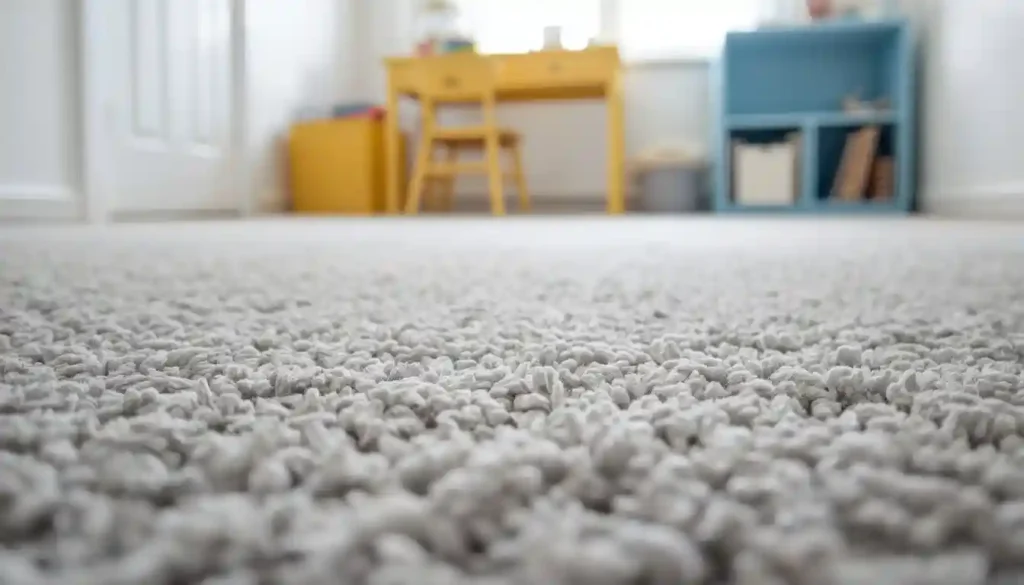
Idea 6: Light Grey Loop Pile Carpet in a Children’s Bedroom
Children’s bedrooms ask for a carpet that can handle play, spills, dropped toys, and an unpredictable cleaning schedule while still looking considered from a design perspective. Light grey in a loop pile construction threads the needle between practical and polished better than almost any other carpet choice for this room.
The loop pile is the functional decision. Its tightly woven surface does not show footprints or vacuum marks the way plush does, and because it sits close to the backing, small objects — toy pieces, crumbs, craft materials — stay near the surface rather than disappearing into a deep pile where they are harder to retrieve. Loop pile in grey also offers a surface that is firm enough for building with blocks and playing on the floor without the give of a high-pile option.
The grey does the design work. A light grey floor creates a neutral canvas that allows the child’s furniture, toys, and textiles to define the room’s personality without the floor competing. A bright yellow desk, a red bookshelf, or a multicolored rug layered over the carpet all read clearly against a light grey base. As the child’s preferences change — and they will, usually every couple of years — the floor stays compatible with whatever the new theme demands.
Stain resistance is the material question. Nylon loop pile in a heathered light grey is the most resilient choice because nylon offers the best crush recovery and responds well to stain treatment. Wool loop pile performs almost as well but costs considerably more. Polyester loop pile is the budget-friendly option, though it tends to mat down faster in a space that sees heavy play activity. For families with children, the carpet type matters as much as the look — understanding the best carpet materials helps you prioritize durability without sacrificing comfort.
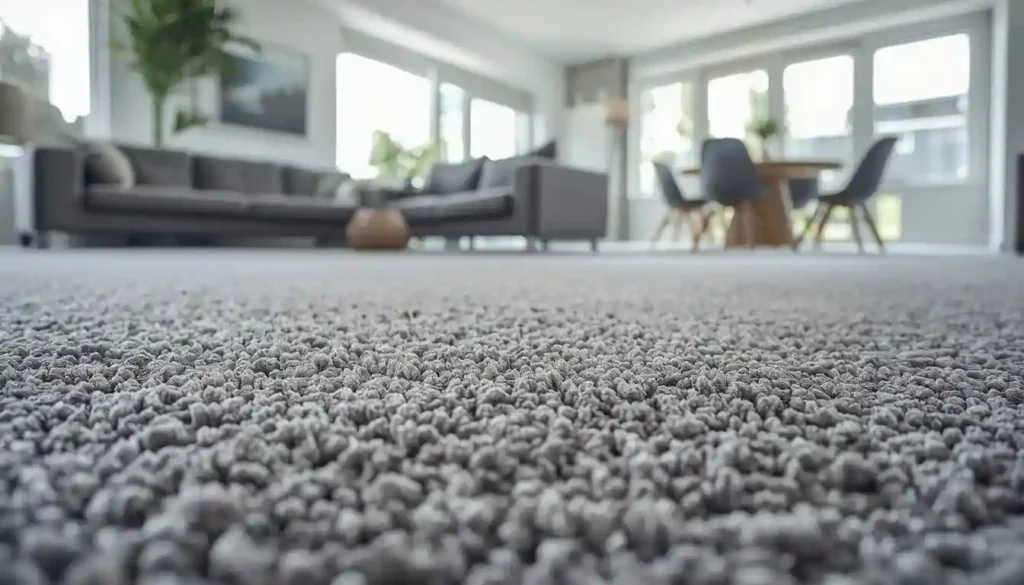
Idea 7: Mid-Grey Textured Cut Pile in an Open-Plan Living and Dining Space
Open-plan spaces with carpet present a challenge that goes beyond color selection: the flooring needs to unify the space while still allowing the different functional zones — seating, dining, circulation — to read as distinct. Mid-grey textured cut pile carpet is the format that handles this best, because its surface variation reads differently depending on the viewing angle, which creates subtle visual zoning without hard borders.
The textured cut pile (sometimes called Saxony or multi-twist) has fibers of slightly varying heights cut at different angles. When you walk around a room with this carpet, the same floor changes tone depending on where you stand and how the light hits it. This natural variation defines the seating area from the dining area simply through the reading of the pile direction — no threshold strip, no rug boundary required, though a rug over the seating zone still works well as a layering option.
Mid-grey is the specific shade choice because it reads neither dramatically light nor dramatically dark. In open-plan spaces with high ceilings or large glazed areas, a very light carpet can read washed out and formless. A very dark carpet in a large open plan can feel oppressive, particularly under artificial light in the evening. Mid-grey sits in the range that holds its visual weight through all lighting conditions without dominating the space.
Furniture placement on carpet in an open plan should respect a simple rule: all legs of a seating grouping either on the rug or all off it, not a mix. In the dining zone, the table and all chairs should sit fully on the carpet when the chairs are pushed in. The carpet beneath a dining table requires particular consideration if the household eats three meals a day at that table — consider a stain-treated or solution-dyed nylon in mid-grey, which resists food spills better than untreated alternatives.
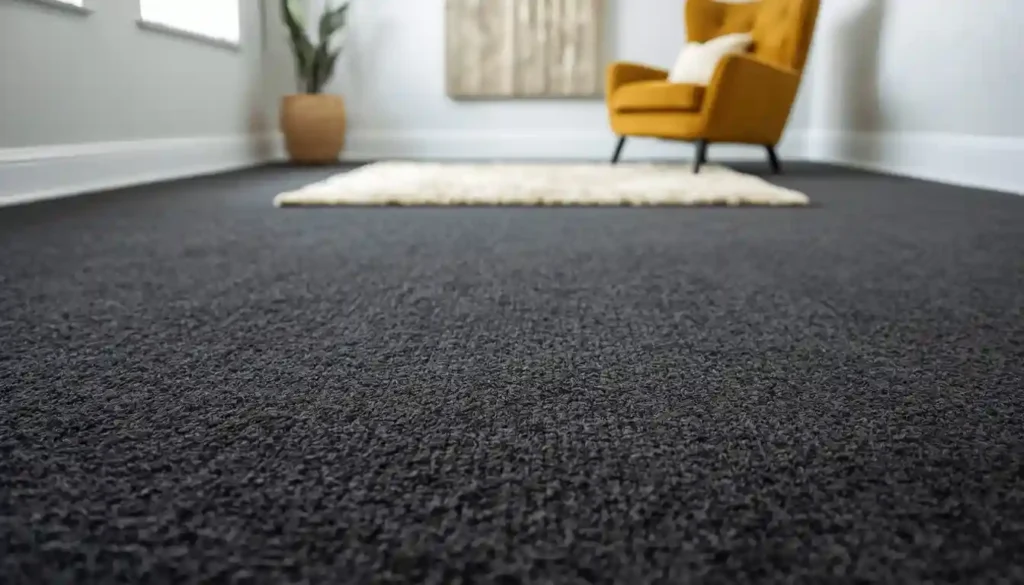
Idea 8: Charcoal Carpet with White Walls and Bold Accent Colors
This is the idea that surprises people who assume dark carpet makes a room feel small and heavy. When paired with white walls and deployed alongside a single bold accent color, charcoal carpet does the opposite — it anchors the room, makes the white appear brighter through contrast, and gives the accent color a dramatic stage to perform on.
The mechanics of this work because of simultaneous contrast: adjacent colors appear more saturated when placed next to a neutral opposite. Charcoal is as close to a neutral opposite as carpet gets. A mustard yellow armchair against charcoal carpet and white walls reads at full intensity. A terracotta cushion group pops. A deep forest green throw appears jewel-like. None of those accent choices would produce the same visual result against a light or mid-grey floor.
The white walls are not negotiable in this pairing. Dark carpet with dark or saturated walls can work — it is the moody, immersive bedroom approach — but in a living room or reception room where you want the accent color to drive the character, white gives the charcoal room to function as a base without competing with the walls for attention.
A cream or ivory rug layered over the charcoal carpet in the center of the seating zone is one of the most effective ways to modulate this idea. The rug introduces a midtone that bridges the contrast between charcoal floor and white walls, preventing the room from reading as too stark in natural daylight. A textured weave rug — jute, wool, or a chunky cotton flatweave — in cream adds material warmth that the charcoal pile alone cannot provide.
Idea 9: Pale Grey Carpet in a Master Bedroom with Warm Timber Furniture
There is a specific combination that designers return to repeatedly because it works across almost every style register: pale grey carpet, warm timber furniture, and soft textile layering. It works because grey and wood are natural complements — grey is the visual residue of aged timber, the color that weathered oak or driftwood arrives at over decades, and putting the two together in a bedroom touches something that reads as organic and settled rather than designed.
The pale grey for this application should lean slightly warm — a greige or warm dove grey rather than a cool ice grey. Cool pale grey next to warm timber furniture creates a subtle clash where the two neutrals fight for warmth dominance. The warm-leaning pale grey connects with the honey or amber in natural oak, walnut, or pine furniture without the floor disappearing into the same color family as the wood.
Bedding is the layer that ties the combination together. Linen in natural or undyed tones sits perfectly on pale grey carpet with timber furniture. A textured knit throw in a deeper warm grey adds depth without introducing color. Cushions in dusty terracotta, muted clay, or soft olive are the accent options that connect to both the warm timber and the neutral carpet without pulling the room away from its calm character.
This combination also handles changing light conditions gracefully. In morning light, the pale grey carpet and warm timber produce a room that feels fresh and airy. By evening with warm lamp light, the same room feels enclosed and restful. That dual performance through the day is one of the reasons this combination continues to appear in bedroom design regardless of the prevailing trend cycle. For those who want to understand how carpeting can genuinely transform a sleep space, the deeper guide on bedroom carpet flooring ideas explores several more directions worth considering.
Idea 10: Grey Carpet Tiles in a Home Gym or Basement Flex Room
Carpet tiles in grey are a different product category from broadloom, and they solve a different set of problems. In a home gym, basement media room, or flex space that needs to function as both a workout area and a usable living zone, carpet tiles offer modular installation, easy replacement of individual damaged sections, and the ability to create pattern through a mix of grey tile shades without requiring professional fitting skills.
For a home gym context, commercial-grade nylon carpet tiles in a dark charcoal or mid-grey loop pile offer the impact absorption that equipment use requires while providing a surface that is far more forgiving underfoot than bare concrete or even hard vinyl. The tile format allows you to leave the area under heavy fixed equipment — a rack, a treadmill base — in a different material or simply uncarpeted, and to carpet only the movement areas, the lifting platform zone, or the stretching area.
In a basement flex room where the function changes between gym and media or hobby space, carpet tiles in two or three shades of grey can be laid in a simple grid pattern that creates a visual zone map. Lighter grey tiles in the seating area, darker charcoal in the activity zone. The pattern does not need to be complex — a simple checkerboard or a bordered-field layout with a lighter perimeter and a darker central zone reads as intentional design rather than DIY improvisation.
The installation advantage is significant for basement spaces where moisture is a variable. Individual tiles that show moisture intrusion can be lifted, dried, and replaced without disturbing the surrounding floor. This is a major practical benefit that broadloom carpet cannot offer in a basement context.
Idea 11: Heathered Grey Carpet in a Family Living Room
A family living room is a high-traffic, multi-use space where the carpet takes spills, pet traffic, shoe scuffing from the back door, and regular rearranging of furniture. The heathered grey carpet — produced by twisting two or more yarn colors together, typically a light and mid grey or a grey and a warm beige — is the construction most specifically designed for this situation.
The heathered or tweed-effect surface breaks up the single tone into a subtle mixed ground. This does several things simultaneously. It hides the surface lint and daily debris that appear between vacuum sessions. It masks the pile direction changes that happen when furniture is moved or traffic wears certain paths through the room. And it gives the floor a visual complexity that pure flat grey cannot achieve, which means the room looks more designed and less utilitarian.
The color combination within the heathered yarn matters. A grey-and-warm-beige heather produces a carpet that reads as warm grey overall — greige on the wall, greige on the floor. A grey-and-cool-cream heather produces something more silver, better suited to rooms with cool light or modern white-painted furniture. A grey-and-charcoal heather produces a deeper, more dramatic surface that works well in larger rooms where you want the floor to have visual weight.
For family rooms specifically, the fiber choice should be nylon rather than polyester or wool. Nylon offers the best resilience under heavy furniture compression and the best response to stain removal products — both of which matter considerably in a room with children and regular activity. Solution-dyed nylon, where the color is part of the fiber’s molecular structure rather than a surface coating, is the most stain-resistant heathered grey option available in residential carpet.
Idea 12: Grey Carpet as the Connecting Floor Through Multiple Adjacent Bedrooms
In homes where multiple bedrooms open off the same landing or hallway, using a single grey carpet through all of them creates a sense of flow that individual room-by-room flooring choices cannot provide. The landing carpet and each bedroom carpet form a continuous visual surface, which makes the upper floor read as a cohesive private zone rather than a collection of independent spaces.
The grey for this connecting application should be mid-range in both tone and undertone neutrality. A strongly cool grey will look blue in some rooms and correct in others depending on window orientation. A heavily warm greige will read differently in the north-facing bedroom than in the south-facing one. A neutral mid-grey with a slight warm lean handles the variation across room orientations better than a strongly directional undertone.
Within each individual bedroom, the occupant’s furniture and textiles define the room’s character independently of the shared floor color. This is the specific practical advantage of a shared grey carpet: the floor imposes no design constraint on the room’s personality. One bedroom can be decorated in blues and whites, another in warm terracottas, a third in deep green, and the shared grey floor connects them through the landing without forcing any coordination between the individual rooms.
The installation consideration for this approach is carpet weight and pile height consistency. If all bedrooms and the landing use the same carpet, the transition through doorways is seamless. If the landing uses a different pile height or weight, a threshold strip is required and the visual continuity is broken. Matching the pile height exactly through all spaces is the detail that makes this idea work as intended.
Idea 13: Grey Patterned or Cut-and-Loop Carpet for a Formal Living Room or Dining Room
Solid grey carpet reads as relaxed and contemporary. Grey in a patterned construction — cut-and-loop, where sections of the pile are cut while others remain looped to create a raised geometric pattern — reads as considered and formal without becoming decorative in the way a printed or woven-pattern carpet does. For a formal living room or dedicated dining room where the design standard is deliberately elevated, patterned grey cut-and-loop carpet brings the floor into the design vocabulary of the room rather than leaving it as a blank base.
The pattern options in cut-and-loop grey carpet range from subtle diamond lattices and tone-on-tone geometric repeats to more assertive ogee or scrollwork patterns. The grey-on-grey execution — where the cut pile and the loop pile are different shades within the same grey family — produces pattern that reads clearly from above but does not shout from across the room. This is a quality that solid-color carpet can never replicate and printed-pattern carpet often overplays.
For a formal dining room, the pattern density matters. A close, fine-scale geometric in grey cut-and-loop handles the visual competition of a dining table, chairs, and the table setting above it without feeling cluttered. A large-scale pattern with open negative space reads better in a room where the floor is more visible — a formal sitting room with a low, central coffee table rather than the visual density of a full dining setting.
The care consideration for patterned cut-and-loop is vacuum direction. Vacuuming with the pile direction, rather than across or against it, preserves the crisp definition of the cut-and-loop contrast. Going against the pile direction with a heavy upright vacuum can begin to feather the cut tufts across the loop sections, softening the pattern over time. A regular care routine that respects the pile direction keeps the pattern reading clearly for the life of the carpet. If you’re comparing carpeting options for different rooms in your home, a side-by-side look at the full pros and cons of carpet flooring is useful context.
How to Choose Between These Grey Carpet Ideas
Thirteen ideas covering a range of rooms, pile constructions, and shade variations make it easy to identify the approaches that fit your specific situation, but the selection process is worth narrowing down with a few targeted questions.
The first question is traffic. High-traffic spaces — hallways, family living rooms, home offices used daily — need loop pile or tightly twisted cut pile. Light-traffic spaces — guest bedrooms, formal dining rooms, studies used occasionally — can work with softer, less dense options like plush or Saxony cut pile. Getting this wrong is the most common and most visible carpet mistake: soft plush carpet in a busy hallway that shows wear within months.
The second question is room orientation. North-facing rooms need a grey with warm undertones to prevent the floor from reading cold in the dominant blue light those rooms receive. South-facing rooms have more flexibility because their warmer light pulls warmth from any grey. East and west-facing rooms change character significantly through the day — a neutral grey with no strong directional undertone is the safest choice here.
The third question is what the carpet needs to connect with. If the furniture is already in place and the carpet is being chosen to work with it, identify the undertone of the dominant furniture piece — the sofa, the bed, the dining table — and match the carpet’s undertone to complement rather than compete with it. Cool grey furniture pairs best with cool grey carpet and cool-toned walls. Warm timber furniture pairs best with warm grey or greige carpet.
For anyone comparing carpet as a floor covering against hard flooring alternatives in the same space, understanding the specific performance differences matters. Carpet genuinely outperforms hard floors on thermal insulation — a fact that affects heating costs in rooms used year-round — and the insulation benefits of carpet make a meaningful difference in bedrooms and living rooms through winter months.
The fourth question is budget. Grey carpet spans an enormous price range, from basic polyester loop tile at a few dollars per square foot to wool Saxony at over $15 per square foot before installation. The fiber, the face weight, the pile density, and the backing system all contribute to the price. Within your budget, prioritize face weight and fiber quality over decorative features — a dense, high-quality nylon in a simple texture will outlast and outperform a low-density polyester in a complex pattern at the same price point.
Grey Carpet and the Rooms Where It Falls Short
Grey carpet is versatile, but it is not universal. There are environments where it is not the right choice regardless of which shade or pile construction you select.
Bathrooms and laundry rooms are the obvious exclusions. The moisture levels in these spaces create conditions where carpet backing degrades, mold develops beneath the pile, and the surface never fully dries between uses. No shade of grey carpet holds up to sustained moisture exposure in a residential bathroom context — hard waterproof flooring is the correct specification for these rooms.
Kitchens present a similar problem with grease rather than moisture. Grey carpet near cooking surfaces absorbs airborne grease particles that become embedded in the pile and produce a surface that is both difficult to clean and develops an unpleasant odor over time. The area immediately adjacent to cooking surfaces should always be a hard floor, regardless of how much the rest of the kitchen might benefit from the softness and sound absorption of carpet.
Rooms with high direct sunlight exposure can cause problems for certain grey carpet fibers. Polyester carpet in particular is vulnerable to UV fading, and a grey that has bleached unevenly through the pile length will look patchy and aged within a few years in a south-facing room with large, uncovered windows. Solution-dyed nylon or natural wool are significantly more UV stable — both should be chosen for sun-exposed rooms over untreated polyester.
For spaces where carpet is ruled out entirely but you still want the soft, warm quality that hard floors cannot provide, the comparison between carpet and vinyl flooring is a useful framework for understanding what each format does and does not deliver in different room types.
Caring for Grey Carpet Over the Long Term
Grey carpet’s maintenance profile is one of its genuine advantages. The mid-tone nature of grey sits in a range where neither light dust nor dark debris reads immediately — it occupies a visual middle ground that allows for a forgiving maintenance schedule compared to very light or very dark carpet.
The heathered or multi-tonal constructions described in several ideas above are specifically engineered to extend that forgiving quality. The mixed yarn colors mean that surface lint, pet hair in natural shades, and the everyday debris of a busy household tend to blend into the carpet surface rather than appearing as obvious contrast. This is not a reason to vacuum less frequently, but it does mean that the carpet looks maintained between sessions rather than obviously neglected.
Vacuuming frequency should match the traffic level of the room. High-traffic areas like hallways and family living rooms benefit from vacuuming two or three times per week. Bedrooms and low-traffic formal rooms can typically be maintained on a once-weekly schedule. The vacuum setting matters: a beater bar or rotating brush is appropriate for cut pile carpet, while loop pile, particularly Berber, performs better with suction-only mode to avoid distorting the loops.
Stain treatment on grey carpet should always begin with blotting rather than rubbing. Rubbing pushes the stain material deeper into the pile and spreads the affected area. Blotting from the outside of the spill inward lifts the material without driving it further into the fiber. Most water-based spills on nylon grey carpet respond well to cold water and a small amount of dish soap worked gently into the pile and rinsed clear. Oil-based spills require a dry-cleaning solvent before the water-based treatment. For persistent stains, enzyme-based cleaners are effective on organic materials — food, pet accidents, biological matter — and are safe for nylon and polyester grey carpet without bleaching the dye.
Professional deep cleaning once every twelve to eighteen months is the maintenance interval most carpet manufacturers recommend for residential carpet in regular use. Steam cleaning is the most effective method for grey carpet that has accumulated embedded soil through normal use — the heat and moisture penetrate the pile and the backing to release material that regular vacuuming cannot reach. Understanding the full range of professional carpet cleaning methods available helps you choose the right service for the carpet construction and soil type you are dealing with.
What These Grey Ideas Add Up To
Grey carpet does not have a single story. It is a family of tones, constructions, and surface treatments that serve fundamentally different purposes across thirteen distinct contexts — from the acoustically quiet home office to the hard-wearing children’s bedroom, from the formal dining room patterned floor to the connecting landing carpet that flows through a whole upper storey of a house.
The ideas in this article are not style suggestions. They are systems: specific combinations of shade, construction, room orientation, and furniture pairing that produce predictable, reliable results. When you take a grey carpet idea that was designed for a formal dining room and try to apply it to a family hallway, it will fail. When you apply the heathered nylon loop pile idea to the family living room it was designed for, it will hold up and look considered for years.
Start with the room, the traffic it handles, and the light it receives. Choose your shade within grey’s broad family based on undertone compatibility with what already exists in the room. Select the pile construction that matches the functional demands of the space. And give the floor appropriate care through the first few years while the carpet settles into its full appearance.
Grey carpet chosen this way does not look like a default. It looks like a decision — and there is a significant visual difference between the two. For anyone weighing the broader question of which room types and living situations benefit most from carpet versus other floor covering categories, the comprehensive look at carpet flooring services and what professional installation involves is a practical next step before making any final commitment.
James Miller is a seasoned flooring contractor with years of hands-on experience transforming homes and businesses with high-quality flooring solutions. As the owner of Flooring Contractors San Diego, James specializes in everything from hardwood and laminate to carpet and vinyl installations. Known for his craftsmanship and attention to detail, he takes pride in helping clients choose the right flooring that balances beauty, durability, and budget. When he’s not on the job, James enjoys sharing his expertise through articles and guides that make flooring projects easier for homeowners.
Your dog just skidded across the hallway and left a fresh trail of muddy paw prints. Your cat has been using the corner of the living room floor as a scratching post. Sound familiar? If you share your home with pets, you already know that not every floor is built to survive them. The good…
11 Budget Tile Flooring Ideas That Look Like They Cost Twice as Much Tile has a reputation problem. Most people hear the word “tile” and assume it comes attached to a contractor quote that makes their eyes water. That reputation is partly deserved when you are shopping for natural marble or hand-painted cement encaustic tiles,…
Pets are not allergic to laminate flooring itself, but the formaldehyde released from laminate’s adhesive resins can cause chemical irritation in dogs and cats — particularly in poorly ventilated spaces with newly installed, low-certification products. The question is almost always asked the wrong way. People ask whether pets are allergic to laminate flooring when the…
Every flooring decision in a pet household eventually runs into the same three problems: claw marks that deepen over time, urine that seeps into seams before you can wipe it, and surfaces that become genuinely dangerous when a wet dog decides to sprint across them. Most flooring categories fail at one of these three points….
Parquetry flooring is not a flooring type. It is an installation method — one where short wood blocks or strips are arranged into repeating geometric patterns to create a floor that carries visual weight no plank flooring can replicate. Herringbone, chevron, basketweave, Versailles: every one of these patterns makes alignment the job. Get the geometry…
A carpet snag is a fiber or loop that has been pulled above the surface of the carpet pile, creating a raised strand that sits visibly higher than the surrounding tufts. The term covers two structurally different events: a pulled fiber in a cut-pile carpet, where an individual strand lifts and separates from the weave,…