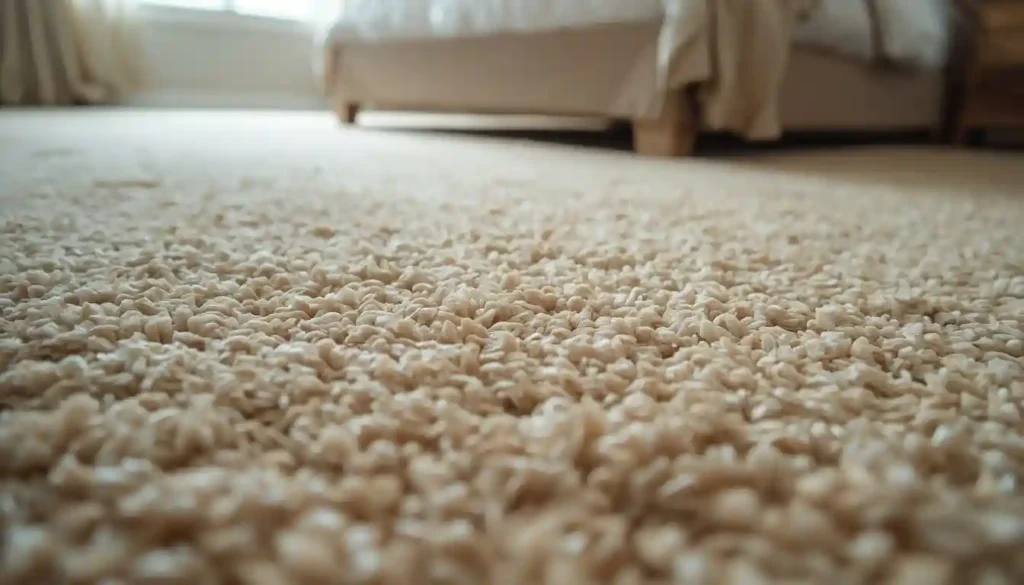
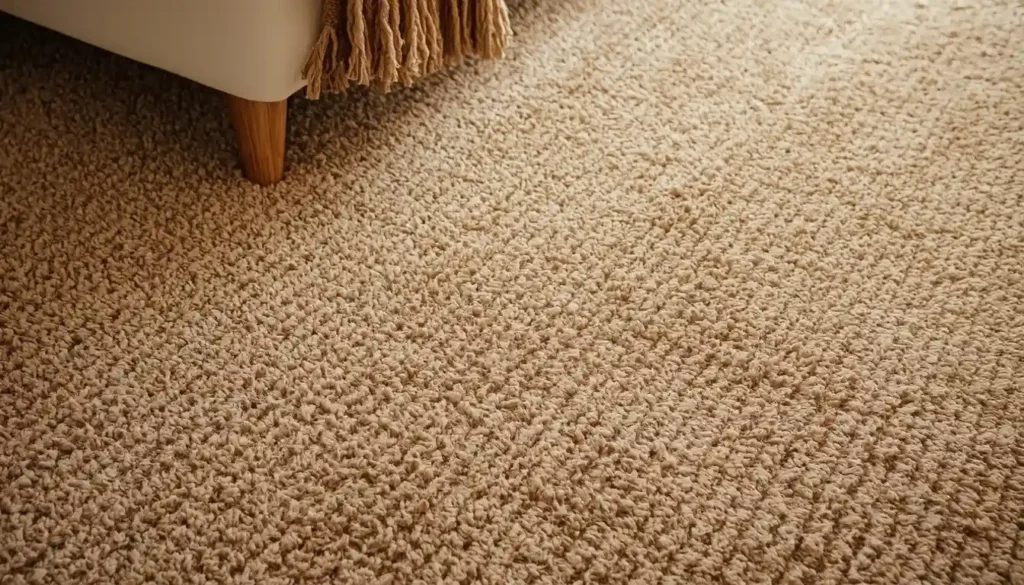
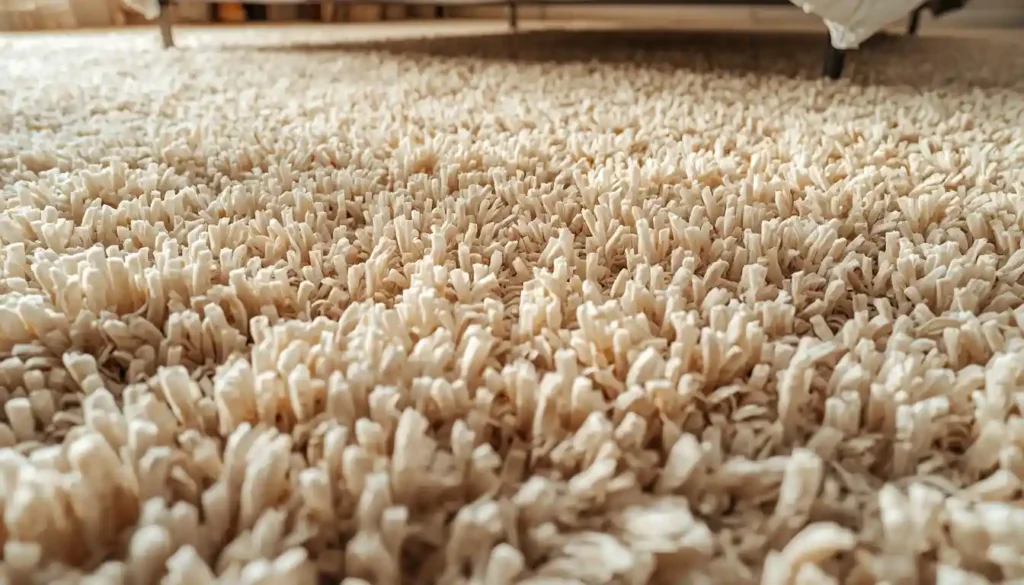
The tradeoff is honesty: plush carpet in pale tones shows everything. Footprints appear with every step. Vacuum tracks are visible. Spills need immediate attention. For a couple with no pets and a habit of removing shoes at the door, this is a manageable reality. For a household with children or dogs, the same carpet becomes a source of daily frustration. In those situations, consider a warm neutral in a slightly deeper tone — sand, light tan, or warm greige — which delivers the same color temperature with considerably more concealment.
Pile height matters here. True plush carpet sits between half an inch and three-quarters of an inch. Anything shorter approaches saxony territory, which has a slightly more formal character. Anything longer crosses into shag, which has a completely different visual personality. Stay within the plush range for a bedroom look that feels classic without being stiff.
2. Light Grey Textured Cut Pile — Modern Neutrality With Depth
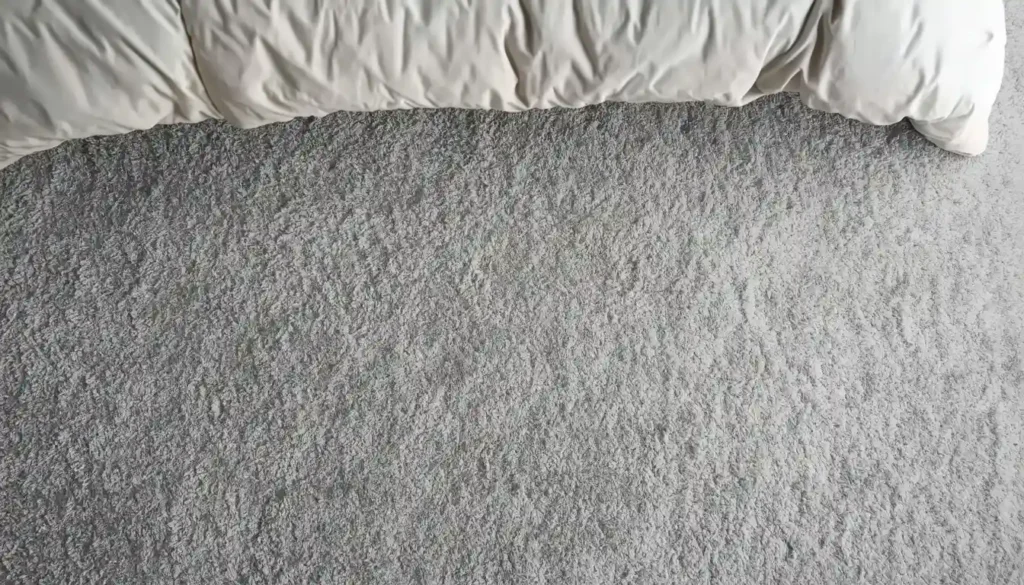
Light grey has become one of the most requested bedroom carpet colors over the past several years, and its continued relevance into 2025 and 2026 is not a trend — it is a structural shift in how people think about bedroom color palettes. Grey sits at the intersection of cool and neutral, which means it pairs with virtually every wall color, furniture finish, and textile scheme without competing for attention.
The key distinction to make within this category is between solid grey plush — which reads flat and smooth — and textured grey cut pile, which incorporates slight variation in fiber height or twist to create a subtly dimensional surface. That texture does important work in a bedroom. It breaks up the monochromatic quality of a fully grey room, provides visual interest at floor level without introducing a pattern, and conceals everyday wear, footprints, and minor soiling far more effectively than plush in the same color.
Textured cut pile is sometimes called “trackless” carpet, though that is a marketing term rather than a technical one. The texture simply means that compressed fibers recover and reorient in ways that make compression patterns less visible. In a bedroom where the foot traffic is primarily one or two people moving between the door and the bed, this difference may seem academic — but in a master bedroom with a seating area or a reading chair that sees regular use, the practical benefit becomes real.
For color calibration: light grey carpet benefits from warm-toned wall colors rather than cool ones. Pale blush, soft terracotta, warm white, and dusty sage all work well against light grey flooring. Pairing cool grey carpet with cool grey walls creates a flat, emotionally cold room that few people find restful. The warmth needs to come from somewhere — walls, textiles, or furniture — and grounding it in the carpet color first makes the entire scheme easier to build.
3. Deep Charcoal Carpet — Dramatic Anchor for a Sophisticated Bedroom
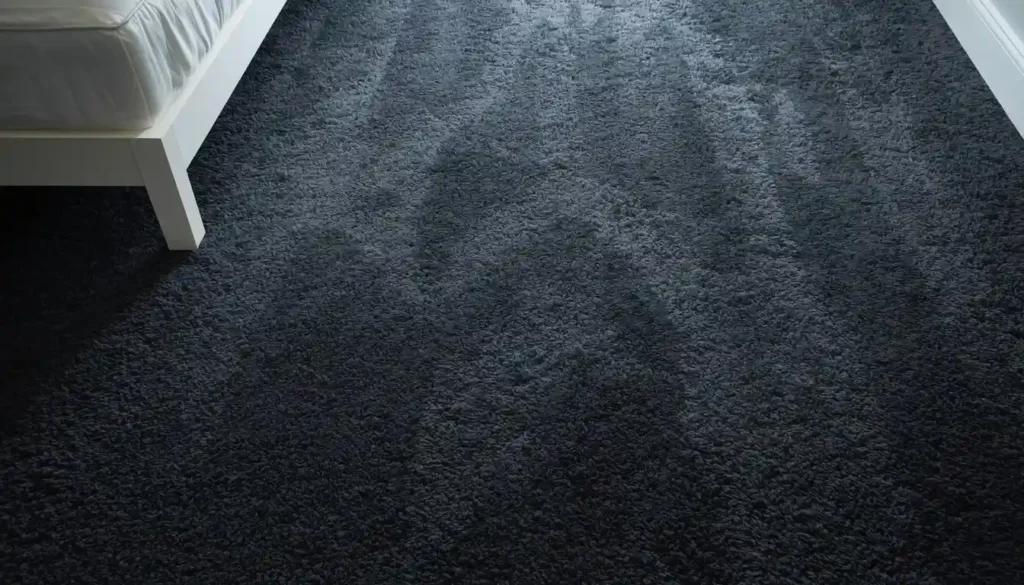
Dark carpet in the bedroom is an underutilized idea, which is surprising given how effectively it solves specific design problems. A deep charcoal, slate, or near-black carpet grounds a room with drama and intentionality that pale options simply cannot replicate. Rather than making the space feel small — the most common objection — a well-deployed dark carpet creates a sense of contained luxury, similar to the effect of dark walls in a boutique hotel room.
The conditions under which dark carpet succeeds in a bedroom are specific. The room needs adequate natural or artificial lighting — not more light than usual, but enough that the floor is not swallowed by shadow. The furniture and walls need to contrast with the floor rather than merge into it. White or very pale furniture against deep charcoal carpet produces one of the cleanest, most deliberately designed looks available in residential interiors. Light walls — crisp white, pale warm grey, or soft ivory — keep the room from feeling cave-like.
From a practical standpoint, dark carpet has one significant advantage that is rarely mentioned in design discussions: it hides dark debris. Pet hair, dust, and most tracked-in dirt blend into a charcoal or near-black carpet in ways they absolutely do not on cream or pale grey. The tradeoff is light debris — lint, crumbs, light-colored pet hair — which shows clearly. If your household generates more dark mess than light mess, dark carpet is genuinely practical as well as visually striking.
Fiber choice matters more at this end of the color spectrum. Dark dyes are harder to achieve in lower-quality fibers without uneven uptake that shows as tonal variation. Nylon and wool hold deep, even color better than polyester at very dark shades. Invest in fiber quality when going dark to avoid the mottled, faded appearance that cheaper dark carpets develop within a few years.
4. Soft Sage Green Carpet — The Nature-Influenced Bedroom Floor
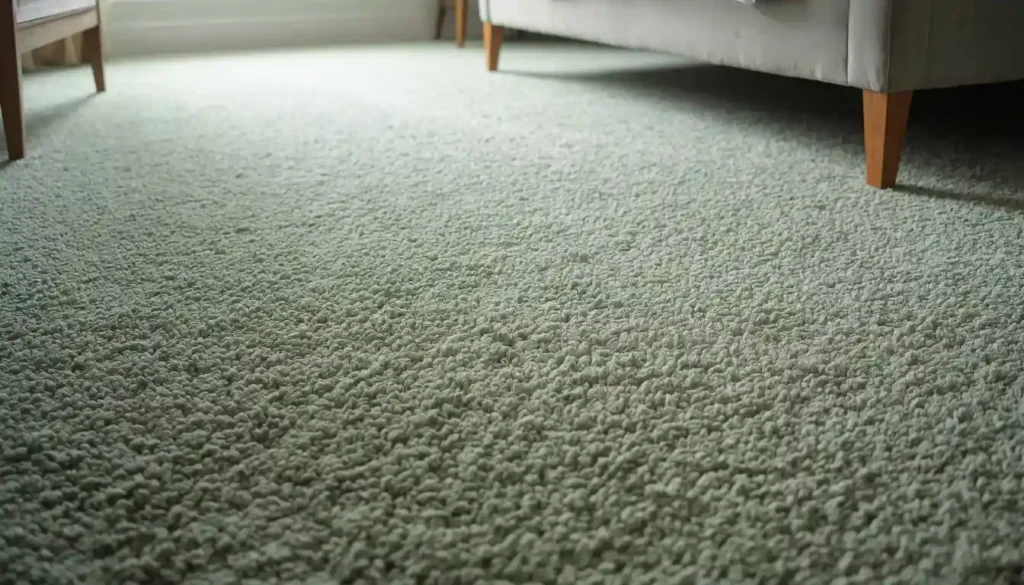
Sage green carpet represents the clearest intersection of the biophilic design movement and bedroom flooring. The color sits in a muted, desaturated middle ground between true green and grey, which means it reads as a natural, organic tone rather than a bold color statement. That quality makes it unusually versatile: sage carpet works in contemporary minimalist bedrooms, in botanical-themed spaces layered with natural materials, and in traditional bedrooms where it reads as a quieter version of classic green.
The psychological dimension of sage green in a sleep space is worth taking seriously. Research into color and sleep environments consistently identifies muted greens as among the most restful tones for bedroom walls and textiles. On a floor, sage green carries that same quality without the intensity of a painted wall. It introduces color without stimulation — a useful distinction in a room designed for rest.
Sage carpet pairs most naturally with warm wood tones in furniture and bedframes. The earthy warmth of walnut, oak, or bamboo against sage green flooring creates a layered natural palette that is cohesive without being calculated. White and cream bedding completes the scheme without competing. Avoid pairing sage green carpet with cool metallics or very bright accent colors; they clash rather than complement the organic quality of the floor.
In terms of pile type, sage green works particularly well in a cut-and-loop texture, where the variation between cut and uncut fibers creates a subtle surface pattern that adds depth to the color. The pattern prevents the saturated tone from reading as flat or monotonous across a large floor area.
5. Wall-to-Wall Berber — Low Maintenance With a Contemporary Edge
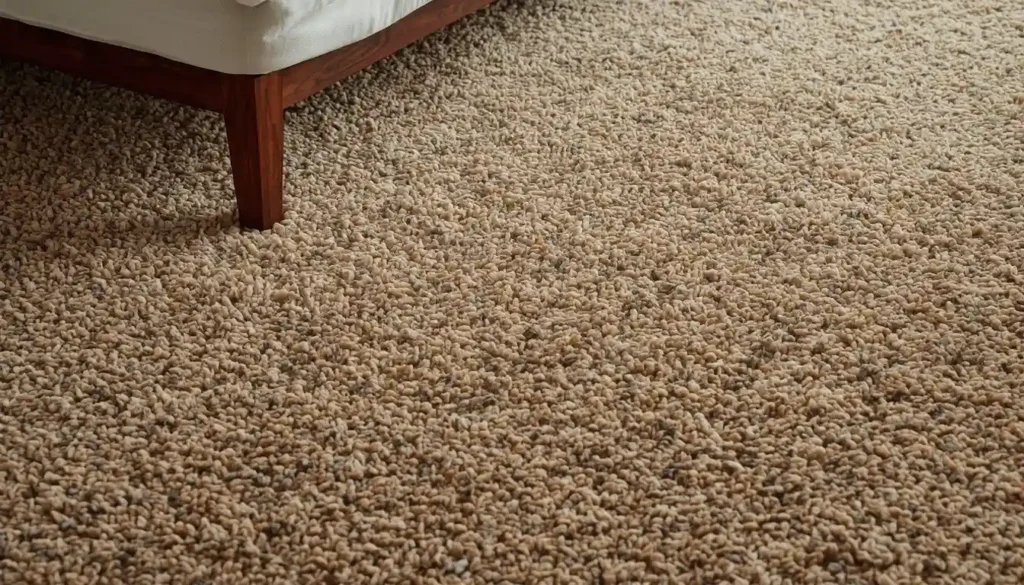
Berber carpet is named for the North African weaving tradition that inspired the construction method: uncut loops of fiber set at a consistent height, creating a dense, tight surface with a distinctive flecked or speckled appearance. In modern residential applications, Berber typically refers to any loop-pile carpet with a speckled, multi-tonal colorway — usually a cream, tan, or grey base with flecks of darker fiber woven through it.
The loop construction has two practical consequences in a bedroom. First, Berber is significantly more durable against compression than cut-pile carpets. Where plush or saxony flatten under heavy furniture, Berber’s loops resist crushing more effectively, meaning the carpet maintains its appearance in areas beneath beds, dressers, and nightstands. Second, the flecked coloring conceals light soiling, dust, and minor staining better than any solid-color carpet. The visual noise of the pattern hides real-world noise in the fiber.
The contemporary edge comes from Berber’s texture and its tendency toward minimalist, clean aesthetics. Modern Berber in medium grey or warm greige reads as intentional and design-forward in a way that traditional plush carpet does not. Paired with streamlined furniture, simple window treatments, and a limited color palette, wall-to-wall Berber creates a bedroom with a confident, contemporary quality.
One caution applies specifically in bedrooms where pets sleep: loop pile catches on claws. A dog or cat that scratches at the carpet can pull a loop, which unravels and creates a visible snag. If pets share the bedroom, cut pile is a safer construction choice. For pet-free rooms or those with pets that do not scratch, Berber is an excellent long-term investment.
Understanding the differences between the key advantages and limitations of Berber carpet before purchasing helps you match the construction to your household’s actual conditions rather than its ideal ones.
6. Patterned Geometric Carpet — Statement Flooring for the Design-Forward Bedroom
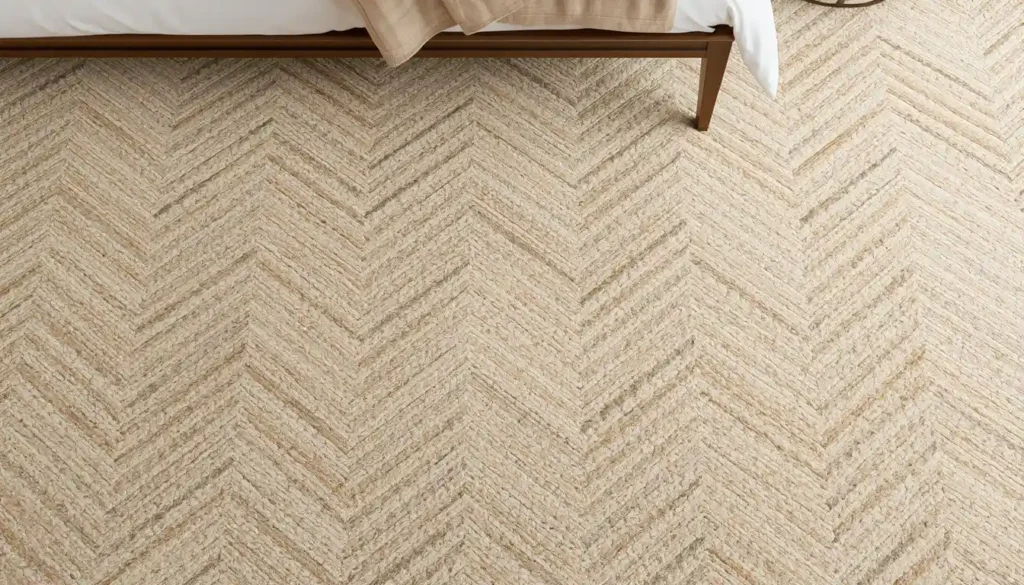
A patterned geometric carpet is one of the most direct ways to make a bedroom floor the intentional focal point of the room rather than a passive backdrop. Herringbone, diamond, chevron, lattice, and trellis patterns woven or printed directly into the carpet body introduce architectural structure at floor level — a quality that changes how the entire room reads.
The key design principle with patterned carpet in a bedroom is scale calibration. Large, bold geometric repeats work in rooms where the floor has room to breathe — a spacious master bedroom where the full pattern can be appreciated before it disappears beneath the bed frame. Smaller, more compact geometric patterns — a tight diamond or a subtle herringbone — work in rooms of all sizes, including smaller guest bedrooms where a large pattern would feel compressed and interrupted.
Color strategy within the pattern matters as much as the geometry itself. Tone-on-tone geometric patterns — a cream diamond on a slightly deeper cream ground, for example — deliver visual interest without color contrast, which creates a bedroom that feels sophisticated rather than busy. High-contrast patterns, such as navy on ivory or charcoal on warm white, create genuine drama that works in spare, contemporary rooms with minimal decorative accessories. The carpet does the visual work; everything else can stay quiet.
Woven Axminster construction — in which the pattern is structurally integrated into the weave rather than printed on — produces the sharpest geometric definition and the longest-lasting pattern integrity. Printed geometric patterns fade and blur more quickly, particularly in areas of foot traffic. For a bedroom where the floor is lightly used, printing is adequate; for a room with a seating area or a dressing zone that sees regular foot traffic, woven construction is worth the additional cost.
7. Dusty Blush and Warm Pink Carpet — Soft Color for a Serene Retreat
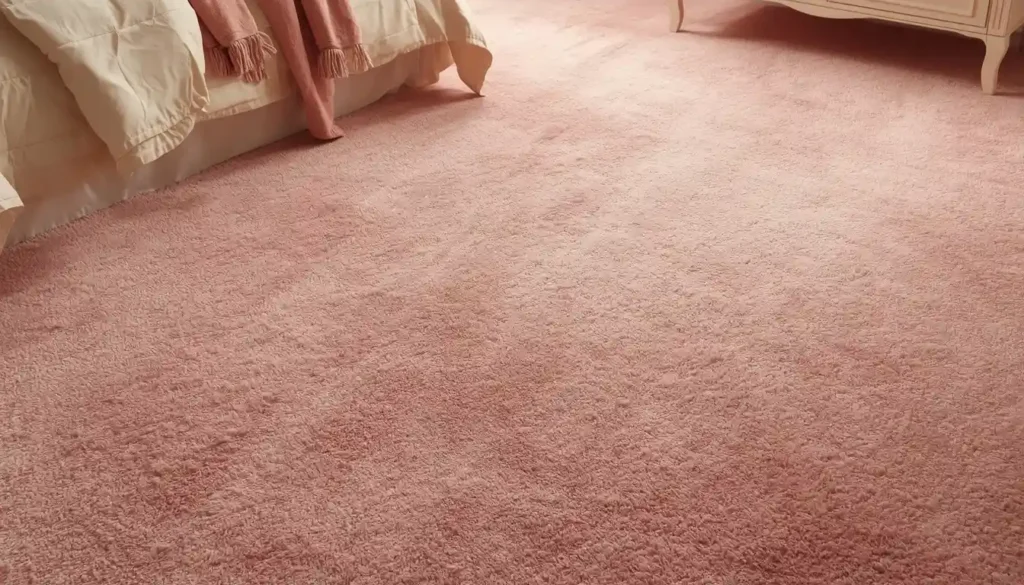
Soft pink carpet is experiencing a genuine moment in bedroom design, and the reasons go beyond trend cycles. Dusty blush, muted rose, and warm blush-pink tones carry the psychological warmth of red without its stimulating intensity. In a sleep environment, that distinction matters: the color registers as intimate and cocooning rather than activating, which supports the room’s primary purpose.
The spectrum within this category ranges from barely-there blush — so pale that it reads as a warm white in many lighting conditions — to a more committed dusty rose that holds its pink identity throughout the day. The brighter or more saturated the pink, the more it demands from the decor around it. True dusty blush operates as an almost-neutral and pairs with grey, cream, warm white, soft terracotta, and even sage green. Deeper rose tones work best in rooms with confident, deliberately feminine aesthetics where the color is a deliberate design statement.
Fiber choice in pink carpet carries extra importance because fading is more visually conspicuous in lighter warm tones than in neutrals. Solution-dyed nylon — in which the dye is introduced into the fiber during manufacturing rather than applied afterward — holds color with significantly greater fade resistance than surface-dyed alternatives. For a blush carpet in a room that receives direct sunlight, solution-dyed fiber is a meaningful investment in long-term color stability.
Pile texture in soft pink carpet is best kept smooth and even. The color itself provides the visual character; a complex pile texture in the same tone can tip from refined to visually cluttered. Plush or velvet cut pile in dusty blush creates a bedroom floor with a clean, deliberate quality that reads as considered rather than coincidental.
8. Navy Blue Carpet — Depth and Drama in the Right Setting
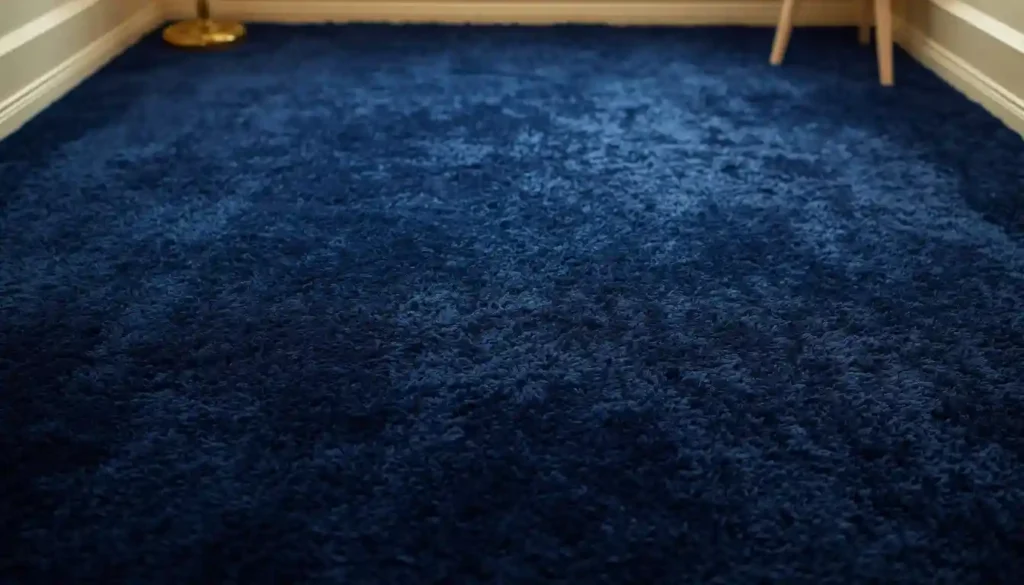
Navy blue carpet occupies a design category all its own: it is dark enough to anchor a room with authority, directional enough in color temperature to establish a clear aesthetic, and historically associated with both traditional British interiors and contemporary coastal design. In a bedroom, navy carpet creates a sense of depth and contained luxury that very few colors match.
The most common concern with navy carpet — that it will make the room feel small or dark — is a lighting problem, not an inherent property of the color. A bedroom with a navy carpet and adequate lighting from warm-toned sources does not feel cave-like. The navy acts as a rich ground from which lighter elements — cream walls, brass hardware, ivory bedding — emerge with heightened visual clarity. The contrast is what makes the room feel finished and intentional rather than accidental.
Navy works best in bedrooms with a defined aesthetic direction. It pairs beautifully with traditional furniture in warm wood tones, creating a classic library-like quality that feels settled and permanent. It also works in contemporary coastal bedrooms where the color connects the interior to the exterior — the ocean, the sky at dusk, the deep water palette that defines coastal California living. In San Diego homes particularly, navy carpet in a bedroom creates an indoor-outdoor color conversation that can be extended through wall color, textiles, and artwork.
For households concerned about showing light-colored pet hair against a dark navy ground, a navy carpet with a slightly heathered or tonal quality — flecks of lighter blue woven through the base color — provides considerable concealment without compromising the depth of the color.
9. Natural Wool Carpet — Fiber Quality as a Design Philosophy
Choosing wool carpet for a bedroom is as much a statement about material values as it is a flooring decision. Wool is the original luxury carpet fiber — softer than most synthetics, naturally warm, inherently resilient, and biodegradable at the end of its long service life. In a bedroom context, those qualities combine to produce a floor that performs well for decades while maintaining a quality of texture underfoot that no synthetic can fully replicate.
The thermal properties of wool are particularly relevant in a sleep environment. Wool fiber is naturally hygroscopic — it absorbs and releases moisture in response to ambient humidity, buffering the microclimate of the room in ways that synthetic fibers do not. In practical terms, this means a wool-carpeted bedroom feels warmer in winter and less stuffy in summer than the same room with synthetic carpet, all else being equal. For bedrooms in homes where temperature regulation during sleep is a concern, that characteristic is genuinely functional, not just aesthetic.
Wool carpet is available in a wide range of pile types — cut pile, loop, cut-and-loop, and even shag — and an equally wide range of colors, from undyed natural ecru through rich jewel tones that hold dye exceptionally well. The inherent texture of wool fiber means that even a simple loop-pile construction has more visual depth than a synthetic equivalent in the same design.
The cost of wool carpet is higher than synthetics, often significantly so. Pure wool carpet typically runs two to three times the cost of comparable nylon per square foot. For homeowners committed to natural materials and long-term quality, that cost difference is amortized over a service life that wool typically outlasts synthetics to justify. For those working within tighter budgets, an 80% wool / 20% nylon blend captures most of wool’s character at a meaningfully lower price point.
10. Frieze Carpet — Casual Luxury With Excellent Practicality
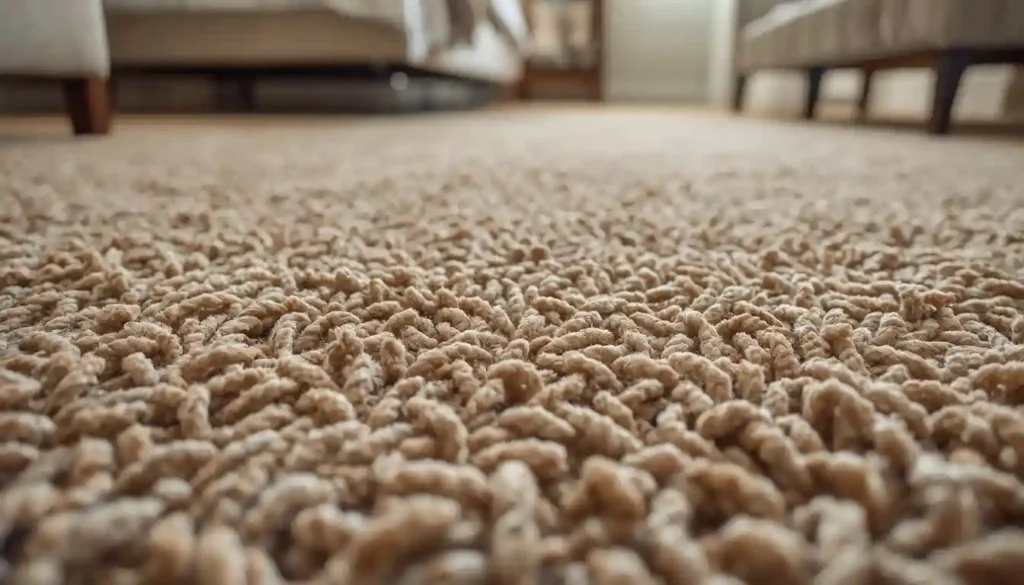
Frieze carpet — pronounced “free-ZAY” — is a cut-pile construction in which the fibers are twisted so tightly that they curl and fall in multiple directions rather than standing uniformly upright. That physical characteristic has two major consequences. First, frieze carpet is extremely effective at concealing footprints and vacuum tracks, because the multi-directional fiber orientation prevents the kind of directional compression that shows clearly on plush or saxony. Second, the texture creates a relaxed, informally luxurious appearance that suits contemporary, eclectic, and casual bedroom aesthetics particularly well.
In a bedroom context, frieze reads as a deliberately laid-back choice — not precious or formal, but genuinely comfortable and designed for living. It is particularly well-suited to master bedrooms where the room functions as a multipurpose space: somewhere for reading, dressing, exercising, and sleeping rather than just sleeping. The carpet takes the visual pressure off the floor and allows furniture arrangements to shift without evidence.
The twisted fiber construction also gives frieze carpet good durability relative to its softness. The tight twist helps fibers resist crushing over time, maintaining the carpet’s dimensional character in areas of regular foot traffic. In a bedroom with a dedicated dressing zone or a seating area beside the bed, that durability matters in ways it would not in a room where the carpet is essentially untouched between morning and night.
Colors in frieze often have a slight tonal variation built in, because the multi-directional fibers catch light differently from different angles. This gives solid-colored frieze a richer, more complex quality than a similarly colored plush, making it a particularly good choice when you want the floor to have character without resorting to a printed pattern.
11. Cut-and-Loop Patterned Carpet — Visual Depth Without Printing
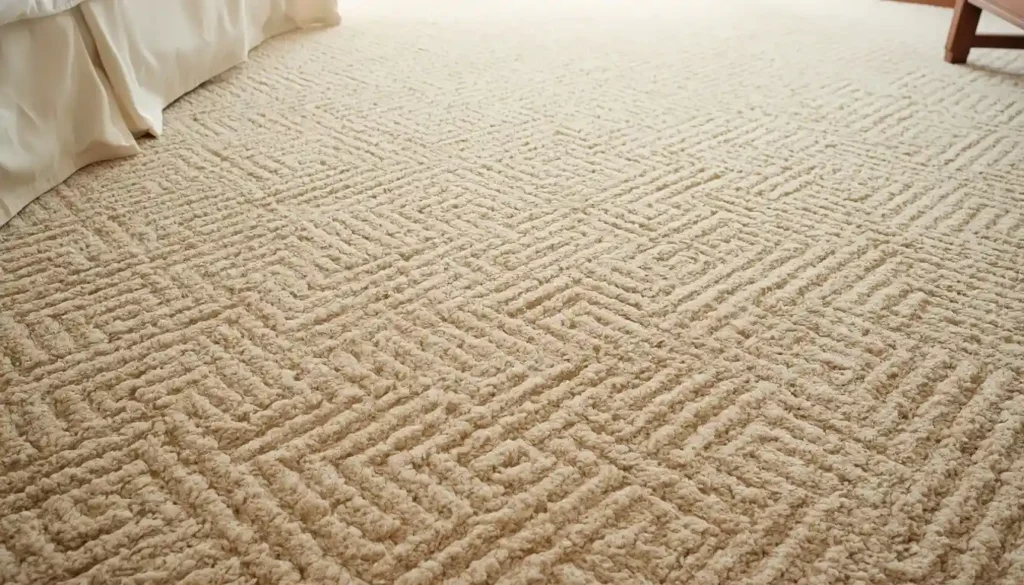
Cut-and-loop carpet is a construction method in which some fibers are cut while others remain in loops, with the height differential between the two creating a sculpted surface that reads as a pattern. The pattern is structural rather than printed — it is created by the physical arrangement of the fibers rather than by any colorant — which means it maintains its definition over decades and resists the fading that affects printed patterns.
In a bedroom, cut-and-loop carpet is one of the most versatile choices available. The structural pattern provides visual interest and texture at floor level without the color commitment of a printed geometric. The same cut-and-loop construction can produce anything from subtle organic shapes that barely register from standing height to clearly defined geometric patterns that read as deliberate design decisions across the room.
The mix of cut and loop fibers also has a practical benefit: the loops provide durability and crush resistance, while the cut fibers provide softness. The result is a carpet that is both pleasant underfoot and reasonably resilient to foot traffic — a combination that neither pure cut pile nor pure loop pile achieves as well individually.
For bedrooms in which the floor will be partially covered by an area rug — a common design approach in larger master bedrooms — cut-and-loop carpet in a subtle, low-contrast pattern provides enough interest to make the surrounding floor areas worth seeing, without competing with the rug’s design. The structural pattern reads quietly from a distance and reveals its detail on closer inspection.
12. Carpet Tiles — Flexibility, Pattern, and Practical Replacement
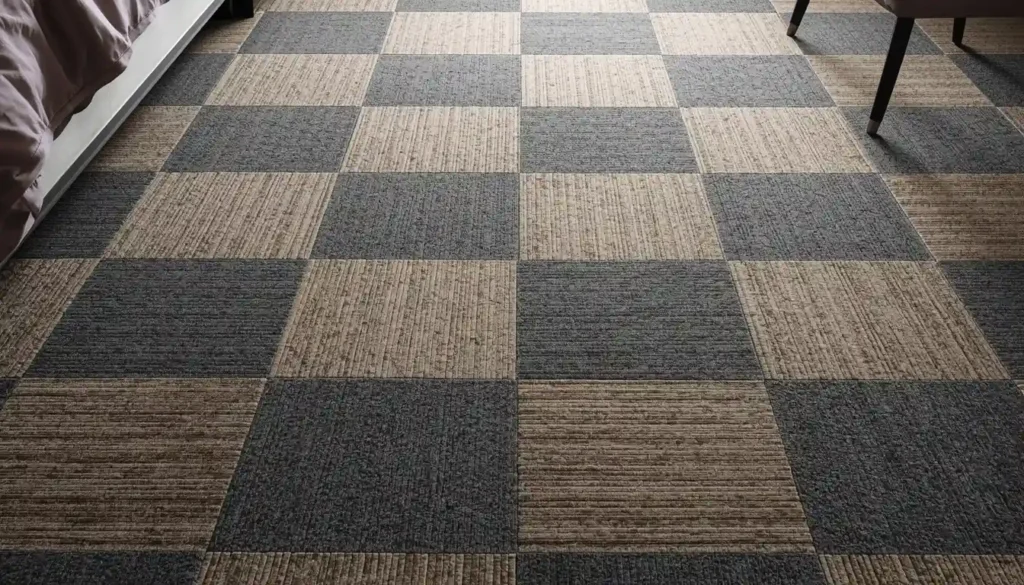
Carpet tiles in a bedroom represent a genuinely different approach to soft flooring — one that exchanges the seamless look of broadloom for modularity, replaceability, and design flexibility. Each tile is a self-contained unit, typically twelve inches or twenty-four inches square, with its own backing that allows it to be installed without adhesive in most residential applications. If a tile is stained, damaged, or simply grows tired after years of heavy use, it can be replaced individually without disturbing the surrounding floor.
In a bedroom context, carpet tiles earn their place in specific situations. Children’s bedrooms benefit enormously from the individual-tile replacement capacity — spills, art projects, and the general chaos of childhood flooring use no longer mean a full carpet replacement. Guest bedrooms with intermittent use can have individual tiles refreshed rather than having the entire floor redone when guest traffic patterns create wear in specific zones.
Beyond practicality, carpet tiles offer a design dimension that broadloom cannot: the ability to mix colors, tones, and even patterns within a single floor. A bedroom with a bordered design — one tile color in the field and a contrasting tone at the perimeter — achieves a visual structure similar to an inlaid rug without the commitment or cost of a custom broadloom installation. Alternating tiles in two closely related tones creates a subtle checkerboard that reads as texture from standing height.
The installation process for carpet tiles is also significantly more accessible to DIY installation than broadloom, which requires stretching, tack strips, and seaming skill. Tiles can typically be placed and repositioned by a careful non-professional, which makes them an option for renters who want to improve their bedroom flooring without permanent modification to the subfloor.
13. Shag Carpet — Maximum Softness as a Deliberate Aesthetic Choice
Shag carpet has a complicated reputation. Its associations with 1970s interiors — avocado green, sunken conversation pits, an entire era of interior decisions that did not age gracefully — made it unfashionable for decades. Contemporary shag, however, is a considerably more refined product. Modern shag construction uses higher-quality fibers, better dyeing processes, and more controlled pile heights than the originals, producing a carpet that delivers the same extraordinary softness with a visual character that suits current bedroom aesthetics.
The case for shag in a bedroom is simple: no other carpet construction gets closer to the experience of walking on something that feels like it was designed entirely around the moment of stepping onto it barefoot. The long, loose fibers — typically between one and a half and two and a half inches in length — create a sensory softness underfoot that denser constructions simply cannot replicate. In a bedroom where the first and last sensory experience of the day is the floor beneath your feet, that quality has genuine value.
The practical requirements of shag are real and worth acknowledging directly. Shag requires regular vacuuming with a suction-only attachment — beater bars damage the long fibers over time. Spills sink into the pile depth before they can be blotted, which makes stain removal more challenging than on low-pile or medium-pile surfaces. Heavy furniture compresses shag fibers without the same recovery capacity that denser constructions provide. These are manageable realities in a primary bedroom used by adults who maintain the floor attentively. They become less manageable in rooms with pets, children, or high foot traffic.
Contemporary shag works best in bedrooms with simple, clean-lined furniture where the floor’s texture is given room to be the design statement. Scandinavian-influenced interiors, minimalist spaces with statement textiles, and bohemian bedrooms with layered natural materials all suit the shag aesthetic naturally.
How to Choose Between These 13 Ideas: The Decision Framework
After working through thirteen distinct carpet directions, the natural question is how to narrow the field to the one that actually belongs in your bedroom. The decision involves four criteria that, taken together, eliminate most of the options and clarify the right direction for your specific situation.
The first criterion is household composition. Pets with claws eliminate loop-pile constructions — Berber and cut-and-loop in their loop-dominant forms — from consideration. Young children in the room elevate the importance of stain resistance and individual-tile replaceability. A single adult or couple with no pets can consider the full range without meaningful restriction.
The second criterion is maintenance tolerance. Plush carpet, saxony, and shag all require attentive upkeep to maintain their appearance. Textured cut pile, frieze, and Berber forgive the most in terms of daily maintenance cycles. Be honest about how frequently the room will be vacuumed and how quickly spills will be addressed.
The third criterion is the room’s existing light levels. Pale, warm-toned carpets help north-facing and low-light bedrooms feel brighter. Dark carpets — charcoal, navy — work best in rooms with good natural or artificial light. Getting this wrong is one of the most common sources of bedroom carpet disappointment.
The fourth criterion is the design commitment level. Geometric patterned carpet, navy blue, and sage green all lock in a design direction. Warm neutrals and light grey leave maximum flexibility for changing bedding, wall colors, and furniture over time. If you redecorate frequently or plan to sell the home in the near term, the flexibility of a true neutral is worth more than the distinctive quality of a directional color.
It is also worth thinking through what lives beneath the carpet. The performance of any bedroom carpet — how warm it feels, how much sound it absorbs between floors, how long it lasts under compression — is shaped substantially by the underlay it sits on. A dense, high-quality underlay transforms even a mid-range carpet into something that feels significantly more premium underfoot and protects the carpet fibers from subfloor irregularities that cause premature wear.
For bedrooms built on concrete subfloors — ground-floor master suites, basement bedrooms, slab-on-grade construction common in San Diego — the underlay also plays an important role in moisture management. Concrete releases vapor upward, and a carpet system without appropriate moisture resistance can develop odor problems over time. Understanding what goes under carpet on concrete subfloors before installation protects both the carpet investment and the indoor air quality of the room.
Carpet vs. Hard Flooring in the Bedroom: The Honest Comparison
Any complete guide to bedroom carpet ideas has to address the alternative directly. Luxury vinyl plank, engineered hardwood, and laminate have all made significant inroads into the bedroom over the past decade, marketed on the basis of durability, easy cleaning, and a modern aesthetic that carpet supposedly cannot match.
The arguments for hard flooring in the bedroom are real. Hard surfaces are easier to clean thoroughly, which matters for allergy sufferers. They do not harbor dust mites at the density that carpet does. They hold their appearance under heavy furniture without the compression issue. And they provide a visual continuity with the rest of the home that carpet does not.
But the arguments for carpet in a bedroom are also real, and they are directly connected to what the bedroom needs to be. Comparing carpet against vinyl flooring reveals that carpet consistently outperforms hard flooring on thermal comfort, acoustic performance between floors, and the softness underfoot that defines the bedroom experience. Hard floors are colder underfoot on winter mornings. They amplify sound in ways that disturb sleep in multi-story homes. They lack the cushioned surface that makes sitting on the floor comfortable.
For bedrooms specifically — as opposed to kitchens, bathrooms, or living areas — carpet’s qualities align more directly with the room’s purpose than hard flooring’s qualities do. The room is primarily a sleep and rest environment, not a high-traffic food-preparation or social space. The properties that make hard flooring practical in kitchens and living rooms are less relevant in a room that is lightly used by one or two people who are usually barefoot.
Flooring type also affects how a bedroom performs across different seasons and climates. San Diego’s mild climate reduces the urgency of carpet’s insulating properties compared to colder regions, but the acoustic benefits and morning-comfort factor remain just as relevant year-round regardless of outdoor temperature.
Professional Installation vs. DIY for Bedroom Carpet
Most bedroom carpet ideas in this guide work best with professional installation — not because the work is technically impossible for an experienced DIY installer, but because the variables involved in getting a high-quality result are numerous and interdependent.
Broadloom carpet installation requires accurate subfloor preparation, tack strip placement, proper seaming technique in rooms wide enough to require it, and the correct stretching tension to prevent buckling and lifting over time. An improperly stretched carpet develops waves and ripples within months that are difficult to correct without fully reinstalling. An improperly seamed carpet shows its seam across the floor for the life of the installation.
Carpet tiles are the notable exception: their modular installation is genuinely accessible to careful non-professionals, particularly in smaller bedrooms where the tile layout requires no cutting at the center and only straightforward trimming at the perimeter. For DIY-oriented homeowners, carpet tiles provide a practical entry point for improving bedroom flooring without professional installation costs.
For all other carpet types discussed in this guide, professional installation protects the investment in the material itself. The cost of a skilled installer is modest relative to the cost of the carpet, and it is the difference between a floor that performs as intended for ten to twenty years and one that begins showing installation errors within the first year.
Those interested in understanding what the full project involves before scheduling estimates will find the overview of carpet installation types and methods useful context for conversations with flooring contractors.
The Role of Carpet in Bedroom Acoustics
One of carpet’s most consistently undervalued contributions in a bedroom is acoustic. In multi-story homes, the floor of a bedroom is the ceiling of the room below — and carpet with appropriate underlay absorbs impact sound with a thoroughness that no hard flooring system matches without extensive and expensive assembly-level treatment.
Impact sound — footsteps, dropped objects, furniture movement — transmits through floor assemblies and appears as noise in the room below. Carpet’s fiber mass and the compressible cushion of the underlay beneath it absorb a significant portion of that impact energy before it reaches the structural floor, reducing the transmitted sound substantially. In a household where noise between floors is a source of friction — a bedroom above a living room, or a child’s bedroom above an adult sleep space — carpet is one of the most practical and cost-effective acoustic interventions available.
Airborne sound — voices, music, television — is absorbed at the surface by carpet’s fiber mass rather than reflected. A fully carpeted bedroom is a quieter room to sleep in than the same room with hard flooring, even if the household noise level is identical, simply because carpet surfaces do not reflect sound back into the space the way hard surfaces do.
For bedrooms where sound isolation is a particular priority — adjacent to a home office, above a garage, or in a building with shared walls — the combination of carpet and a dense, thick underlay represents one of the most straightforward acoustic improvements available. Those interested in the broader range of strategies for managing sound in flooring systems can explore the range of silent flooring options available for different construction contexts.
Maintenance and Longevity: What These 13 Ideas Require
Any carpet choice in a bedroom carries an implicit maintenance commitment. The type and frequency of that maintenance varies significantly across the thirteen ideas in this guide, and aligning the carpet’s needs with your actual maintenance habits is one of the most important practical decisions in the selection process.
Regular vacuuming is the non-negotiable baseline for all carpet types. The recommended frequency for a bedroom is two to three times per week for households with pets or allergy sufferers, and once per week for standard conditions. This regularity removes the particulate matter — skin cells, dust, fiber debris — before it settles deep into the pile where it becomes difficult to extract. Carpets that are infrequently vacuumed wear faster, smell staler, and become increasingly resistant to cleaning as embedded debris works its way into the fiber structure.
Deep cleaning — either professional hot water extraction or thorough dry cleaning — extends the life of bedroom carpet significantly and is recommended every twelve to eighteen months for regularly maintained floors. The pile types that accumulate debris most deeply — shag, high-pile plush, and deep-texture cut-and-loop — benefit most from professional deep cleaning and should be scheduled more frequently than dense, low-pile constructions.
The expected lifespan of bedroom carpet, assuming correct installation and regular maintenance, is typically ten to fifteen years for quality synthetic fiber and fifteen to twenty-five years for wool. Those lifespans are dramatically shortened by incorrect installation, insufficient underlay, inadequate maintenance, or selecting a pile type that is fundamentally mismatched to the room’s actual use patterns. A high-pile shag in a busy household with dogs will show its age in five years. The same wool cut pile in a guest bedroom with occasional use may look fresh for thirty years.
The question of what type of cushion or padding lives beneath the carpet affects longevity as meaningfully as fiber choice. Matching the padding type to the carpet construction and use context is a decision that is often rushed through at the point of purchase but that shapes the carpet’s daily feel and structural performance for its entire life.
Bringing These Ideas to Your Bedroom
The thirteen carpet ideas in this guide range from the confidently neutral to the deliberately dramatic, from the practically minded to the fiber-quality focused. What they share is specificity: each one is not merely a color or a texture category but a complete approach to the bedroom floor that connects construction choices, color psychology, fiber performance, and design direction into a coherent whole.
The right choice is the one that fits your room’s light levels, your household’s actual habits, your design sensibility, and the role the bedroom plays in your daily life. A guest bedroom calls for different decisions than a master suite. A child’s room calls for different decisions than a studio apartment. A slab-on-grade home in coastal San Diego calls for different decisions than an upstairs bedroom in a wood-frame construction.
Taking the time to work through those conditions before selecting a carpet — rather than selecting a carpet and then hoping the conditions cooperate — is the difference between a bedroom floor that rewards the investment for a decade and one that generates disappointment within the first year. The flooring decisions that last are always the ones that start with the room’s actual reality rather than with an aspirational image on a screen.
The carpet ideas in this guide are a starting point. Bring samples home. Live with them under your bedroom’s specific light conditions for several days before deciding. Walk on them barefoot, at the time of morning when the floor matters most. The right carpet will announce itself in that moment more clearly than any specification sheet or design guide can.
For rooms where the carpet question leads into broader flooring conversations — whether about how carpet compares to soft vinyl alternatives in specific rooms, or how to approach flooring decisions across a whole-home renovation — the practical flooring guide for different room types and household contexts covers the range of decisions that arise when one room’s flooring choice prompts questions about the rest of the home.
James Miller is a seasoned flooring contractor with years of hands-on experience transforming homes and businesses with high-quality flooring solutions. As the owner of Flooring Contractors San Diego, James specializes in everything from hardwood and laminate to carpet and vinyl installations. Known for his craftsmanship and attention to detail, he takes pride in helping clients choose the right flooring that balances beauty, durability, and budget. When he’s not on the job, James enjoys sharing his expertise through articles and guides that make flooring projects easier for homeowners.
Your dog just skidded across the hallway and left a fresh trail of muddy paw prints. Your cat has been using the corner of the living room floor as a scratching post. Sound familiar? If you share your home with pets, you already know that not every floor is built to survive them. The good…
Water will not ruin the vinyl plank itself. A single plank can be submerged for days without swelling, warping, or breaking apart. That is not the problem. The problem is that your floor is not one plank — it is hundreds of planks clicked together, laid over a subfloor that is not waterproof. Water does…
When homeowners ask about hardwood flooring vs laminate, they are rarely just asking about materials. They are asking which floor will hold up under their dog, whether they need to gut their budget to get something that looks real, and what that choice is going to cost them when they sell the house in seven…
Hardwood flooring installation is not a single task. It is a sequence of decisions, each one affecting the outcome of the next. The installation method you choose depends on your subfloor type. The acclimation period you commit to depends on your wood species and local humidity. The expansion gap you leave determines whether your floor…
Most people spend hours choosing the right laminate planks. They agonize over thickness, AC rating, color, and finish. Then they grab the first roll of foam underlay they see at the checkout counter and call it a day. That is exactly backwards. The underlay sits between your subfloor and your laminate. It absorbs impact, manages…
Your carpet does not tell you when it is done. It does not send a notification, throw an error, or visually collapse in a way that makes the answer obvious. It just accumulates — slowly, silently, and in layers that regular vacuuming cannot reach. By the time most homeowners recognize a problem, the carpet has…