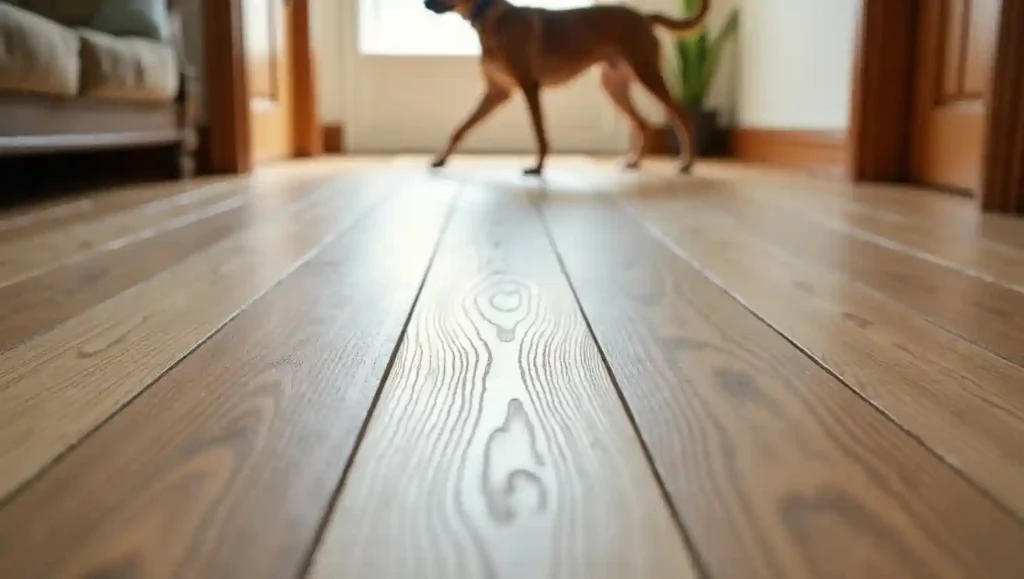
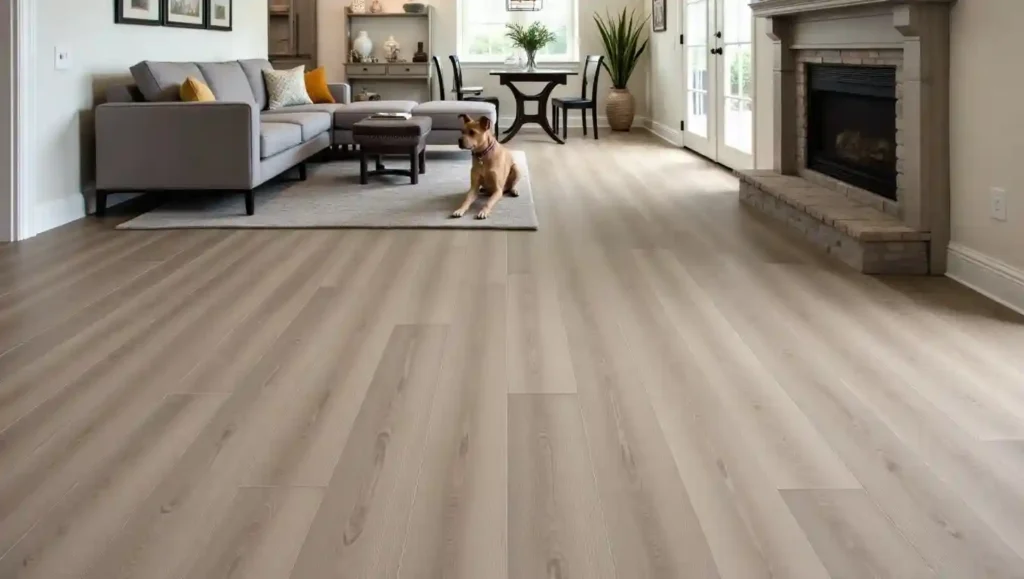
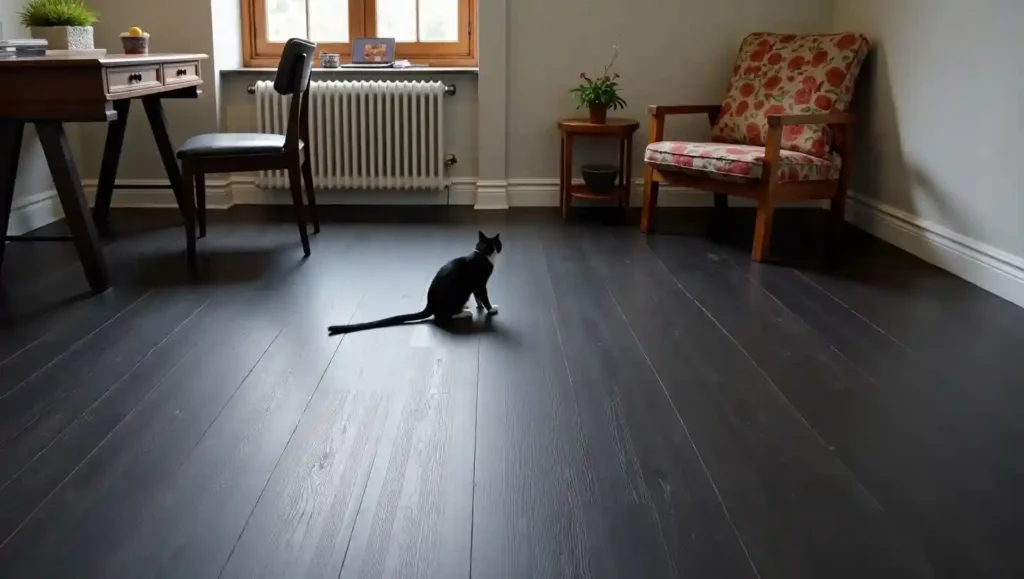
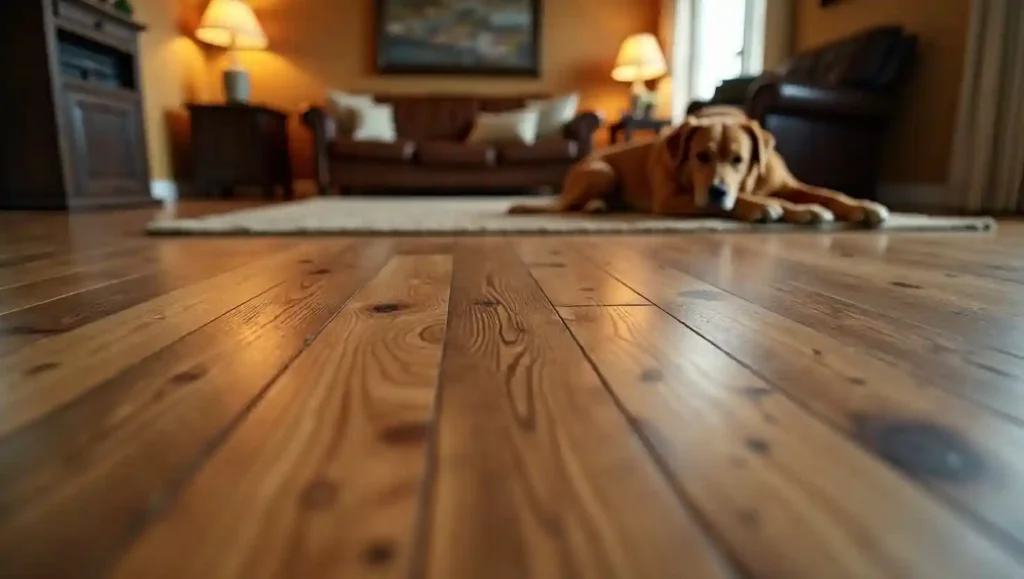
The second specification is the core type. Traditional HDF cores absorb moisture when liquid sits in the seams, causing swelling, warping, and the kind of permanent odor that no amount of cleaning removes. Premium pet-friendly laminate now uses waterproof or highly water-resistant cores, often incorporating synthetic materials, that stop moisture from reaching the subfloor even if a spill sits for several hours.
The third factor is surface texture. A high-gloss smooth finish looks beautiful in a photo, but it shows every paw print, every scratch, and every hair. More practically, it gives pets almost no grip, which is a real safety concern for older dogs with joint issues or excitable large breeds that run and corner at speed. Embossed-in-Register (EIR) texture, where the physical surface grooves align with the printed grain beneath, gives paws something to grip while naturally hiding minor surface wear.
Keep all three of those specifications in mind as you read through the following ideas, because the aesthetic concept and the technical requirements always go hand in hand.
Idea 1: Medium-Tone Oak with Matte Finish
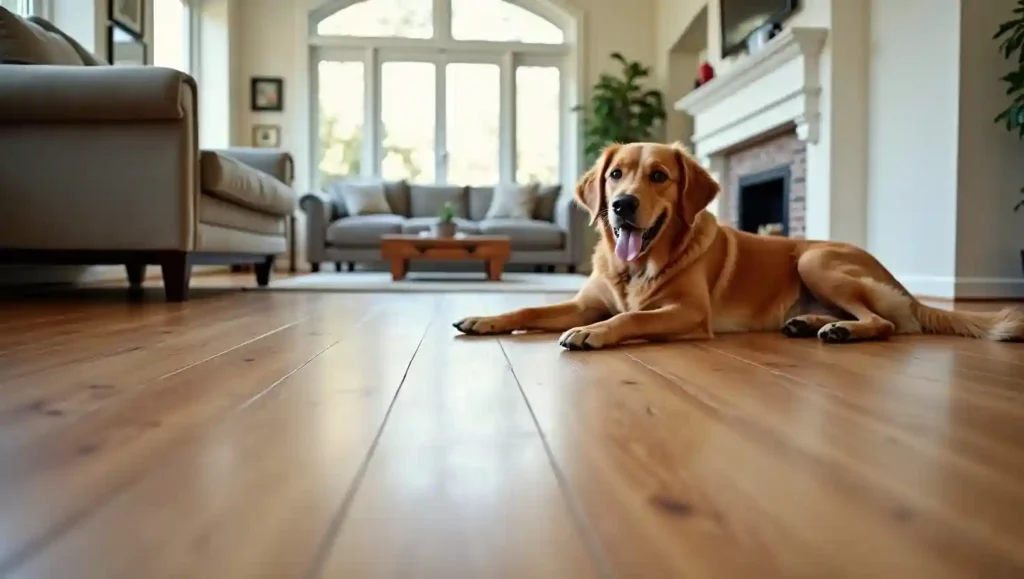
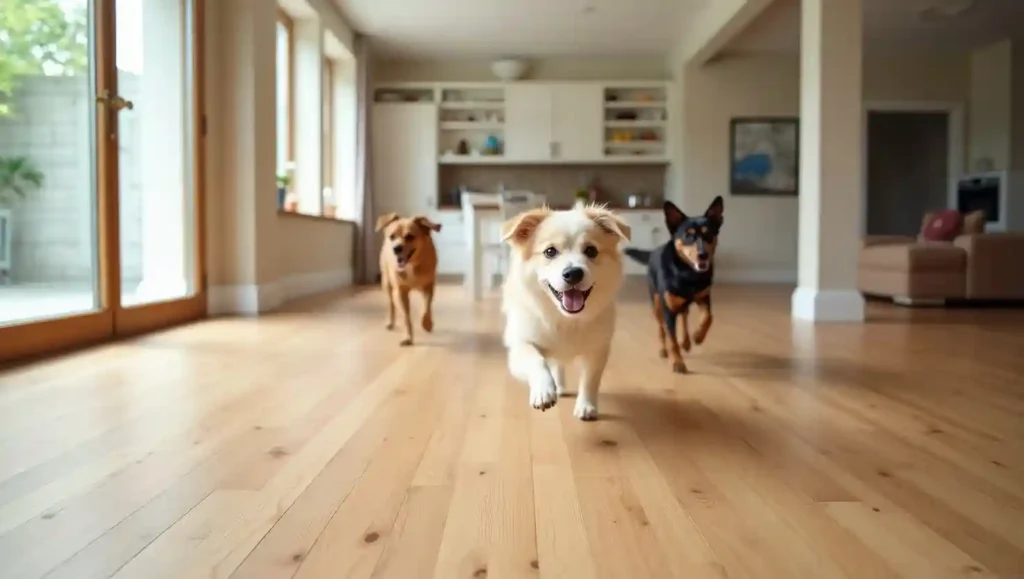
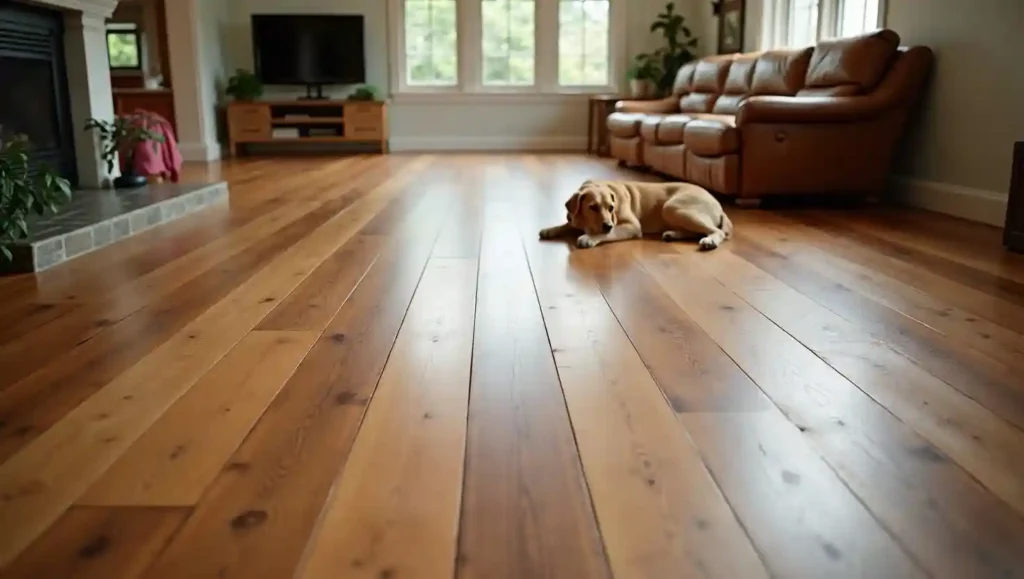
If you have to pick one single color and finish combination that works across every pet scenario, this is it. Medium-toned oak laminate in a matte or low-sheen finish is the practical workhorse of pet-friendly flooring, and it earns that title through very specific visual properties.
Medium brown and greige tones sit in a sweet spot between extremes. Very light floors show every strand of dark pet hair and every dirty paw print with high contrast. Very dark floors do the same with light hair and become a daily cleaning marathon. Medium tones absorb both visually, so a Golden Retriever’s shedding and a cat’s muddy tracks blend rather than announce themselves. This is not a stylistic compromise, it is a deliberate maintenance strategy.
The matte finish contributes in two ways. First, it suppresses the visibility of surface micro-scratches. On a high-gloss floor, even minor claw drag catches light and becomes visible across the room. A matte surface diffuses that same light, making the same amount of scratch activity much harder to see. Second, matte finishes typically have slightly more surface texture than high-gloss products, which means better traction for paws.
For the plank width, aim for five to seven inches. Wide planks show the grain pattern clearly, which adds more visual complexity and further reduces how much any individual mark stands out. Pair this with an AC4 rating and a waterproof core, and you have a floor that can handle years of active pet life with minimal visible aging.
This idea works particularly well in open living areas, dining rooms, and hallways where pets spend most of their time and where a clean, universal aesthetic is easiest to maintain.
Idea 2: Grey Laminate with Multi-Tonal Variation
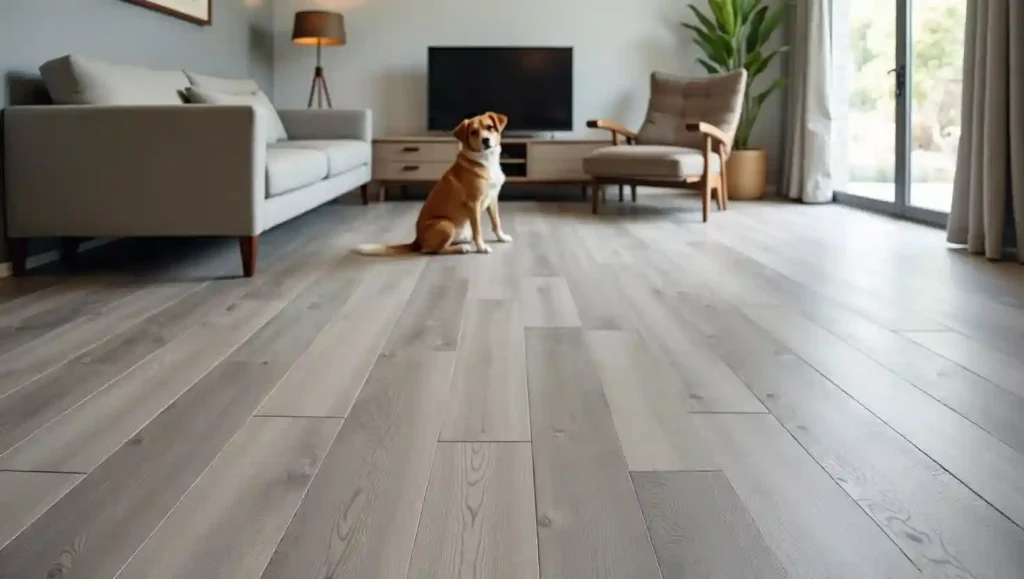
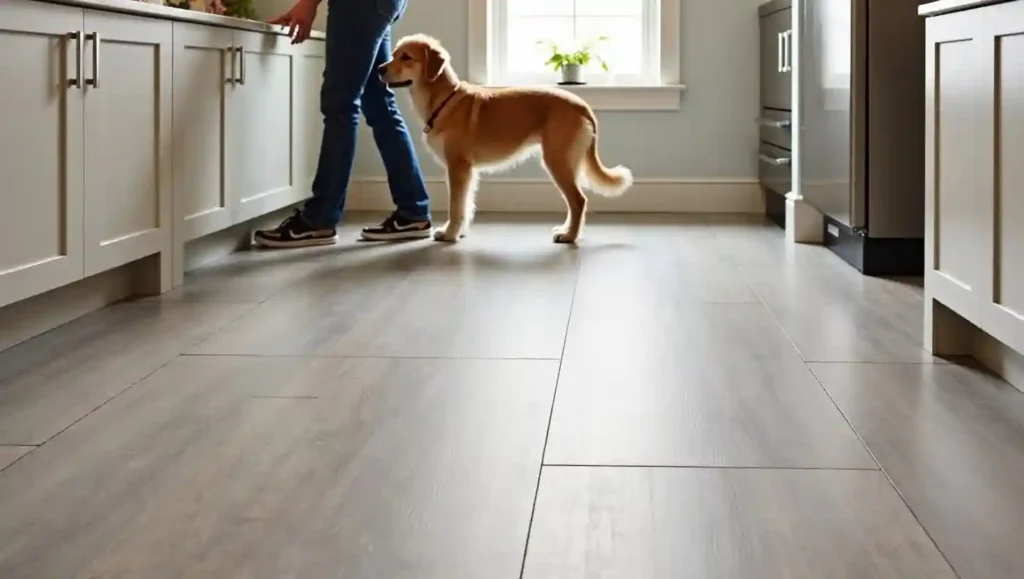
Grey laminate became the dominant trend in residential flooring for a reason, and for pet owners specifically, the right grey product offers performance advantages that go beyond aesthetics. The key word is variation.
A solid, flat grey floor with minimal grain variation is a pet hair magnet that shows contrast clearly. But grey laminate with multi-tonal planks, meaning boards that vary from lighter silver to deeper charcoal within the same plank, creates a visual complexity that absorbs pet hair and dust with remarkable efficiency. The eye is already moving across multiple tones, so individual hairs and light scratches blend into the overall pattern.
Grey also has a unique functional advantage in pet households: it hides dried mud. When a dog comes inside after rain and walks across the floor before you can intervene, the dried residue on a medium grey floor is far less visible than on a light natural or dark espresso surface. Grey sits in an optical midpoint where muddy tones dissolve into the background.
Look specifically for grey laminate with a wire-brushed or hand-scraped texture finish. These textures add surface dimensionality that contributes additional grip for paws and makes minor claw activity nearly invisible. Wire-brushed grey gives a Scandinavian or coastal feel depending on your room’s other elements, while hand-scraped leans into a more rustic character.
This style integrates well with modern, transitional, and coastal interiors. It is also flexible enough to serve as a neutral base that works regardless of what furniture you bring in later, which matters if your pet has already shortened the life expectancy of your current sofa.
Idea 3: Waterproof Core Laminate in Warm Walnut Tones
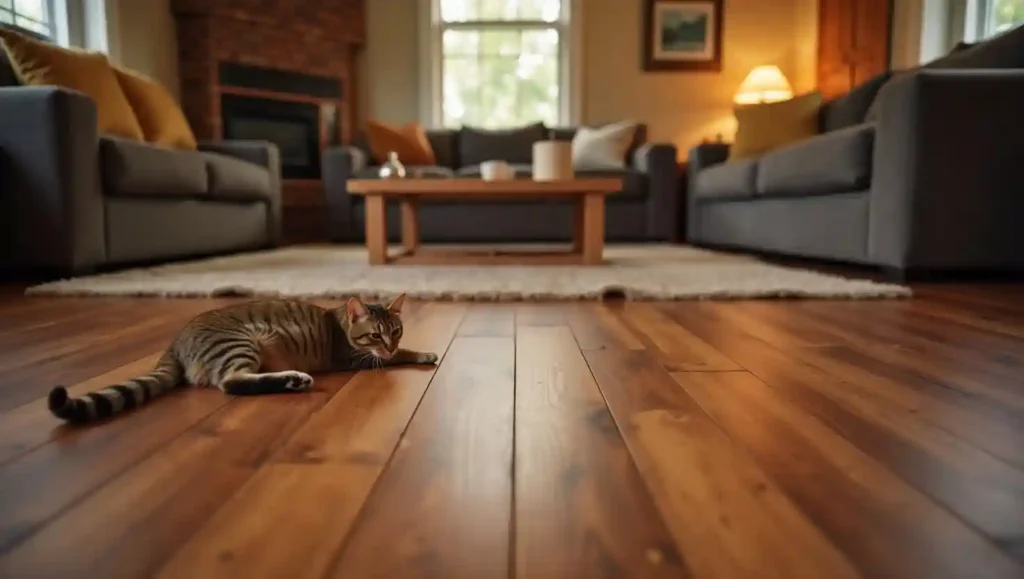
Walnut is a rich, deep brown tone with warm red and amber undertones that has been a benchmark of premium hardwood flooring for decades. The problem with real walnut in a pet household is that it is a softer wood that shows claw damage easily and has virtually no tolerance for moisture accidents. Modern walnut-look laminate solves both problems without giving up the aesthetic.
The practical reason to choose walnut-tone laminate specifically for pet households is the colour depth. Deep, warm brown tones are genuinely excellent at concealing minor surface wear. Claw drag marks on a dark surface are much harder to detect than on a light or mid-tone floor because the contrast between the scratch and the surrounding material is low. The warm red-brown of walnut tends to absorb both light and dark pet hair visually, though it works especially well in homes with dark-coated animals.
The essential qualification is the core specification. Standard HDF laminate in a walnut colourway is not appropriate for pet households because any moisture at the seams will cause the core to swell and can lead to permanent odour retention. You need waterproof core laminate, which uses a composite or modified HDF that resists liquid penetration even when a spill sits for an extended period. This is especially important if you have a puppy still in training or an elderly pet with incontinence issues.
Walnut-tone laminate in wider planks, seven inches or more, creates a luxurious visual effect that reads as high-end even when guests know it is not solid wood. It suits traditional, contemporary, and transitional interiors with equal ease.
Idea 4: Light Blonde Oak for Bright, Hair-Hiding Spaces
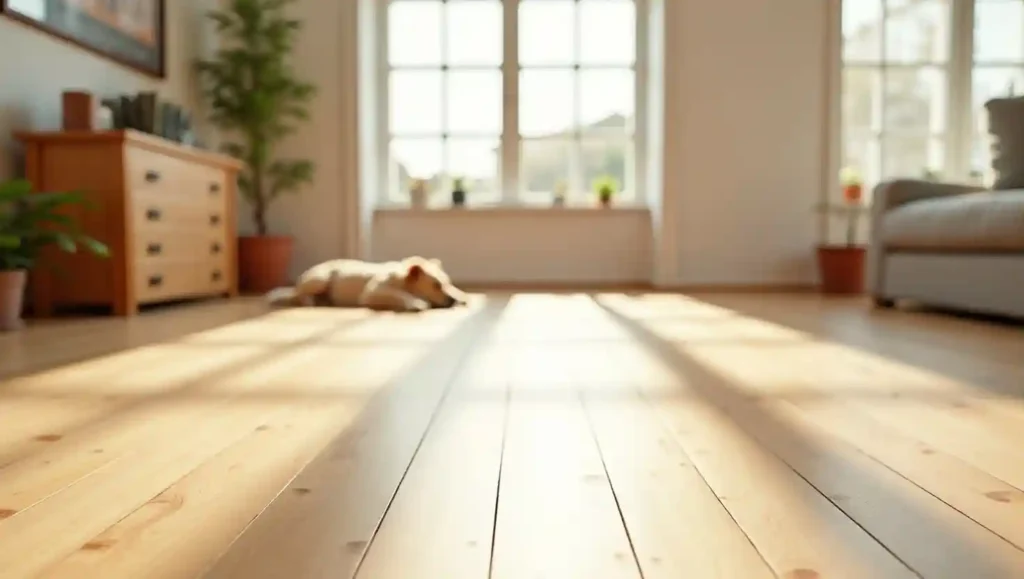
Light blonde laminate is the one pale option that can actually work in a pet household, but only when you approach it with the right specifications and realistic expectations. The visual logic is counterintuitive but real: light-coloured floors hide light-coloured pet hair, and many of the most common breeds, Labrador Retrievers, Poodles, Maltese, Persian cats, shed coat colours that blend into pale blonde tones rather than contrasting against them.
The performance requirement for light laminate in a pet home is an AC4 or AC5 wear layer. At lighter tones, any surface scratch has less colour depth to hide it, which means the wear layer needs to work harder. High-quality light laminate with aluminum oxide wear layer and EIR texture will resist the kind of visible claw activity that makes lighter floors impractical. Without that specification, you will see every mark clearly.
Light blonde works beautifully in sun-filled rooms, particularly south or west-facing living areas or bedrooms. It reflects rather than absorbs daylight, making spaces feel larger and airier. If your pet tends to nap in sunny spots, the pale floor integrates them visually without creating a stark contrast.
The honest caveat is that light floors require more frequent cleaning in high-traffic zones. Muddy paw prints are highly visible, and this colour shows dried dirt more readily than medium or dark options. If your pet spends significant time outside in wet conditions, consider whether light blonde makes practical sense for your specific household.
One strong pairing is light blonde laminate with a soft greige or warm white interior palette. The floor and walls read as a continuous warm tone, which makes the space feel cohesive and spacious rather than clinical.
Idea 5: Embossed-in-Register Texture for Pet Traction
This idea is less about colour and more about a specific technical feature that directly addresses one of the most overlooked pet-safety concerns in flooring selection: traction. Standard smooth or high-gloss laminate gives pets almost no grip, and the consequences are more serious than they might appear.
Dogs, especially larger breeds, generate significant lateral force when starting, stopping, or cornering. On a slippery smooth surface, that force cannot be absorbed through the paws, so the movement transfers to the joints instead. Over time, repeated slipping on smooth floors contributes to joint strain and can accelerate the development of hip dysplasia, a condition already common in breeds like German Shepherds and Golden Retrievers. Older dogs with existing arthritis or mobility issues face immediate daily risk on slippery surfaces.
Embossed-in-Register (EIR) laminate addresses this by aligning the physical surface texture exactly with the printed grain below. The result is a surface with genuine tactile depth, with grooves and ridges that give paws something to push against. This texture provides meaningful grip without requiring any rugs or mats, which are tripping hazards in their own right.
EIR texture also has secondary benefits. The surface grooves make micro-scratches harder to see because they already exist as intentional surface variation. Paw prints and smudges settle into the texture rather than sitting on a flat reflective surface, making them less visible between cleaning sessions. The texture also gives the floor a much more realistic wood feel underfoot, which has nothing to do with pets but is worth mentioning as a design benefit.
When you are selecting laminate for any room where pets are active, prioritizing EIR texture over smooth or lightly embossed finishes is one of the most impactful decisions you can make for both safety and long-term appearance.
Idea 6: Wide Plank Laminate in Natural Greige
Greige, the grey-beige hybrid that dominated interior design for the better part of the 2010s, has matured into something more sophisticated in modern laminate collections. Today’s greige laminate is less uniform and more dynamic, with planks that shift between warm taupe and cool stone tones within the same board. That variation is what makes it outstanding for pet-filled homes.
Wide plank format, anything above six inches, amplifies the tonal variation effect by showing more of each board’s grain pattern. The result is a floor that has significant built-in visual complexity even before any surface wear occurs. Scratches, hair, and muddy marks dissolve into the existing pattern variation rather than standing out against a uniform background.
Greige also occupies the optimal colour temperature for maintenance practicality. It is neither cold enough to show warm-toned dirt (dried mud, food debris) nor warm enough to highlight cool-toned elements (grey pet hair, ashy dirt). It essentially splits the difference on everything, which is exactly what you want in a household where you cannot predict what the floor will encounter on any given day.
The width of wide planks also contributes to an unexpected traction benefit. Fewer seam lines per square foot mean fewer gaps for pet nails to catch on during movement, and the broader surface of each plank allows for more consistent EIR texture application. Wide-plank greige with a matte finish and EIR surface is the three-way combination that delivers on every pet-household priority simultaneously.
This style is especially suited to open-plan living spaces where a continuous floor needs to perform visually across different zones, from a dog’s crate area to a formal dining space, without losing coherence.
Idea 7: Dark Charcoal Laminate in Lower-Traffic Rooms
Dark laminate deserves an honest conversation rather than a blanket recommendation or dismissal. The honest position is this: very dark charcoal and near-black laminate is genuinely beautiful, and it is manageable in a pet household if you are selective about where you use it and commit to the maintenance rhythm it requires.
The visual challenge with dark floors and pets is contrast. Light-coloured pet hair, dried drool, and dust all register strongly against a near-black surface. That contrast means cleaning needs to happen more frequently to keep the floor looking the way you intended. Daily dry mopping or robot vacuum coverage is essentially non-negotiable with dark laminate in a pet home.
Where dark charcoal laminate genuinely pays off is in lower-traffic rooms: a home office that a single cat visits, a formal sitting room that dogs enter occasionally, or a master bedroom used primarily by adults. In these contexts, the floor sees reduced pet traffic, and the dramatic aesthetic effect of dark laminate against light walls and furnishings delivers a visual impact that lighter options simply cannot match.
If you choose dark laminate, the specification requirements stay the same as any pet-friendly product: AC4 rating minimum, waterproof or water-resistant core, and EIR or brushed texture. On dark surfaces specifically, avoid high-gloss finishes absolutely. A high-gloss dark floor shows every single mark in extremely high contrast, including paw prints left by clean dry paws. A matte or satin dark finish suppresses that contrast significantly and is the only finish that makes dark laminate livable in a pet household.
Idea 8: Rustic Hand-Scraped Laminate for High-Traffic Zones
Hand-scraped laminate may be the single most effective style choice for managing the visual impact of a genuinely active pet household. The aesthetic is inspired by the character marks left on antique hardwood floors over decades of use: irregular surface variations, slight unevenness in the grain, and a surface that already looks like it has lived a full life. That is exactly why it works so well in homes with animals.
The principle is simple. When a floor already has intentional visual character built into its surface, additional marks from pet activity blend in rather than detracting. A hand-scraped laminate that already has irregular texture across every plank absorbs minor claw activity, scuffs from dog bowls being pushed around, and the occasional drag mark from a chew toy, all of these disappear into the pre-existing surface character.
Hand-scraped laminate comes in a wide tonal range, from lighter honey oak through medium cognac to deep tobacco browns. The medium cognac range is the most practical choice for most pet households, combining the colour-camouflage benefits of medium tones with the surface-complexity benefits of the scraped texture. The two systems reinforce each other.
This style works best in rooms where pets are most active: living rooms, family rooms, playrooms, and open entryways. The rustic character reads as deliberate and warm rather than worn or damaged, so the floor maintains its aesthetic integrity even as it accumulates real wear from animal traffic over years of use.
It pairs naturally with farmhouse, cottage, transitional, and warm-contemporary interiors. If your home has natural wood furniture, exposed beams, or earthy textile tones, hand-scraped laminate will integrate seamlessly while handling whatever your pets bring to it.
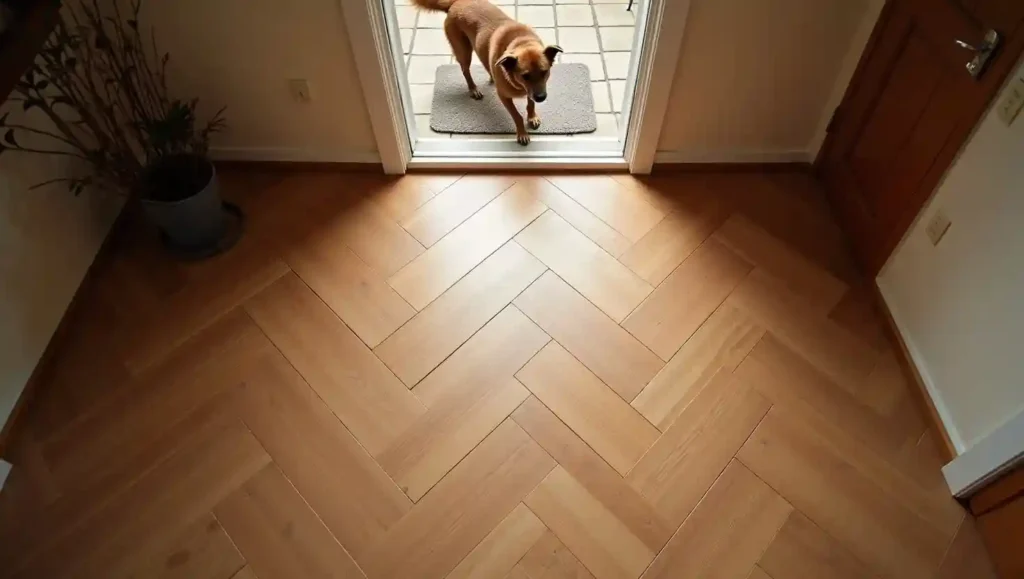
Idea 9: Herringbone Pattern Laminate for Entry Zones
Herringbone is the most searched laminate pattern online, and there is a functional reason beyond aesthetics that makes it particularly smart in pet-specific entry zones. Understanding why requires looking at how the pattern interacts with pet movement.
In a standard straight-lay floor, planks run in a single direction. Claw marks from a running or stopping dog tend to run parallel or perpendicular to the plank direction, which means they align with the natural grain and can become visible along the length of a board. In a herringbone layout, planks are set at 45-degree angles to the room’s walls, and the interlocking pattern means that claw activity from any direction of movement crosses multiple plank angles simultaneously. That angular crossing makes individual marks visually disruptive rather than following the grain, which paradoxically makes them less visible as coherent scratches and more likely to read as pattern texture.
Herringbone is particularly valuable in entryways and mudrooms, which are the highest-risk zones in any pet household. These are the areas where dogs enter wet from outside, where muddy paws first make contact with indoor flooring, and where the concentration of pet traffic is highest. Installing a more complex, visually active pattern in these zones creates a natural focal point that draws attention to the design rather than to the floor condition.
For a herringbone installation to work well with pets, the laminate planks need EIR texture to provide grip on the angled surfaces, and the tone should be medium to dark rather than pale. The seam density of herringbone is higher than straight-lay, which means the choice of a quality waterproof core is particularly important.
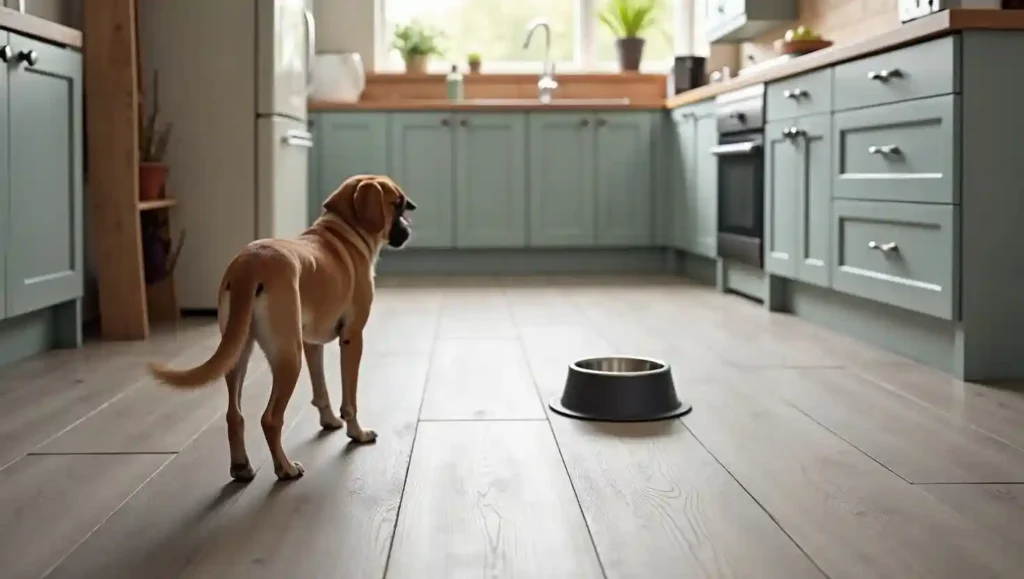
Idea 10: Waterproof Laminate in Kitchen and Feeding Areas
The area around a pet’s food and water bowls is, without argument, the most moisture-challenged zone in any pet household. Dogs splash water while drinking. Wet food spills. Water bowls get knocked. Cats carry water from their bowl on their chins and deposit it on the floor several feet away. All of this concentrated, repeated moisture exposure is exactly why standard laminate, even good-quality standard laminate, is not appropriate in these zones.
The solution is waterproof core laminate, which uses a core material that does not absorb moisture even when liquid penetrates the seam gaps between planks. This protection is not hypothetical. In a feeding area, moisture will reach the seams. The question is whether the floor can handle it without swelling, warping, or beginning to harbour odour-causing bacteria in the compromised core.
For laminate specifically in the kitchen or feeding zone, you want a product that specifies waterproof core (sometimes marketed as WPC-style laminate or water-resistant laminate with sealed edges) rather than simply water-resistant surface. The surface of almost any laminate is sealed and water-resistant. It is the core and seam protection that distinguishes a floor that will last in a pet feeding area from one that will fail within a year.
The colour recommendation for this specific application leans toward medium tones with a slight variation in the grain, which hides dried food debris, dried water marks, and tracking from wet paws without requiring a dark floor that shows every dried drop. A medium grey or warm greige in a shorter plank format works well in kitchen spaces, where the smaller scale complements typical kitchen proportions.
Understanding the connection between moisture barriers for concrete floors and your laminate installation is also worth looking into if your kitchen sits on a slab foundation, since ground moisture adds a second layer of risk beneath the floor.
Idea 11: Acoustic Underlayment Laminate for Multi-Pet Homes
In homes with multiple pets, particularly homes with dogs that run at speed through interior spaces, the sound of claws on hard flooring becomes a real quality-of-life issue. The click and clatter of dog nails on laminate is amplified by the hollow space beneath a floating floor, and in open-plan spaces or upper floors, that sound carries through the entire home.
Laminate with attached acoustic underlayment addresses this directly. The foam or cork backing bonded to the underside of each plank absorbs impact sound at the source, meaning the sound of paws hitting the floor is dampened before it transfers into the floor structure. The result is a noticeably quieter floor, which benefits both humans and the pets themselves, since the noise of their own movement on hard flooring can be stressful for anxious animals.
From a design perspective, laminate with attached underlayment also feels softer underfoot, which matters for older pets with joint pain who spend long periods lying on hard floors. The slight cushioning does not replicate carpet, but it is a meaningful improvement over bare hard laminate for an elderly dog that sleeps on the floor throughout the day.
For multi-pet homes, the practical ideal is laminate that combines all three features: attached acoustic underlayment for sound reduction, waterproof core for moisture protection, and an AC4 wear layer for scratch resistance. Some premium laminate products offer all three in a single plank, which simplifies installation and ensures the specifications work together rather than competing.
The style itself is flexible, since the acoustic underlayment is a functional feature rather than an aesthetic one. Any colour and texture can come with this specification, so choose the surface appearance based on your interior design goals and the acoustic underlayment based on the performance needs of your multi-pet household.
Idea 12: Stone-Look Laminate in Bathrooms and Grooming Areas
Stone-look laminate is one of the more underused options in pet-friendly flooring, and that is a missed opportunity. The category has improved enormously in recent years. Laminate that mimics slate, travertine, or concrete tile now achieves a visual accuracy that reads as genuine stone in most lighting conditions, while offering a practical profile that real stone absolutely cannot match for pet households.
Real stone, particularly polished marble or travertine, is cold, hard, slippery when wet, and extremely unforgiving to dropped items. In a pet bathing or grooming space, those properties create safety and comfort problems. Stone-look laminate delivers the aesthetic without any of those drawbacks. The surface is warmer than ceramic tile, the texture provides grip even when damp, and the sealed surface resists the heavy moisture exposure of a dog bathing area far better than real stone with its grout lines.
For pet grooming spaces, mudrooms with washing stations, or any area where you regularly bathe or clean your animals, stone-look laminate with a fully waterproof core is the appropriate specification. The seams need to be sealed during installation, and any laminate in a grooming space should have the highest available moisture resistance rating from the manufacturer.
Large-format stone-look planks, mimicking twenty-four-by-twenty-four-inch tile or twelve-by-forty-eight-inch slab looks, create a particularly clean and hygienic visual impression. The reduced number of seams per square foot also reduces potential moisture infiltration points, which is directly relevant in high-moisture grooming environments.
Idea 13: Mixed-Width Plank Laminate for a Custom Artisan Look
Mixed-width plank laminate is the current frontier of realistic wood-look flooring design, and it brings a specific advantage in pet households that goes beyond its obvious aesthetic appeal. When plank widths alternate between narrow and wide boards across the same floor, the installed result has a visual complexity that rivals genuine reclaimed hardwood. That complexity is also the key to why it performs so well visually in pet-active homes.
A floor with genuine visual variety, meaning different plank widths, varied grain length, and natural colour graduation between boards, does not have a single dominant visual tone or pattern. It has movement. Pet hair, minor claw marks, and surface variation from everyday use are absorbed into that movement. The eye travels across multiple elements simultaneously, rather than locking onto any single mark or hair as a contrast point against a uniform background.
Mixed-width laminate replicates the look of authentic wide-plank reclaimed or artisan hardwood floors at a fraction of the cost and with the practical durability that real reclaimed wood cannot offer. It suits farmhouse, cottage, eclectic, and warm-transitional interiors, particularly spaces where you want the floor to feel like it has history and character built in from day one, rather than waiting decades for real wood to develop it naturally.
The practical specifications for mixed-width laminate in a pet home are unchanged from any other pet-friendly laminate: AC4 rating, waterproof or water-resistant core, and EIR or wire-brushed texture for surface traction. The medium cognac to warm brown tonal range works best, as it enhances the reclaimed wood effect while providing the colour camouflage that a busy pet household needs daily.
Given how much character a mixed-width floor adds to a space, it is also worth considering how different laminate widths fit into the wide plank laminate flooring ideas already available, since the two concepts can complement each other beautifully in different rooms of the same home.
Specification Summary: What to Look for on the Label
All thirteen of these ideas represent real aesthetic approaches, but every single one needs to be grounded in the right product specifications. The visual concept is only half the decision. Here is what to confirm before purchasing any laminate for a pet-active household.
AC rating should be AC3 at minimum for any room with pets, and AC4 for high-traffic zones or large/active dogs. AC5 products exist for commercial applications and provide the highest level of scratch resistance available in laminate, which can be worthwhile if you have multiple large dogs or a particularly destructive chewer.
Core construction needs to be waterproof or highly water-resistant, not just surface-sealed. Ask specifically about seam protection and whether the core material will resist moisture penetration if a spill sits for two to four hours, which is the realistic window before you notice and clean up a pet accident.
Thickness matters for stability and sound dampening. For most pet-active spaces, twelve millimeter laminate provides better dimensional stability and a more solid underfoot feel than eight millimeter products. Understanding the difference between 8mm and 12mm laminate will help you decide what makes sense for your specific subfloor and pet situation.
Surface texture should be EIR, wire-brushed, hand-scraped, or otherwise textured rather than smooth or high-gloss. This contributes to both pet safety and scratch concealment.
Finish should be matte or low-sheen rather than high-gloss in almost every pet household situation. High-gloss shows every mark, every paw print, and every hair with maximum clarity. Matte finishes absorb visual noise significantly.
Warranty should specifically cover or at least not exclude pet-related wear. Some laminate manufacturers have begun offering explicit pet warranties or pet-protection guarantees, which indicates confidence in the product’s real-world durability. A manufacturer willing to warrant against pet use is telling you something meaningful about how the product performs.
Installation and Ongoing Maintenance
The right laminate, properly installed and maintained, can last fifteen to twenty-five years in a pet household. The installation details matter as much as the product itself, particularly in the context of moisture protection.
Expansion gaps around the perimeter of the room are essential for any floating laminate installation, and this is especially relevant in pet homes where temperature swings from open doors and windows can be more frequent. Understanding the maximum expansion gap for laminate flooring and making sure it is correctly observed during installation will prevent buckling later.
For maintenance, the most important daily habit in a pet home is keeping pet nails trimmed. This is the single most effective thing you can do to extend the life of any hard surface floor, and it applies to every one of the thirteen ideas above. A dog with regularly trimmed nails on an AC4 matte laminate floor will leave almost no visible surface impact over years of normal traffic.
Dry mopping or robot vacuuming daily prevents pet hair and grit from accumulating and acting as abrasive particles underfoot. Grit carried in on paw pads and then ground into the floor surface by foot traffic causes far more visible surface wear than direct claw contact in most households.
For wet cleaning, use a damp mop rather than a soaking wet one, and choose a cleaning product specified for laminate rather than a general floor cleaner. Many general cleaners contain waxes, oils, or surfactants that build up on laminate over time and create a film that actually increases the visibility of paw prints and hair.
If you ever do face surface damage despite taking all the right precautions, it is useful to know that scratches on laminate flooring can be repaired with the right approach rather than requiring full replacement, which makes the economics of investing in good-quality pet-friendly laminate even more favourable over the long term.
Final Thought
A pet-friendly laminate floor is not a compromise. The right specification in the right style gives you a floor that genuinely handles the realities of living with animals while looking intentional, not defensive. The thirteen ideas here represent the range of what modern laminate can do: from the practical everyday reliability of medium-tone matte oak to the design ambition of herringbone entry zones and mixed-width artisan planks.
The constant across all of them is the specification: AC4 wear layer, waterproof or water-resistant core, matte or textured finish, EIR or brushed surface. Get those details right, choose the style that fits your interior and your household’s actual life, and you will have a floor that serves both you and your pets well for many years.
James Miller is a seasoned flooring contractor with years of hands-on experience transforming homes and businesses with high-quality flooring solutions. As the owner of Flooring Contractors San Diego, James specializes in everything from hardwood and laminate to carpet and vinyl installations. Known for his craftsmanship and attention to detail, he takes pride in helping clients choose the right flooring that balances beauty, durability, and budget. When he’s not on the job, James enjoys sharing his expertise through articles and guides that make flooring projects easier for homeowners.
The kitchen is the most demanding room in any home for flooring. It collects spill after spill, bears the brunt of dropped cast iron pans, and sees more foot traffic before noon than most rooms see all day. Yet hardwood remains one of the most sought-after materials for kitchen floors, not because it is the…
The best thickness for laminate flooring is 8mm for most standard residential installations, and 12mm where subfloor irregularities, multi-story sound transmission, or a premium underfoot feel are priorities. For underfloor heating, 8mm is the correct specification in almost every case. For stairs, 12mm is the minimum. The 6mm and 7mm options are budget compromises with…
Most people shop for carpet by how it looks in the showroom. That is usually the wrong starting point. A carpet that feels luxuriously soft under your fingers in a store can look beaten, grey, and matted within two years of living at the bottom of your staircase or across the path between your front…
Hybrid flooring and laminate flooring may look similar on the surface, but they are built for very different realities inside a home. Hybrid flooring combines a rigid waterproof core with a vinyl-based wear system, while laminate flooring relies on a high-density fiberboard core designed for dry, controlled environments. The key difference comes down to how…
Why Stairs Are the Most Demanding Surface You Will Ever Carpet Every foot that lands on a stair tread does something flat floors never experience: it bends the carpet over a sharp edge, compresses the pile against the nosing, and then releases it again with each step. Multiply that cycle by the number of people…
Laminate flooring does not invite bugs the way solid hardwood does. The surface is sealed, the core is compressed fiberboard, and there is no exposed cellulose for wood-boring insects to target. That is the short answer. The longer answer is more important, and it is where most homeowners go wrong. Bugs do not live inside…