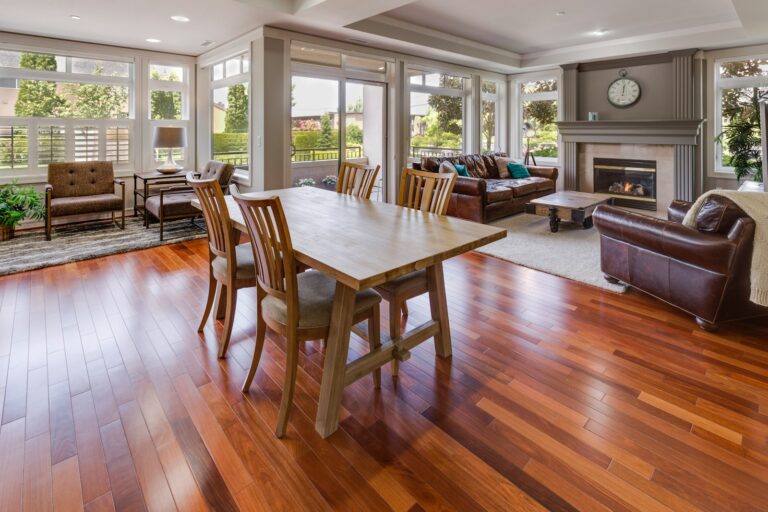
The practical implication is that thicker boards are more forgiving over minor subfloor imperfections. A 12mm board will bridge small dips and humps more effectively than a 6mm board, which can telegraph every subfloor irregularity to the surface. This means that in rooms where the subfloor requires leveling work, choosing a thicker laminate can offset some of the leveling cost — though it does not eliminate the need for a flat substrate within the manufacturer’s tolerance, typically 3/16 inch over 10 feet.
For a detailed comparison of the two most common residential thickness options, the breakdown of whether to use 8mm or 12mm laminate examines both the performance differences and the cost-per-performance value each tier delivers.
AC Rating and Wear Layer Cost
The Abrasion Class (AC) rating system, developed by the European Producers of Laminate Flooring (EPLF), classifies laminate flooring by its resistance to surface wear, impact, staining, and burns. Ratings run from AC1 through AC6, though residential products are almost exclusively AC3 and AC4, with AC5 appearing in commercial applications and premium residential lines.
AC3 products — the most common residential grade — typically cost $1.50–$3.50/sq ft. AC4 boards, which carry a thicker and more durable aluminium oxide-impregnated wear layer, cost $2.50–$5.00/sq ft. AC5 products, designed for commercial use but increasingly specified in high-traffic residential areas, cost $4.00–$8.00/sq ft. The wear layer itself accounts for roughly 15–25% of the board’s manufacturing cost, which is why the AC rating jump from AC3 to AC4 produces a noticeable price step even when all other variables remain equal.
The full cost and performance implications of each AC tier are covered in the comparison of AC3 vs AC4 laminate flooring and the follow-on comparison of AC4 vs AC5 laminate flooring, both of which address how the rating affects warranty length and appropriate use-case selection.
Core Density and HDF Quality
The core of a laminate plank is High Density Fiberboard (HDF). Core density is measured in kg/m³ and ranges from approximately 750 kg/m³ in budget products to over 900 kg/m³ in premium boards. Higher density cores resist moisture penetration more effectively, produce a harder, more stable walking surface, and hold fasteners and locking joints more securely over time. Core density is rarely printed on packaging, but it correlates closely with board weight — a 12mm board weighing significantly less than a competitor’s 12mm board is almost certainly built on a lower-density core.
Core density affects cost because denser HDF requires more fiber, longer press times, and tighter manufacturing tolerances. This contributes to the cost difference between a $2.00/sq ft board and a $5.00/sq ft board of the same nominal thickness. The practical consequence of low core density is not immediately visible but appears over time as joint failure, edge swelling from minor moisture exposure, and a hollow sound underfoot.
Laminate Flooring Material Cost by Tier
Laminate flooring products fall into three commercial tiers — entry-level, mid-range, and premium — and the cost of each tier reflects differences in every physical layer of the plank, not just the surface appearance.
Entry-Level Laminate: $1.50–$3.00 per Square Foot ($16–$32 per m²)
Entry-level laminate is typically 6mm to 8mm thick, rated AC3, and built on a standard-density HDF core. The décor layer prints are competent but lack the depth-of-texture variation that higher-end products achieve through longer repeat patterns and multi-pass embossing. Locking systems at this price point tend to be simpler and have tighter tolerances, meaning installation errors — slight misalignment, insufficient tapping — are more likely to result in joint gaps over time.
Entry-level laminate is appropriate for lower-traffic bedrooms, guest rooms, and rental properties where cost recovery is the primary concern. It should not be specified for kitchens, bathrooms with poor ventilation, or any area with regular foot traffic above what AC3 is rated for. Expected lifespan under normal residential conditions is ten to fifteen years before significant surface wear becomes visible.
Mid-Range Laminate: $3.00–$5.00 per Square Foot ($32–$54 per m²)
Mid-range laminate represents the largest segment of the residential market and the point at which most of the significant quality improvements per dollar are realized. Products in this range are typically 10mm to 12mm thick, rated AC3 to AC4, and feature improved HDF core density. Surface textures are more convincingly realistic — embossed-in-register (EIR) technology aligns the surface texture to the printed wood grain beneath it, producing a tactile and visual result that entry-level products cannot match.
Pre-attached underlayment foam is standard in most mid-range boards, which reduces installation time and adds acoustic damping. Locking joint systems at this price point — Uniclic, Megaloc, and equivalent proprietary systems — are engineered to more precise tolerances and perform better across temperature and humidity cycles. This is the appropriate tier for main living areas, kitchens with adequate moisture management, and any room that will see consistent daily use. Lifespan under normal residential conditions is fifteen to twenty-five years.
Premium Laminate: $5.00–$8.00+ per Square Foot ($54–$86+ per m²)
Premium laminate occupies the upper end of the category and competes directly with engineered hardwood and luxury vinyl plank on price while offering a different value proposition. Products at this tier are typically 12mm or thicker, rated AC4 to AC5, and built on the highest-density HDF cores available. Surface textures are executed with the most sophisticated EIR processes, producing plank-to-plank variation in grain and texture that approaches solid wood appearance at close range.
Many premium laminate lines include enhanced moisture-resistant treatments on the core and edge seals that improve performance in kitchens and bathrooms, though no standard laminate is waterproof in the way that SPC vinyl is. Some products in this tier carry enhanced warranties of twenty-five years or longer, which reflects genuine confidence in the construction. The question of what specifically constitutes luxury laminate — and when the premium price is justified — is addressed in detail in the guide on what luxury laminate flooring is.
Laminate Flooring Installation Cost
Material cost is only one component of total project cost. Installation labor, underlayment, transitions, subfloor preparation, and waste factor all add to the per-square-foot figure you will actually pay by the time the job is complete.
Professional Installation Labor: $1.50–$4.00 per Square Foot
Professional laminate flooring installation costs between $1.50 and $4.00 per square foot for labor, depending on geographic market, room complexity, and the installation method specified. Floating installations — which account for the vast majority of laminate work — sit at the lower end of this range because they require no adhesive and proceed quickly once the subfloor is prepared. Rooms with multiple angles, alcoves, bay windows, stairs, or pattern-matched layouts command a higher labor rate because cutting time increases substantially.
Stair installation is billed separately from field installation in most quotes. Expect to pay $35–$75 per stair tread and riser, depending on the complexity of the nosing solution and whether a site-fabricated or pre-made stair nose profile is being used. A standard flight of thirteen stairs adds $450–$975 to a project.
Geographic variation in labor cost is significant. Markets with high construction labor costs — California, New York, Massachusetts — will see labor rates at or above the high end of that range. Markets in the Southeast, Midwest, and parts of the Mountain West tend to sit at the lower end. Getting three quotes from licensed contractors in your specific market is the only reliable way to establish local labor pricing.
Underlayment Cost: $0.25–$0.85 per Square Foot
Underlayment is a mandatory cost component for any laminate installation over a hard substrate. It serves three functions simultaneously: acoustic damping (reducing impact noise transmission to the floor below), minor subfloor irregularity absorption (smoothing out small bumps and dips within tolerance), and moisture vapor management (slowing the transmission of moisture vapor from concrete subfloors into the laminate core).
Basic foam underlayment costs $0.25–$0.35/sq ft and is appropriate over plywood subfloors where moisture is not a concern. Combination underlayment products that integrate a vapor barrier film cost $0.35–$0.55/sq ft and are the standard specification for concrete slab installations. Premium underlayment with enhanced acoustic ratings, thicker foam, and integrated vapor barriers costs $0.55–$0.85/sq ft and is appropriate for upper-floor installations where impact noise transmission to lower floors is a concern.
Many mid-range and premium laminate boards come with a pre-attached foam pad factory-bonded to the bottom face of the plank. When a pre-attached pad is present, a separate underlayment is generally not installed (and in most cases should not be, as stacking foam layers produces an excessively compressible substrate that stresses the locking joints). The pre-attached pad adds roughly $0.15–$0.30/sq ft to the board’s material cost but eliminates the separate underlayment purchase and reduces installation time.
Subfloor Preparation Cost: $0–$3.00+ per Square Foot
Subfloor preparation is the most variable and least predictable cost in any laminate project. If the existing subfloor is flat to within manufacturer tolerance, dry, and structurally sound, preparation cost is near zero — a thorough sweep and perhaps a minor fill of isolated low spots. If the subfloor requires leveling, moisture remediation, or structural repair, preparation cost can equal or exceed the material cost of the laminate itself.
Self-leveling compound for a moderately uneven concrete slab typically costs $0.50–$1.50/sq ft in materials plus labor. Large areas requiring significant leveling can push this to $2.00–$3.00/sq ft. Plywood subfloors with squeaky joists, raised fasteners, or OSB delamination require mechanical repair before laminate installation — costs vary widely by the extent of the damage.
Moisture is the most serious subfloor condition affecting laminate. Concrete slabs always emit some level of moisture vapor, and a slab that tests above 3 lbs per 1,000 sq ft per 24 hours (ASTM F1869) or above 75% relative humidity (ASTM F2170) requires active moisture mitigation before laminate installation. This typically means a topical moisture barrier applied to the slab surface, costing $0.50–$1.50/sq ft in materials and labor, in addition to the standard vapor barrier underlayment.
Transition Strips and Moldings: $2.00–$8.00 per Linear Foot
Transition strips bridge the gap between the laminate field and adjacent floor surfaces — doorways, room thresholds, changes of level, and terminations at walls or cabinets. They are a real cost that is frequently omitted from early budget estimates. T-moldings, reducers, end caps, stair noses, and quarter-round base shoe are all required components of a complete installation.
Standard laminate-matched transition profiles cost $2.00–$4.00 per linear foot. Premium profiles in solid wood or metal cost $4.00–$8.00 per linear foot. A typical two-bedroom home with four interior doorways and a kitchen threshold might require thirty to forty linear feet of transition material, adding $60–$320 to the project cost depending on profile selection.
Waste Factor: 10–15% on Material Quantity
Laminate flooring must be purchased with a waste allowance above the net measured square footage of the room. The standard waste factor is 10% for rooms with straightforward rectangular geometry and a running-bond or offset installation pattern. Rooms with diagonal installations, complex shapes, or significant cut-waste at doorways and alcoves require a 12–15% waste allowance. This waste factor applies to both the laminate and the underlayment.
The waste allowance is not a contractor markup — it reflects the physical reality that every cut plank has a off-cut that is often too small to be reused. Purchasing to exact square footage and running short mid-installation is a scenario that creates real problems: dye-lot matching, production run availability, and installation delays all become issues if additional material must be sourced after the job has started.
How Much Does Laminate Flooring Installation Cost in Total?
Laminate flooring installation costs $1.50–$4.00 per square foot for labor alone and roughly $1.75 to $8.00 or more per square foot once underlayment and subfloor preparation are added, before the laminate itself and per-linear-foot moldings are counted. The table below collects each installation line item from this guide so a written quote can be checked against it.
Installation line item
Typical price
Unit
Floating installation labor
$1.50–$4.00
per sq ft
Underlayment (foam, combination, premium)
$0.25–$0.85
per sq ft
Self-leveling and subfloor preparation
$0–$3.00+
per sq ft
Topical moisture mitigation on concrete
$0.50–$1.50
per sq ft
Transition strips and moldings
$2.00–$8.00
per linear ft
Stair tread and riser
$35–$75
per stair
Baseboard removal, reinstall and touch-up
$0.25–$0.50
per sq ft
Old flooring removal and disposal
$0.50–$1.50
per sq ft removed
Furniture moving (if offered)
$50–$150
per room
Laminate installation labor in San Diego sits at or above the $4.00 per square foot top of that range, because California is one of the high-cost construction labor markets. Diagonal layouts add 20–30% to labor, large-format planks (wider than 5 inches and longer than 48 inches) add 10–20%, and on-grade slabs in coastal, humid areas often need the moisture-mitigation line. Because these costs are the same whichever board you choose, a San Diego project using mid-range laminate will land toward the upper half of the $6.00–$9.00 per square foot all-in range shown in the summary below.
Total Installed Cost by Room Size
The following cost estimates assume a mid-range laminate ($3.50/sq ft material), standard combination underlayment ($0.45/sq ft), professional installation labor ($2.50/sq ft), basic transition moldings, and a 10% waste factor. Subfloor preparation is assumed to be minimal. These figures represent typical all-in installed costs in a mid-range US market.
A 150 sq ft bedroom (roughly 12 x 12.5 feet) would cost approximately $950–$1,150 installed. A 250 sq ft living room (approximately 15 x 17 feet) would cost approximately $1,600–$1,900. A 400 sq ft open-plan living and dining area would cost approximately $2,500–$3,000. A whole-house project covering 1,200 sq ft of flooring would cost approximately $7,500–$9,500 installed, with per-square-foot unit costs declining slightly due to reduced proportional overhead and transition costs.
These estimates shift materially based on product tier. Selecting entry-level laminate over mid-range reduces material cost by approximately 35–40% but does not reduce labor or preparation cost proportionally, since installation time is similar regardless of product quality. Selecting premium laminate over mid-range adds 40–60% to material cost. For a 400 sq ft project, the material cost difference between entry-level ($1.80/sq ft) and premium ($6.50/sq ft) laminate is approximately $1,880 — a significant figure against a total installed budget where labor and preparation are fixed costs regardless of product selection.
DIY vs. Professional Installation: Cost Comparison
DIY laminate installation eliminates the labor component of the cost entirely, which represents a saving of $1.50–$4.00 per square foot. On a 400 sq ft project, this is a potential saving of $600–$1,600. The tools required are not expensive — a circular saw or jigsaw, a tapping block, pull bar, spacers, tape measure, and square — and most can be rented or purchased for $100–$250 total. A detailed list of what is required is covered in the guide to what tools you need to lay laminate flooring.
The DIY saving is real but not risk-free. The most common DIY installation errors — insufficient expansion gap, improper acclimation of the material before installation, inadequate moisture testing of the subfloor, and incorrect underlayment selection for a concrete substrate — can produce failures that cost more to remediate than the original labor saving. A floor that has buckled due to an inadequate expansion gap or swelled due to an undetected moisture problem must be removed and reinstalled, with all associated costs.
Flooring contractors also carry the cost of mistakes. A professional installation that fails due to installer error is typically covered by the contractor’s workmanship warranty, whereas a DIY installation that fails for the same reasons is entirely at the homeowner’s expense. The decision to DIY is financially rational when the homeowner has genuine carpentry competence, has properly acclimated and tested the material, and is working over a subfloor in good condition. It is higher risk when any of those conditions is absent.
Laminate Flooring vs. Alternative Flooring Costs
Laminate’s cost position makes sense only in relation to the alternatives competing for the same budget and performance requirements.
Laminate vs. Hardwood Flooring
Solid hardwood flooring costs $5.00–$15.00/sq ft for materials and $4.00–$8.00/sq ft for installation, producing a total installed cost of $9.00–$23.00/sq ft — two to four times the installed cost of mid-range laminate. Engineered hardwood narrows this gap: material costs are $4.00–$12.00/sq ft with installation at $3.00–$6.00/sq ft, for a total of $7.00–$18.00/sq ft. Hardwood can be sanded and refinished multiple times, extending its effective lifespan to fifty years or more and recovering value at resale that laminate cannot match. For detailed hardwood cost analysis, the cost to install hardwood flooring guide breaks down species-by-species pricing and installation variables.
Laminate vs. Luxury Vinyl Plank (LVP)
LVP costs $2.00–$7.00/sq ft for materials and $1.50–$3.50/sq ft for installation, producing a total installed cost of $3.50–$10.50/sq ft — closely comparable to mid-range laminate. The key differentiation is not cost but performance profile: LVP is 100% waterproof at the plank level and is appropriate for bathrooms, laundry rooms, and below-grade installations where laminate carries significant risk. LVP is generally softer and quieter underfoot than laminate but is more susceptible to surface scratching from furniture and pet nails. The cost comparison of LVP against other flooring types is examined in depth in the analysis of the cost of LVT compared to other flooring.
Laminate vs. Carpet
Carpet installed in a standard residential bedroom costs $3.00–$8.00/sq ft all-in, which brackets mid-range laminate. Carpet carries lower installed cost per square foot at the entry level but requires replacement in twelve to fifteen years under normal residential use and earlier in pet households or high-traffic areas. Laminate’s hard surface is easier to clean, does not trap allergens the way carpet fiber does, and holds its appearance better under heavy foot traffic. The choice between the two is primarily a comfort and lifestyle question, not a cost question at most budget levels.
Hidden Costs in Laminate Flooring Projects
Several cost items are consistently underestimated or omitted from initial project budgets. Acknowledging them upfront prevents the budget overruns that make flooring projects stressful.
Furniture removal and replacement is rarely included in flooring contractor quotes. Moving furniture out of a room before installation, storing it temporarily, and moving it back after installation is either a labor cost charged separately or a homeowner task that requires advance planning. Contractors who do include furniture moving typically charge $50–$150 per room.
Baseboard removal and reinstallation is handled differently by different contractors. Some include it in their standard quote; others do not. When baseboards are removed and reinstalled rather than replaced with new material, there is always some damage — nail holes, paint chips, minor splits — that requires touch-up painting. Budget $0.25–$0.50/sq ft for baseboard handling and associated painting touch-up if it is not explicitly included in the installation quote.
Disposal of the old flooring is a real cost on replacement projects. Carpet and pad removal generates significant waste volume that must be hauled away. Old vinyl sheet flooring may contain asbestos in pre-1980 homes and requires professional testing and potentially abatement before removal. Contractor disposal fees for old flooring material run $0.50–$1.50/sq ft of old floor removed.
Material acclimation time affects project scheduling. Laminate flooring must acclimate to the installation environment for 48–72 hours before installation — longer in conditions of extreme temperature or humidity difference between storage and installation environment. This acclimation period is not a cost, but it affects scheduling and must be factored into project timelines. The reasons this step is non-negotiable are explained in the guide on why you should acclimate laminate flooring.
How AC Rating Affects Long-Term Cost of Ownership
The initial cost of the laminate is only one component of its total cost of ownership over the floor’s service life. A floor that wears through its surface in eight years and must be replaced costs more in total than a floor with a higher initial price that lasts twenty-five years. This is the economic argument for specifying the correct AC rating rather than the cheapest available product.
An AC3 floor in a high-traffic living room or kitchen will show surface wear within seven to twelve years under normal residential use. Replacement at that point requires the full cost of materials, labor, preparation, and transition work again — typically $4.00–$8.00/sq ft all-in. An AC4 floor in the same location, costing perhaps $1.00–$1.50/sq ft more at the time of installation, will last fifteen to twenty-five years before similar wear appears. Over a thirty-year horizon, the AC4 floor installed once is almost always cheaper in total than the AC3 floor replaced once or twice.
This lifecycle cost logic applies with equal force to thickness selection, underlayment quality, and subfloor preparation. The temptation to compress cost in every line item of a flooring budget is understandable, but the items that most directly affect durability — core density, AC rating, subfloor flatness, and moisture management — are the wrong places to find savings.
Factors That Increase Installation Cost Beyond the Baseline
Several specific conditions reliably push a laminate installation above the baseline cost estimates presented above. If any of these conditions apply to a project, the budget should be adjusted accordingly before soliciting contractor quotes.
Diagonal installation patterns add 15–20% to material cost (higher waste factor from cut pieces at every wall) and 20–30% to labor cost (more complex layout geometry and significantly more cutting time). The visual result — a room that appears wider and more dynamic — is a legitimate design choice, but the cost premium is real and should be confirmed before specifying a diagonal layout.
Below-grade installations in basements or slab-on-grade rooms in humid climates require more rigorous moisture testing and vapor barrier specification. If moisture testing indicates elevated vapor emission, the remediation cost described earlier applies. The selection of laminate for below-grade applications should also be reconsidered in favor of SPC vinyl in environments where moisture is an ongoing structural condition rather than an isolated issue.
Rooms with significant subfloor height variation — older homes where joists have deflected, rooms where previous flooring installations have created build-up at transitions — require leveling before laminate installation. The cost of self-leveling compound, skim coat application, and curing time adds to both material and labor costs and can delay the overall project schedule.
Large-format planks (wider than 5 inches and longer than 48 inches) are more difficult to handle during installation, produce more waste at room edges due to their proportions, and require more precise subfloor flatness because long boards bridge subfloor irregularities differently than short ones. The labor premium for large-format plank installation is typically 10–20% over standard plank sizing.
How to Get an Accurate Laminate Flooring Quote
An accurate quote for a laminate flooring project requires more than a square footage measurement and a product selection. Contractors who quote based on square footage alone without visiting the site are not accounting for the variables that actually drive final cost — subfloor condition, room geometry, access constraints, existing flooring removal, and transition requirements. Site visits before quoting are standard practice for legitimate flooring contractors and should be expected as part of the process.
When soliciting quotes, provide contractors with the specific product you are considering (or a product tier and performance requirement) rather than asking them to specify the material. This produces comparable quotes across contractors and prevents the practice of substituting lower-quality material to reduce the bid price while nominally hitting a budget target. Confirm that quotes include underlayment, transitions, baseboard handling, disposal of old material, and any identified subfloor preparation work. These line items should appear explicitly in the written quote, not be bundled opaquely into a per-square-foot rate.
For homeowners who want to use a calculator to estimate costs before getting contractor quotes, the laminate, hardwood, and vinyl flooring calculator provides a starting-point estimate based on room dimensions and product tier.
Get a minimum of three written quotes from contractors who have visited the site. The range between the lowest and highest quote on a comparable scope is typically 20–35% — a meaningful difference that reflects real variation in labor cost, overhead structure, and how individual contractors assess the risk of subfloor preparation and unforeseen conditions. The lowest quote is not always the best value, particularly if it omits preparation work that a higher-quoted contractor has identified and included.
Laminate Flooring Cost Summary
Laminate flooring material costs range from $1.50/sq ft for entry-level AC3 products to $8.00/sq ft for premium AC5 commercial-grade boards, with the most common residential specification — 10mm to 12mm AC3 to AC4 — landing at $3.00–$5.00/sq ft. Underlayment adds $0.25–$0.85/sq ft. Professional installation labor adds $1.50–$4.00/sq ft. Subfloor preparation ranges from near zero to $3.00+/sq ft depending on existing conditions. Transitions, waste factor, baseboard work, and disposal add further to the all-in cost.
A realistic total installed cost for a professionally installed mid-range laminate project is $6.00–$9.00/sq ft ($65–$97/m²). DIY installation reduces this to $4.00–$6.00/sq ft ($43–$65/m²) by eliminating the labor component. Premium projects with top-tier material, complex geometry, and significant subfloor preparation can reach $12.00/sq ft ($130/m²) or more.
The most reliable way to control laminate flooring project cost is to invest in accurate subfloor assessment upfront (preventing expensive mid-project discoveries), select the appropriate AC rating for the actual use case (preventing premature replacement), and obtain site-specific quotes from multiple contractors before committing to a budget. The product tier decision — entry, mid-range, or premium — should be made after the fixed costs of installation, preparation, and transitions are understood, since those costs are largely independent of the board price and represent a floor below which total project cost cannot fall regardless of how inexpensive the selected product is.
James Miller is a seasoned flooring contractor with years of hands-on experience transforming homes and businesses with high-quality flooring solutions. As the owner of Flooring Contractors San Diego, James specializes in everything from hardwood and laminate to carpet and vinyl installations. Known for his craftsmanship and attention to detail, he takes pride in helping clients choose the right flooring that balances beauty, durability, and budget. When he’s not on the job, James enjoys sharing his expertise through articles and guides that make flooring projects easier for homeowners.
A carpet snag is a fiber or loop that has been pulled above the surface of the carpet pile, creating a raised strand that sits visibly higher than the surrounding tufts. The term covers two structurally different events: a pulled fiber in a cut-pile carpet, where an individual strand lifts and separates from the weave,…
The vinyl flooring market has become genuinely crowded. There are hundreds of brand names on store shelves and even more floating around online, and most of them use the same language: waterproof, durable, easy install, realistic wood look. That uniformity makes the brand comparison problem harder than it looks. You are not comparing apples to…
Bamboo flooring sits in an interesting position in the market. It is neither the cheapest option on the shelf nor the most expensive, yet it gets misquoted constantly because buyers compare the material price alone without accounting for what actually drives the total project cost. The number you see on the box rarely reflects what…
Yes, vinyl flooring can be installed over existing tile in most situations — but whether it should be depends entirely on the condition of the tile underneath, the type of vinyl you are using, and how much floor height gain your doorways, baseboards, and transitions can tolerate. The answer is not a blanket yes or…
Every laminate flooring decision starts with the same problem: dozens of brands, thousands of SKUs, and almost no transparent way to compare what you are actually getting for your money. The marketing language across the category is nearly identical — “realistic wood look,” “waterproof core,” “easy click installation” — yet the difference between a $0.79/sq…
11 Herringbone Tile Flooring Ideas That Work in Every Room The herringbone pattern is one of the oldest floor layouts in the world, and somehow it keeps looking like the newest idea in the room. Roman engineers used it to surface roads. Elizabethan craftsmen used it to dress palace floors. And today, homeowners from San…