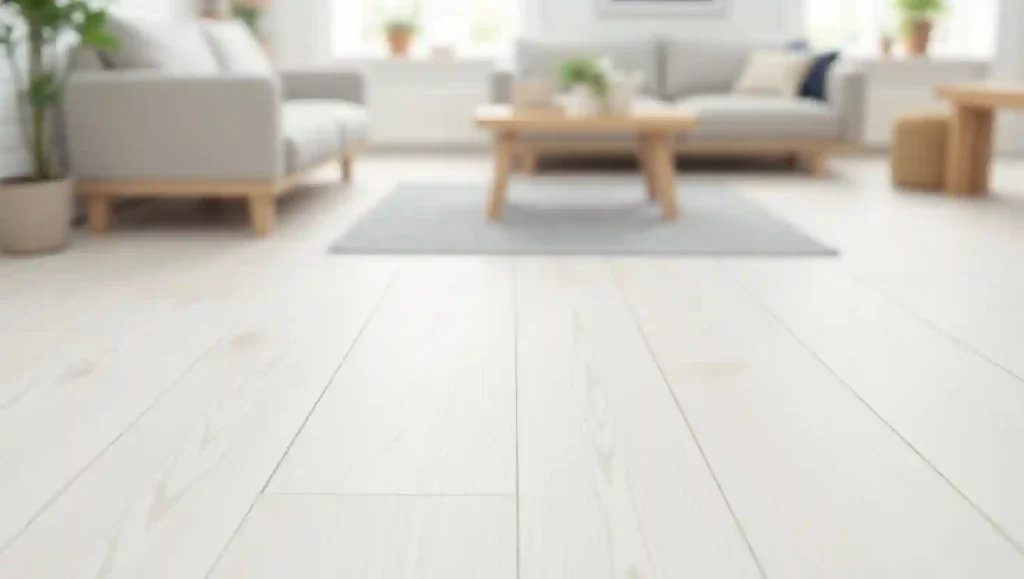
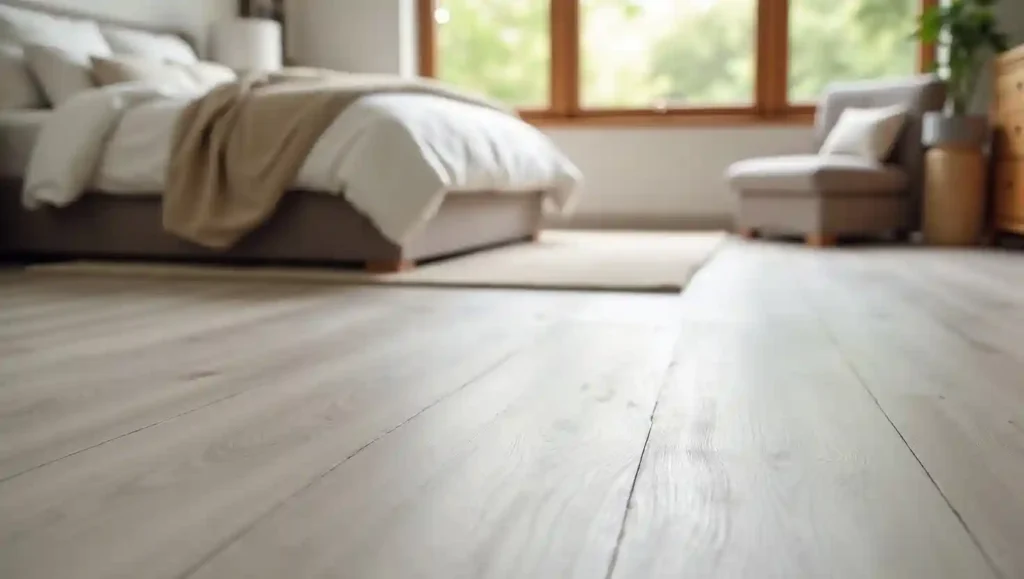
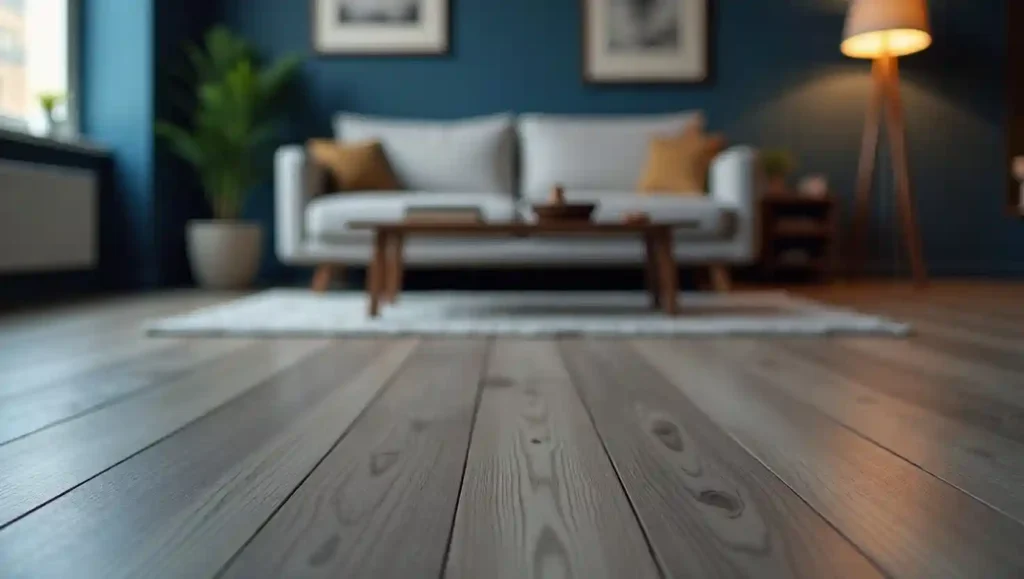
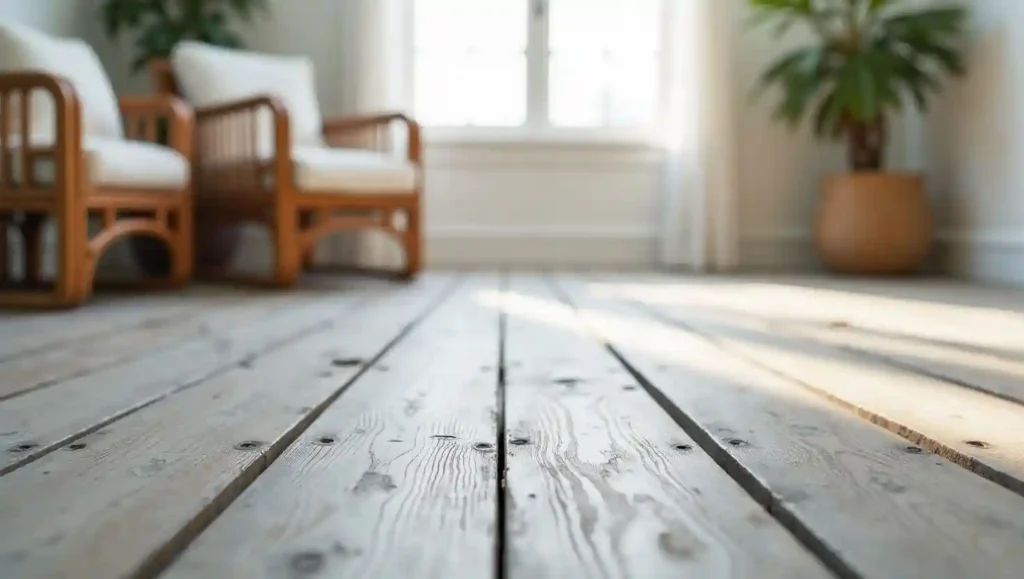
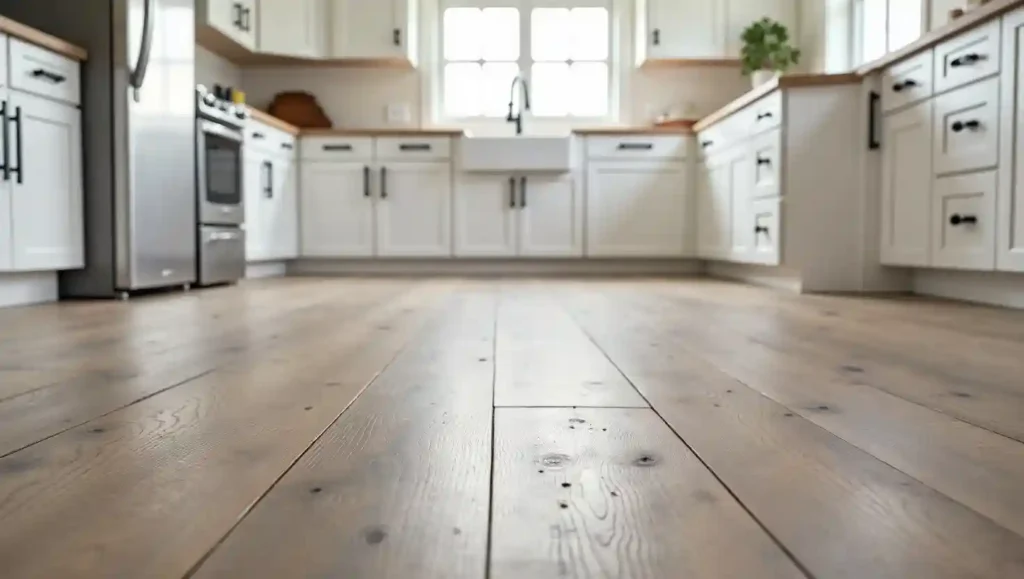
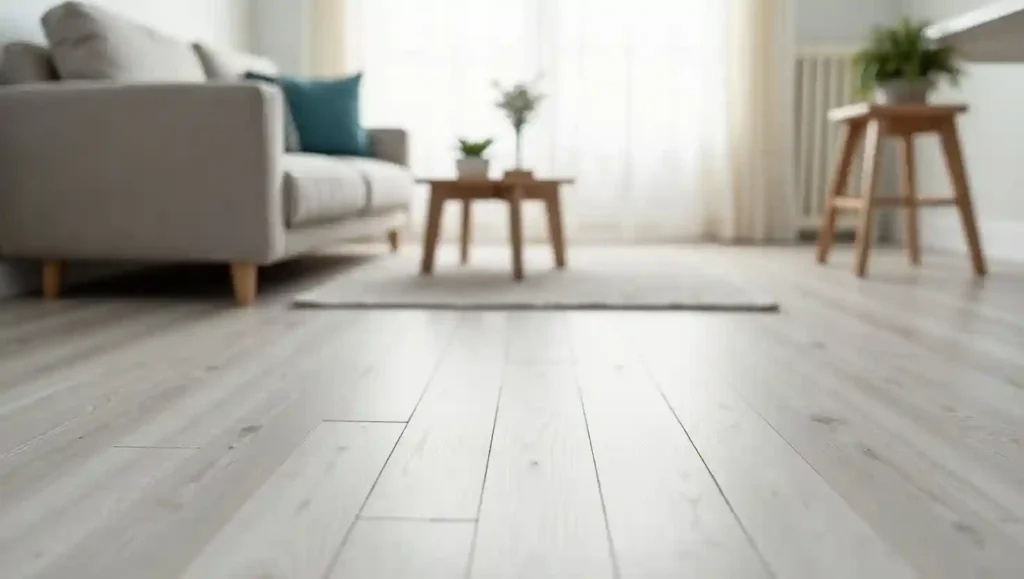
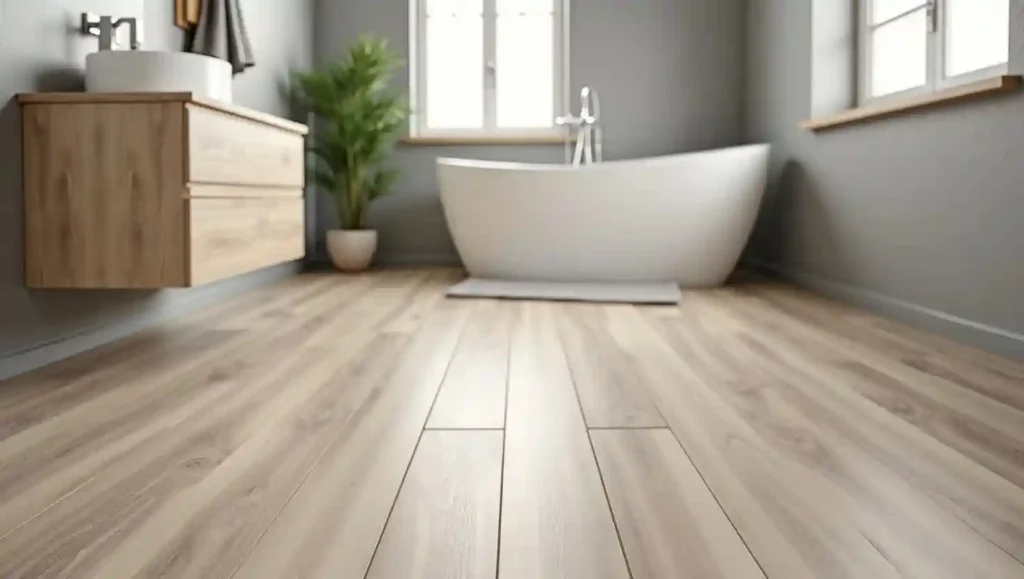
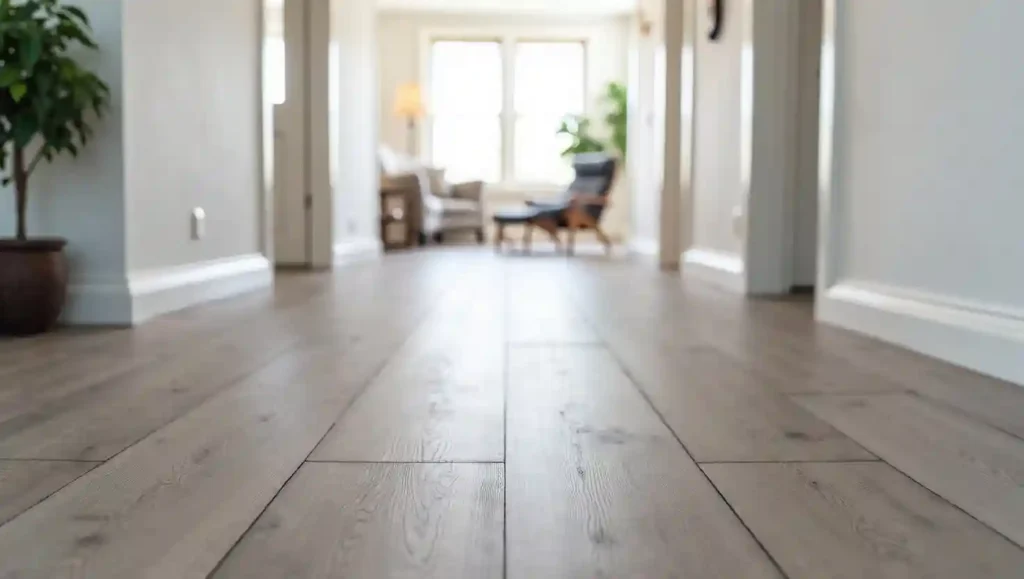
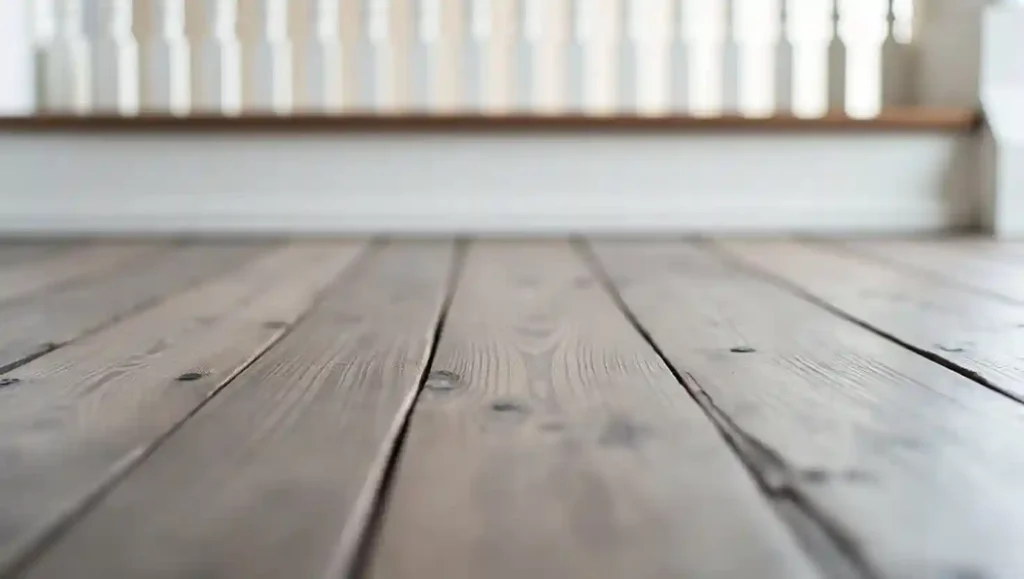
Matte or satin finishes are the right call here. High-gloss on a pale grey floor in a light room can look clinical and harsh. A matte finish instead lets the natural grain of the white oak show through the grey stain without competing with it.
One practical note worth raising for any Scandinavian-inspired installation: because these floors are typically floating installations over concrete or wood subfloors, the quality of your underlayment matters enormously for the acoustic experience of the room. A floating wide-plank floor without proper underlayment sounds hollow and amplifies footstep noise. The right underlayment dampens that entirely and also provides a thermal barrier.
If you want to understand which underlayment works best for this kind of installation, our guide on underlayment for hardwood floors covers all the material options and thickness considerations in full.
2. Greige Hardwood Floors in a Warm, Open-Plan Kitchen and Dining Area
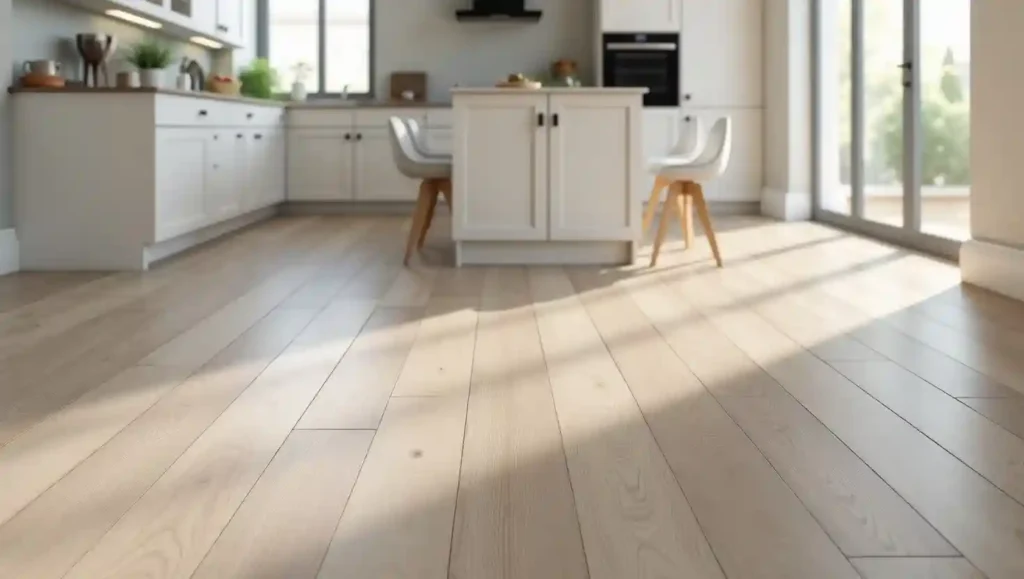
Greige — the grey-beige hybrid tone — is arguably the most commercially intelligent grey hardwood finish available right now. It solves one of the most common complaints about cooler grey floors: the feeling of coldness or sterility that can creep into a room when the walls are also light and the furniture is neutral. Greige reads warmer because of its beige undertones, but it retains enough grey to look polished and contemporary rather than plain beige.
In open-plan kitchen and dining spaces, greige hardwood is practically ideal. It runs continuously under the kitchen island, through the eating area, and into the adjoining living space without the color of the floor clashing with any particular zone. Natural oak or European oak species stained to a greige tone pair beautifully with white shaker cabinets, cream-painted lowers with a navy island, or walnut veneer cabinetry — all common kitchen door finishes. The floor ties the whole open plan together rather than competing with any section of it.
The warmer interpretation of grey also means greige floors age gracefully. As furniture and wall colors evolve over the years — and in a family home they always do — the greige floor adapts. It is one of the few hardwood colors that works equally well with a warm color scheme and a cool one, which gives you genuine design flexibility across the life of the floor.
For kitchens specifically, a water-resistant finish or a hardwood product with a factory-applied moisture-resistant topcoat is worth the extra investment. Hardwood is not waterproof, and kitchens produce significant moisture around the sink, dishwasher, and refrigerator. Choosing the right finish up front prevents cupping and swelling that would cost far more to repair later.
3. Charcoal Grey Hardwood Floors with White Walls and Black Accents
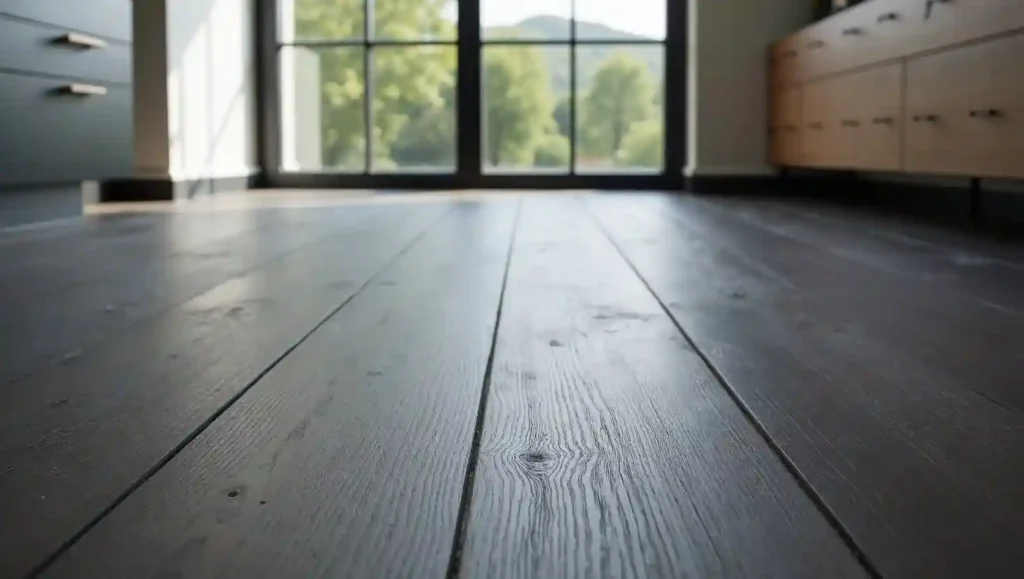
Charcoal grey hardwood is the floor that comes up consistently in high-design interiors, architectural photography, and upscale renovation projects. It is a bold, decisive choice — far removed from the safe neutrality of lighter grey tones — and it reads as confident rather than tentative. When executed correctly, charcoal grey hardwood floors give a room a gallery-like quality: clean, focused, and dramatic.
The design formula that works most reliably is crisp white walls, charcoal grey floors, and black architectural accents — window frames, door hardware, light fixtures, handrail details. This monochromatic approach plays with light and shadow in a way that pale floors cannot. The contrast between the white walls and the dark floor makes the room feel taller, because the eye jumps between the ceiling and the floor rather than reading them as a continuous visual field.
Charcoal is a shade that responds strongly to room size and natural light. In a large, well-lit room with good ceiling height, charcoal hardwood floors look magnificent. In a small, low-ceilinged room without much natural light, the same floor can feel heavy and oppressive. The fix in smaller rooms is to maximize light sources — large mirrors, white or pale ceilings, north-facing windows left uncovered — rather than choosing a lighter floor tone simply out of caution.
Species-wise, white oak and ash are the best candidates for a true charcoal stain. European oak fumed with ammonia vapors before finishing produces an especially rich and even charcoal tone that is deeper than surface staining alone can achieve. Wirebrushed texture on a charcoal floor adds another layer of visual interest, catching light in the grain channels and preventing the floor from looking flat or monotonous.
4. Grey Herringbone Hardwood Floors in a Formal Dining Room
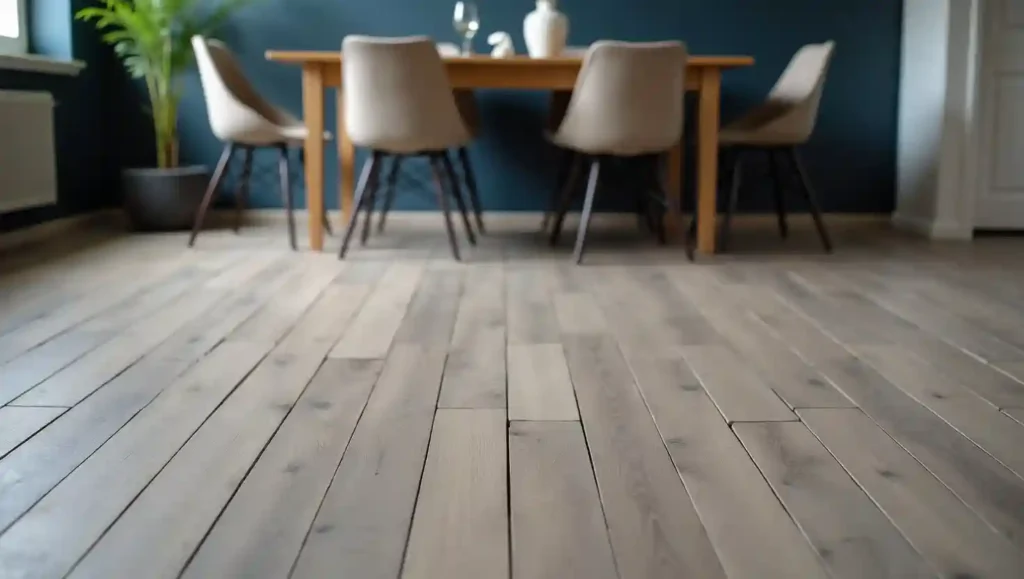
The herringbone pattern and grey-stained hardwood floors are a combination that elevates any room they enter. In a formal dining room specifically, grey herringbone floors signal a level of design intentionality that guests register immediately. The interlocking zigzag of the herringbone creates a dynamic floor surface that moves with the eye rather than presenting a static background, and grey is the tonal choice that keeps the pattern sophisticated rather than rustic or country-casual.
Mid-tone grey is the best choice for a dining room herringbone installation. Too light and the pattern becomes difficult to see against pale furniture legs and a light rug. Too dark and the pattern competes with the visual weight of a large dining table. A mid-grey with visible grain detail sits in the sweet spot: the herringbone is clearly readable, the grain adds texture that keeps the floor from looking flat, and the grey tone integrates with the full range of dining room decor from modern to traditional.
Herringbone requires significantly more material than straight-lay installations because of the angled cuts required. Plan for a waste factor of fifteen to twenty percent over your calculated room area. White oak in engineered form is the preferred material for herringbone, because the engineered construction resists the seasonal movement that can open gaps or buckle narrow herringbone pieces in a solid hardwood format.
In terms of styling, grey herringbone floors in a dining room work especially well with a long linen or velvet-upholstered dining chair, pendant lighting that anchors the table visually, and wall colors from dark navy to deep sage green. The pattern in the floor is strong enough that the walls can afford to be bold rather than safe.
Our article on herringbone hardwood flooring ideas goes deeper into pattern variations, wood species, and installation approaches for anyone who wants to explore this direction fully.
5. Light Grey Hardwood Floors in a Master Bedroom
The master bedroom is where light grey hardwood floors perform at their best. The tone is calming without being cold, restful without being clinical, and the wood grain underneath adds enough visual warmth to prevent the room from feeling like a hotel corridor. This combination — soft grey finish, visible grain, matte surface — is one of the most frequently requested hardwood looks in residential renovation projects.
For a master bedroom, plank width between five and seven inches hits the best balance between the sense of space that wide planks create and the warm, tactile grain detail that narrower planks preserve. At five inches you still get the continuity of a wide-plank floor, but the grain is concentrated enough in each plank to be clearly visible.
Layering over a light grey hardwood floor in a bedroom is where the styling becomes interesting. A large area rug in ivory, cream, or soft blush placed under the bed anchors the furniture grouping and adds acoustic comfort — a benefit that matters more in a bedroom than in most other rooms. Natural linen bedding, warm brass or matte black hardware on the furniture, and curtains in off-white or warm stone complement the cool floor tone without neutralizing it.
Avoid the trap of grey-on-grey throughout a bedroom. If the floor is light grey and the walls are also grey, the room loses definition and starts to feel flat. Instead, consider walls in a soft white, a warm off-white, or a very pale sage — colors that read as almost neutral but carry enough warmth or hue to give the grey floor something to contrast against.
6. Grey Hardwood Floors with Navy Blue Walls
If there is a single color pairing in grey hardwood flooring that has genuine staying power, it is grey floors against navy blue walls. The combination works because navy and grey share the same cool undertone, so they are tonally related without being identical. Navy walls make grey floors look warmer — the relative coolness of the wall pushes the floor toward its warm undertones, which are there even in quite cool grey stains.
This pairing works across multiple room types. In a living room with navy walls and mid-grey hardwood floors, the space feels enveloped and library-like — excellent for an adult sitting room or a home office. In a hallway, navy walls with grey floors create a confident, directional passage that feels more deliberate than a plain white-walled corridor. In a dining room, the combination is formal enough to anchor a significant dinner table without feeling stuffy.
The finishing elements in a navy-and-grey scheme benefit from metallic accents that bridge the two tones. Brass and gold are the warmest metals and they cut through the cool palette most effectively. Brushed brass pendant lights, antique brass cabinet hardware, and gold-framed mirrors all pull the room toward warmth while the navy walls and grey floor provide the cool structural base.
One choice you need to make carefully in this pairing is the degree of contrast between wall and floor. If the walls are a very deep navy — almost black-navy — then the grey floor needs to be distinctly lighter to maintain visual separation. If the navy is softer, a mid-grey floor can hold its own without the contrast feeling harsh.
7. Weathered Grey Hardwood for a Coastal or Beach-House Interior
Weathered grey hardwood flooring is the most direct flooring translation of driftwood aesthetics. The finish mimics what saltwater, sun, and wind do to unprotected timber over decades: the color bleaches toward grey, the surface becomes lightly textured as the softer cells of the wood grain erode, and the overall appearance carries a sense of calm, worn-in ease that polished or high-gloss floors simply cannot replicate.
In a coastal home or beach house, weathered grey hardwood floors connect the interior to the landscape outside in a way that feels organic rather than decorative. Paired with white-painted shiplap walls, natural fiber rugs in seagrass or jute, and furniture in bleached linen or rattan, the floor locks the whole interior into a coherent coastal narrative without a single seashell or nautical print in sight.
The practical appeal of weathered and wire-brushed grey finishes extends well beyond aesthetics. The surface texture of a wire-brushed or hand-scraped floor hides minor scratches and dents far more effectively than a smooth-sanded, high-gloss surface. In a beach house that sees barefoot traffic, sand tracked indoors, and a general attitude of relaxed living, this is a meaningful practical advantage.
White oak and pine are the most appropriate species for a weathered grey finish in a coastal setting. White oak’s grain has the open, elongated structure that resembles driftwood under a light grey wash. Pine, with its pronounced knots and dramatic grain pattern, can take on a genuinely weathered character when finished with a grey wash, though pine is a softer species and requires more care against denting in high-traffic areas.
8. Grey Stained Oak Floors in a Modern Farmhouse Kitchen
The modern farmhouse aesthetic is built on the tension between rugged natural materials and clean, contemporary design. Grey-stained oak floors are uniquely positioned to serve both sides of that tension: they carry enough grain character and warmth to read as organic and honest, while the grey stain moves them away from the honey-brown tones of traditional farmhouse wood and into a more contemporary register.
In a farmhouse kitchen, grey oak floors pair naturally with white or off-white shaker cabinetry, farmhouse sinks, and matte black hardware. The floor becomes a bridge between the warmth of the wood and the coolness of the appliances and countertops. When the upper cabinets are white and the lower section or island is painted a deeper color — forest green, charcoal, navy — the grey floor connects both cabinet tones without favoring either one.
Plank width matters more in a farmhouse kitchen than in most other rooms because of the traffic and the style context. Wide planks — six inches and above — read as more farmhouse-appropriate because they reference the broad-board floors of old American farmhouses. Narrower strip flooring, by contrast, reads more formal or commercial in a farmhouse kitchen, which is the opposite of the aesthetic intention.
Surface texture is also worth deliberate attention in this setting. A hand-scraped or slightly distressed grey oak floor carries the farmhouse spirit with far more authenticity than a smooth, perfectly uniform surface. The slight variation in depth across the face of a hand-scraped plank catches light differently throughout the day and makes the floor feel genuinely alive.
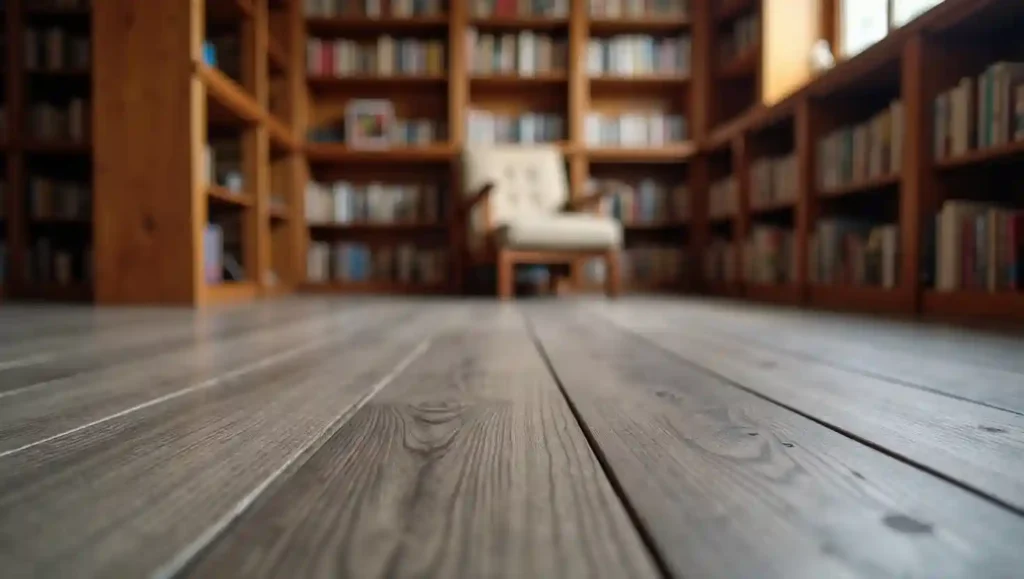
9. Ash Grey Hardwood Floors in a Home Office or Library
Ash is a wood species that is genuinely underused in grey hardwood flooring conversations that tend to focus almost exclusively on oak. But ash stained grey is a remarkable floor: the straight, tight grain of ash takes a grey stain differently from oak — producing a more uniform, slightly more formal surface — and the resulting floor has a quiet, focused quality that is particularly well-suited to rooms where concentration is the goal.
In a home office or library setting, grey ash hardwood floors work brilliantly. The regularity of the grain pattern does not distract the eye when you are seated and looking across the room toward a bookshelf or a window. The grey tone keeps the room feeling clear-headed and clean. Combined with floor-to-ceiling built-in shelving in a warm wood veneer, the contrast between the warm shelves and the cool grey floor creates a focused, productive visual dynamic.
From a durability standpoint, ash is one of the hardest domestic hardwood species. Its Janka hardness rating is approximately 1,320, which places it above most red and white oak and comfortably above walnut. For a room where a chair on castors will be rolling across the floor daily — as in a home office — hardness is not a minor consideration. Softer species like pine or walnut show caster damage quickly; ash resists it effectively.
Finish selection for a grey ash floor in a library or office should lean toward matte or satin rather than high gloss. Gloss finishes in a room that is used during daylight hours with significant natural light create distracting reflections and show footprints and fine scratches more readily than matte surfaces.
10. Pale Grey Floors in a Small Apartment or Studio Space
One of the most practically useful properties of pale grey hardwood flooring is its ability to make small spaces feel larger than they are. A pale grey floor does this through two mechanisms: it reflects significantly more light than a dark floor, and its lack of strong color does not pull the eye downward. In a small apartment or studio space where every visual trick in the designer’s toolkit needs to be deployed, pale grey hardwood floors are one of the most effective single choices you can make.
The effect is strongest when the pale grey floor is combined with walls in a very pale off-white or a soft warm white. This creates a seamless visual field — floor and walls read as a continuous pale backdrop rather than two separate planes — and the room feels like it has more volume than its dimensions warrant. Contrast this with a dark hardwood floor in the same room: the dark floor makes the ceiling feel lower and the walls feel closer, which is the opposite of what a small space needs.
For a studio apartment specifically, where one room serves as living area, bedroom, and workspace simultaneously, pale grey hardwood floors are a unifying element. They do not define any single zone — they pass under the bed, under the sofa, under the desk — and that continuity is what makes a studio feel like a coherent home rather than a cramped single room with several different functions.
Engineered hardwood in a pale grey finish is often the more practical choice for apartment installations because it can be installed as a floating floor without adhesive or nails, which is important in rental or condominium buildings where drilling into concrete subfloors may not be permitted.
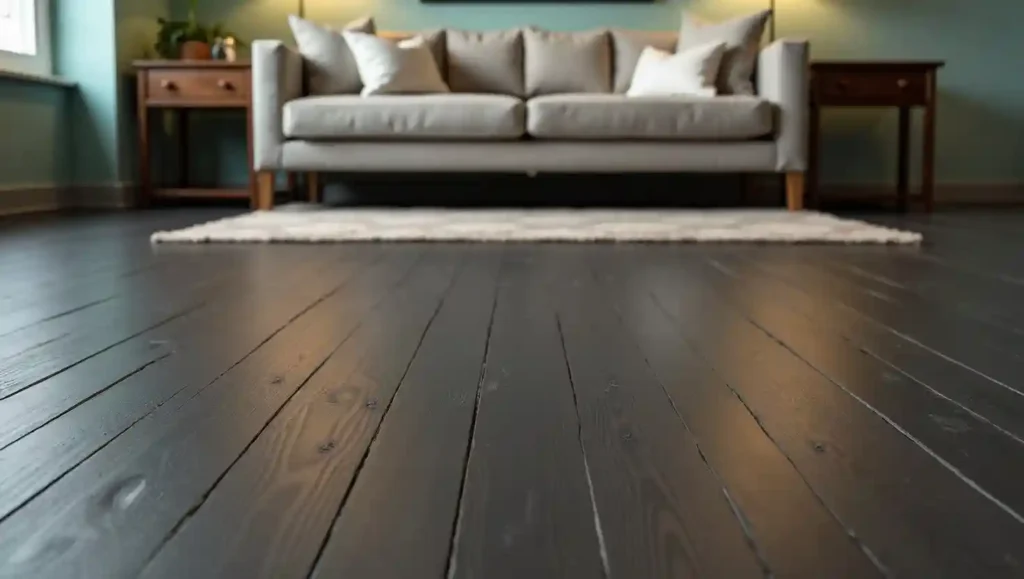
11. Dark Charcoal Floors with Sage Green Walls
Charcoal grey hardwood floors paired with sage green walls is one of the more unexpected grey floor combinations, and one of the most rewarding when executed correctly. Sage is a complex color — it carries both grey and yellow in its undertones — which means it bridges the cool grey of the floor and the organic warmth of the wood grain without creating a jarring shift between the two surfaces. The result is a room that feels simultaneously grounded and fresh.
This combination is particularly successful in living rooms, dining rooms, and master bedrooms. In a living room setting, charcoal floors and sage walls provide a lush, layered backdrop for furniture in natural linen, cognac leather, or warm walnut. The palette is sophisticated without the hard-edged severity of an all-grey or all-black scheme, and it is distinctive enough to give the room a clear identity.
Getting the right shade of sage is important. Sage that trends too yellow will look tired against a cool charcoal floor. Sage that leans too blue can feel cold. The versions that work best with grey hardwood floors are mid-value sages that sit clearly between grey and green on the color wheel — muted enough to feel quiet, green enough to carry life and warmth into the room.
Lighting in a charcoal-floor, sage-wall room is worth planning carefully. Because both surfaces absorb light — the dark floor more aggressively — artificial lighting needs to be warm, layered, and abundant. A single overhead fixture is not sufficient. Floor lamps, table lamps, and under-cabinet lighting all contribute to the warmth that counterbalances the depth of the charcoal floor.
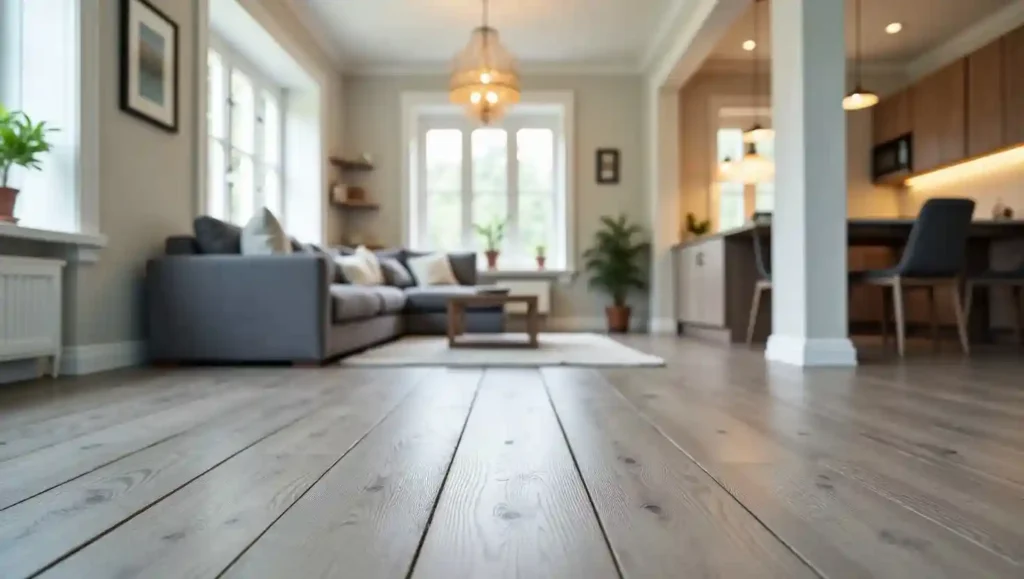
12. Grey Hardwood Floors in a Transitional Open Plan with Engineered Hardwood
Transitional style — the design space between traditional and contemporary — is the dominant residential interior idiom in the United States, and grey hardwood floors are its most faithful flooring partner. The grey tone is contemporary enough for a clean, uncluttered aesthetic but warm enough in its wood grain to feel traditional and inviting. It is a floor that a thirty-year-old minimalist and a fifty-year-old traditionalist can both live with comfortably.
In a transitional open-plan home, where the living area, dining room, and kitchen flow into each other without visual division, running a consistent grey hardwood floor throughout the entire ground level is one of the most spatially effective design decisions available. The floor becomes the single unifying element across all three zones. Walls can vary — a different wall color in the kitchen, an accent wall in the living room — but the floor remains constant, which gives the open plan coherence rather than chaos.
Engineered hardwood in a grey finish is the practical choice for a large open-plan installation because it can run continuously across subfloor types — from concrete slab to wood joist — without changes in material or height. This is significant in open plans where the kitchen may be on a concrete slab while the adjacent living area is over a crawl space. Solid hardwood cannot do this without complex height equalization; engineered hardwood handles it with ease.
Understanding the different characteristics of solid versus engineered hardwood is important before making this decision. The full comparison of performance, cost, and suitability by room type is covered in our detailed guide on solid vs engineered hardwood flooring.
13. Greige Hardwood in a Primary Bathroom
Hardwood flooring in bathrooms is genuinely achievable when the right precautions are taken, and greige-toned engineered hardwood is one of the most beautiful bathroom floor options available for homeowners who want the warmth of wood where tile would traditionally be the default choice. The visual warmth of greige hardwood in a bathroom transforms the room’s atmosphere completely — from the cool, clinical quality of white tiles to something softer and more spa-like.
The key to success with hardwood in a bathroom is moisture management at every level. The hardwood itself needs to be either an engineered product with a water-resistant core and a factory-applied waterproof topcoat, or a solid hardwood species that has been site-finished with multiple coats of a moisture-resistant oil or polyurethane. The subfloor needs to be dry and stable. And the bathroom needs to be well-ventilated so that humidity dissipates rather than sitting on the floor surface.
In a primary bathroom setting, greige hardwood floors pair beautifully with large-format stone or porcelain tiles on the walls in grey, white, or travertine tones. The interplay between the natural grain texture of the floor and the geometric precision of wall tiles creates a sophisticated material contrast. Freestanding bathtubs, warm brass fixtures, and white oak vanity cabinetry all complement greige hardwood floors in a primary bathroom context.
The floor finish should be satin or semi-gloss in a bathroom — matte finishes, while excellent in living rooms and bedrooms, are more porous and harder to clean in high-moisture rooms. A harder topcoat provides better protection against water pooling and is easier to maintain over the long term.
14. Grey Hardwood Floors Throughout an Entire Home for Resale Value
Grey hardwood flooring throughout an entire home — unified from the entry hall through all living areas and bedrooms — is one of the more significant renovation investments a homeowner can make with respect to resale value. Unlike strong color choices in paint or fixture finishes, which often feel personal to the point of putting off potential buyers, a quality grey hardwood floor installed throughout has broad market appeal. It photographs well, it reads as contemporary and well-maintained, and it does not require buyers to mentally edit the existing condition.
The grey tone that performs best for resale is a mid-tone grey — not too pale, not too dark. Very pale floors can look cold and fragile in real estate photography. Very dark charcoal floors read as a strong design statement that not every buyer will share. Mid-grey tones, particularly those with a slight warm bias toward greige, have the widest market acceptance and the best track record for positive buyer response.
From a practical standpoint, installing a consistent grey hardwood floor throughout a home also simplifies transitions between rooms. No transition strips, no threshold bars, no color changes from room to room. The floor flows from the front door to the back of the house without interruption, which makes the home feel larger and more cohesive in person and in listing photographs.
Choosing the right hardwood species for a whole-home installation also involves durability considerations. High-traffic areas like hallways, entry rooms, and kitchens need harder species — white oak, ash, hickory — while bedrooms are more forgiving and can accept softer options. Running the same species throughout maintains visual consistency while ensuring the floor holds up in the areas that matter most.
It is also worth understanding how the flooring direction you choose affects the perceived dimensions of each room. Our guide on grades of hardwood flooring explains how grade selection influences the visual uniformity of large-scale installations, which is relevant when choosing a grey tone that will run across hundreds of square feet.
15. Grey Hardwood on Stairs and Landing for a Unified Design Statement
Grey hardwood flooring does not have to stop at the bottom of a staircase. Running the same grey hardwood up the stairs and across the landing above is one of the most visually resolved design moves in a home with multiple floors, and it is also one of the more effective ways to make a staircase feel like a designed feature rather than a functional afterthought.
When grey hardwood runs continuously from the ground floor up the stairs and across the upper landing, the staircase becomes a grey hardwood cascade rather than a visual interruption. From the base of the stairs, the consistent tone and grain of the hardwood draws the eye upward in a smooth, continuous movement. This is especially effective in homes with open-plan ground floors, where the staircase is visible from the main living space.
The installation on stairs involves stair nosings — the rounded edge piece that covers the front of each tread — and risers, which can be painted white to contrast with the grey tread or finished in the same grey hardwood for a more monolithic, unified effect. White risers against grey treads is the more traditional approach and provides clear visual demarcation of each step, which is important for safety. Matching risers create a stronger design statement but require precise installation so the join between tread and riser is tight and clean.
Hardwood on stairs requires careful attention to surface grip. Grey hardwood treads with a high-gloss finish can be slippery, particularly in socks. Matte or satin finishes provide better grip, and some installations include a thin anti-slip strip along the front edge of each tread. This is especially worth planning for in homes with young children or elderly residents.
The full process of installing hardwood on stairs — from cutting mitered nosings to fitting returns and balancing finish consistency with safety — is covered step by step in our guide on how to install hardwood flooring.
Choosing the Right Grey: Species, Stain, and Finish Decisions
Running through fifteen ideas without addressing the underlying decisions that determine whether a grey hardwood floor actually delivers the look intended would leave this guide incomplete. The choices of species, stain method, and finish type are the three technical variables that determine the outcome, and they interact with each other in ways that are not always intuitive before you see physical samples in your space.
Species choice is the foundation. White oak is the benchmark choice for grey staining because its open grain accepts pigment evenly and its natural color base — neither pink like red oak nor yellow like pine — does not introduce unwanted undertones into the finished grey. European oak, ash, and maple are all viable alternatives, though maple requires professional application to achieve an even grey result because its density causes blotching under surface stains applied without a proper sealer. Cherry and walnut are generally poor candidates for true grey finishes because their natural warmth fights the stain’s cooler intention.
Stain method matters equally. Reactive stains — which chemically alter the wood’s tannins — produce different grey tones than pigment-based surface stains. The ammonia fuming technique used on European oak produces a grey that comes from within the wood’s structure rather than sitting on its surface, which gives the floor a depth that surface staining cannot fully replicate. For most residential projects, a quality pigment-based stain applied by a skilled finisher with a proper sanding and sealing protocol will deliver excellent results.
Finish type changes the lived experience of the floor more than most buyers anticipate before installation. Matte finishes hide minor scratches and cleaning swipe marks far more effectively than satin or semi-gloss. High-gloss finishes amplify grey’s cooler undertones and make grain texture less visible. For most of the grey hardwood ideas in this guide, a matte or satin finish delivers the best balance of aesthetics and practical durability.
If you are comparing grey hardwood flooring against grey in other materials — for instance, grey vinyl plank, which is available in nearly identical tones — the surface texture and warmth of the wood grain underfoot is the decisive experiential difference. The comparison is worth understanding before committing, and our article on engineered hardwood vs hardwood helps clarify where each product performs strongest.
How Grey Hardwood Floors Interact with Natural Light
The tone of a grey hardwood floor is not a fixed characteristic — it shifts significantly with the quality and direction of the natural light in the room. This is one of the most important variables for homeowners to test before committing to a grey shade, because a sample chip viewed in a showroom under artificial lighting will not look the same as the installed floor in a room with north-facing windows or strong afternoon sunlight from the west.
Rooms with north-facing light receive cool, even, indirect illumination throughout the day. In these rooms, grey hardwood floors look their coolest and clearest — which is ideal for contemporary and Scandinavian-style interiors, but can feel too clinical in a room that is meant to feel warm and inviting. The fix is to choose a grey with a greige or warm undertone rather than a pure cool grey, so that the floor reads warmer even in cooler light.
South-facing rooms receive warm, strong, direct sunlight for most of the day. In these rooms, cool grey floors can look almost beige in the height of afternoon — a significant shift from how they appeared in the showroom. The warm directional light pulls out any yellow or brown undertones in the stain, and the floor can end up reading warmer than intended. If you want a true grey in a south-facing room, choose a stain with a distinctly blue-grey bias to counteract the warming effect of the light.
East and west-facing rooms experience dramatic light shifts across the day — warm and raking in the morning or evening, flat and neutral midday. Grey hardwood floors in these rooms will show their full tonal range across a single day, which is one of the genuinely pleasurable characteristics of this flooring choice. The floor is not a static surface; it participates in the changing quality of the space in a way that tile or vinyl flooring cannot replicate.
Understanding how your specific light conditions will interact with a grey stain before installation is not optional — it is the single most important step in the selection process. Always test full-size samples, at least twelve by twelve inches, in the actual room at multiple times of day before ordering materials.
Maintenance and Long-Term Care for Grey Hardwood Floors
Grey hardwood floors, regardless of species or finish, require regular maintenance to preserve their appearance and structural integrity over the long term. The good news is that grey is one of the most forgiving floor colors for everyday maintenance: light pet hair, fine dust, and surface scratches are all significantly less visible on grey than on very dark or very light surfaces. This practical advantage is not a minor footnote — in a busy household, it translates directly to reduced cleaning frequency and a floor that always looks reasonably presentable even between scheduled cleanings.
The routine maintenance regime for grey hardwood floors is straightforward. Dry sweeping or vacuuming two to three times per week — more frequently in high-traffic areas — prevents fine grit particles from accumulating on the surface and acting as abrasives under foot traffic. Damp mopping with a well-wrung microfiber mop and a pH-neutral hardwood floor cleaner should be done weekly or as needed. Avoid steam mops, wet mops, and any product that deposits a shine-enhancing film on the floor surface, as these damage the finish over time.
Grey stained floors require slightly more attention to cleaning product selection than natural hardwood floors, because the grey pigment in the finish can occasionally be lifted by harsh chemical cleaners. Always use a cleaner specifically formulated for finished hardwood, and test in an inconspicuous area before applying broadly if you are switching products.
Deeper maintenance — recoating the finish without sanding, or full sanding and refinishing when the finish is significantly worn — follows the same schedule as any other hardwood floor. A well-maintained grey hardwood floor should hold its finish for eight to fifteen years before a full refinishing is necessary, depending on traffic levels and species hardness. Our full guide on how to refinish hardwood floors covers the complete process when the time comes.
Grey Hardwood Flooring and Underfloor Heating
Grey hardwood floors and underfloor heating are a compatible combination, but the pairing requires careful material selection and installation discipline to perform correctly. Wood and heat have a complicated relationship: hardwood expands and contracts with temperature and humidity changes, and a radiant heat system that cycles aggressively can cause premature gapping, cupping, or cracking if the wrong species or product is installed.
Engineered hardwood is significantly more stable than solid hardwood over a radiant heat system. The cross-ply construction of engineered boards resists the dimensional movement that solid planks undergo as temperatures rise and fall. For any grey hardwood floor installation over underfloor heating, engineered products — particularly those with a thicker wear layer that can be sanded and refinished as needed — are the appropriate choice.
Species stability over heat varies. European oak and white oak are both considered good choices for heated floors because they are dimensionally stable relative to other species. Wider planks over radiant heat require more careful acclimatization and a lower maximum operating temperature — typically no higher than 27 degrees Celsius at the floor surface — to prevent excessive movement.
The grey finish itself is not directly affected by underfloor heating. The stain is locked within the topcoat finish and does not change color with temperature. What can change is the texture of the floor surface if the topcoat cracks due to excessive heat or dryness — which is why maintaining a consistent indoor humidity level between forty and sixty percent is essential in a home with both hardwood floors and a radiant heat system.
For a complete technical overview of the considerations involved, our article on hardwood flooring and underfloor heating covers system types, temperature limits, species selection, and installation protocols in full detail.
Is Grey Hardwood Flooring Right for Your Home?
Grey hardwood flooring is not a universal answer to every flooring brief, and it is worth being honest about where it performs less well rather than overselling its versatility. In a very warm, traditionally furnished home — think rich mahogany furniture, deep jewel-toned upholstery, Persian rugs — a cool grey hardwood floor can feel tonally disconnected from the rest of the room’s palette. In these cases, a greige floor that carries visible warm undertones is a better choice than a pure cool grey.
Grey hardwood also requires buyers to be honest about the lighting conditions in their home before choosing a shade. As discussed earlier, the same stain color can read very differently across rooms with different light exposures. The investment in physical samples and the time spent testing them in the actual space is never wasted.
For households with very young children or large dogs, species hardness and finish durability are practical considerations that run parallel to aesthetic choices. A pale, smooth grey finish on a softer species in a high-traffic family room will show wear quickly. Choosing a harder species — white oak over walnut, ash over pine — and a more textured surface finish will deliver a far better long-term result without compromising the grey tone you are after.
Ultimately, grey hardwood flooring has earned its sustained popularity because it genuinely delivers on its central promise: a floor that works with almost everything, wears gracefully, and makes the rest of the room look considered and complete. The fifteen ideas in this guide represent only a fraction of what is achievable with grey hardwood — but they should give you a clear starting framework for wherever your project begins.
James Miller is a seasoned flooring contractor with years of hands-on experience transforming homes and businesses with high-quality flooring solutions. As the owner of Flooring Contractors San Diego, James specializes in everything from hardwood and laminate to carpet and vinyl installations. Known for his craftsmanship and attention to detail, he takes pride in helping clients choose the right flooring that balances beauty, durability, and budget. When he’s not on the job, James enjoys sharing his expertise through articles and guides that make flooring projects easier for homeowners.
Most parents spend hours choosing the right paint color, the right bed frame, the right storage solution for a kid’s room. The floor gets far less thought. That’s a mistake, because the floor is the surface a child interacts with more than any other in the house — crawling across it as an infant, building…
You can install laminate flooring over engineered hardwood, and over nailed-down solid hardwood — but whether you should depends entirely on one thing: the condition and installation method of the engineered floor underneath. This distinction matters more than most articles will tell you. A glued-down engineered hardwood floor creates a completely different base than a…
Most people shopping for kitchen laminate are asking the wrong question. They open a browser, type “best laminate flooring for kitchens,” and spend the next hour reading product roundups that were written before waterproof laminate technology even existed. The result is that they end up buying a floor rated for a bedroom and wondering why…
What Makes SPC Flooring Structurally Different From Other Vinyl Products SPC stands for Stone Plastic Composite. The core layer is a compressed blend of natural limestone powder, polyvinyl chloride, and stabilizers, calendared under high pressure into a rigid slab. That manufacturing process produces a core density typically between 1.85 g/cm³ and 2.0 g/cm³, which is…
A teak shower floor sits at an interesting crossroads between practical engineering and bathroom aesthetics. It is not simply a flooring choice — it is a system decision, one that touches subfloor preparation, waterproofing assemblies, drain geometry, wood species behavior under constant moisture, and long-term maintenance chemistry. Most guides collapse all of that into a…
Nail polish spills on carpet happen in seconds, but the damage they leave can last weeks if you respond incorrectly. Nail polish is a lacquer-based product. It contains nitrocellulose, resins, plasticizers, and pigments suspended in a fast-evaporating solvent. The moment that solvent begins to evaporate, the polymer film starts to bond with carpet fibers at…