Their HDF core is produced at a higher density than industry average. A standard laminate core sits at around 820–850 kg/m³. Quick-Step’s core typically runs at 880–900 kg/m³. That increased core density translates directly into reduced hollow-sound underfoot, better resistance to indentation, and a stiffer plank that sits flatter during installation. When you walk on cheap laminate, you hear a hollow, plasticky sound. When you walk on a properly dense HDF board, the sound is muffled and the plank feels more like real wood — and Quick-Step’s density figures are a primary reason for that difference.
The wear layer on Quick-Step laminate is applied using a proprietary process they call Scratch Guard or Scratch Guard Plus depending on the product line. The wear layer is an aluminium oxide-impregnated overlay, which is standard across the industry, but the thickness and the grit concentration vary considerably. Their premium lines achieve wear layer thicknesses that allow them to reach AC4 and AC5 ratings, which means they are certified for heavy residential and commercial use respectively. Understanding wear layer thickness is critical when comparing laminate products across brands, because it is the single most reliable predictor of how long a floor will maintain its appearance under real traffic conditions.
The Uniclic System: Why It Defined the Category
Quick-Step’s Uniclic locking system is the feature that most professionals reference first when describing the brand. The mechanism works on a fold-down principle — planks connect at an angle and fold flat, locking together without glue. The geometry of the tongue and groove profile is machined to tolerances of less than 0.1 mm, which is why Quick-Step floors typically produce tighter joints and fewer gaps than competitors using less precise milling equipment.
The newer version, Uniclic Multifit, goes further — it allows installation using either the fold-down method or the tap method, meaning the same plank can be clicked together from above or from the side. This is particularly valuable when installing against walls, around obstacles like radiator pipes, or in awkward-shaped rooms where angled insertion is not possible.
The practical consequence is that click-lock failures are far less common with Quick-Step than with budget laminate, where the locking profile tolerances are loose enough to allow planks to separate under thermal movement or moderate foot traffic. Quick-Step’s system is also rated to allow disassembly and reinstallation in floating format, which matters if you ever need to lift a section of floor to access pipework.
Quick-Step Product Lines Explained
Quick-Step operates several distinct product lines, each targeting a different price point and performance requirement. These lines change over time, but the following represent the core offering as of the time of writing.
Impressive and Impressive Ultra
The Impressive range is the most widely stocked and the most commonly specified in residential projects. Planks are 8mm thick in standard Impressive and 12mm in Impressive Ultra. The surface layer replicates timber grain with reasonable accuracy using a registered emboss process — the texture of the wear layer is physically aligned with the printed grain pattern underneath, so the visual and tactile experience corresponds rather than being a flat texture over a wood image.
Impressive Ultra achieves an AC5 rating, making it one of the few residential laminate products rated for commercial heavy use. It also carries Quick-Step’s HydroSeal edge protection on all four sides of every plank, which is a wax-based impregnation applied to the cut edges of the board to reduce moisture ingress at the joints. This is not the same as a waterproof core, but it meaningfully reduces swelling damage from spills if they are cleaned within a reasonable timeframe.
Eligna and Largo
Eligna is an older line that uses a gloss or semi-gloss finish, producing a more formal, polished appearance. It is now less prominent in the Quick-Step lineup as matte and satin finishes have become dominant in interior design trends. Largo is the wide-plank format line, with boards running up to 205mm in width and 2050mm in length. Wide planks are particularly effective in open-plan spaces where the floor needs to read as a single continuous element rather than a series of narrow strips.
Livyn and Pulse (LVT Lines)
It is worth clarifying a common confusion in the market: Quick-Step also manufactures luxury vinyl tile (LVT) products under the Livyn and Pulse brand names. These are frequently displayed alongside their laminate ranges in showrooms, and buyers sometimes purchase one believing they are buying the other. Livyn and Pulse are 100% waterproof because they have a PVC core, whereas Quick-Step laminate is water-resistant but not waterproof. The laminate and vinyl products look similar on the surface — the distinction matters enormously in wet areas like bathrooms or laundry rooms. Comparing waterproof laminate to waterproof vinyl is worth doing in detail before specifying a floor in any room that sees regular water exposure.
Signature and Elite
These are Quick-Step’s premium laminate lines, featuring longer boards (up to 2050mm), wider profiles, more complex surface textures including handscraped and brushed finishes, and the highest HDF core density in their range. They are positioned as a direct visual alternative to engineered hardwood, targeting buyers who want the aesthetic of a real-wood floor without the cost or maintenance commitment of a timber product.
AC Ratings and Where Quick-Step Sits
Every laminate floor sold in Europe and increasingly in the US is tested and rated under the AC classification system — AC1 through AC5, where AC1 is suitable for light residential use and AC5 is suitable for heavy commercial traffic. The rating is determined by a standardized battery of tests including abrasion resistance, impact resistance, stain resistance, and resistance to swelling from water.
Quick-Step’s residential lines generally achieve AC3 to AC5. Their Impressive Ultra and Signature lines are AC5-rated. This is important context: most budget laminate available in big-box retailers is AC3 at best, which is rated for moderate residential traffic only. Understanding AC ratings in laminate flooring allows you to make a direct, objective comparison between Quick-Step and any competing product — the rating system removes brand marketing from the equation.
For buyers choosing between AC3 and AC4 options within the Quick-Step range, the practical question is room usage. A bedroom or a formal dining room used weekly may never stress an AC3 floor. A hallway, open-plan kitchen-living room, or home with dogs and children will show wear on an AC3 floor within five years. Quick-Step’s AC4 and AC5 products are specified precisely for those high-traffic conditions.
Thickness Options in Quick-Step Laminate
Quick-Step laminate is available in 7mm, 8mm, 10mm, and 12mm thicknesses depending on the product line. Thickness affects several things simultaneously: acoustic performance, rigidity over imperfect subfloors, and thermal mass when used with underfloor heating systems.
The 8mm boards in the Impressive range are the most versatile specification — thick enough to absorb minor subfloor irregularities, thin enough to keep the floor level manageable at doorways and transitions. The 12mm Impressive Ultra boards are noticeably stiffer and produce a better acoustic result, but the additional 4mm of floor height is a real consideration in rooms with existing floor finishes where transitions need to be managed carefully.
For underfloor heating specifically, Quick-Step approves most of its laminate ranges for use over warm water and electric systems, but the combined tog value of floor and underlay must stay within their published specifications — typically below 0.15 tog for the floor itself. Choosing the right laminate thickness involves balancing all of these factors simultaneously, and Quick-Step’s thickness range gives enough options to resolve most installation scenarios without compromise.
What Underlay Does Quick-Step Require?
Quick-Step specifies underlay requirements in their installation guidelines, and those requirements affect warranty validity. Their planks that include a pre-attached underlay — a thin foam layer bonded to the back of each plank — should not be installed over a separate underlay, as the combined thickness creates too much flex in the locking system and causes joint failure over time.
For boards without pre-attached underlay, Quick-Step recommends their own Silentwalк underlay range, which is engineered to complement the acoustic and thermal performance characteristics of their floors. Using a third-party underlay is not prohibited, but the underlay must meet the same minimum compressive strength and maximum compression depth specifications. An underlay that is too soft — common with cheap foam products — introduces flex into the locking joint with every footstep, which causes the Uniclic connection to fatigue and eventually crack.
On concrete subfloors, the underlay must also incorporate a vapour barrier layer rated at a minimum 75 µm polyethylene film. Quick-Step sells a combined foam-and-vapour-barrier product for this application. The vapour management question is not optional on concrete — all concrete slabs emit residual moisture, and that moisture will reach the HDF core of any laminate plank over time if there is no membrane between the slab and the floor.
Where Quick-Step Laminate Performs Well
Quick-Step laminate is well-suited to living rooms, bedrooms, hallways, home offices, and open-plan kitchen-dining spaces where the kitchen zone does not see frequent standing water. The Scratch Guard wear layer handles normal residential traffic, including pets and children, without visible degradation in the timeframe covered by their warranty (25 years for residential use across most product lines).
Their wide-plank Largo format works particularly well in rooms over 25 square metres, where the scale of the plank aligns better with the visual proportions of the space. Narrow planks in large rooms can read as busy or dated — this is a real design consideration and Quick-Step’s range of plank widths addresses it directly.
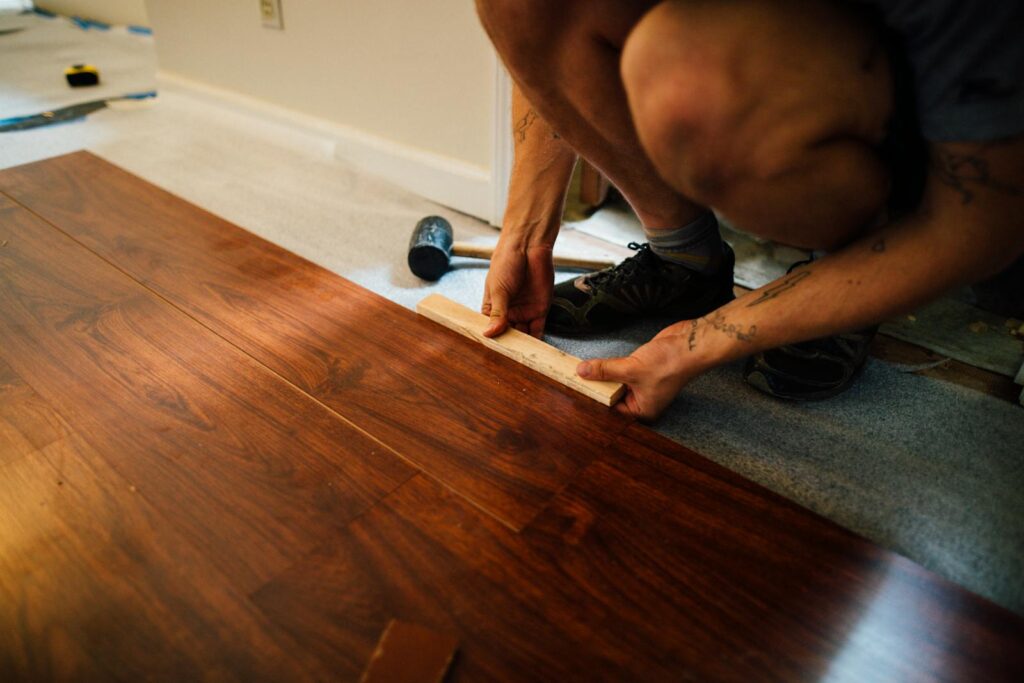
The Uniclic system also makes Quick-Step one of the more practical choices for DIY laminate installation, as the click mechanism is forgiving enough for inexperienced installers while precise enough that the floor, when finished, looks as clean as a professional result. Most Quick-Step products can be installed as a floating floor over a variety of subfloor types without adhesive, which simplifies removal and makes future changes more practical.
Where Quick-Step Laminate Does Not Perform Well
Quick-Step laminate is not appropriate for bathrooms, wet rooms, or any space where the floor is regularly exposed to standing water. This is true of all laminate, including products marketed as “water-resistant.” The HydroSeal edge treatment in Quick-Step’s range extends the window in which a spill can be cleaned without damage, but it does not make the floor waterproof. If water infiltrates the joint and reaches the HDF core, swelling is irreversible. There are specific rooms and conditions where laminate flooring should not be used, and bathrooms are the clearest example regardless of brand.
Quick-Step laminate is also not suitable for saunas, conservatories without temperature regulation, or outdoor covered spaces. Laminate HDF cores are manufactured to close tolerances, and temperature extremes that fall outside the range of a normal conditioned interior can cause irreversible dimensional changes — buckling in heat, cracking at cold extremes.
For commercial environments with very high foot traffic — retail floors, hospital corridors, school classrooms — even Quick-Step’s AC5 products are at the lower end of what is typically specified. Commercial-grade vinyl or ceramic tile is usually the more appropriate choice in those contexts.
Quick-Step vs. Luxury Laminate: Is There a Difference?
The term “luxury laminate” is used in the market in two distinct ways that are worth separating. In some cases, it describes laminate products at the premium end of the price spectrum — thicker boards, higher AC ratings, more complex surface textures. In other cases, it is used loosely to describe LVT (luxury vinyl tile), which is a fundamentally different product with a different core material and different performance characteristics.
Quick-Step sits within the first category by any reasonable definition — luxury laminate flooring represents the top tier of the laminate category, and Quick-Step’s Signature and Impressive Ultra lines are competitive with any other premium laminate product globally. Whether they represent better value than the best offerings from Pergo, Kronotex, or Balterio depends on the specific products being compared and the relative pricing in your market at the time of purchase.
Pricing: What to Expect
Quick-Step laminate is priced above the mid-market in most retail channels. In the US market, Impressive typically retails between $3.50 and $5.00 per square foot for the material alone, with Impressive Ultra and Signature lines running higher. Installation costs are separate and depend on your location and the complexity of the project.
The pricing is justified by measurable attributes — core density, wear layer specification, locking system precision, and warranty length — but buyers should be aware that the brand premium also reflects distribution and marketing costs that are embedded in any globally distributed product. Comparable technical specifications exist in less widely-known European brands at lower price points, but those brands have less consistent availability in the US market.
The total cost of ownership calculation tends to favour Quick-Step in high-traffic applications where a cheaper floor might need replacing in 8–10 years. A floor that lasts 20–25 years with no significant degradation is substantially better value over time even if the upfront cost is 30–40% higher.
Installation Requirements for Quick-Step Laminate
Quick-Step recommends a subfloor flatness tolerance of no more than 3mm deviation over a 1.8-metre span. This is tighter than many contractor specifications and means that subfloor preparation is a genuine prerequisite, not an optional step. Deviations beyond this tolerance cause the locking system to be under constant stress as the floor tries to bridge a low point, which eventually leads to joint cracking.
Acclimation is required before installation. Quick-Step specifies a minimum of 48 hours with the packaging open in the room where the floor will be installed, at normal living temperature and humidity. Skipping acclimation is one of the most common causes of post-installation problems with any laminate — the boards absorb or release moisture relative to their new environment, and if they do this after installation rather than before, the resulting dimensional movement stresses the joints. Acclimating laminate flooring properly is a step that directly affects long-term performance and should not be shortened regardless of project schedule pressure.
Expansion gaps are mandatory at all walls and fixed obstacles. Quick-Step specifies a minimum 8mm gap around the perimeter of the room. In larger rooms — over 10 metres in any direction — additional expansion joints may be needed depending on the ambient temperature and humidity range. The maximum and minimum expansion gap dimensions for laminate are defined by the thermal and hygroscopic movement characteristics of the HDF core, and Quick-Step’s specifications are consistent with the physics of the material.
Maintenance and Long-Term Care
Quick-Step publishes specific cleaning instructions for their floors, and following them matters more than it does with harder flooring materials. The wear layer on laminate, while hard, is not impervious to cleaning products that contain wax, oil, or strong solvents — these leave residue that dulls the surface or, in the case of solvents, can damage the aluminium oxide layer itself.
Quick-Step’s recommended cleaning approach is straightforward: sweep or vacuum regularly to remove grit (which acts as an abrasive under foot), clean spills immediately with a slightly damp cloth, and use their own Maintenance Spray or equivalent pH-neutral laminate cleaner for periodic deeper cleaning. Steam mops are not approved for any Quick-Step laminate product — the combination of heat and moisture penetrates the joints faster than dry steam marketing suggests.
The high-gloss finishes in older Eligna products and some Signature lines show surface scratches more visibly than matte or satin finishes. If your household includes dogs, heavy furniture movement, or active children, a matte or low-sheen finish in an AC4 or AC5 product will maintain its appearance significantly better over time than a high-gloss surface at any AC rating.
What the Warranty Actually Covers
Quick-Step offers a 25-year residential warranty on most of their laminate products, but the warranty terms contain conditions that are worth reading before purchase. The warranty covers manufacturing defects and premature wear of the wear layer under normal residential use conditions. It does not cover damage from flooding, standing water, steam cleaning, improper installation, failure to maintain the correct expansion gap, or installation without the required underlay.
The warranty is also conditional on the floor being installed in conditions that match Quick-Step’s specified temperature and humidity ranges — between 15°C and 25°C (59°F–77°F) and 30–65% relative humidity during installation and ongoing use. A floor installed in an unheated property during winter, then brought up to temperature with central heating, may have experienced conditions that void the warranty before it was ever occupied.
Understanding the warranty terms in full is part of making a properly informed purchasing decision. The 25-year headline figure is legitimate for a floor that is correctly installed and maintained, but it is not unconditional.
Is Quick-Step the Right Choice for Your Project?
Quick-Step laminate is the right choice when you need a laminate floor that will perform without degradation in a high-traffic residential environment for 15–25 years, that can be installed floating without adhesive, and that provides a close visual approximation of real timber grain at a fraction of the cost of engineered hardwood.
It is not the right choice for wet areas, for extreme commercial traffic, or for buyers whose primary criterion is the lowest possible cost per square foot. If waterproofing is the priority, their own Livyn LVT range or a comparable vinyl product addresses that requirement at a comparable price point.
The brand’s real advantage is consistency. Because they control the entire manufacturing process, board-to-board variation is lower than in brands that source components externally. That consistency means fewer installation problems, tighter joints, and a finished floor that behaves the same in year fifteen as it did in year one.
For most residential projects in the living areas of a well-maintained home, Quick-Step sits at the point in the market where additional spending produces diminishing returns. Below their price point, you give up measurable performance attributes. Above it, you are largely buying a different product category — engineered hardwood or high-end LVT — rather than a better laminate.
James Miller is a seasoned flooring contractor with years of hands-on experience transforming homes and businesses with high-quality flooring solutions. As the owner of Flooring Contractors San Diego, James specializes in everything from hardwood and laminate to carpet and vinyl installations. Known for his craftsmanship and attention to detail, he takes pride in helping clients choose the right flooring that balances beauty, durability, and budget. When he’s not on the job, James enjoys sharing his expertise through articles and guides that make flooring projects easier for homeowners.
Vinyl flooring is not a single product. It is a family of products that share a base material — polyvinyl chloride — but diverge dramatically in construction, performance, thickness, and installation method. When someone walks into a showroom and asks for “vinyl flooring,” they could end up with five completely different floors depending on which…
Most people walk into a flooring showroom, see thirty shades of oak, and leave more confused than when they arrived. That is not a buying problem. That is an information architecture problem. You have not been given the right framework yet. This guide fixes that. It builds the decision tree from the structural level up…
What the Subfloor Actually Does — and Why Preparation Is the Whole Game Every conversation about wood flooring eventually becomes a conversation about what sits underneath it. The finish, the species, the plank width — all of that matters. But none of it matters as much as whether the subfloor was prepared correctly before the…
Choosing hardwood floors when you share your home with dogs or cats is one of the most debated decisions in interior design. People love the warmth and character of real wood, but they worry constantly about scratches, accidents, and the daily wear that comes from paws, claws, and enthusiasm. The good news is that with…
Laying laminate in a doorway is the part of the installation where most DIY jobs start to look amateur. The planks click together easily across an open room, but the moment the floor reaches a door jamb, casing, or threshold, the work changes. The doorway is a transition zone, and the floor has to pass…
Hardwood flooring over radiant heating is possible. But “possible” and “problem-free” are two very different things — and most of the damage homeowners see years after installation traces back to decisions made before a single plank was laid. The combination works when three conditions align: the right wood product is selected, the floor surface temperature…