The Structural Rule First: Floor Joists Cannot Be Ignored
Before any conversation about light sources or room shape, there is one constraint that takes priority on wood-framed subfloor systems: the direction of your floor joists.
If you are on a wooden floor system, the direction of the laminate should be perpendicular to the floor joists. This prevents waves in the floor that can result from deflection in the subfloor between the floor joists. When planks run parallel to joists, the subfloor can develop a slight rise-and-fall rhythm between joist spans. Laminate, being a floating product with click-lock or tongue-and-groove connections, cannot flex to accommodate that movement without the joints eventually separating or the surface developing a subtle ripple you can feel underfoot.
Installing planks perpendicular to the floor joists provides extra support, spanning dips in the subfloor and contributing to a more level surface. The planks effectively bridge across the joist bays rather than running along them, which is structurally far more stable.
The practical implication: before you decide anything based on aesthetics, locate your joists (usually visible in the basement or identifiable with a stud finder) and note which direction they run. In most homes, joists run the short dimension of the house. That means your preferred visual direction — parallel to the longest wall — will typically also be perpendicular to the joists, which is fortunate. But in older homes or additions, joist direction can surprise you, and you should know before you start laying planks.
On a concrete slab, this constraint disappears entirely. If on a slab, you can decide which way you want the floor to go as it doesn’t really matter other than personal choice. All of the guidance below on aesthetics applies without restriction when your subfloor is concrete.
Your subfloor condition is worth checking before installation regardless of direction. Take a look at what makes an adequate subfloor for laminate to understand what level and flatness tolerances you are working within before the first plank goes down.
The Longest Wall: The Baseline Direction and Why It Exists
Traditionally, laminate planks are recommended to be installed in alignment with the longest side of the room to streamline the appearance and minimize cuts, which is particularly advantageous in long and narrow spaces.
This recommendation exists for two distinct reasons that are worth understanding separately.
The first is practical. Running laminate flooring in the direction of the longest side of the room means less cuts are required, especially in a long, narrow space. Fewer cuts means less material waste and faster installation. When planks run the short dimension instead, every single row terminates at a cut, and in a long room that means dozens of them.
The second reason is perceptual. Long planks running parallel to the longest wall extend the sightline. The eye follows the seams between rows toward the far wall and the room reads as deeper. This is essentially the same optical principle as wearing vertical stripes — the repeated lines draw the gaze along the dominant axis and amplify the perceived dimension in that direction.
This is why parallel-to-longest-wall is the correct default when nothing else overrides it. But several things can and should override it.
Natural Light: The Most Underappreciated Factor
Where your windows are situated relative to plank direction has a real, observable effect on how the floor looks in daily use — not just in photos, but throughout changing daylight conditions.
As a general rule, make sure to lay your floor in the same direction as the main light source in a room and in the same line as the most frequently used entrance.
The reason is seam visibility. When planks run perpendicular to the incoming light, the cross-seams between each plank cast small shadows and become more visible. Run the planks parallel to the light source and those seams are grazed at a low angle — they become nearly invisible. The floor reads as a continuous surface rather than a grid of individual boards.
In rooms with large south- or west-facing windows, ignoring light direction can make an otherwise excellent laminate product look cheap. The same floor, run in the correct orientation relative to the windows, looks seamless and natural. This is not a minor cosmetic detail — it is the difference between a floor that photographs well once and a floor that looks good every afternoon.
When the longest wall and the main light source are not aligned — which happens regularly in L-shaped rooms or rooms with corner windows — light direction should generally win. You can work around cut waste on the short dimension. You cannot escape the daily reality of a floor that visually fragments every time the afternoon sun hits it at the wrong angle.
Room Shape and What Each Direction Actually Does
Different room geometries respond differently to plank orientation. Here is how to think about each scenario rather than applying a blanket rule.
Square Rooms
In a truly square room, there is no longest wall to align with, which makes this the hardest case for the standard rule. In practice, align with the direction of natural light or with the direction that connects most logically to adjacent rooms. A diagonal installation is also worth considering in square rooms — it sidesteps the ambiguity entirely and creates visual interest that a purely parallel layout cannot.
Rectangular Rooms
This is the clearest case. Run parallel to the long wall. If your long and narrow room runs north to south, running the laminate flooring along the same direction may serve to make the room feel longer. Laying the flooring east to west, or horizontally, may help the room feel wider. However, this approach requires caution in that if the room is too narrow, the shortness of the individual laminate pieces might impart a cluttered or claustrophobic feeling to the room.
Hallways
In narrow spaces such as a hallway, laying planks crossways can make the room look wider. This is because the joints of the planks are at right angles to the long walls, distracting the eye from the length of the room. That said, most installers and homeowners ultimately prefer planks running the length of a hallway. The lengthwise orientation creates a corridor effect that actually feels comfortable to walk through, and the seams underfoot feel natural rather than like speed bumps you are stepping across repeatedly.
Laminate or wooden flooring looks the best when it is placed in the same direction as the long walls in the hallway. The sightlines of the laminate run parallel with the walls, which makes the hallway appear longer and spacious. Unless you have a specific reason to go crosswise — an unusually wide hallway that risks feeling like a tunnel — the lengthwise default is correct here.
Open-Plan Spaces
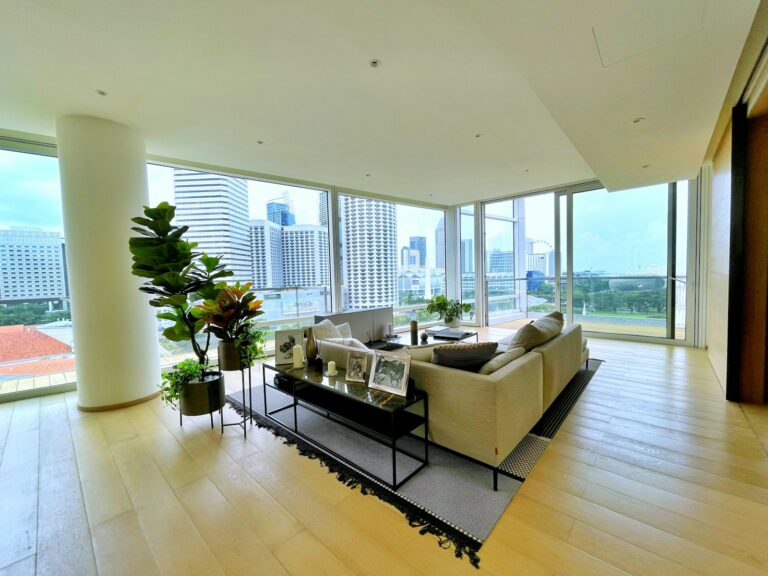
If you are installing your flooring on a main floor, you will want to float the floor in the same direction throughout all the rooms to create a cohesive feel. If you have a width-wise open concept, you will want to run the flooring parallel to the longest walls.
Open-plan layouts are where direction decisions become the most consequential and the most difficult. A change in direction within a shared space — kitchen bleeding into dining room, dining room into living room — creates a visual break that reads as an error rather than a design choice unless it is handled with an intentional transition. The better approach is to identify the dominant axis of the entire open space and run the planks along it throughout.
Consider your dimensions — a floating floor should not run more than 40 feet long or 20 feet wide, and must be broken up at these dimensions. In very large open-plan spaces, you may need a transition strip regardless of direction, which gives you more flexibility to reconsider orientation at that natural break point.
When you do cross room thresholds, handling the transition correctly matters. Getting laminate through doorways without visible gaps or height mismatches requires planning the direction well in advance of reaching that threshold.
Traffic Patterns and Entry Points
A principle that does not get enough attention: where people enter a room should influence how the planks run. Running the flooring boards from the main entrance of a room toward the opposite wall simplifies the sightline and makes the room appear less busy.
When planks run toward you as you enter, the floor leads you into the space. The seams function like lines on a road — they guide movement and give the eye a direction to follow. When planks run across your path of entry, you step across them and the floor feels interrupted rather than welcoming.
In foyers and entryways this is especially noticeable. A floor that runs toward you as you open the front door creates immediate depth. The same floor running sideways reads as a wall — it stops the eye rather than inviting it forward.
Diagonal Installation: When It Makes Sense and What It Costs
Diagonal installation can give your home a modern and upscale look. You can choose from a variety of angles, from dramatic to subtle. Keep in mind that this installation will require additional materials due to the cuts.
The 45-degree diagonal is the most common variant. It works well in several specific situations: square rooms where parallel installation has no obvious dominant direction; spaces where the direction of adjacent rooms conflicts and a diagonal lets you avoid committing to either; and rooms where you want the floor to be a design element rather than a neutral backdrop.
Pulling a room together, uniting elements of texture and color, and tying together asymmetric wall sizes might benefit from a diagonal pattern. A diagonal install can be subtle — even a ten-degree slant can draw elements of the room together.
The cost of diagonal installation is material waste — typically 10 to 15 percent more material than a parallel layout because of the angled perimeter cuts. Factor that into your total square footage before ordering. If you are already calculating laminate flooring costs for your project, add the diagonal waste surcharge to your estimates from the start rather than discovering it after you have ordered.
Multi-Room Consistency and Direction Changes
When laminate runs through multiple rooms — even through doorways — the direction should generally stay consistent unless there is a deliberate, executed reason to change it. The importance of maintaining consistency in flooring direction across various rooms cannot be overstated, especially in open-plan living areas or when rooms are connected without dividing doors. Extending the laminate flooring in the same direction as the longest wall or prevailing layout is appropriate unless the objective is to match the direction with pre-existing flooring.
Where a direction change is unavoidable or intentional, a transition strip is the correct solution. When transitioning between different rooms or corridor directions, it is advisable to utilize a T-molding strip to prevent uneven thresholds and ensure a stable transition. Understand when transition strips are actually required versus when they are optional — the answer depends on height differences and expansion gap management, not just aesthetics.
The mistake to avoid is changing direction at a doorway without any transition treatment — one room running east-west, the adjacent room running north-south, with the planks simply butting against each other at the threshold. This creates an installation that looks unfinished and creates a stress point at the joint line that will eventually show movement.
The Specific-Room Breakdown
Living Rooms
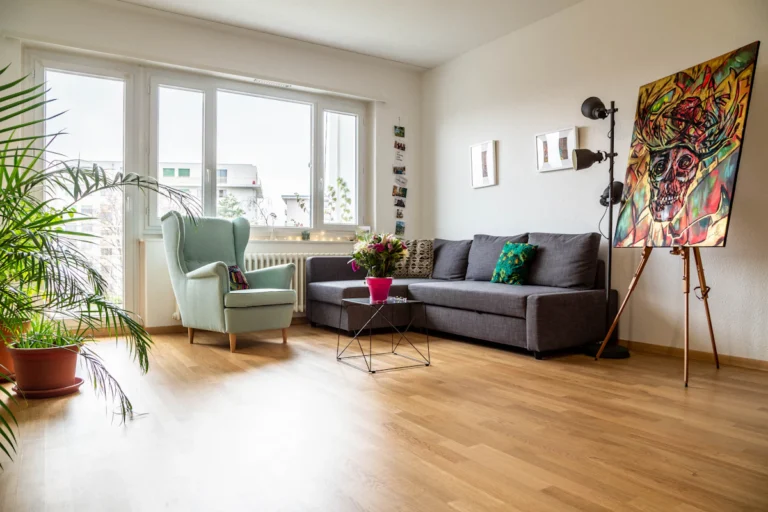
Parallel to the longest wall, aligned with primary light source. In rooms with a fireplace or dominant feature wall, consider running planks toward the feature — this draws the eye deliberately and gives the room a focal point that the floor reinforces. If the living room opens directly into a dining room or kitchen, establish the shared direction before laying a single plank.
Bedrooms
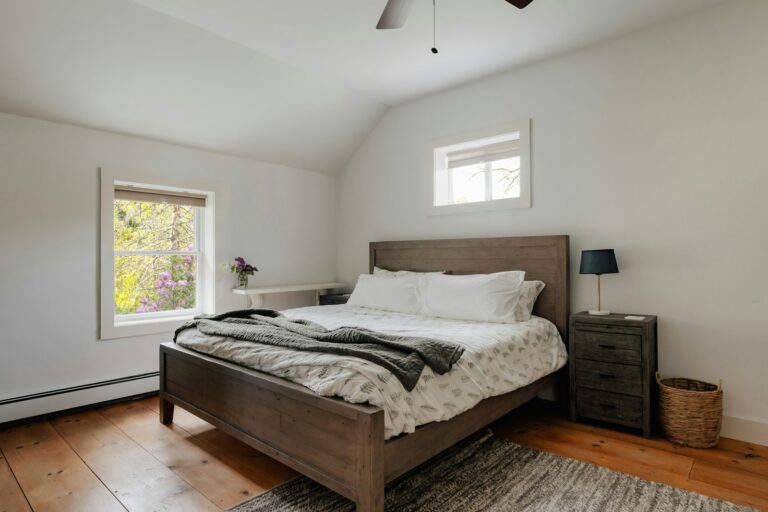
The foot of the bed is the primary entry sightline. Run planks so they extend away from the foot of the bed toward the far wall — this creates depth when you enter the room and makes the space read larger. Light direction is the tiebreaker when this conflicts with longest-wall alignment.
Kitchens
In kitchens with galley layouts, run planks lengthwise along the galley — this extends the space and reduces visual interruption. In L-shaped or open kitchens, align with the primary traffic path between work zones. If the kitchen connects to a living or dining area without a defined threshold, match the direction of those spaces. See also the considerations around using laminate in kitchens generally — moisture and wear patterns affect which product you should be directing before the direction question even arises.
Stairs
Direction on stairs is essentially predetermined — planks run across the width of each tread, perpendicular to the direction of travel. There is no meaningful choice to be made here beyond ensuring continuity with the landing at the top and bottom. Installing laminate on stairs introduces its own set of structural and finishing considerations that go well beyond direction.
How the Installation Method Interacts with Direction
The method you use to install the laminate — floating, glued, or click-lock — does not change which direction you should lay it, but it does affect how the planks behave once installed and what happens if you get the direction wrong relative to the subfloor.
Floating installations are the most sensitive to subfloor irregularities because the planks are not mechanically fastened — they rely on each other for stability. This makes the perpendicular-to-joists rule particularly important for floating systems. A glued-down installation is more forgiving of parallel-to-joist orientation because the adhesive provides the stability that the click-lock system cannot. If you are deciding between glued and floating installation, factor in how your desired direction relates to the joist orientation — it may influence which method makes more structural sense for your specific layout.
The Planning Step Most People Skip
Before you commit to a direction, dry-lay a few rows in each candidate direction and live with them for a day. Photograph the space in morning light and afternoon light. Walk through the entry points. Sit in the positions where you will spend the most time in the room. The difference between two directions is often not visible in a manufacturer’s rendering but immediately obvious in your actual space with your actual light conditions.
Most professionals run planks parallel to the longest wall or incoming daylight to create smoother visual flow and hide seams. But professional installers also know that these defaults exist to be adjusted when the specific room calls for it — and that no rendering replaces standing in the room.
A detail worth checking before you start: the acclimation period. Acclimating laminate to the room before installation affects how the planks expand and contract after laying. Direction determines where expansion gaps need to go around the perimeter, and if the planks have not stabilized before installation, even a perfectly planned direction can result in buckling at the walls.
The Decision Framework in Practice
Work through these questions in this order:
First: Is your subfloor wood-framed? If yes, identify joist direction. That establishes your structural preferred direction. If no — concrete slab — proceed directly to aesthetics.
Second: Where is the primary light source? Mark the axis of incoming daylight. This is your preferred visual direction.
Third: What is the longest wall? If it aligns with the first two answers, you have your direction. If it conflicts, light source direction generally wins over longest-wall convention.
Fourth: Where is the primary entry point? Does the candidate direction lead the eye into the room or cut across it? Adjust if needed.
Fifth: What are the adjacent rooms doing? If the laminate will continue through doorways or into open-plan areas, does your direction create a coherent flow or a conflict at the transition?
If after all five questions you still have two equally valid options, go parallel to the longest wall. It is the default for a reason — it works in the broadest range of situations and will not look wrong even if it does not look exceptional.
What Direction Cannot Fix
Direction is a powerful tool but it is not the whole picture. A poorly chosen laminate product laid in the perfect direction will still disappoint. The thickness of the core affects sound, stability, and feel underfoot — especially relevant on concrete subfloors where there is no give in the substrate. Understanding which thickness actually suits your subfloor and use case matters as much as the orientation of the planks.
Similarly, direction cannot compensate for a subfloor that is not adequately flat or level. Laminate tolerates minor subfloor variations but has real limits. If your subfloor has significant dips or crowns, address them before installation — the direction of the planks will not hide an uneven base, and in some orientations it will make the unevenness more visible, not less.
The direction decision is best made as part of a complete pre-installation plan — one that considers subfloor condition, product selection, expansion gaps, transition points, and light conditions together rather than as separate items. Direction is the organizing principle. Everything else lines up behind it.
James Miller is a seasoned flooring contractor with years of hands-on experience transforming homes and businesses with high-quality flooring solutions. As the owner of Flooring Contractors San Diego, James specializes in everything from hardwood and laminate to carpet and vinyl installations. Known for his craftsmanship and attention to detail, he takes pride in helping clients choose the right flooring that balances beauty, durability, and budget. When he’s not on the job, James enjoys sharing his expertise through articles and guides that make flooring projects easier for homeowners.
Before you pick a fiber type or a color, you need to understand what makes stairs structurally different from a living room or hallway. Every time someone walks up or down, their foot lands on roughly the same six-inch strip of the tread nose. The carpet bends over the bullnose edge at a sharp angle,…
Light hardwood floors have quietly become the defining feature of modern interior design. Walk into almost any newly remodeled home, and you will likely find wide-plank blonde oak stretching from the entryway all the way into the kitchen, or creamy maple running through bedrooms that feel twice as spacious as they actually are. That is…
AC3 vs AC4 laminate flooring is a comparison of two abrasion class ratings that define how a laminate plank resists surface wear, foot traffic, scratching, and impact. AC3 laminate flooring is certified for heavy residential and light commercial use and withstands a minimum of 2,500 Taber test rotations before the decorative layer breaks down. AC4…
A gap in laminate flooring is a visible separation between two adjacent planks — a space where the locking joints have either partially disengaged or failed to close flush. This is not a surface crack or a scratch. The gap runs along the seam between planks, and it can appear mid-floor, along rows, or near…
MDF is not a laminate floor. MDF — medium-density fiberboard — is a core material that can be found inside a laminate floor, but it is not itself a finished flooring product. The confusion is understandable because the terms get blurred in marketing language, home improvement forums, and even at the trade counter. When someone…
Vinyl flooring buckles when the forces acting on a plank — thermal expansion, moisture-driven swelling, subfloor movement, or adhesive failure — exceed the floor’s ability to absorb them. The plank has nowhere to go except upward. That is the entire phenomenon. Everything else in this guide is an explanation of which force is responsible in…