There is also a practical dimension. Softer species like pine show surface scratches readily, but when stained very dark the scratches simply blend into the overall tone. Denser species like walnut and hard maple take dark stains beautifully and maintain their surface integrity under daily wear. Choosing the right species for your traffic level is the single most important decision you will make before selecting a stain color.
Idea 1: Espresso-Stained White Oak in a Modern Living Room
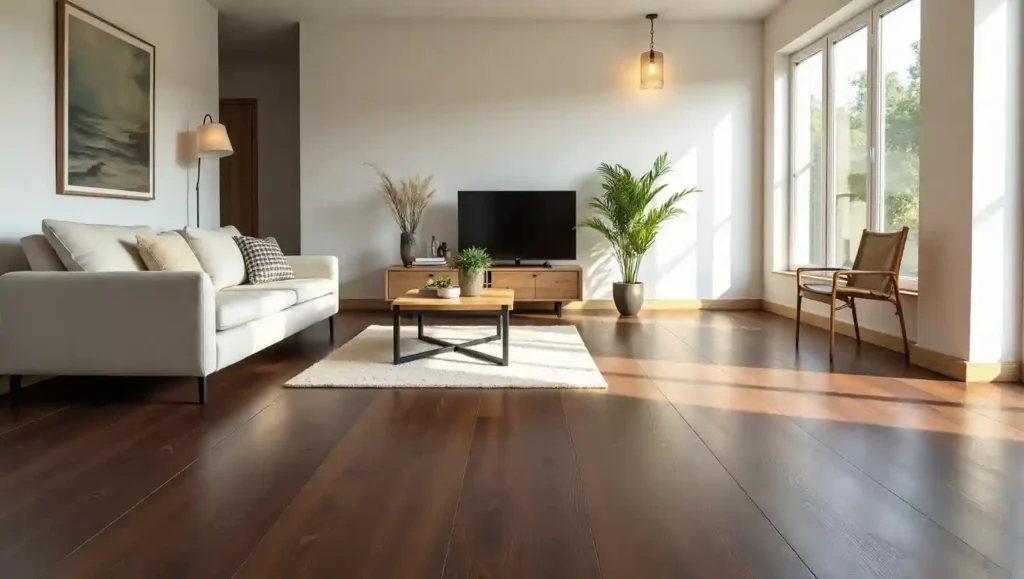
Espresso stain on white oak is the definition of controlled drama. White oak’s tight, even grain accepts dark stains without the blotchy variation that red oak produces, resulting in a floor with rich, uniform color and just enough grain movement to prevent it from reading flat. The finished floor lands somewhere between deep chocolate and very dark brown, with warm undertones that prevent it from feeling cold or industrial.
In a modern living room, this combination works because it provides tonal contrast against the typical off-white or warm grey walls of contemporary interiors. The floor becomes the visual anchor, and everything else orbits around it. Furniture in cream boucle, natural linen, or warm beige creates a layered tonal palette that feels sophisticated rather than stark. A large flat-weave area rug in ivory or pale gold defines the seating zone without lifting too much of the floor’s drama away from sight.
The finish matters significantly. A matte or satin sheen on espresso white oak allows the natural grain to read through the stain without adding the reflective quality that semi-gloss finishes produce. Matte finishes also show fewer footprints and everyday marks, which is a practical consideration in any high-traffic living room. Lighting should include both overhead and floor-level sources since dark floors absorb light rather than reflect it, and a room that relies solely on ceiling fixtures will feel underlit.
If you are comparing finish options and considering whether a high-gloss or lower sheen direction is right for your dark floor, the comparison between high-gloss and matte hardwood floor finishes lays out the practical differences in maintenance, visual character, and long-term durability in a way that will help you decide before committing.
Idea 2: Dark Walnut Wide Planks in an Open-Plan Kitchen and Dining Space
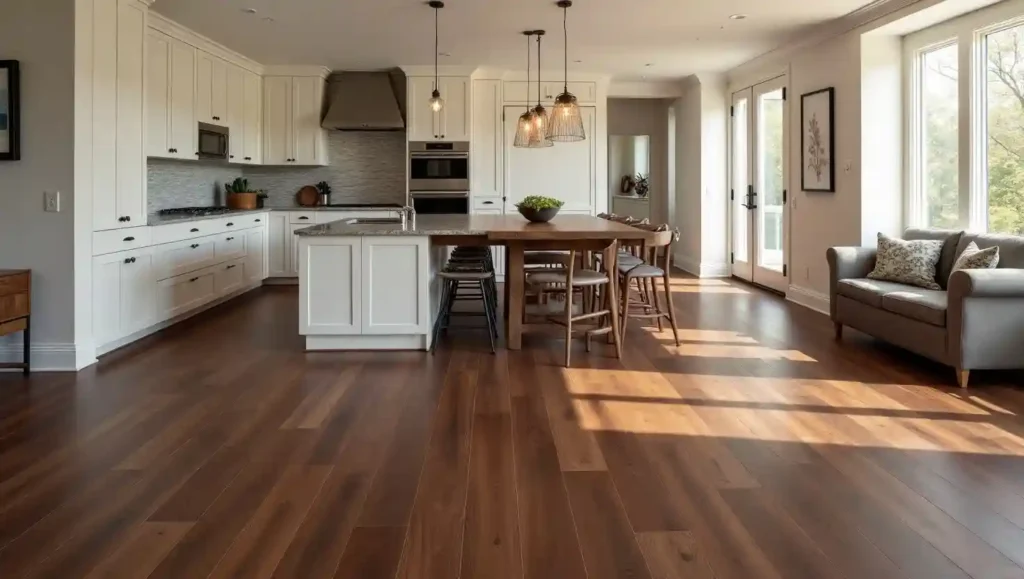
Natural walnut is one of the few species where darkness is inherent to the wood itself rather than achieved through staining. Its deep chocolate-brown base color is shot through with cooler, purplish undertones that shift with the light, and the grain is bold enough to carry wide-plank formats without looking monotonous. Wide planks, typically five inches and above, are particularly effective in open-plan spaces because fewer seams across a large floor area creates a calmer visual field that lets the wood’s natural character dominate.
In an open-plan kitchen and dining area, walnut wide planks pair best with cabinetry in contrasting tones. White shaker-style cabinets create the most classic contrast, but navy, sage green, and even black cabinetry all work because the walnut floor has enough visual weight to hold its own against bold cabinet colors. What tends to fail is cabinetry in a similar mid-brown tone since the floor and the cabinets begin to compete rather than complement.
Countertop materials also interact with walnut in meaningful ways. Honed white marble, light concrete, and brushed stainless steel all create the kind of material contrast that lets each surface read clearly. Quartz in warm cream tones is equally effective. What to avoid is heavily veined brown-toned stone that pulls the eye in too many directions at once when combined with the walnut’s own natural variation.
For those comparing whether dark natural walnut or a stained alternative better suits their space, the detailed breakdown of walnut flooring pros and cons covers the species in depth, including how it responds to humidity, whether it is appropriate for kitchens, and what to expect in terms of aging over time.
Idea 3: Ebony-Stained Oak in a Dramatic Bedroom
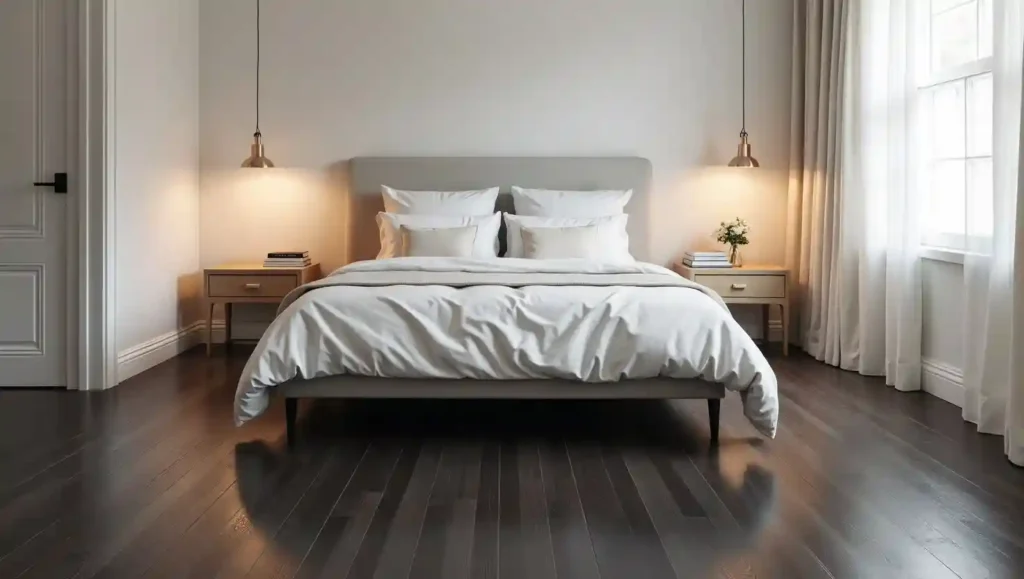
Ebony stain represents the deepest end of the dark hardwood spectrum. When applied to oak, it produces a near-black surface with subtle brown undertones that prevent it from reading as flat paint. The effect is unquestionably dramatic, but in a bedroom setting that drama translates to something unexpected: deep, enveloping calm. Bedrooms with very dark floors feel cocooned and intimate in a way that lighter floors simply cannot achieve.
The key to making ebony-stained oak work in a bedroom is aggressive counter-balancing at eye level. Bedding in white, cream, or very pale linen creates a luminous contrast that lifts the visual weight of the floor. A light-colored upholstered headboard, whether in warm white, soft oat, or pale grey, serves the same function. Window treatments should be sheer or semi-sheer to allow maximum natural light, since the floor will absorb significant amounts of daylight that lighter floors would reflect back into the room.
Bedroom furniture in light oak, ash, or painted finishes works far better alongside ebony floors than dark wood furniture. Matching the furniture tone to the floor collapses the contrast that makes the combination work in the first place. Metallic hardware in brass or aged gold adds warmth against the deep floor tone without disturbing the overall calm. A pale wool rug under the bed, extending at least two feet on each side, grounds the sleeping zone and introduces a tactile element that softens the starkness of a near-black floor.
Idea 4: Dark-Stained Hickory in a Farmhouse-Style Dining Room
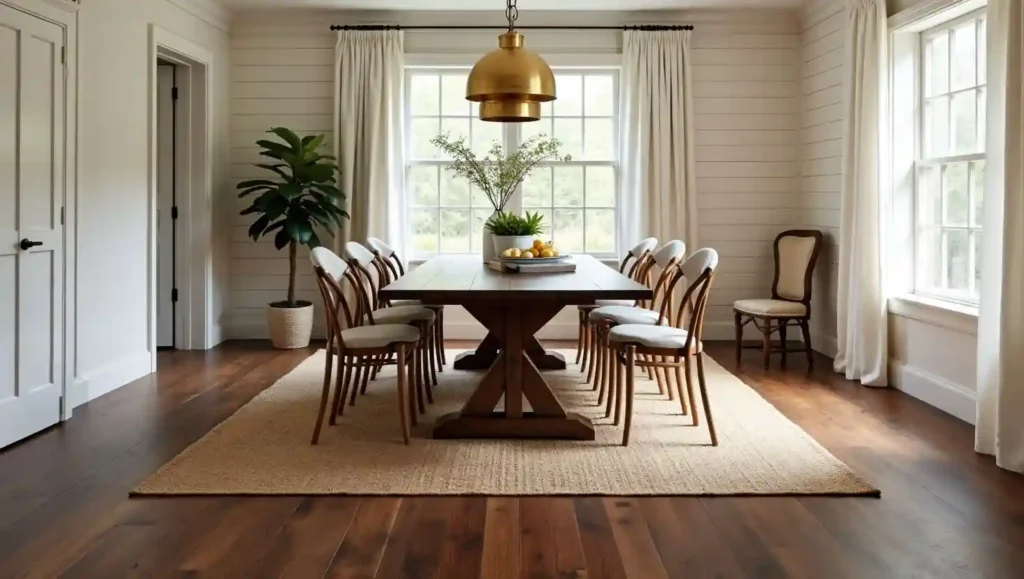
Hickory is one of the most under-appreciated species for dark flooring. Its natural grain is far more varied and dramatic than oak, with a mix of light and dark streaks running through each plank. When stained dark, this variation does not disappear entirely but instead creates a floor with extraordinary visual depth, almost like looking at wood that has decades of character rather than a uniform stain. In a farmhouse dining room, this character is exactly what the design calls for.
The farmhouse direction works with dark hickory because the design style draws on authentic materials and visible craftsmanship. A reclaimed or live-edge dining table in a complementary warm tone, bench seating with linen upholstery, and simple pendant lights in aged brass or black metal all reinforce the aesthetic without fighting the floor’s inherent visual complexity. The dark stain on hickory also pairs naturally with shiplap walls, exposed ceiling beams, and the kind of layered textiles that characterize the farmhouse interior at its best.
One practical note about hickory: it is one of the hardest domestic species available, ranking above hard maple on the Janka hardness scale. This makes it an excellent choice for dining rooms where chairs drag across the surface daily. Dark stains on hickory also tend to be more forgiving of the inevitable chair scuffs over time since the natural color variation absorbs minor marks into the overall pattern.
For homeowners weighing hickory against oak for a dark-stained floor, the detailed comparison of hickory versus oak goes into the hardness differences, grain character, staining behavior, and long-term performance of both species, which is particularly useful if you are deciding between the two for a high-use room.
Idea 5: Jacobean-Stained Oak in a Home Office
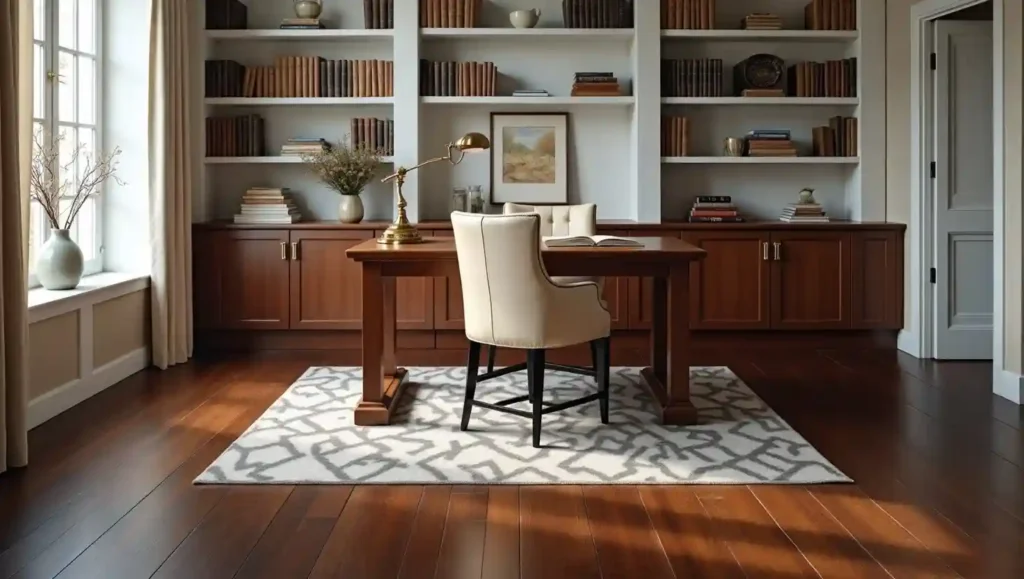
Jacobean is a stain color that occupies a specific and extremely useful tonal territory: darker than dark walnut, warmer than ebony, with a distinctly rich brown-black quality that reads as deeply serious without crossing into the flatness of a pure black finish. It has been one of the most popular dark stain choices for professional interiors for good reason. In a home office, Jacobean-stained oak creates a floor that signals concentration and authority the moment you step into the room.
The psychological effect of a dark floor in a work environment is well-documented. Spaces with darker floors tend to feel more focused and purposeful than rooms with light floors, which read as more casual and open-ended. For a home office where you need to shift into a productive mindset, that tonal quality is an asset rather than a liability.
Built-in shelving in white or light grey paint against a Jacobean floor creates a clean, functional contrast. A mid-toned leather desk chair brings warmth without matching the floor tone too closely. Brass desk accessories, warm-spectrum LED task lighting, and a geometric rug in charcoal or cream under the desk complete the look. The floor anchors the entire palette, and every other element reads against it with clarity.
Idea 6: Dark Smoked Oak in an Industrial-Inspired Living Space
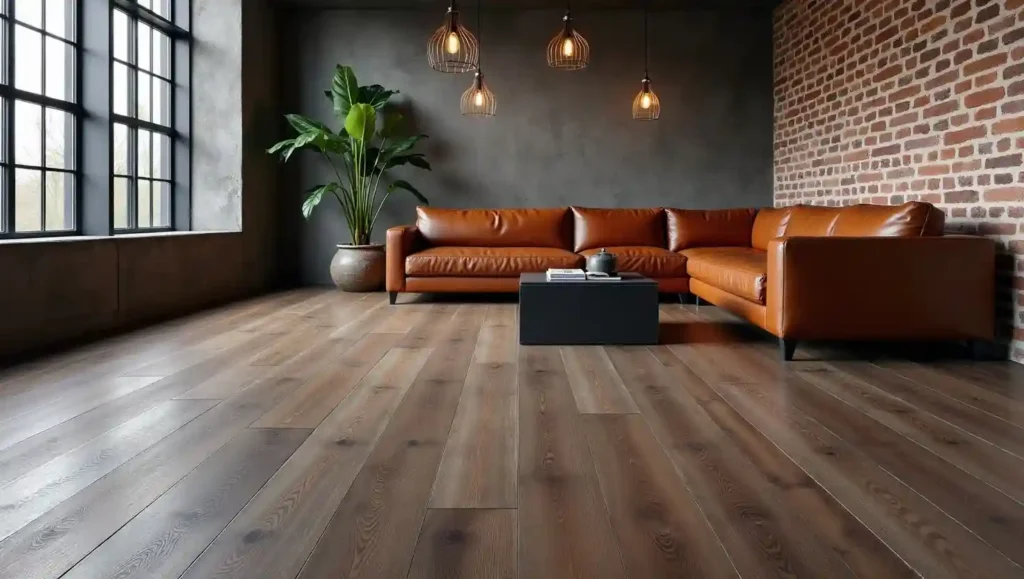
Smoked oak is produced through a chemical process where ammonia vapors react with the natural tannins in oak to produce deep, rich brown tones with a cooler, greyer undertone than conventional dark stains. The result is a floor that looks genuinely aged rather than artificially darkened, with plank-to-plank color variation that mimics the visual complexity of reclaimed wood without the practical challenges of working with salvaged material.
In an industrial-inspired living space, smoked oak works because the finish sits at the intersection of natural and processed, aged and refined. It pairs naturally with exposed brick, raw concrete surfaces, black steel window frames, and the kind of furniture that blends industrial materiality with contemporary comfort: a leather sofa in dark cognac, a coffee table with a welded steel base, pendant lights in cage or globe styles with visible bulbs. The smoked oak floor reads as a warm counterpoint to the harder industrial materials around it.
The cooler undertone of smoked oak also means it is more forgiving of grey walls than conventionally stained dark oak, which can pull warm and clash slightly with pure greys. Smoked oak reads comfortably against both warm greige and cool slate grey wall colors, making it a more versatile choice for spaces where the wall color direction is not yet settled.
Idea 7: Dark Mahogany in a Traditional Formal Living Room
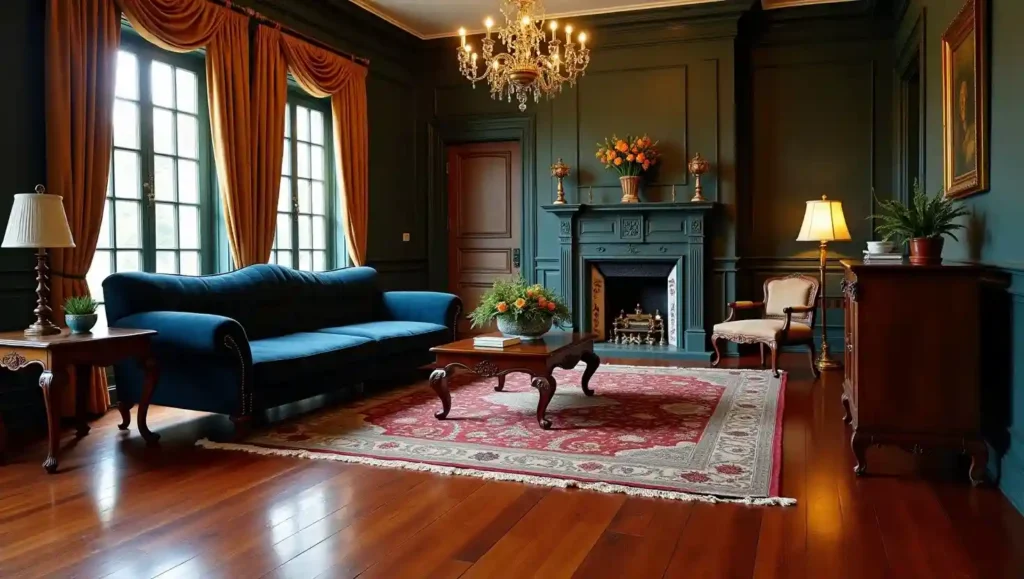
Mahogany occupies a unique position in the dark hardwood spectrum because its darkness comes with an inherent warmth and reddish undertone that no stained species can quite replicate. Genuine mahogany floors have a quality of depth that changes with the viewing angle, appearing lighter and more reddish when seen along the grain and darker when viewed against it. This chatoyance gives mahogany floors a luxurious, almost jewel-like quality in traditional interiors.
In a formal living room, mahogany’s warm darkness pairs naturally with the deep, saturated colors that traditional design favors: navy, forest green, burgundy, and warm charcoal all work as wall colors against a mahogany floor. The combination of dark floor and deeply saturated walls can feel overwhelming in smaller rooms, but in a formal living space with generous ceiling height, it creates the kind of immersive, enveloping atmosphere that high-end traditional interiors are designed to provide.
Upholstered furniture in velvet or silk, antique or antique-inspired occasional tables, and layered Persian or oriental rugs all sit comfortably against mahogany. The floor’s warm, reddish depth picks up the warm tones in traditional pattern rugs, tying the flooring and the rug together in a way that feels intentional rather than coincidental.
Idea 8: Dark Herringbone Pattern in an Entryway or Hallway
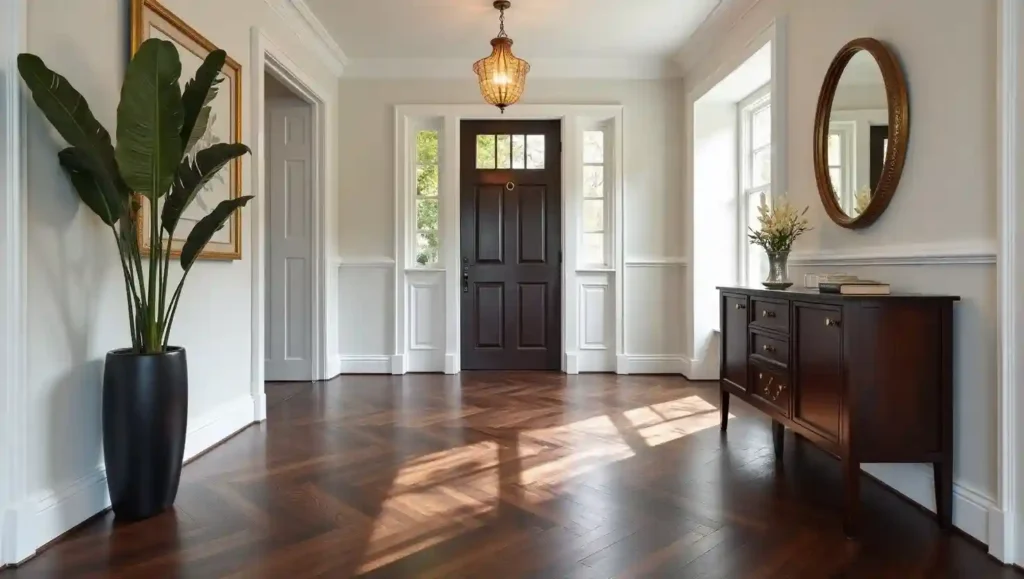
The herringbone pattern transforms dark hardwood from a simple surface treatment into a genuine architectural element. Where straight plank flooring reads as background, herringbone commands attention and directs the eye along its interlocking V-shapes with a rhythmic energy that makes even a narrow hallway feel considered and designed. In dark tones, the herringbone pattern is even more dramatic because the shadows between the angled planks read more clearly against a deep base color.
Entryways and hallways are the natural home of herringbone dark hardwood because they are transitional spaces that benefit from strong visual definition. A dark herringbone floor in an entryway signals immediately that the interior is designed with care and intention. It makes an impression before a guest has crossed the threshold into any main living space.
The scale of the herringbone blocks matters significantly. Traditional herringbone uses shorter, narrower planks that produce a tight, intricate pattern well-suited to period properties and classic interiors. Contemporary herringbone uses wider, longer planks for a more open, dramatic pattern that reads as current rather than historical. For a dark stain direction, the larger contemporary plank scale tends to let the color breathe and the grain remain legible, while very small traditional herringbone in deep ebony can sometimes read as a solid dark surface rather than a recognizable pattern.
Grout-line borders, threshold strips in contrasting light wood, and painted wainscoting in crisp white all work as complementary elements that frame a dark herringbone entry floor and prevent it from bleeding visually into the adjacent rooms.
If you want to continue the herringbone direction beyond the entryway, the fifteen herringbone hardwood flooring ideas covers the full range of applications, from formal dining rooms to open-plan living spaces, with practical guidance on how to handle the pattern transitions at room boundaries.
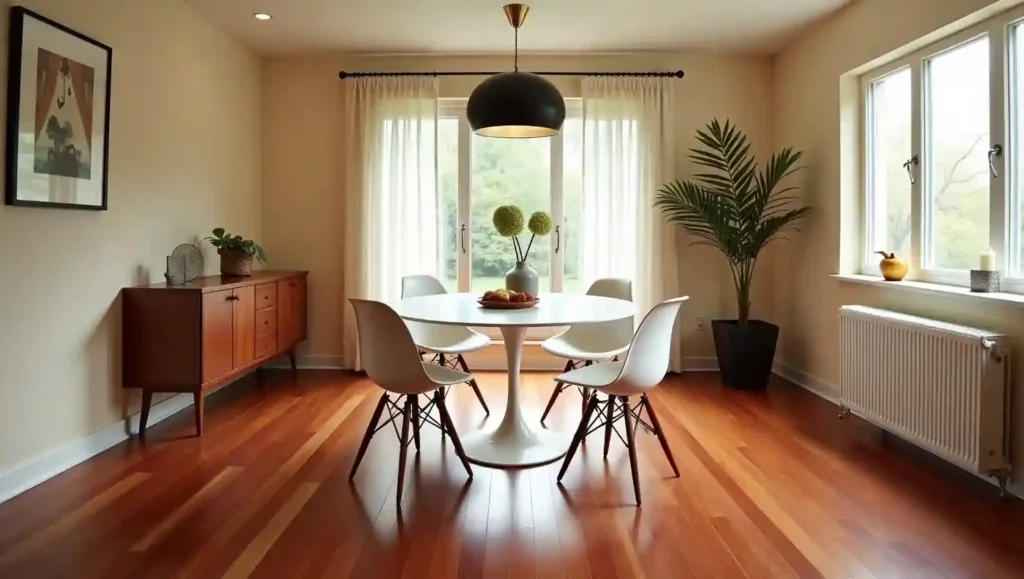
Idea 9: Dark Brazilian Cherry in a Mid-Century Modern Dining Room
Brazilian cherry, also called Jatoba, achieves its deep color naturally over time through oxidation and light exposure rather than through staining alone. Freshly installed Brazilian cherry is actually a bright salmon-orange, but within months of installation and exposure to light it deepens dramatically to a rich, dark reddish-brown that has no close equivalent among stained domestic species. This natural darkening process means Brazilian cherry floors become richer over decades rather than fading, which is a significant advantage over stained floors that can show wear at the finish layer.
In a mid-century modern dining room, the deep reddish tones of aged Brazilian cherry align naturally with the warm wood tones that define the aesthetic. A tulip or Saarinen-style round dining table in white against Brazilian cherry creates the kind of warm-cool contrast that defines mid-century design at its most refined. Chairs in molded plywood, cord, or leather complete the look without competing with the floor’s strong color character.
Wall colors work best in the neutral-warm range: creamy white, warm sand, and soft terracotta all pull from the floor’s tonal family without matching it directly. Cooler wall tones like pure grey or blue can work as deliberate contrast pairings but require careful calibration to prevent the room from reading as mismatched rather than intentionally contrasted.
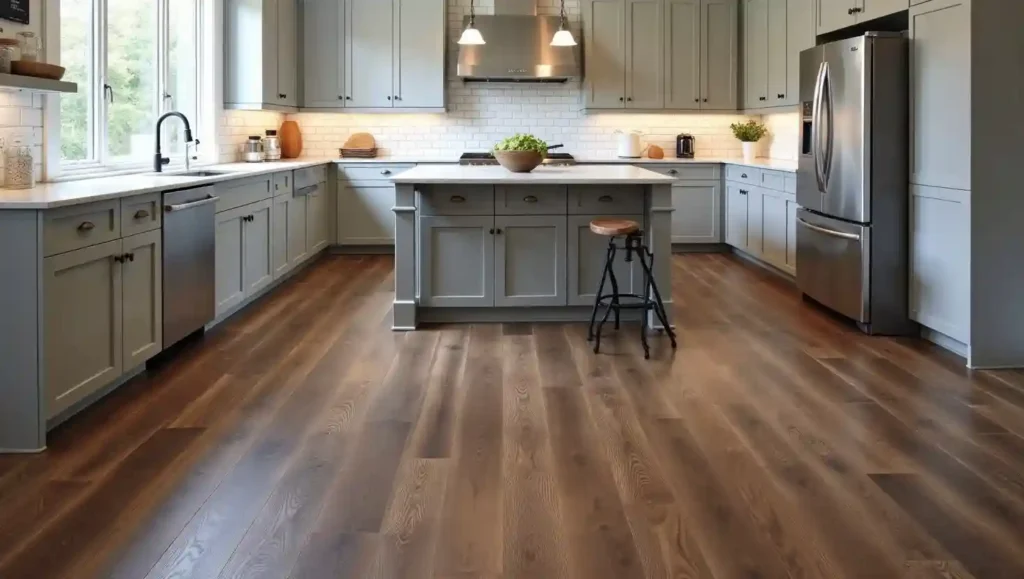
Idea 10: Distressed Dark Hardwood in a Transitional Kitchen
Distressed dark hardwood combines two design values that individually might seem contradictory but together produce something deeply appealing: the visual weight of a deep dark stain and the tactile authenticity of a surface that looks genuinely aged. Wire-brushed and hand-scraped dark hardwood floors carry marks that read as character rather than damage, making them ideal for high-traffic spaces like kitchens where unmarked floors are an unrealistic expectation.
In a transitional kitchen that blends contemporary cabinet lines with warmer, more traditional materials, a distressed dark floor provides exactly the right visual bridge. The distressing pulls the floor toward the traditional end of the spectrum, softening the edge of contemporary flat-panel cabinetry and helping the space feel layered rather than freshly installed. Grey-stained distressed oak is particularly effective in transitional spaces because the grey undertone aligns with contemporary cabinet finishes while the distressing adds the texture that modern kitchens often lack.
Paired with stone or quartz countertops in light cream or veined white, dark distressed floors create a kitchen palette that feels both timeless and current. The visual texture of the distressed floor surface also has a practical advantage: the brushed or scraped surface holds less surface dust and fine particles compared to smooth-finished floors, making maintenance between cleanings noticeably easier.
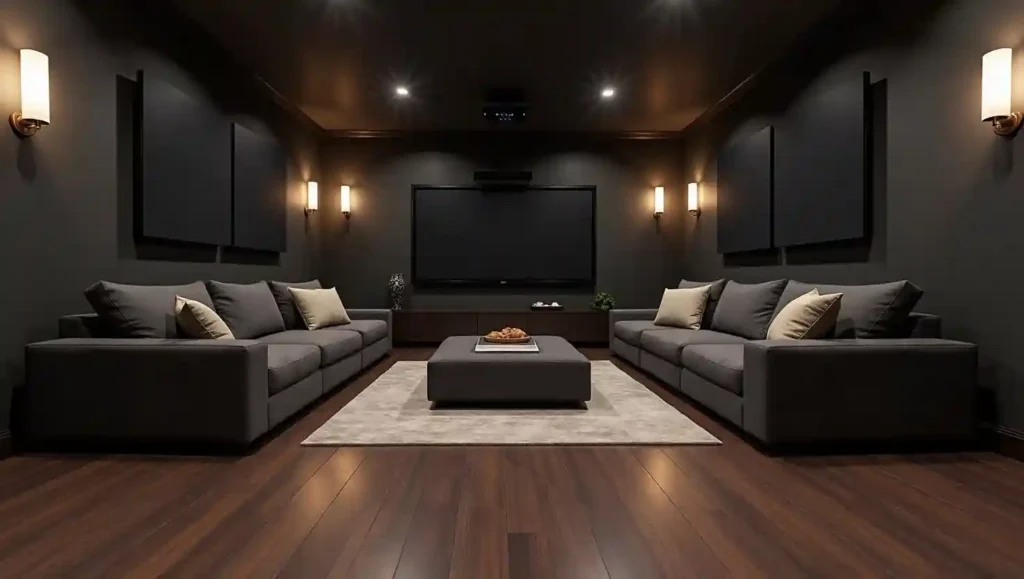
Idea 11: Dark Engineered Hardwood in a Basement Entertainment Room
Basements present a specific challenge for dark hardwood: the subfloor is typically concrete, the moisture conditions are less predictable than above-grade rooms, and the lighting is almost always artificial rather than natural. All three of these factors actually make engineered dark hardwood a stronger choice than solid hardwood in basement applications. Engineered hardwood’s dimensional stability under humidity fluctuation makes it suitable for below-grade installation, and its ability to be installed as a floating floor over concrete removes the nail-down requirement that solid hardwood demands.
Dark engineered hardwood in a basement entertainment room works particularly well because the controlled artificial lighting environment eliminates the concern about the floor absorbing natural daylight. With well-designed ambient and task lighting, a dark engineered floor in deep espresso or smoked oak creates an immersive, cinema-like atmosphere that is ideal for a media or entertainment space. Acoustic considerations are also relevant: dark engineered floors with an attached underlayment provide some degree of sound dampening that bare concrete or light tile surfaces cannot offer.
The furniture and color direction for a basement entertainment room with dark floors should lean into the inherent cocooning quality of the space. Deep-seated sectional sofas in charcoal or warm grey, layered area rugs, and dimmable overhead lighting with sconces along the walls all work with the dark floor to create a space that feels intentionally designed for comfort and immersion rather than accidentally dark.
The technical side of selecting the right hardwood flooring covers the difference between solid and engineered construction in depth, including which applications each is suited for, how thickness affects the long-term refinishing options, and what to look for in grade and construction quality before purchasing.
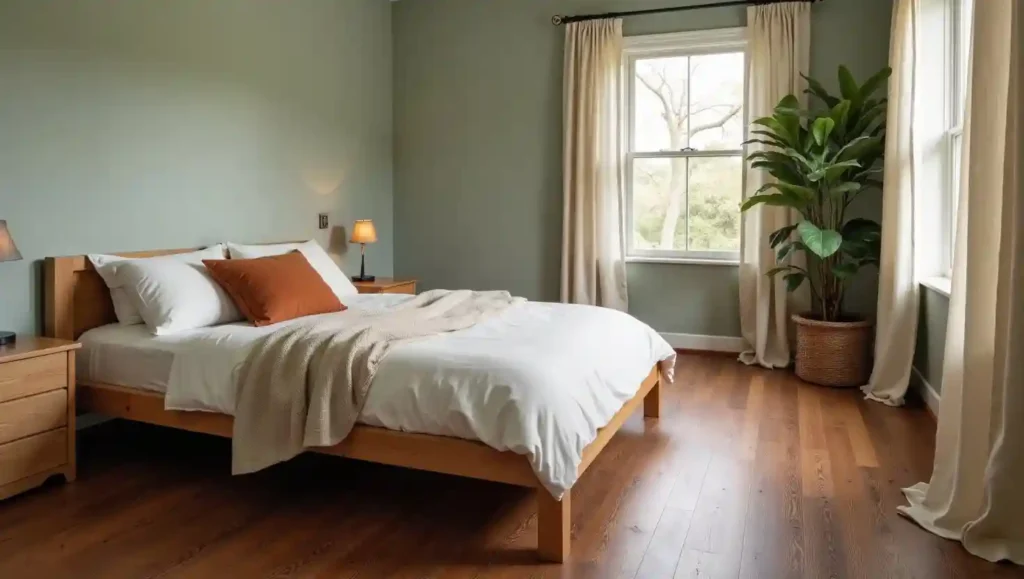
Idea 12: Dark Hardwood with Sage Green Walls in a Bedroom
The combination of dark hardwood flooring and sage green walls is one of those pairings that feels immediately right because both elements share the same organic, earthy undertone. Sage green reads as a natural color in the truest sense, drawn from the plant world in the same way that dark walnut or espresso oak is drawn from the wood world. Together they create a room palette that is entirely grounded in nature, which produces a very specific quality of calm that no other color combination quite replicates.
The green should be muted and dusty rather than vibrant or yellow-leaning. Farrow and Ball’s Mizzle, Pigeon, or Lichen, and Benjamin Moore’s Saybrook Sage or Verdigris are all appropriate tonal directions. Against a dark floor, these dusty greens read as sophisticated and considered rather than trendy or overstated. The green also draws out the warm brown undertones in the floor, which creates a sense of tonal cohesion that makes the room feel designed rather than assembled.
Bedding in warm white or natural linen, furniture in light-toned wood or painted in the same green family, and textiles in terracotta or rust all sit naturally within this palette. The terracotta accent is particularly effective because it introduces a warm complementary note that prevents the green-and-dark-wood combination from reading as too cool or naturalistic at the expense of comfort.
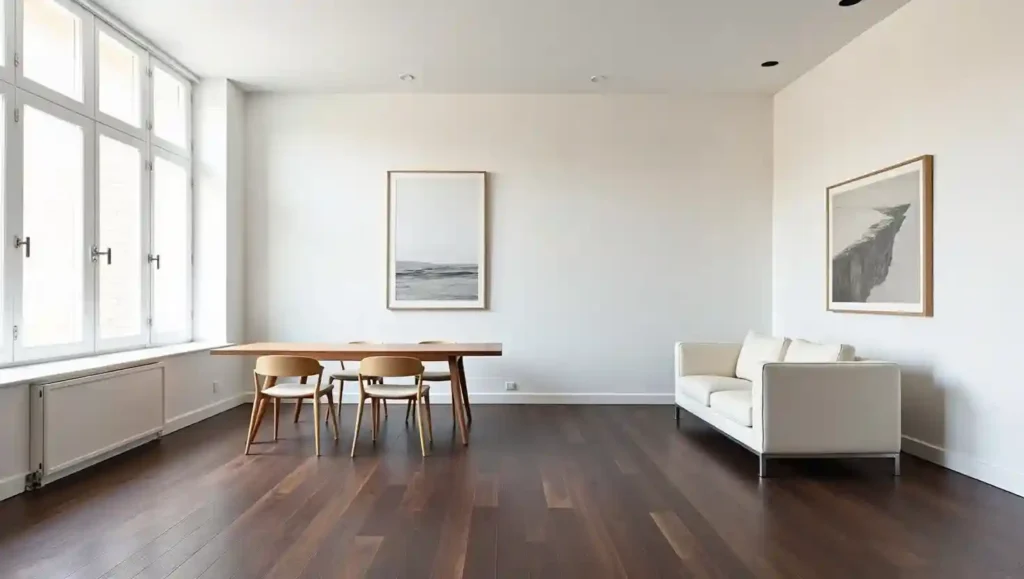
Idea 13: Dark Hardwood Paired with White Walls in a Minimalist Open Plan
The most enduring and versatile application for dark hardwood flooring is also the most disciplined: deep espresso or dark walnut planks against crisp white walls in a genuinely minimal space. This is not a combination that forgives clutter or half-considered furniture choices. Every object in the room reads with the clarity of a piece on a stage, which makes the combination demanding but also enormously rewarding when executed with care.
The power of this pairing is pure tonal contrast. The floor and the walls sit at opposite ends of the value scale, and everything in between, furniture, art, plants, textiles, defines itself against that contrast rather than blending into either element. A low, modern sofa in warm cream reads as a warm mid-tone. A black steel floor lamp reads as a strong graphic accent. A single large piece of framed art on a white wall is amplified by the dark horizontal plane below it. The floor effectively becomes the backdrop against which the entire room is staged.
The white used on the walls should carry warmth rather than blue-white coolness. Warm whites like Benjamin Moore Chantilly Lace or Sherwin-Williams Alabaster prevent the room from feeling clinical against a dark floor. Pure cool whites can make the contrast feel harsh rather than graphic, and the transition between the deep floor and the wall above it should feel intentional rather than abrupt.
In terms of flooring direction across a large open-plan space, the question of how to orient the planks relative to the room’s main axis matters. Laying planks parallel to the longest wall of the space creates a sense of horizontal extension. Diagonal installation across the full space adds dynamic energy but requires significantly more material and planning. For a minimalist open-plan, the standard parallel orientation tends to serve the clean, quiet quality of the design direction best.
If you are planning a dark hardwood installation across a large open-plan floor and weighing the options between different wood species, the thirteen open-plan hardwood flooring ideas addresses the specific considerations that large, connected floor areas introduce, including how to handle transitions between zones, which species hold up best under the varied traffic patterns of open-plan living, and how to use the flooring direction to reinforce or define spatial zones without physical dividers.
Species and Stain Guide for Dark Hardwood Flooring
Understanding which species accept dark stains most predictably, and which produce the most distinct natural dark tones, will shape your final decision more than almost any other factor.
White oak is the most reliable canvas for custom dark staining. Its tight, even grain and low tannin content relative to red oak means dark stains apply uniformly without blotching. White oak also accepts fuming and smoking treatments that produce naturally complex dark tones without conventional stain at all. It is the most versatile dark hardwood platform available to the modern homeowner.
Red oak responds differently. Its open grain and higher tannin content means dark stains produce more visible grain contrast, which some designers prefer as a feature but others find visually restless. Red oak stained dark tends to show the difference between early wood and late wood more clearly than white oak, producing a floor with more pronounced streaking.
Hard maple is notoriously difficult to stain dark evenly because of its density, which limits stain penetration. When it does take a dark stain successfully, the result is a floor with a very smooth, dense surface character that is quite different from the more open-grained oak alternatives. Pre-conditioner and careful surface preparation are non-negotiable with maple if a uniform dark stain is the goal.
Natural dark species, walnut, Brazilian cherry, and teak, achieve their depth without staining and continue to deepen over time through oxidation. They carry tonal complexity that stained floors cannot fully replicate, but they also carry higher price points and sometimes more limited availability than domestic oak species stained to equivalent visual depths.
Practical Considerations Before Installing Dark Hardwood
Dark floors show dust, pet hair, and fine particles more clearly than light floors. This is the most commonly cited maintenance challenge and it is real, but it is also manageable. The solution is a combination of regular dry mopping with a microfiber pad, which captures surface particles without pushing them around, and a finish with a lower sheen level, which reveals fewer surface marks than semi-gloss or high-gloss finishes. Homeowners with dogs or cats find that weekly dry mopping is sufficient to maintain a dark floor’s appearance between deeper cleanings.
The cleaning regimen for dark hardwood is the same as for any hardwood floor: avoid excess water, use a wood-specific cleaner rather than general-purpose household cleaners, and address spills immediately. The deep cleaning guide for hardwood floors walks through the products and methods that work without risking finish damage, which is particularly relevant for dark floors where the finish layer is the primary visual surface.
Humidity management is equally important. Dark stains can appear to shift in tone as wood expands and contracts with seasonal humidity changes, with the end grain of each board becoming more visible when planks swell. Maintaining consistent indoor humidity, typically between 35 and 55 percent year-round, minimizes this movement and keeps the floor looking consistent across seasons.
Refinishing is a practical long-term consideration. Solid dark hardwood can be sanded and restained multiple times over its lifespan, which means the commitment to a particular dark tone is not permanent. Engineered hardwood with a thicker wear layer can also be refinished once or twice depending on the wear layer thickness. Understanding the hardwood floor refinishing process in advance, including timing, preparation requirements, and how to match the existing stain color, will help you plan for the long-term care of a dark floor investment.
Matching Dark Hardwood with Room Decor and Wall Colors
The wall color decisions you make alongside a dark hardwood floor will shape the room’s final character more than any other single choice. The primary principle is contrast: dark floors work best when the walls are clearly lighter, either through warm whites, pale neutrals, or mid-tone colors that are several values higher than the floor itself.
Warm whites and off-whites are the most reliable choice. They create strong contrast without introducing a competing color temperature and they work with every dark stain direction from espresso to ebony. Soft greiges, the grey-beige neutrals that occupy the warm middle of the neutral spectrum, also work universally. They read as slightly more casual and less crisp than white, which can be the right direction for a bedroom or family room where hard contrast feels too formal.
Earthy, nature-derived colors, sage green, dusty terracotta, warm clay, and deep navy, all work as more assertive wall directions against dark floors because they share the same tonal seriousness. These pairings create rooms with a strong, coherent character rather than the versatile neutrality of white walls, which is either an asset or a limitation depending on the design direction.
Cool grey walls against warm-toned dark floors require the most careful calibration. The temperature difference between a cool grey wall and a warm brown floor can create visual discord if either element leans too far from neutral. Mid-toned warm greys rather than cool blue-greys are the safer choice when you want grey walls with a dark hardwood floor, and adding warm-toned accessories and textiles in the room helps bridge the temperature gap.
For more structured guidance on coordinating a complete room palette around a hardwood floor choice, the resource on matching flooring with room decor covers the underlying color theory principles that apply equally to hardwood and laminate directions, including how undertones interact, how lighting affects perceived floor color, and how to use the floor as the starting point for a cohesive room palette rather than the final selection.
The Long View on Dark Hardwood Flooring
Dark hardwood flooring has been present in well-designed interiors across centuries of furniture and architectural styles. It appeared in the formal rooms of Georgian townhouses, it ran through the apartments of the mid-century modernists, and it is currently the choice of homeowners who want a floor with real presence and longevity. That endurance is the best argument for its relevance: dark hardwood has never been a passing trend because it is rooted in the unchanging properties of the material itself, the depth of grain, the warmth of wood, and the visual authority of a dark, grounded floor.
The thirteen ideas above represent a range of directions, species, and room types that collectively demonstrate how broadly dark hardwood applies. Whether you are drawn to the near-black drama of ebony-stained oak in a quiet bedroom, the warm complexity of natural walnut in a kitchen and dining space, or the geometric energy of dark herringbone in an entryway, the unifying principle is the same: dark hardwood grounds a room with a confidence that lighter floors cannot match, and the rooms it creates tend to be the ones people remember.
For those ready to move from inspiration into planning, the comprehensive hardwood flooring cost guide covers the material and installation cost ranges for different species and stain directions, which will help you align your design ambitions with a realistic budget before selecting a contractor and committing to a specific product.
James Miller is a seasoned flooring contractor with years of hands-on experience transforming homes and businesses with high-quality flooring solutions. As the owner of Flooring Contractors San Diego, James specializes in everything from hardwood and laminate to carpet and vinyl installations. Known for his craftsmanship and attention to detail, he takes pride in helping clients choose the right flooring that balances beauty, durability, and budget. When he’s not on the job, James enjoys sharing his expertise through articles and guides that make flooring projects easier for homeowners.
There are flooring patterns that look nice, and then there is herringbone — a layout so geometrically precise and historically grounded that it has decorated the floors of French chateaux, Georgian townhouses, and now modern open-plan homes without ever feeling dated. The distinctive zigzag of rectangular planks arranged at alternating 90-degree angles does something no…
Glued down laminate flooring is bonded directly to the subfloor using a pressure-sensitive adhesive, locking each plank permanently in place. Floating laminate flooring is not attached to the subfloor at all — the planks interlock with each other through a click-lock or tongue-and-groove system and rest on top of an underlayment, free to move as…
When most people say “steam cleaning,” they picture a machine blasting hot vapor into carpet fibers. What professional cleaners actually use is something slightly different — hot water extraction (HWE), where pressurized hot water and a cleaning agent are injected deep into the pile and immediately vacuumed back out. The two terms get used interchangeably…
Most gym flooring conversations start and end with rubber. It is durable, it handles dropped weights, and it is what every commercial facility uses. But that conversation is incomplete, because it skips over a material that outperforms rubber in several categories that actually matter for home gym owners, yoga studios, physical therapy spaces, and multi-use…
Herringbone laminate flooring is one of the most captivating flooring patterns you can bring into a home. The interlocking V-shaped arrangement of planks creates visual movement that feels both timeless and surprisingly fresh in modern interiors. What makes this layout especially exciting is that you can achieve this sophisticated look with laminate — a material…
Wide plank hardwood flooring has moved well beyond trend status. In 2025 and into 2026, it is the defining choice for homeowners and interior designers who want floors that feel genuinely luxurious rather than just functional. The difference between a standard 2¼-inch strip floor and a 7-inch wide plank is something you feel the moment…