Idea 1: Light Grey Wood-Look LVP in a Scandinavian Living Room
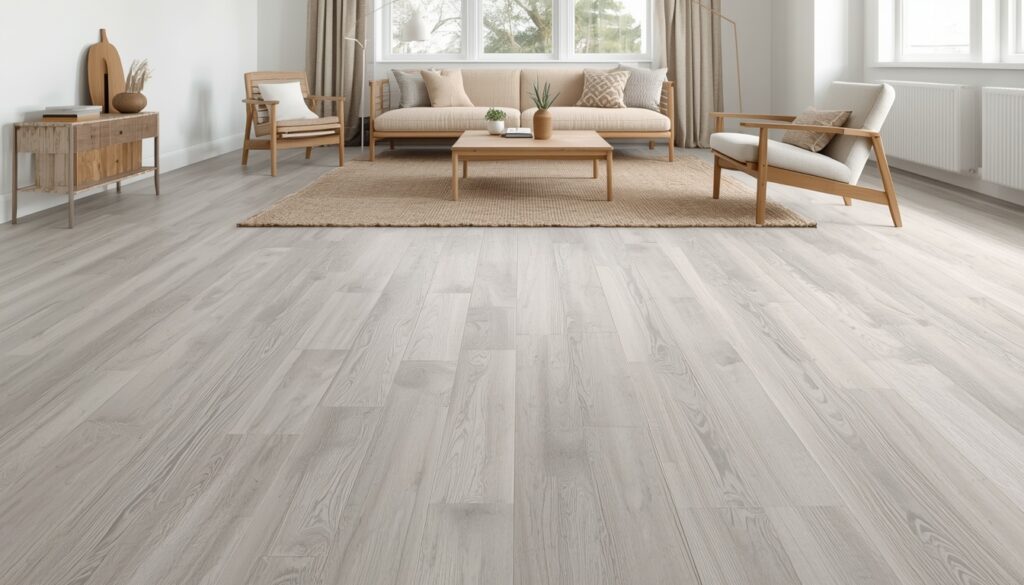
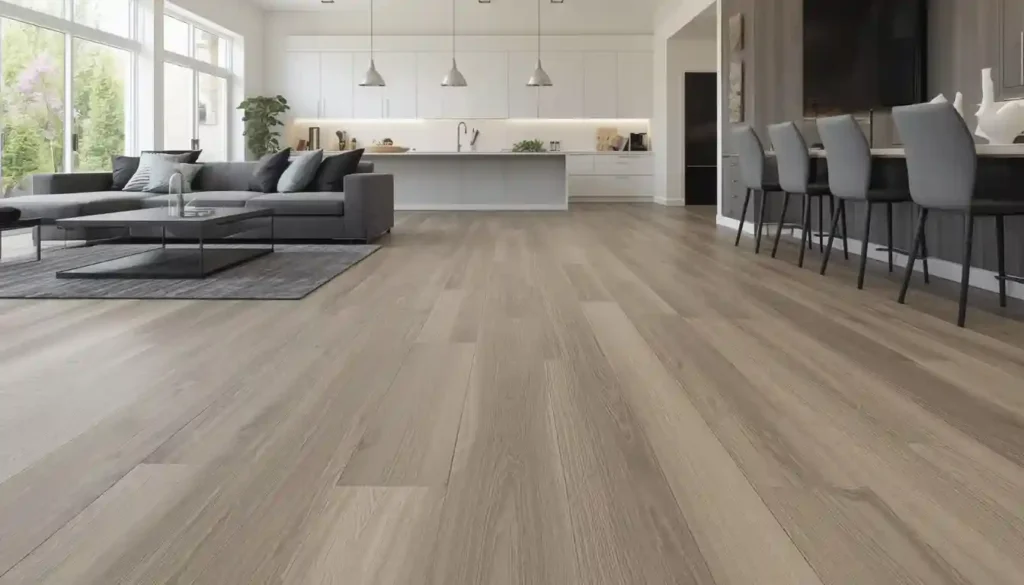
The hallmarks of Scandinavian interior design are simplicity, functionality, and a deep connection to natural materials. Light grey wood-look luxury vinyl plank captures all three of these qualities in a format that performs better than real timber in most living room conditions. The pale, slightly bleached grey tone of this flooring style reads as clean without being stark. It reflects light beautifully, which is the core reason it has dominated Scandinavian-inspired interiors for the past decade.
For this idea, choose a plank with a subtle wire-brush texture and a matte low-sheen finish. The texture prevents the floor from looking plasticky and gives it the visual depth you associate with real limewashed or white-oiled Nordic pine. Plank widths between 7 and 9 inches allow the grain pattern to fully express itself. Install in a straight run parallel to the longest wall or windows — this elongates the room visually and is the most common choice for this aesthetic.
Pair the floor with white-painted walls and ceiling, low-profile furniture in natural birch or pale ash, linen or cotton textiles in off-white and dusty blue, and pendant lighting in matte black. The grey floor anchors the room without competing with the soft furnishings. Add a large flat-weave wool rug in a natural oatmeal or warm sage to break the continuity of the floor and introduce texture at ground level.
This combination is particularly effective in rooms with south or east-facing windows, where the morning light will interact with the pale planks to create a genuinely airy, comfortable space. If you are choosing between product options, explore the full range of available shades by reviewing a comprehensive vinyl flooring buying guide before committing to a specific tone.
Idea 2: Dark Charcoal Grey Vinyl Planks in a Modern Open-Plan Kitchen
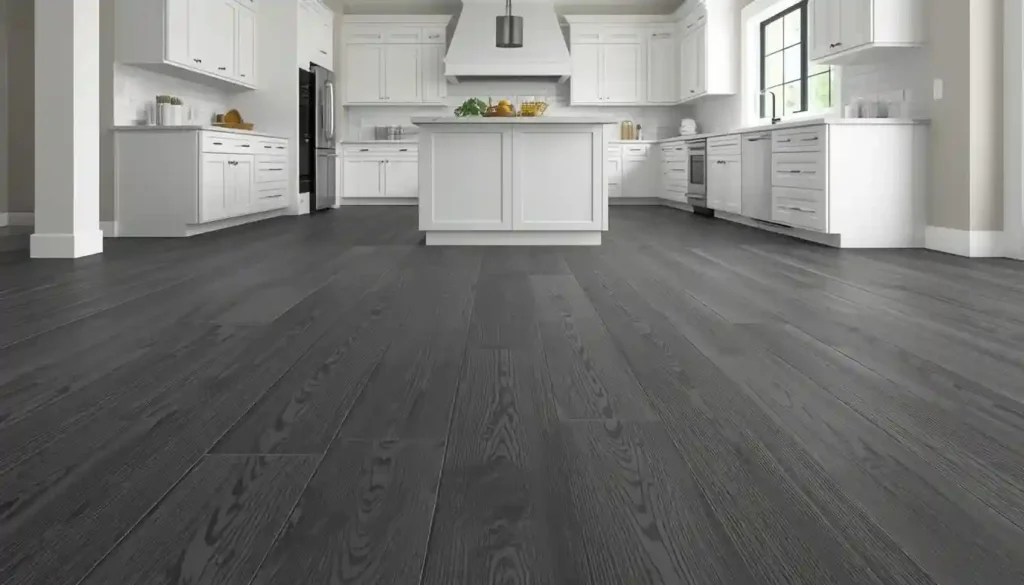
Dark charcoal grey vinyl flooring in a kitchen creates a high-contrast, gallery-like backdrop that makes white or pale-coloured cabinets pop dramatically. This is a bold move but an incredibly effective one when executed with intention. The deep, near-black grey of charcoal vinyl planks grounds the kitchen and gives the entire room a sense of visual weight that makes it feel designed rather than assembled.
The key to making dark flooring work in a kitchen is controlling the rest of the palette carefully. White shaker cabinets with brushed brass or matte black hardware are the classic pairing. Pale quartz or marble-look countertops provide contrast at the surface level, while open shelving in natural walnut above the counters breaks the monochromatism and adds warmth. The dark floor essentially becomes the foundation that all other elements sit against.
From a practical standpoint, dark grey vinyl is one of the better choices for kitchens. The darker tone is more forgiving of scuffs and light surface marks than pale floors, and the waterproof construction of quality vinyl handles splashes and spills without any concern. Choose a plank with a brushed or hand-scraped texture so the surface has some grip and the finish does not read as too glossy under kitchen lighting. Avoid high-gloss finishes here — they amplify every footprint and cleaning streak.
Because kitchens flow into dining areas in most modern homes, this dark floor creates a natural visual connection between the cooking zone and the eating zone without needing any transition strips. For open-plan spaces, that continuity is enormously valuable. It reads as a deliberate design choice, not a happy accident.
Idea 3: Stone-Look Grey Vinyl Tile in a Bathroom
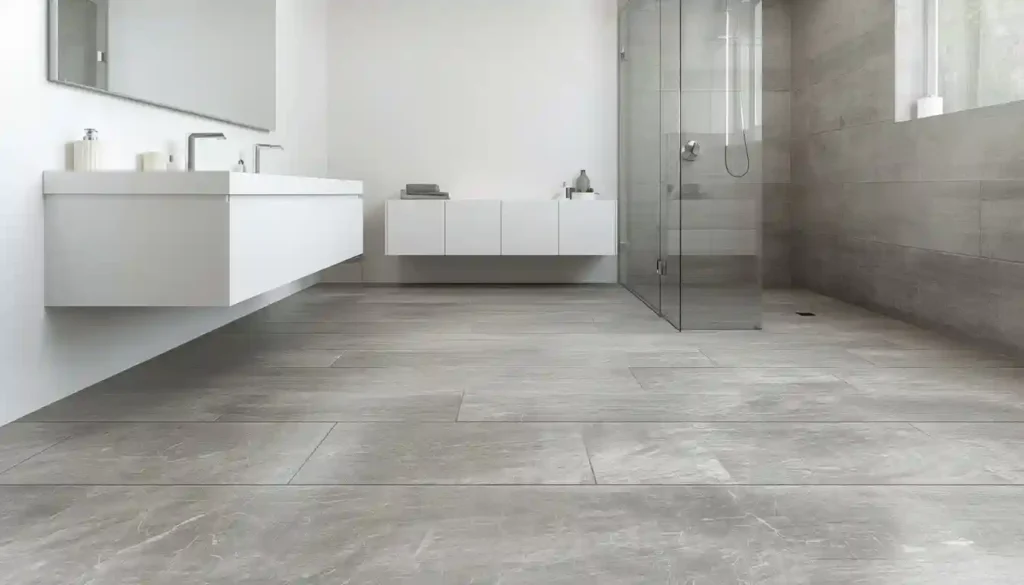
Grey stone-look luxury vinyl tile is one of the most transformative choices you can make in a bathroom. Natural stone and large-format porcelain are the traditional choices for a spa-like bathroom aesthetic, but grey vinyl tile replicates that visual language while solving the problems those materials introduce — cold surfaces, grout maintenance, and installation complexity in rooms above a timber subfloor.
For a bathroom, choose a large-format grey LVT in a concrete, slate, or travertine-look finish. Sizes between 18×18 inches and 24×24 inches create the seamless, expansive feel associated with high-end hotel bathrooms. The fewer grout lines, the more the floor reads as a continuous surface rather than a tiled grid. This minimises visual busyness and keeps the eye moving smoothly through the space.
Pair this floor with a floating vanity in white or pale oak, a frameless glass shower enclosure, brushed nickel or chrome fixtures, and a large rectangular mirror. The grey vinyl tile below reads as the cool, clean foundation that all the other elements respond to. For contrast, bring in a single warm element — a bamboo bath mat, a wooden stool, or a small plant — so the room does not tip into feeling clinical.
The waterproof performance of vinyl is obviously critical in a bathroom. Unlike natural stone, which requires sealing and can harbour mould in unsealed grout, a quality vinyl tile handles standing water, condensation, and humidity without any degradation over time. This makes it one of the most genuinely practical choices for the room where performance demands are highest. You can explore how this material performs in wet rooms in our full breakdown of the best vinyl flooring for bathrooms.
Idea 4: Grey Herringbone Vinyl Planks in an Entryway
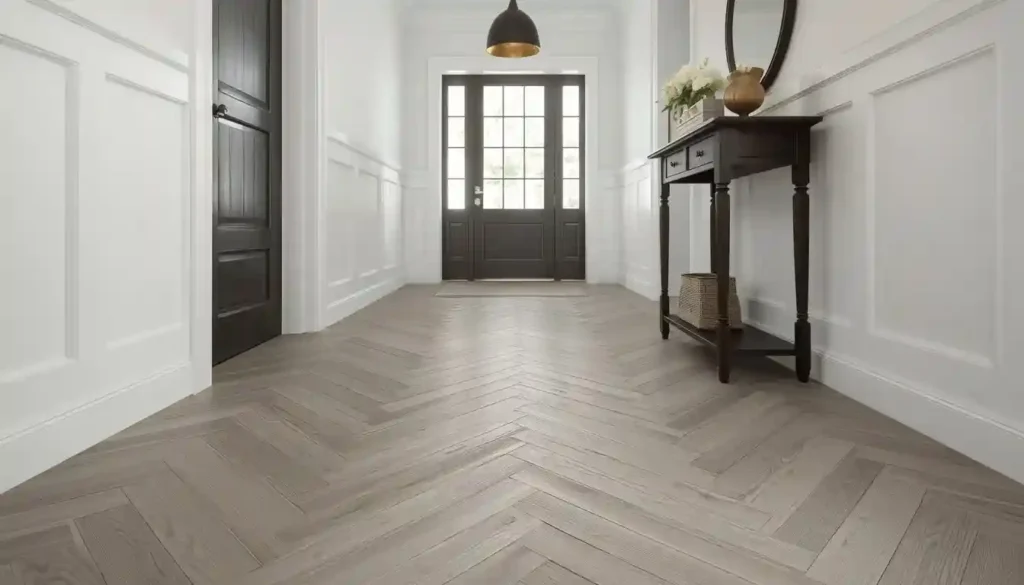
The entryway is the first thing guests see, and grey vinyl in a herringbone layout makes an immediate impression that signals a deliberate, design-conscious home. The herringbone pattern adds visual complexity and movement to what is often a narrow, transitional space, elevating it from a functional corridor into something that feels genuinely welcoming and considered.
Herringbone vinyl is available in dedicated pre-cut formats designed for this specific pattern, making installation more straightforward than it sounds. The planks are typically shorter and narrower than standard LVP — often 4 to 5 inches wide and 18 to 24 inches long — which creates a tighter, more intricate pattern underfoot. A mid-tone grey with warm undertones works particularly well in entryways because it is welcoming rather than severe, and it handles the dirt and moisture tracked in from outside without showing every mark.
Combine a grey herringbone floor with painted wainscoting in white, a dark-stained timber console table, and wall-mounted hooks or a shaker peg rail. A statement pendant or semi-flush ceiling fixture in aged brass or matte black completes the look. The herringbone pattern references traditional parquet layouts — think classic European interiors — but the grey colour keeps it firmly contemporary rather than period-pastiche.
This is one of the most Pinterest-worthy applications of grey vinyl because it photographs exceptionally well. The diagonal geometry of the herringbone pattern is visually engaging in images, and the grey tones work in both natural and artificial light without colour shifting dramatically.
Idea 5: Greige Vinyl Planks in an Open-Plan Living and Dining Space
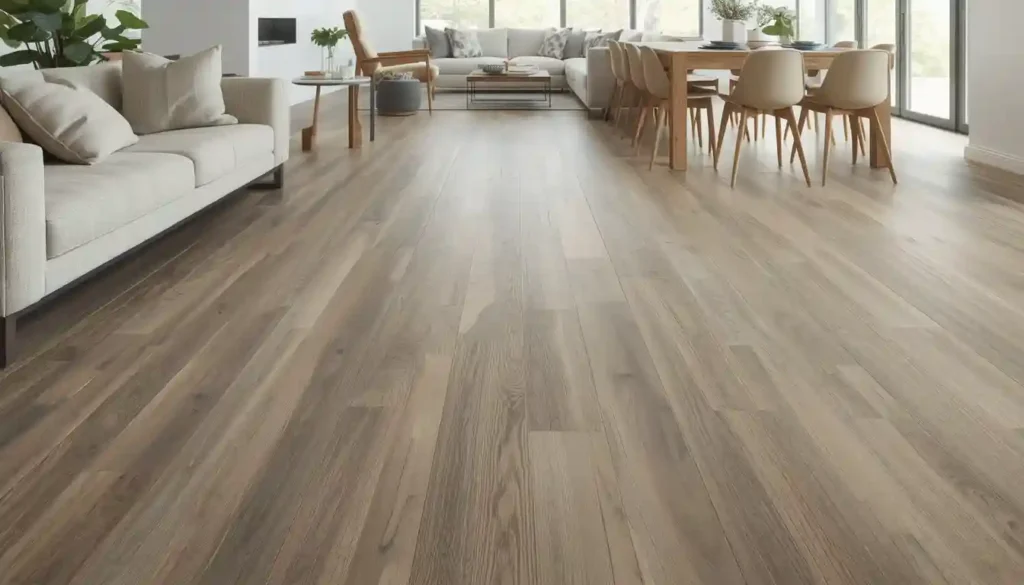
Greige — the blend of grey and beige — is the most requested neutral in residential flooring for good reason. It threads the needle between cool and warm, making it compatible with a wider range of furniture and decor than either pure grey or straight beige can manage. In open-plan living and dining areas, where a single floor must serve multiple moods and functions, greige vinyl planks deliver a kind of quiet cohesion that feels effortlessly resolved.
The practical logic is straightforward: greige reads cool next to the white walls and kitchen cabinets of the open kitchen, and warm next to the timber dining table and upholstered sofa of the living zone. It does not fight with either environment. This adaptability is exactly what open-plan design demands from a floor.
Choose medium-width planks in the 6 to 8 inch range with a natural wood grain texture and a satin or matte finish. Run them in a single direction throughout the entire open space — this is critical for visual flow and the sense of connected, continuous space. Stagger the joints randomly rather than in a pattern to mimic the natural variation of real hardwood floors.
In terms of palette, greige vinyl lets you introduce almost any colour accent without a clash. Terracotta throw pillows, sage green upholstery, dusty pink curtains, or deep navy dining chairs all coexist harmoniously over this floor because the greige base is genuinely neutral. For those who enjoy experimenting with colour but want a floor they will not need to replace when their decor tastes evolve, this is the most future-proof choice in the grey family.
Idea 6: Wide-Plank Grey Vinyl in a Master Bedroom
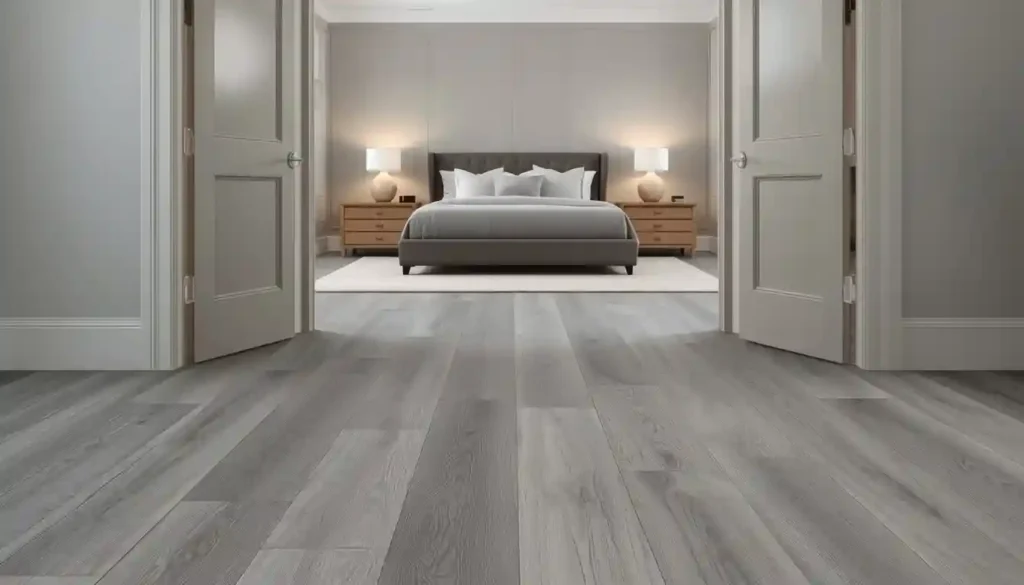
Wide-plank flooring has a grounding, luxurious quality that works particularly well in bedrooms. The wider the plank, the fewer joints there are across the floor, which creates a quieter, more expansive visual surface — exactly the calm, uncluttered atmosphere a bedroom benefits from. In a grey tone, wide planks (9 inches and above) read as genuinely sophisticated, especially in rooms with large upholstered beds and layered bedding in soft neutrals.
For a master bedroom, choose a grey vinyl plank with a smooth or very lightly textured surface and a low-sheen matte finish. Avoid heavily distressed or hand-scraped textures in bedrooms — they introduce a rusticity that clashes with the softness of bedding and upholstery. The clean surface of a smooth-finish wide plank keeps the room feeling restful. A cool silver-grey or a warm mushroom-grey both work here; your choice depends on the undertones of your wall paint.
Pair this floor with a large upholstered bed frame in charcoal, navy, or warm linen, bedside tables in natural oak or painted white, and soft layered lighting with warm-toned bulbs. The grey floor provides an elegant canvas that makes the bed — the focal point of the room — feel properly centred and grounded. Add a large area rug under the bed in a tone that bridges the grey floor and the wall colour, and the room will feel complete rather than sparse.
Wide-plank vinyl in grey is also one of the quietest options underfoot when installed over a foam or cork underlayment. This makes it particularly well-suited to bedrooms above a basement or ground-floor family room where sound transmission between levels would otherwise be noticeable. Our detailed resource on the best vinyl flooring for bedrooms covers both aesthetics and performance criteria worth reviewing before installation.
Idea 7: Pale Grey Vinyl Planks in a Small Apartment to Maximise Space
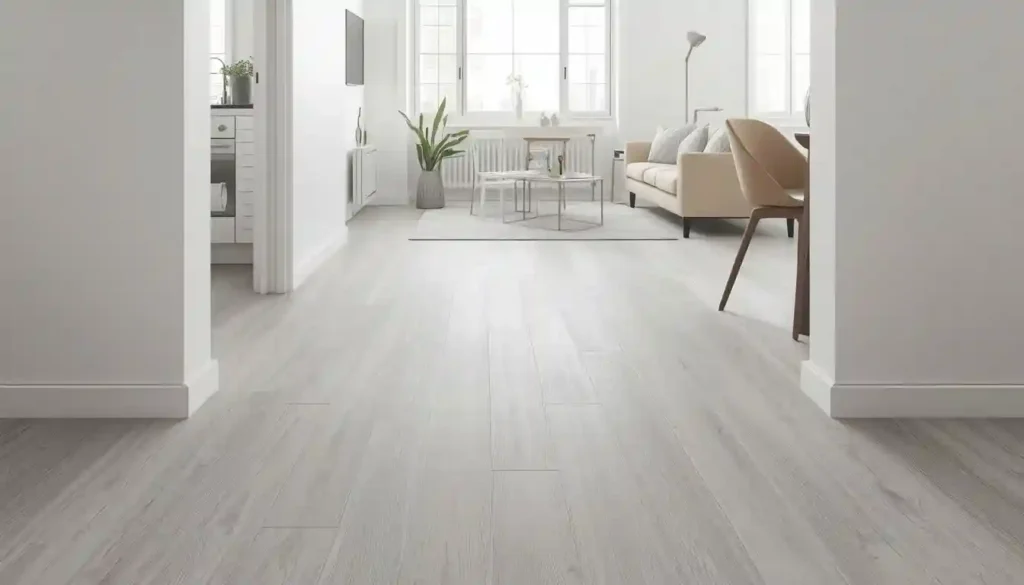
In small apartments, floor colour is one of the highest-leverage design decisions you can make. A pale grey vinyl floor — particularly one in a silver or light ash grey — reflects rather than absorbs light, which creates the optical illusion of more space. The floor appears to recede rather than come forward, making walls feel farther apart and ceilings feel higher than they actually are.
The strategy here is continuity. Install the same pale grey vinyl throughout every room, including the kitchen and bathroom if the layout allows. Eliminating flooring transitions between rooms removes the visual interruption that makes apartments feel chopped up and compressed. When a single light grey floor flows from the entry through the living area into the bedroom, the eye reads the apartment as one continuous, larger space.
Keep furniture in pale, receding tones — white, cream, and light ash wood — so the floor does not have to compete with dark, visually heavy pieces. The pale grey vinyl essentially functions as an extended version of the walls, drawing the room outward in every direction. Use mirrors strategically to amplify the light-reflecting properties of the floor, and keep window treatments minimal to allow daylight to hit the pale planks directly. You can find more tailored advice about this in our article on vinyl flooring ideas for small spaces.
Idea 8: Grey Stone-Look Vinyl in a Basement
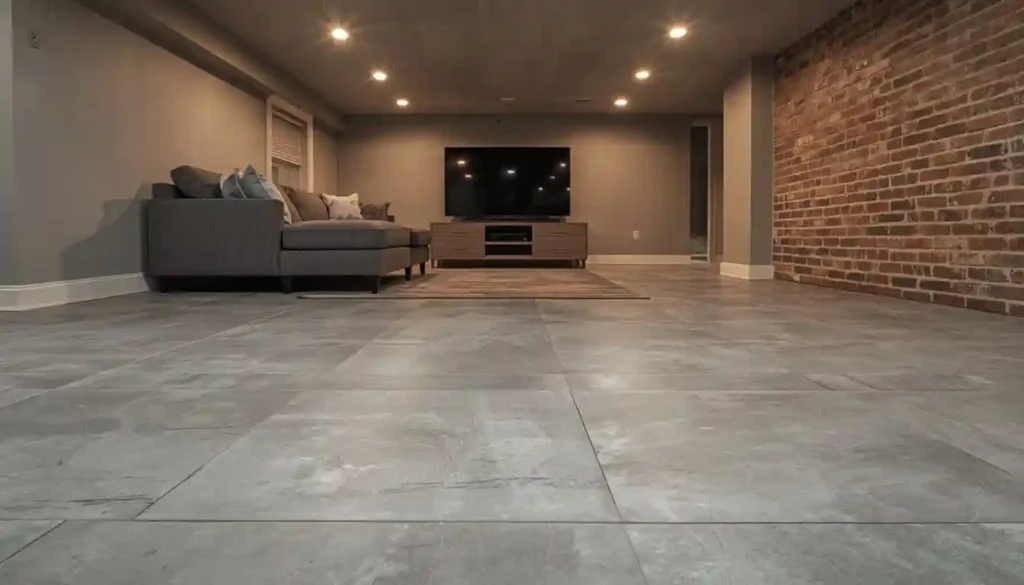
Basements present a specific set of challenges for flooring: moisture risk, limited natural light, subterranean feel, and the need for a floor that can handle everything from a home gym to a media room. Grey stone-look vinyl solves nearly all of these problems at once. The waterproof construction addresses the moisture concern, the lighter-to-mid grey tones counteract the darkness, and the stone look adds a polished, intentional quality that elevates the basement from storage space to genuinely liveable room.
For a basement conversion, choose a concrete-look or slate-look grey LVT in a mid-grey tone. Avoid very dark shades here — they will make a naturally dim space feel cave-like without compensating with dramatic design elements. A mid-tone grey with subtle texture variation across the surface adds visual interest without the repetition that uniform mid-tones can sometimes produce in larger areas.
Pair the stone-look grey vinyl with warm-toned artificial lighting — recessed warm-white LED panels, floor lamps, and wall sconces — to counteract the lack of natural light. The cool grey floor acts as a contrast surface that makes warm light glow more noticeably, creating a comfortable, enveloping atmosphere. Wood-panelled walls or exposed brick combined with this floor type give basements a genuinely characterful finish rather than the typical finished-but-forgettable look.
Vinyl is also the correct technical choice for below-grade installations because it handles moisture from both directions. Unlike engineered hardwood or laminate, it does not swell or delaminate when humidity rises, which is a realistic condition in most basements through spring and summer. The full case for vinyl in this application is explored in our piece on the best vinyl flooring for basements.
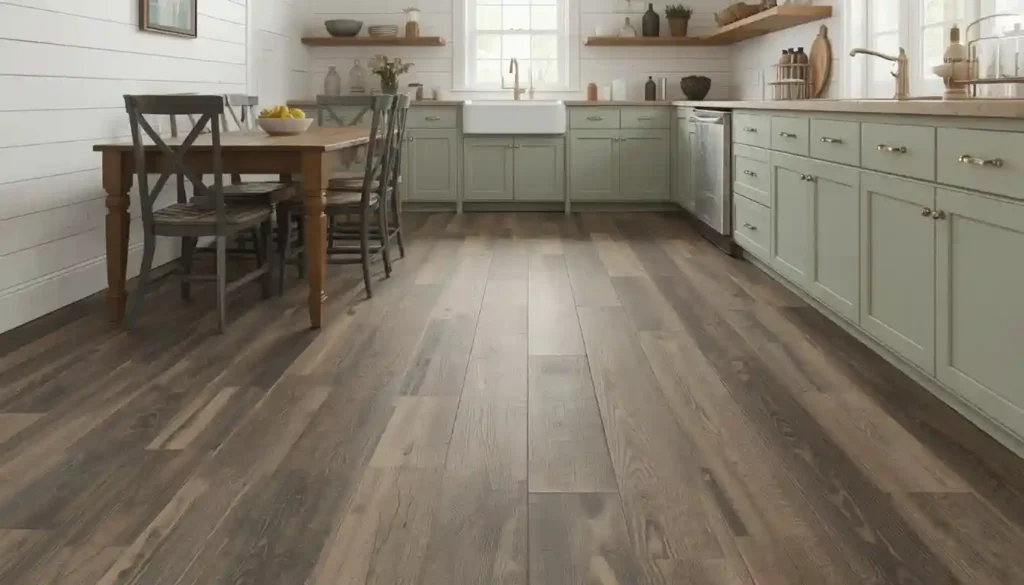
Idea 9: Grey Vinyl in a Farmhouse-Style Kitchen
The farmhouse kitchen aesthetic — shiplap walls, apron-front sinks, open shelving, and butcher block counters — has become one of the most enduring interior styles of the past decade. Grey vinyl flooring modernises this aesthetic and prevents it from tipping into a dated country-cottage look. Specifically, a weathered or reclaimed-wood-look grey vinyl plank brings the warmth and character of aged timber while adding a grounding visual sophistication that the farmhouse style sometimes lacks.
Look for grey vinyl planks with a heavily textured, hand-scraped surface and visible knots or grain variation in a warm grey-brown or mushroom tone. The visual complexity of this surface texture reads as genuinely aged and characterful rather than uniform and manufactured. Plank widths of 5 to 7 inches in varying lengths further reinforce the impression of reclaimed timber.
Set this floor against white or cream shiplap walls, painted wooden cabinets in sage green or warm white, an apron-front farmhouse sink, and open shelving in natural pine. Woven baskets, ceramic canisters, and copper or oil-rubbed bronze hardware complete the layered, organic feel. The grey of the floor ties the white walls and warm wood elements together without pulling the room toward any single warm or cool extreme.
This idea particularly suits kitchens that flow into informal dining areas or back porches, where the transition from the interior into an outdoor-adjacent space benefits from a floor that bridges the gap between refined and relaxed.
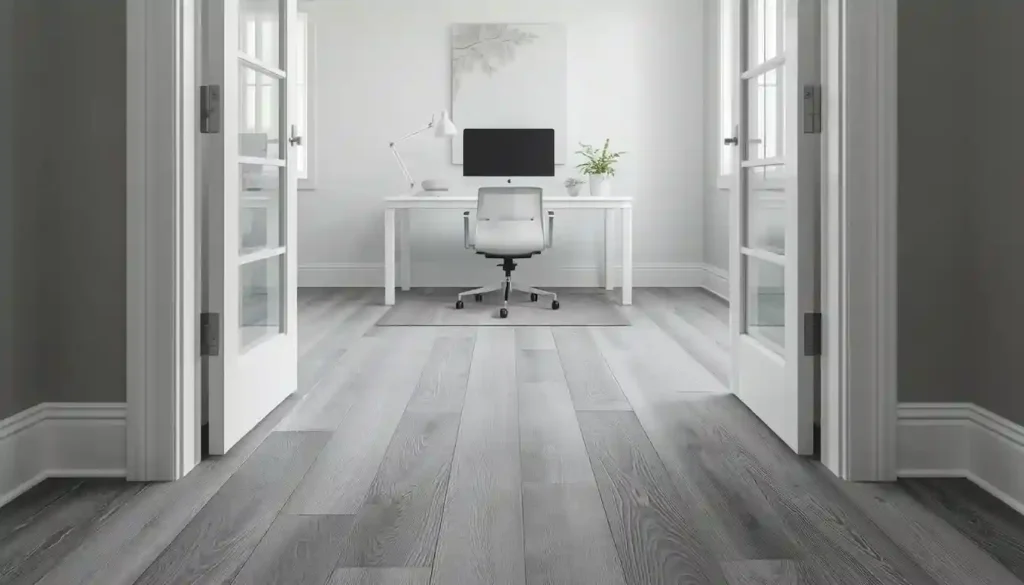
Idea 10: Cool Grey LVP in a Contemporary Home Office
The home office demands a floor that supports focus without being visually noisy. Cool grey luxury vinyl plank — in a smooth, uniform tone with minimal grain variation — creates exactly this kind of clean, distraction-free base. The floor recedes visually, keeping attention on the work surface and the wall behind the desk rather than drawing the eye downward.
Choose a cool grey with blue or green undertones in a smooth or lightly wire-brushed texture. Plank widths of 5 to 6 inches work well in home office settings — wide enough to avoid a busy joint pattern but narrow enough to avoid the bedroom-like quality that very wide planks introduce. A matte finish prevents glare under overhead lighting, which is important in a room where screens are in constant use.
This floor type plays particularly well with the clean-lined, Bauhaus-influenced aesthetic of contemporary home office design: white or walnut desks, Eames-style task chairs, architectural floor lamps, and a single large canvas print or typographic wall piece. The cool grey floor makes even mid-range furniture look deliberately chosen rather than accumulated, which is one of the most underappreciated contributions a good floor makes to an interior.
Chair mats are unnecessary with quality vinyl flooring — the surface handles rolling chair legs without denting or scratching, which eliminates one of the most visually disruptive elements in a typical home office setup. This practical benefit pairs well with the clean aesthetic of the cool grey floor and contributes to the overall sense of an uncluttered, professional workspace.
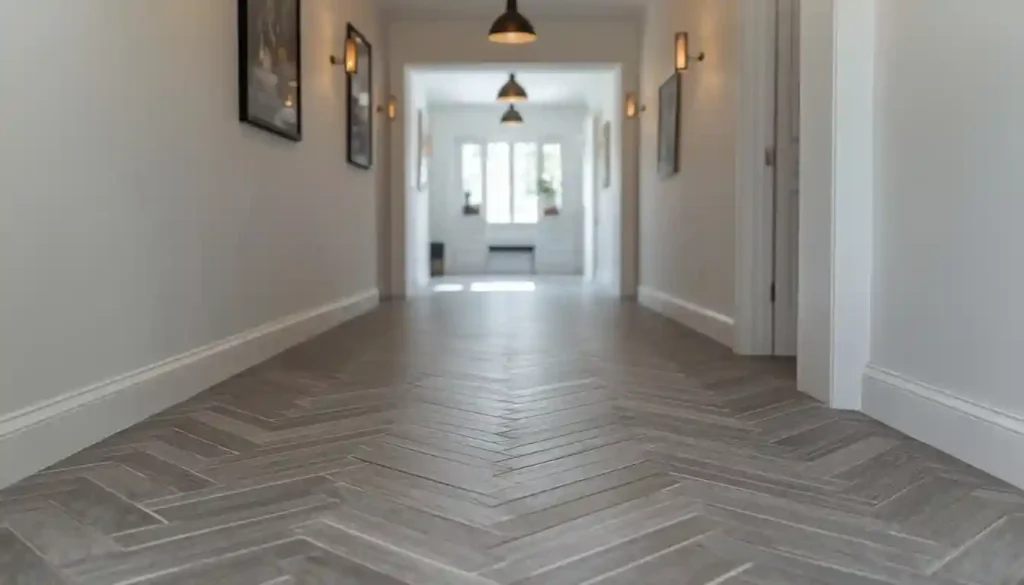
Idea 11: Grey Vinyl Tile in a Herringbone Pattern for a Long Hallway
Long, narrow hallways are among the most difficult spaces to floor effectively. A straight-run plank pattern parallel to the length of the hallway amplifies how tunnel-like the space feels. Grey vinyl tile in a herringbone layout solves this by introducing a diagonal geometry that draws the eye across the width of the hallway rather than just straight ahead, making the space feel wider and more dynamic.
Use small-to-medium format grey tile — 6×12 inches or 4×12 inches — in a warm or mid-grey tone. The smaller format creates a finer herringbone weave that suits the scale of a hallway better than the bold geometry of larger tiles. A satin finish with slight texture adds grip underfoot, which is practically important in a high-traffic passage that will see damp boots in wet weather.
Hallways in grey herringbone vinyl benefit enormously from strong vertical elements on the walls. Picture rails with hanging artwork, wall-mounted lighting at regular intervals, or a continuous horizontal rail of hooks in matte black give the eye rest points as it moves through the space. A runner rug in a natural jute or woven cotton can be layered over the herringbone if the hallway is long enough — it adds warmth and protects the highest-traffic section of the floor without hiding the pattern at the entry and exit.
This is one of the most searched and pinned interior ideas on visual platforms precisely because it solves a real design problem — the awkward hallway — in a way that looks genuinely elevated rather than compensatory.
Idea 12: Grey Vinyl Planks Running Diagonally in a Square Room
Square rooms present a compositional challenge: without a dominant axis, the room has no natural focal point or sense of direction. Installing grey vinyl planks diagonally — at a 45-degree angle to the walls — solves this immediately. The diagonal run creates movement and visual energy, makes the room appear larger by drawing the eye toward the corners, and adds a sense of deliberate design intent that straight-run flooring in a square room lacks.
This technique works with most grey tones but is most effective with medium-width planks in a mid-grey or greige tone, where the floor pattern itself becomes a genuine design feature. The waste factor in a diagonal installation is slightly higher than a straight run — typically 15 percent — so factor this into your material order.
For a square living room or dining room, pair the diagonal grey floor with symmetrically arranged furniture: a square dining table centred in the room, or a symmetrical sofa arrangement around a central coffee table. The diagonal floor creates visual asymmetry at the ground plane while the furniture above provides reassuring symmetry — this contrast between the geometric dynamism of the floor and the stability of the furniture arrangement produces a room that feels lively and balanced simultaneously.
This approach is particularly effective in rooms with low ceilings, where the diagonal floor introduces a horizontal dynamism that distracts from the ceiling height. It is an interior design technique with a long history in period homes with parquet floors, now made accessible and practical through luxury vinyl.
Idea 13: Grey LVP Through an Open-Plan Kitchen and Living Room with Continuity
One of the most common design mistakes in open-plan homes is using different flooring in the kitchen area versus the living area. The visual interruption created by a transition strip or a flooring change within a single room breaks the spatial flow and makes the space feel smaller than it is. Running a single grey vinyl plank throughout the entire open-plan zone eliminates this problem completely.
The key design decision is choosing a grey tone that works for both zones. A mid-tone greige or a warm grey-brown performs best here because it is neutral enough to complement both the functional, hard-surfaced aesthetic of a kitchen and the soft, upholstered comfort of a living space. Cool greys can feel clinical in living areas if not balanced carefully, while very warm greige tones sometimes look inconsistent under the task lighting of a kitchen versus the ambient lighting of the living zone.
Install the planks in a single direction throughout the entire space — typically parallel to the longest wall or the direction of the main source of natural light. This creates a visual current that moves the eye through the room smoothly. Use the same plank width and finish throughout, and avoid changing the pattern or direction at the boundary between kitchen and living room, as this defeats the entire purpose of the continuous run.
The result is a space that reads as significantly larger than its square footage because there are no visual interruptions at the ground level to signal “this room ends here.” For anyone wanting to understand how this material compares to other options that might work across both zones, our breakdown of waterproof laminate versus waterproof vinyl addresses the practical tradeoffs worth knowing before making a final decision.
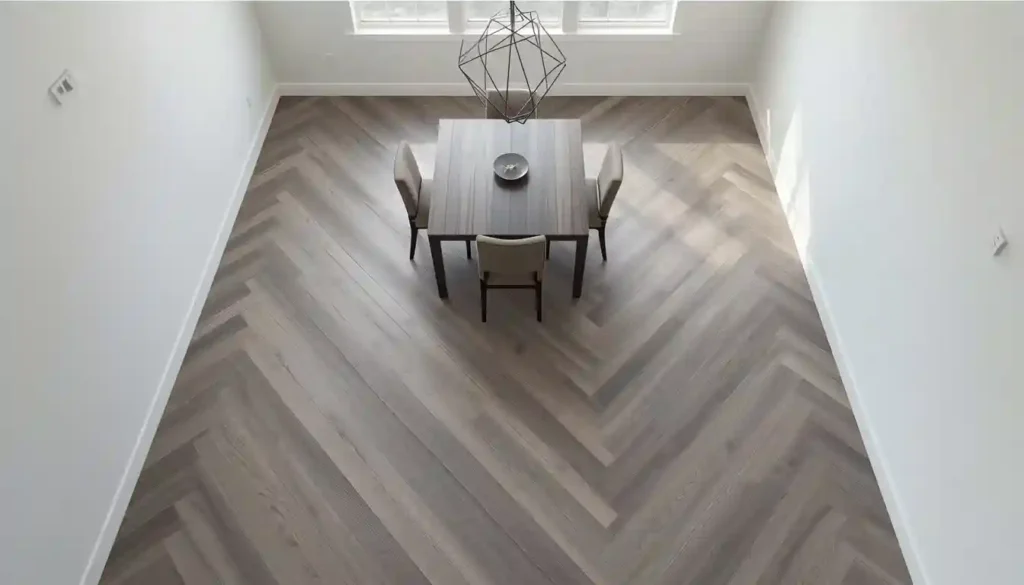
Idea 14: Mid-Grey Vinyl Tile in a Chevron Pattern for a Feature Dining Room Floor
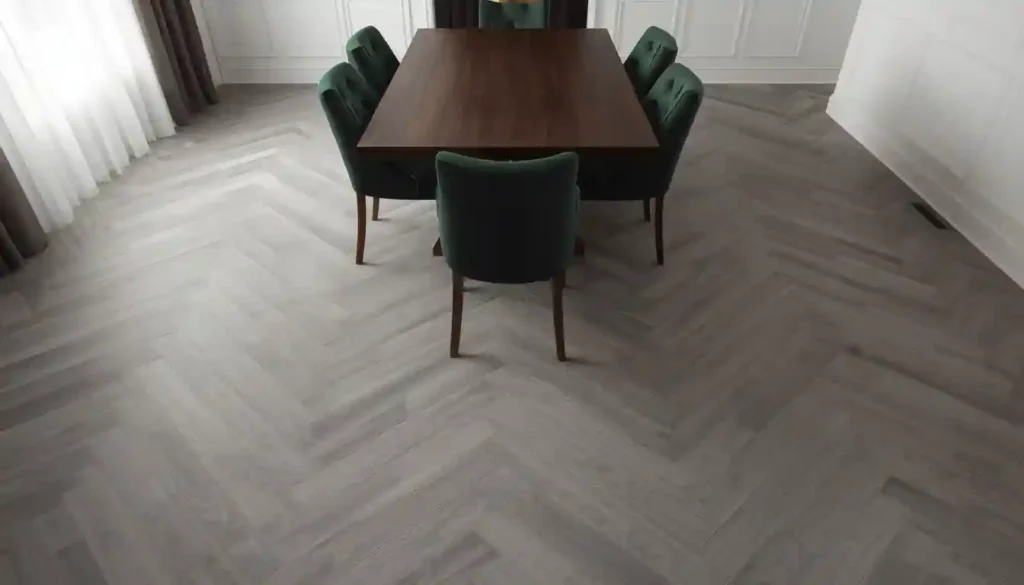
The chevron pattern is closely related to herringbone but distinct in an important way: where herringbone uses rectangular planks meeting at 90 degrees, chevron planks are cut at an angle so that the pointed end of each plank meets the pointed end of its neighbour, creating a continuous zigzag arrow. This unbroken, flowing geometry is arguably more dynamic than herringbone and works particularly well as a statement floor in a formal dining room where the floor is meant to be noticed.
A mid-grey vinyl tile or plank in a chevron layout commands attention in the best possible way. It immediately signals that the floor was chosen rather than defaulted to. Pair it with a long, oval or rectangular dining table in a contrasting material — dark walnut or white marble-look laminate — and upholstered dining chairs in a warm tone like terracotta, dusty rose, or deep forest green. The grey chevron floor below sets up a neutral field that makes these material and colour choices land with maximum impact.
Overhead, a statement pendant or chandelier in aged brass or matte black completes the room by providing a vertical focal point that the chevron floor anchors from below. The dining room is one of the few spaces in a home where a truly decorative floor is appropriate rather than distracting — it is the room where people sit still and look around, which means the floor has a chance to be properly appreciated.
This design idea is also one of the most shareable on platforms like Pinterest because the geometry of the chevron pattern reads beautifully in a top-down or slight overhead photograph — which is worth considering if you plan to document your renovation for social content.
Idea 15: Weathered Grey Vinyl Planks on Stairs for a Cohesive Multi-Level Home
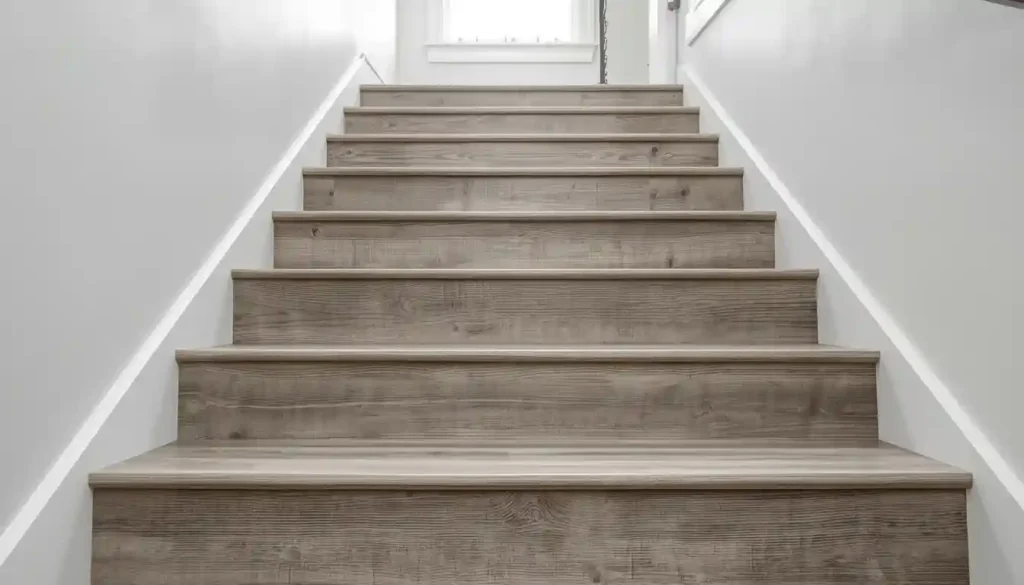
Most vinyl flooring ideas focus exclusively on horizontal floor planes, but extending grey vinyl up the stairs is one of the most impactful ways to create visual cohesion in a multi-level home. When the same weathered grey vinyl plank material wraps from the ground floor up the staircase, the vertical transition between levels feels intentional and continuous rather than like two separate design decisions stitched together.
Stair-rated vinyl is available specifically for this application: the planks are designed with reinforced wear layers to handle the concentrated foot traffic and edge wear that stair treads experience. Stair nosing profiles in a matching or complementary tone protect the leading edge of each tread and provide a finished, professional appearance. For open-riser stairs, the same grey vinyl can be applied to the side stringers for complete visual coverage.
Pairing the stairs with a simple painted white or grey riser between each tread creates the classic Scandi stair look — grey treads, white risers — that has become one of the most recognisable interior design aesthetics of the past five years. A simple cable or glass balustrade rather than a traditional timber spindle keeps the look clean and allows the grey stair surface to be the visual star.
From a practical standpoint, grey vinyl on stairs performs better than most alternatives. It handles the moisture brought in on wet shoes better than laminate or hardwood, resists the edge wear that carpet is prone to, and is significantly easier to clean than a carpeted stair. The slight texture of a weathered-look plank also provides better grip than smooth hardwood, which is an important safety consideration for stairs with frequent use by children or older family members. Our detailed guidance on how to install vinyl flooring on stairs is worth reviewing before starting this project, as the stair installation process differs from standard floor installation in several important ways.
Choosing the Right Grey: A Room-by-Room Summary
Before committing to any grey vinyl flooring installation, it is worth reviewing how the tone interacts with the specific conditions of each room. In living rooms with abundant natural light, you have the greatest freedom — cool, warm, or mid-tone grey all perform well, and wide planks in any direction work. In bedrooms, choose lighter tones with a smooth finish to support the calm, restful atmosphere the room requires. In kitchens and bathrooms, the waterproofing of vinyl is non-negotiable, and the stone-look or concrete-look formats in grey are the most visually appropriate for these functional spaces. In basements, mid-tone greys outperform very dark shades because they compensate for the lack of natural light rather than amplifying it. In hallways and entryways, pattern-based installations — herringbone or chevron — add decorative value to transitional spaces that would be visually unremarkable with a straight-run approach.
The most important practical step before installation is confirming your subfloor condition. Grey vinyl, regardless of format or tone, will telegraph subfloor imperfections if the surface beneath it is uneven or damaged. A flat, clean, structurally sound subfloor is the precondition for any vinyl installation looking as good in person as it does in the photographs. Our guide to choosing the right subfloor for vinyl flooring covers the preparation and assessment steps in detail.
Grey vinyl flooring is also one of the easiest formats to maintain once installed. A dry dust mop or microfibre pad daily, and a damp mop with a vinyl-safe cleaner weekly, is all the routine maintenance these floors require. The colour and surface finish are integrated into the construction of the plank or tile rather than applied as a topcoat, so there is no waxing, polishing, or refinishing required over the life of the floor. This low-maintenance quality is one of the core reasons grey vinyl has become such a dominant choice across every room type in contemporary residential design. For a detailed walk-through of everything you need to know before buying, our vinyl flooring buying guide covers material construction, wear layer thickness, installation methods, and brand recommendations in a single comprehensive reference.
Whether you are renovating a single room or rethinking the flooring across an entire home, grey vinyl flooring offers a depth of choice, a reliability of performance, and a design versatility that few other materials can match at any price point. The fifteen ideas in this guide represent just a fraction of what becomes possible when you start with this flexible, durable, and genuinely beautiful foundation.
James Miller is a seasoned flooring contractor with years of hands-on experience transforming homes and businesses with high-quality flooring solutions. As the owner of Flooring Contractors San Diego, James specializes in everything from hardwood and laminate to carpet and vinyl installations. Known for his craftsmanship and attention to detail, he takes pride in helping clients choose the right flooring that balances beauty, durability, and budget. When he’s not on the job, James enjoys sharing his expertise through articles and guides that make flooring projects easier for homeowners.
The best thickness for laminate flooring over underfloor heating is between 8mm and 10mm for most residential systems, with 8mm preferred for electric mats and 10mm to 12mm acceptable for hydronic systems. The deciding factor is not the millimetre figure on the box — it is the thermal resistance value of the plank, which must…
There is a reason hardwood flooring keeps showing up in every bedroom inspiration board you scroll past. It ages gracefully. It grounds a room without competing for attention. It makes soft things — linen bedding, a plush area rug, pale curtains — look even softer by contrast. And unlike carpet, which traps allergens and shows…
The reason most vinyl flooring installations fail has nothing to do with the vinyl itself. It has everything to do with what happens before a single plank is ever laid down. Concrete subfloors are deceptive. They look solid, flat, and ready. But a concrete slab is a porous, living material that absorbs and releases moisture,…
11 Modern Carpet Flooring Ideas – Styles, Colors & Design Inspiration Carpet has spent a few years in the design penalty box. Hard surfaces dominated, minimal interiors went viral, and soft flooring quietly retreated to one demographic: people who hadn’t yet renovated. That story is now over. In 2025 and into 2026, carpet is returning…
What Makes a Subfloor “Good” for Vinyl Flooring? The subfloor is the structural panel layer that sits on top of your floor joists and beneath the finished flooring. It is not the same as the underlayment, which is a thin cushioning layer placed directly under the vinyl. The subfloor is load-bearing. It determines how much…
Laminate flooring is one of the most purchased floor coverings in the world, yet most buyers walk into a showroom armed with nothing more than a color preference and a rough square footage number. That mismatch between what you know and what you need to know is where buying mistakes happen — mistakes that surface…