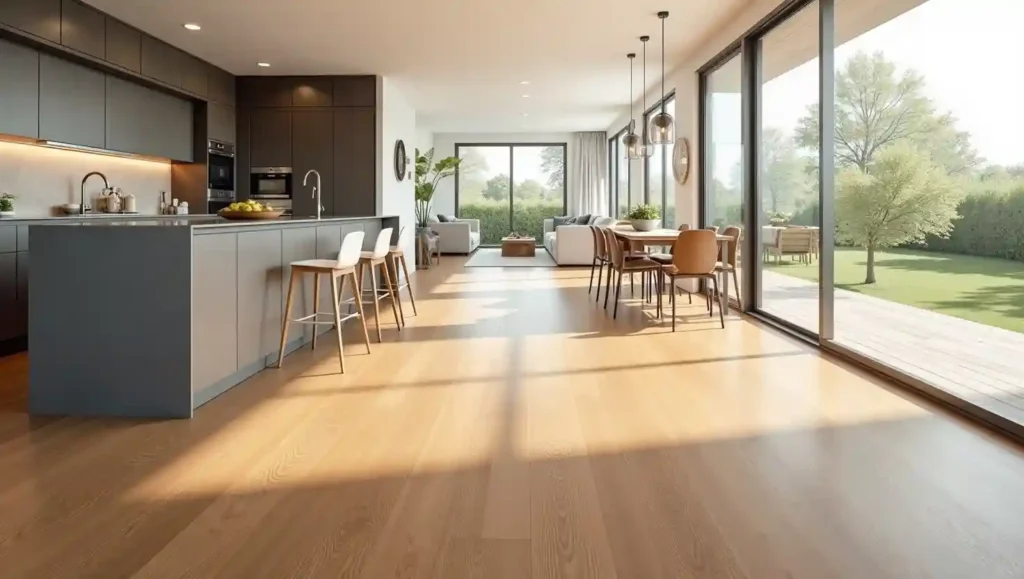
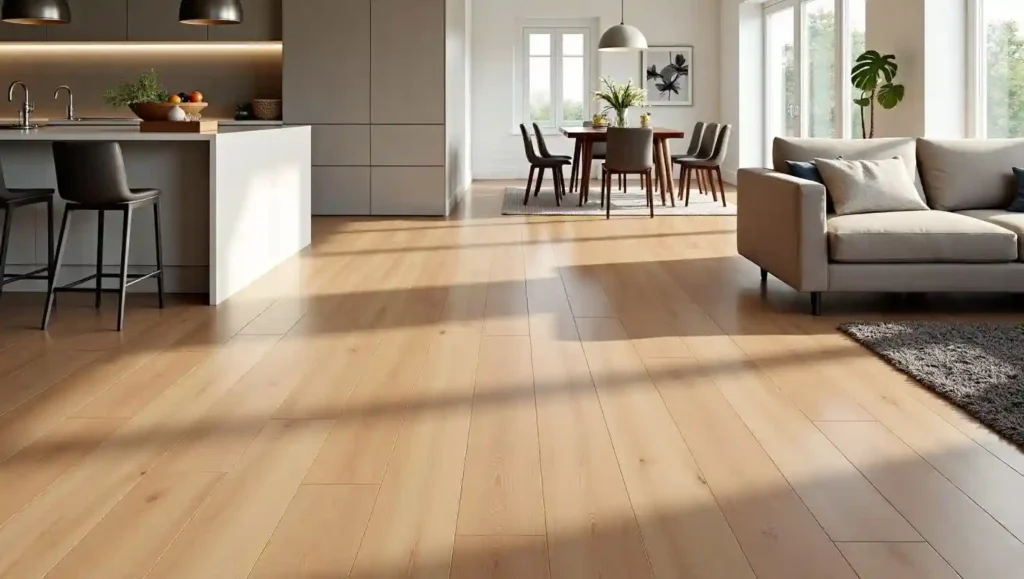
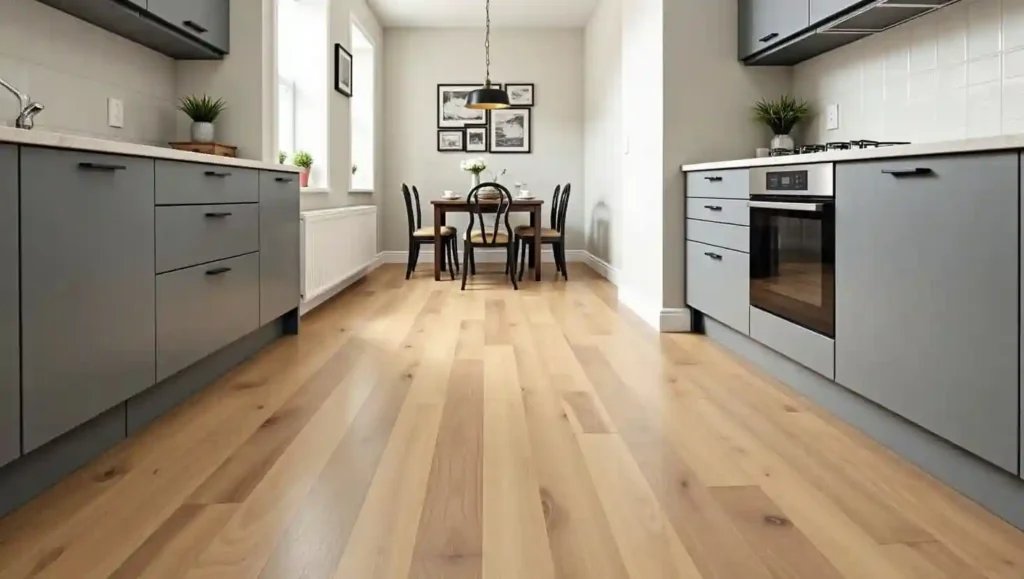
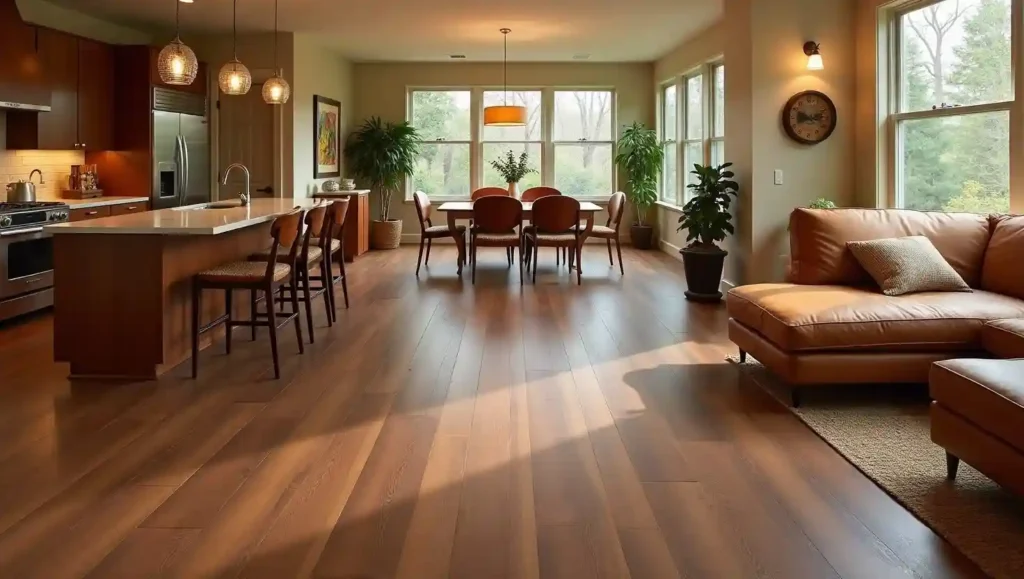
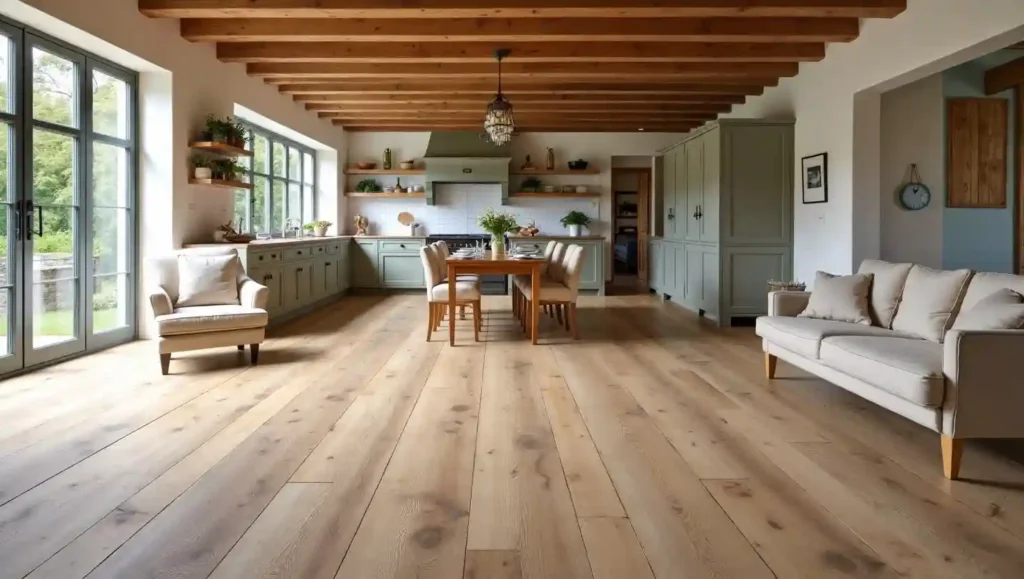
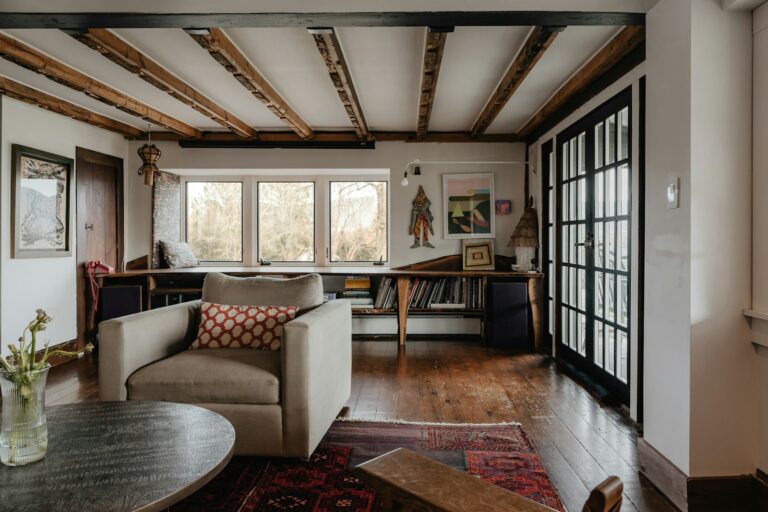
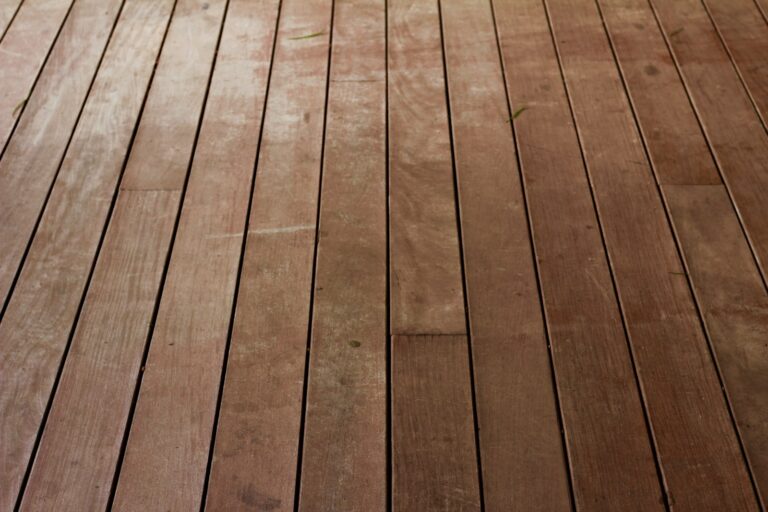
This approach pairs especially well with white or off-white cabinetry in the kitchen zone and neutral furniture in the living area, since the flooring provides the warmth that softer furnishings can then amplify. It is also the most forgiving choice if you are not entirely sure how the space will be furnished — oak reads with almost everything.
2. Cool Grey LVP for a Modern, Airy Open Layout
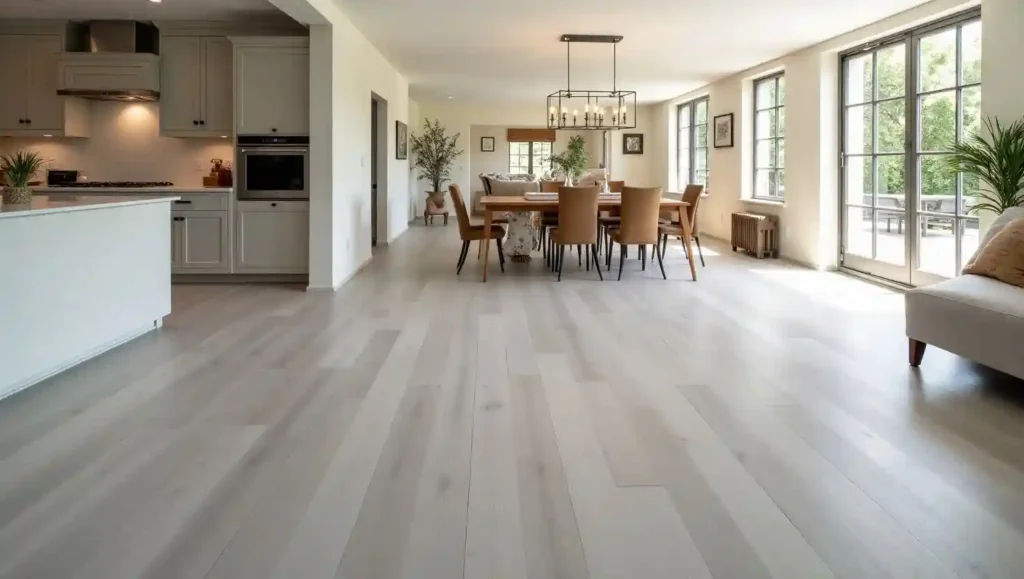
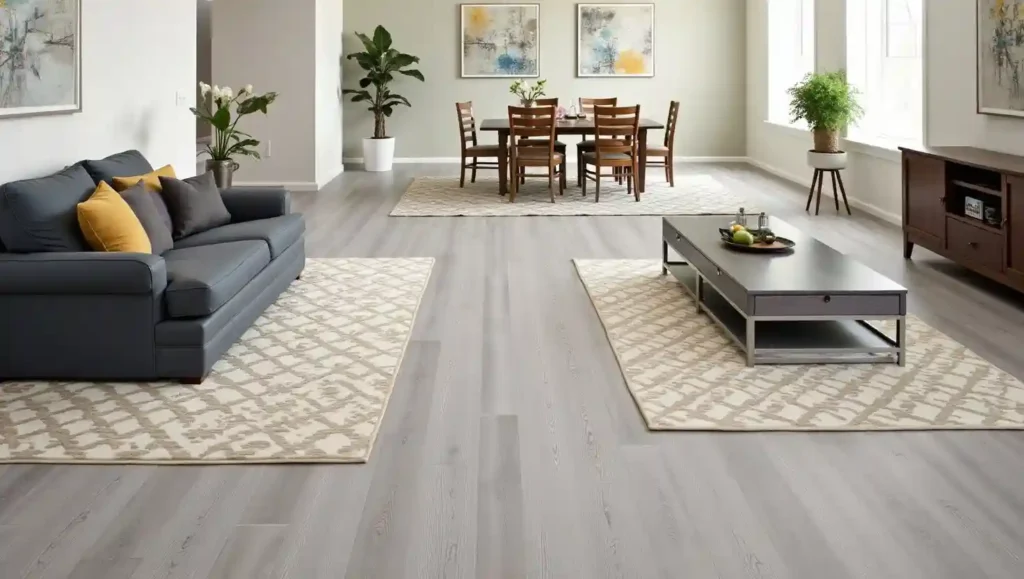
Cool grey luxury vinyl plank has become one of the defining floor choices of contemporary open plan design, and for good reason. A medium grey LVP — neither too silver nor too charcoal — provides a neutral backdrop that keeps the entire space feeling open and uncluttered, regardless of what furniture or cabinetry surrounds it. In open plan layouts where the kitchen zone typically involves bold cabinetry colors, stainless appliances, and hard countertop surfaces, a grey floor acts as a visual anchor that holds everything together without competing with any single element.
The practical case for grey is equally strong. Grey vinyl flooring conceals dust, pet hair, and everyday scuffs far better than lighter blonde tones, which makes it a particularly sensible choice for high-traffic open plan spaces where the kitchen’s foot traffic merges with the living area’s daily wear. Wide-plank grey LVP also provides visual continuity across the open layout, with fewer seams breaking the sightlines and a more modern, seamless appearance overall.
If you are working with a greige — a grey-beige hybrid — you gain extra flexibility because greige reads as warm under some lighting conditions and cool under others. This chameleon quality makes it one of the safest long-term investments in open plan spaces where you may repaint walls or change furniture over time.
Pairing grey floors with warm wood accents — a timber dining table, floating shelves in walnut, or a wood-clad kitchen island — is the most common and effective counterbalance to prevent the grey from reading cold or sterile. If your open plan has minimal wall space, the floor color does even more work, so getting the grey-to-greige ratio right is worth the effort of bringing samples home before committing. You can read more about how different flooring affects the feel of a space in our guide to 15 grey vinyl flooring ideas.
3. Wide Plank LVP to Maximize the Sense of Space
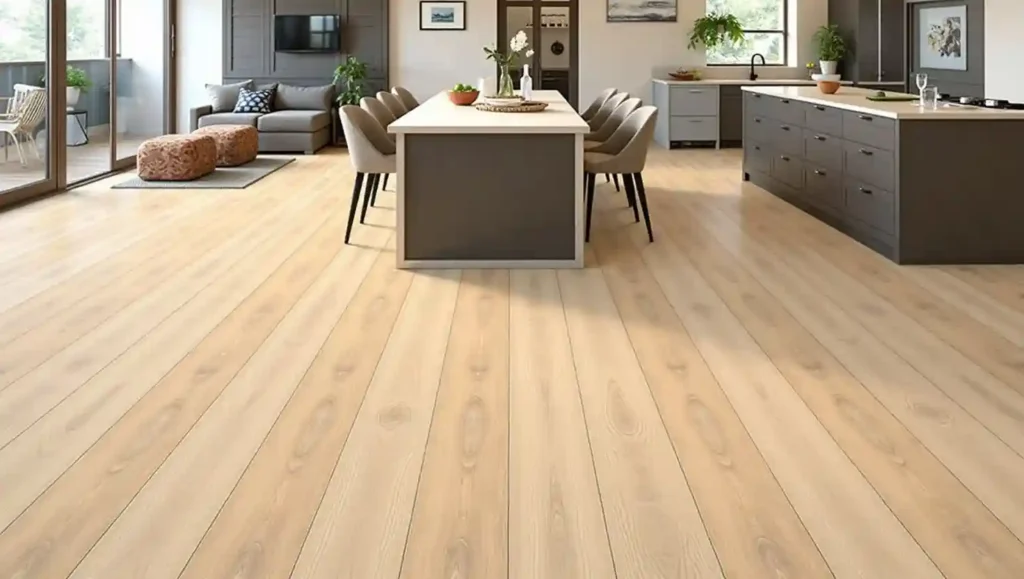
Plank width is one of the most underrated decisions in open plan flooring. Standard plank widths — around three to four inches — were designed for smaller, closed rooms where narrower boards suit the scale. In an open plan space with a large, unbroken floor plane, narrow planks create too many seam lines, which fragments the visual field and makes a large space feel busier than it should.
Wide plank LVP, starting at seven inches and going up to twelve or more, dramatically reduces the number of seams visible across an open layout. Fewer seams mean a cleaner, more modern appearance with a visual expansiveness that narrow-plank floors simply cannot replicate. The grain of the individual planks becomes more prominent, which adds character and visual depth without the added complexity of a pattern or multiple colors.
Wide plank vinyl is also easier to clean in open plan spaces — fewer grout-like seams means less dirt accumulation along edges, which matters enormously in a kitchen-adjacent living area where crumbs and spills are a daily reality. For the best visual effect, run wide planks along the longest axis of the open plan space; the length of the planks will carry the eye through the zones and emphasize the depth and openness of the layout rather than interrupting it.
4. Herringbone Pattern LVP as a Statement Floor Across Zones
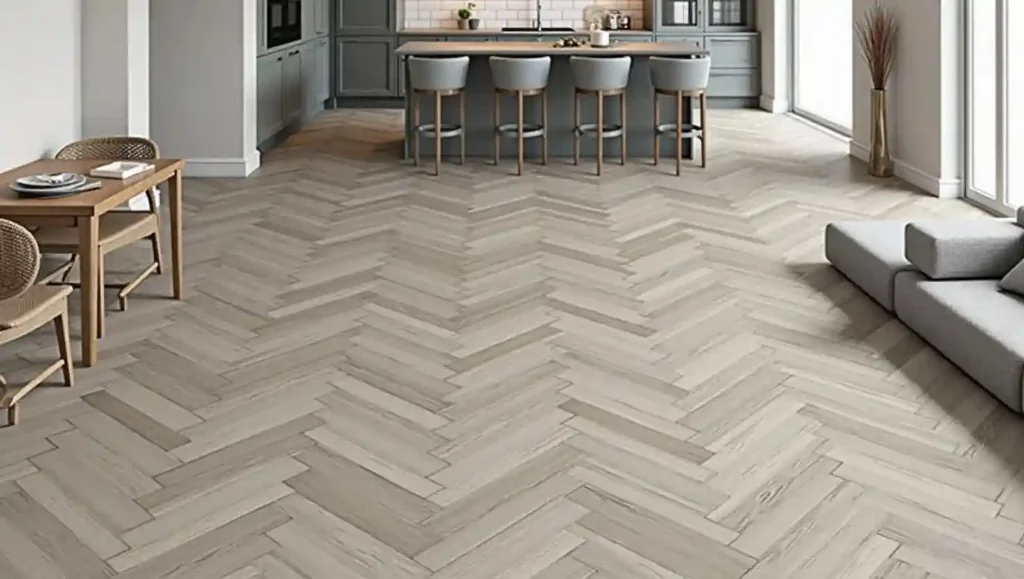
A herringbone layout takes the same planks as a standard LVP installation and arranges them in interlocking right angles to produce a V-shaped zigzag pattern that runs continuously across the floor. In an open plan space, herringbone pattern vinyl does something that no other layout achieves: it creates visual movement and texture across the floor plane without changing the color or material, which means it unifies all the zones while simultaneously making the floor itself a design feature worth noticing.
The pattern is particularly effective in open plans that connect a kitchen and living area, because the diagonal energy of herringbone draws the eye diagonally across the space rather than along the walls, which makes the room feel wider and more dynamic. Grey oak herringbone LVP combines the cool-grey color trend with the classic pattern, producing a result that works in both contemporary and transitional interiors. Natural oak herringbone has a warmer, slightly more traditional character that suits farmhouse and Scandinavian-influenced open plans well.
One practical note: herringbone installations require more planks than a straight lay because of the angled cuts at the room perimeter, so plan for a higher material cost. The installation is also more complex, making professional fitting the recommended approach for large open plan areas where precision alignment is critical. The result, however, is a floor that genuinely transforms the room from functional to architectural.
5. Stone-Look LVT for a Modern Open Plan Kitchen and Living Room
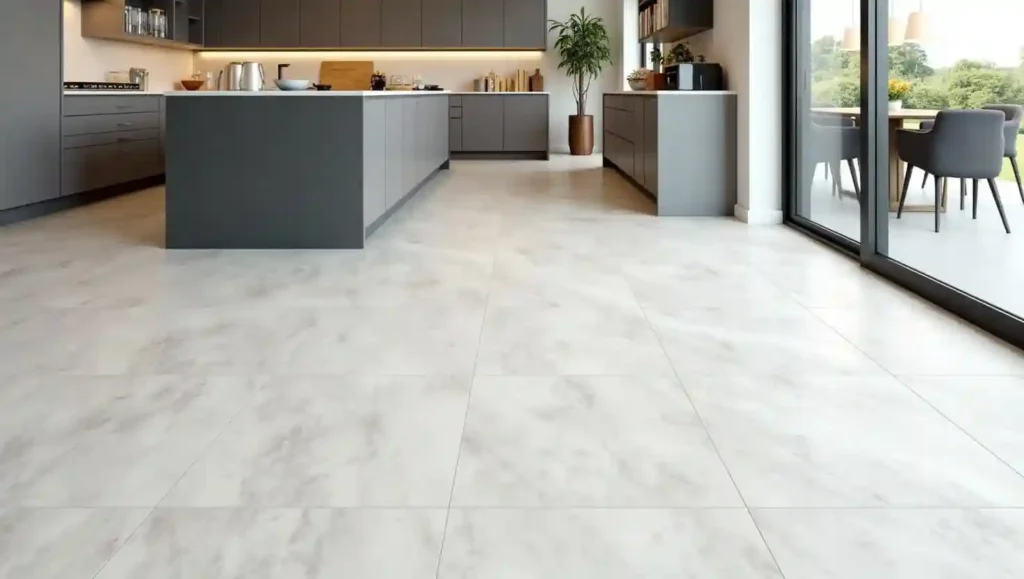
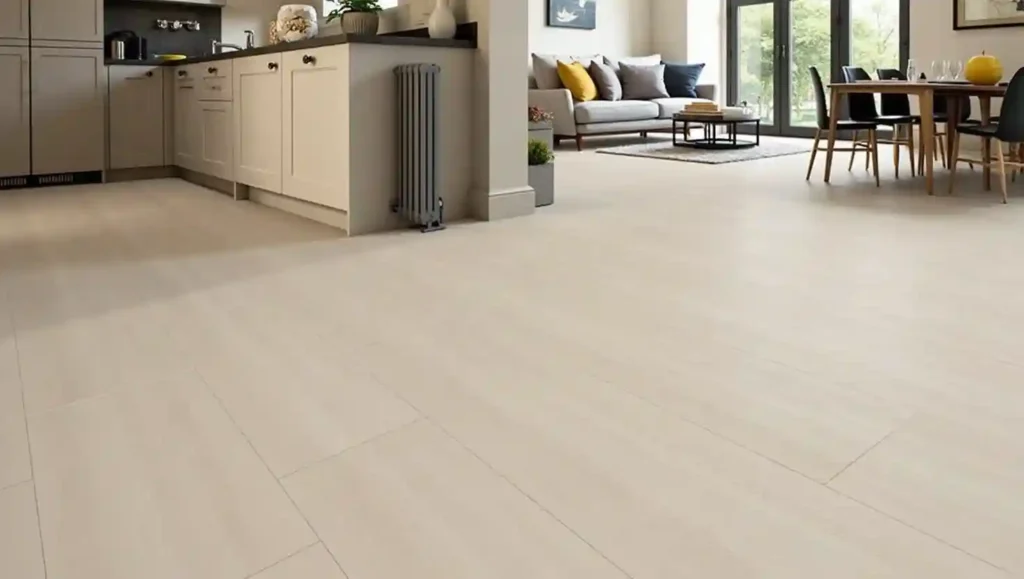
Not every open plan space calls for wood-effect flooring. Stone-look luxury vinyl tile — whether replicating marble, slate, travertine, or large-format concrete — offers a distinctly different aesthetic that suits contemporary and industrial open plan interiors particularly well. The clean, smooth visual surface of stone-effect LVT reduces visual noise across a large open area, producing the kind of calm, gallery-like backdrop that makes statement furniture and kitchen cabinetry read with maximum clarity.
Light grey marble-effect LVT in a large format — 24 by 48 inches, for example — creates an almost seamless visual floor when the grout lines are minimal or tone-matched to the tile. Across an open plan living and kitchen space, this produces a sleek, high-end aesthetic that would cost several times as much with actual stone. The practical advantage of LVT over real stone is equally significant: it is warmer underfoot, more resistant to cracking, far lighter for subfloor loading, and completely waterproof in a way that natural stone with standard grout is not.
Concrete-effect LVT in a large plank or tile format is another strong option for open plans with an industrial or loft-inspired aesthetic. It pairs naturally with exposed structural elements, black-framed windows, and matte metal fixtures without the cold acoustic properties of actual polished concrete. For those wondering about the acoustic side of vinyl in open plan spaces, this is worth exploring further — you can learn more about how different flooring materials handle sound in our detailed look at methods to soundproof vinyl flooring.
6. Dark Charcoal LVP for a Dramatic, Grounded Open Plan Interior
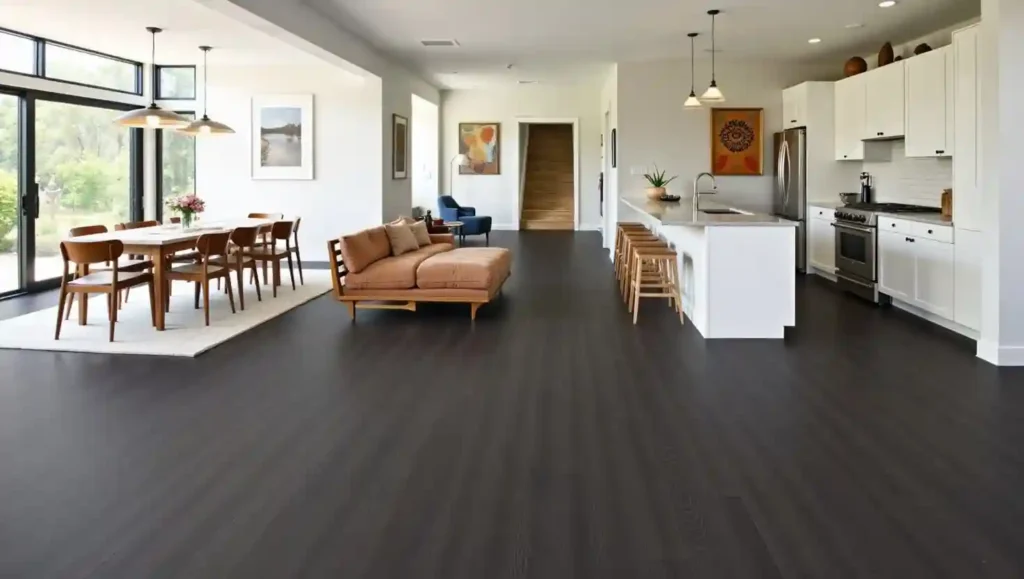
Dark flooring in an open plan space runs counter to the conventional advice of “go light to make it feel larger,” but it can produce one of the most striking and sophisticated results in contemporary residential design. A dark charcoal or near-black luxury vinyl plank grounds the entire open plan layout, creating a strong horizontal plane that anchors furniture, cabinetry, and architectural features above it with unusual clarity and intentionality.
The key to making dark LVP work in an open plan is balancing it vertically. White or very light walls, high ceilings, and generous natural light through large windows or skylights counteract the weight of a dark floor and prevent the space from feeling enclosed or heavy. Light-colored furniture — cream sofas, pale timber dining tables, white cabinetry — floats visually above the dark floor surface, creating a contrast that gives every element in the room more presence and definition than it would have on a mid-tone floor.
Dark vinyl also has a practical advantage in open plan spaces that connect to outdoor areas or include heavy traffic from a kitchen: it conceals the kind of everyday dirt, scuff marks, and wear that accumulate fastest in these areas. In homes with pets or young children, a dark floor in the open plan significantly reduces the visible evidence of daily life between cleaning sessions.
7. Greige LVP to Bridge Warm and Cool Tones Across an Open Layout
Greige — the blend of grey and beige — is the most versatile and forgiving vinyl floor tone available for open plan spaces. It operates in a tonal range that reads as warm under incandescent and warm LED lighting, and cool under natural daylight or cool-white fluorescent light. This adaptive quality makes it uniquely suited to large open plan spaces where the flooring is seen simultaneously under multiple different lighting conditions throughout the day.
In an open plan with south-facing windows that flood the kitchen zone with natural light while the living room end remains in relative shadow, a greige floor bridges the two lighting environments without looking inconsistent. It is also the most neutral choice for open plans that include both warm-toned kitchen cabinets — honey maple, cream shaker — and cooler-toned living room furnishings like grey upholstery or white walls, because it makes concessions to both without appearing to clash with either.
Wide-plank greige LVP in a matte or low-sheen finish is currently one of the most popular specifications in both new-build and renovation open plan projects. The matte finish prevents harsh light reflections across the large exposed floor surface, which is a common problem with high-gloss options in open plan spaces where light enters from multiple angles.
8. Diagonal LVP Laying Pattern to Expand a Narrow Open Plan Visually
In open plan layouts that are longer than they are wide — a common configuration in terraced houses, narrow new-builds, or apartments with a galley kitchen at one end — a diagonal laying pattern is one of the most effective tools for visually broadening the space. When LVP planks are installed at 45 degrees to the walls rather than parallel to them, the diagonal lines draw the eye outward toward the corners of the room rather than along the length of the space, which creates an optical widening effect.
The diagonal pattern works particularly well in greige or mid-tone oak LVP because the angled lines are visible without being distracting — the pattern reads as a subtle background texture rather than a dominant design statement. In very long narrow open plans, this is the difference between a space that feels like a corridor and one that feels genuinely open.
The installation requires more material than a straight lay because of the angled cuts along every wall, so budget approximately ten to fifteen percent additional wastage. The visual payoff in a constrained open plan layout, however, makes this additional cost worthwhile. The diagonal pattern also hides individual plank joints more effectively than a straight lay, because the eye follows the diagonal lines rather than scanning horizontally to count seams.
9. Zoning an Open Plan with Two Complementary Vinyl Floors
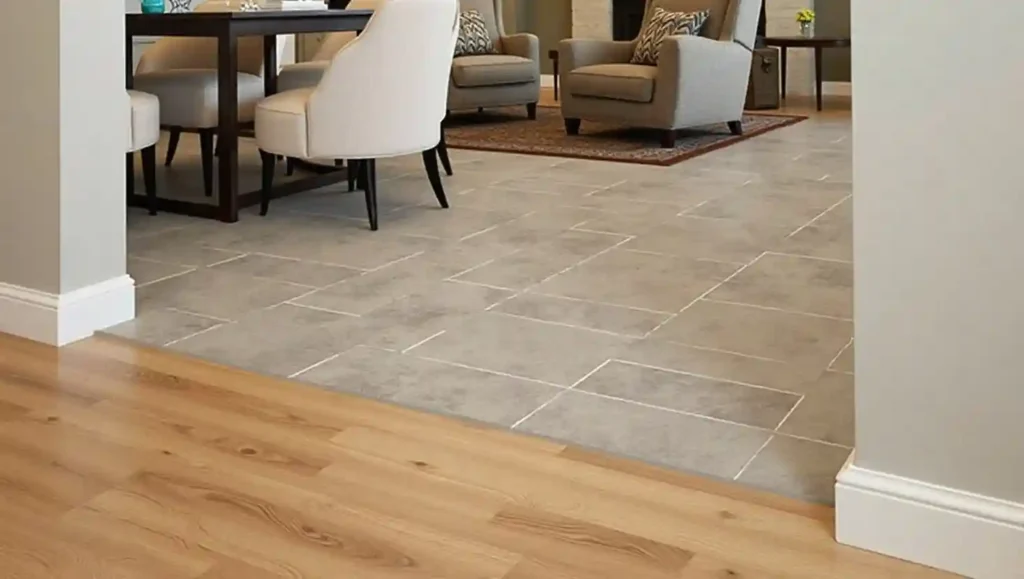
While continuous flooring is the default recommendation for open plan spaces, there is a strong design argument for using two different but complementary vinyl floors to define functional zones without physical barriers. A wood-effect LVP in the living and dining zones paired with a stone-effect LVT in the kitchen zone, for example, gives each area its own material identity while remaining visually cohesive if the tones and finishes are carefully matched.
The key word is complementary: the two floors need to share a tonal family. A warm honey oak LVP in the living zone works alongside a warm travertine or sand-toned LVT in the kitchen because they share the warm beige-brown spectrum. A cool grey LVP in the living zone pairs cleanly with a light concrete or grey marble LVT in the kitchen for the same reason. Where zoned flooring fails is when the two materials have different warm-cool undertones — a cool grey LVP meeting a warm terracotta tile reads as unintentional rather than designed.
The transition between the two floors also matters enormously. A clean threshold strip in brushed brass, black or chrome — depending on the metal finish used elsewhere in the space — makes the transition look deliberate and architectural rather than like a patched repair. Some installers also use a change in plank direction at the threshold, which reinforces the zone boundary with a subtle visual cue rather than a hardware strip. This is a design choice worth exploring with your installer before the job begins, and if you are researching the full range of vinyl flooring types, our overview of LVP, LVT, SPC, WPC, and sheet vinyl explained is a useful starting point.
10. Light Blonde LVP for a Scandinavian-Influenced Open Plan
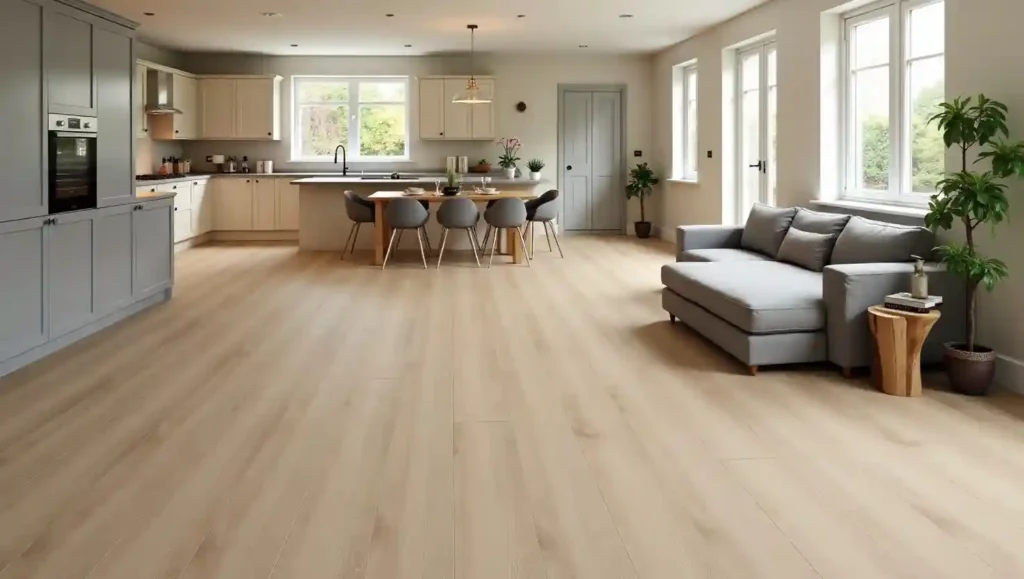
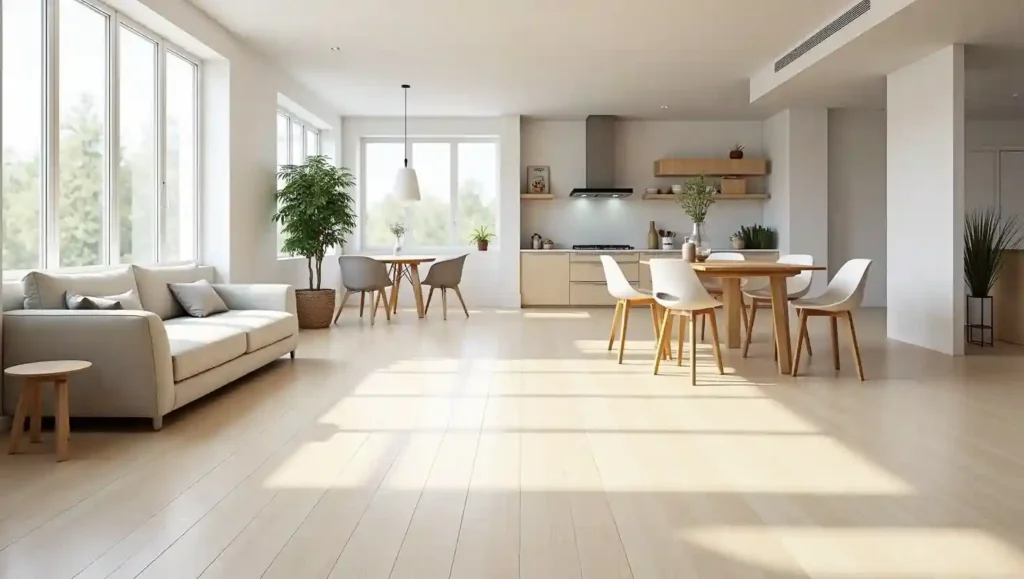
Light blonde or whitewashed luxury vinyl plank channels the Scandinavian design principle of maximizing light reflectivity in every surface, which makes a large open plan feel even more spacious and airy than it physically is. The pale, almost ash-toned wood finish bounces natural light around the space and creates a clean, uncluttered visual quality that complements minimalist and hygge-influenced interior styles particularly well.
In a south-facing or well-glazed open plan, light blonde LVP amplifies the brightness of the space in a way that darker or mid-tone floors simply cannot. The floor becomes part of the light strategy of the room rather than just a surface to walk on. Combined with white or light grey walls, natural linen upholstery, and simple timber furniture in complementary pale tones, light blonde LVP creates a cohesive, restrained interior that feels deliberate and calm.
The practical consideration with very pale floors in open plan spaces is maintenance visibility — dust, pet hair, and fine debris show more readily on a light surface than on a mid-tone or dark one. High-quality LVP with a textured or brushed surface finish helps conceal minor dust accumulation between cleanings, but this is a genuine trade-off to factor into the decision. The practical benefits of LVP in terms of waterproofing and durability do help offset the cleaning demands, and you can explore this in more detail in our article on whether vinyl flooring is truly waterproof.
11. Warm Walnut-Tone LVP for a Rich, Intimate Open Plan
Where light tones create airiness, warm walnut-toned LVP creates depth, intimacy, and a sense of considered luxury. The rich brown spectrum of walnut — ranging from medium reddish-brown to a deeper espresso — produces a floor that gives an open plan space a feeling of weight and substance, anchoring what might otherwise feel like a large, empty expanse. In open plans with a lot of glass, high ceilings, or minimal furniture, a walnut-toned LVP prevents the space from feeling cavernous or austere.
Walnut-effect LVP works particularly well in open plans with a mid-century modern or transitional design direction. The warm tones complement leather upholstery, brass and bronze hardware, and natural stone surfaces in ways that cool grey or blonde floors do not. The richness of the floor becomes a backdrop that makes warm-toned furnishings and architectural finishes look more cohesive and curated.
In terms of visual scale, walnut LVP in a wide plank format — seven or eight inches — produces a dramatically different result from the same tone in a narrow plank. Narrow walnut planks can make an open plan feel busy and fussy; wide walnut planks feel confident and architectural. If you are comparing walnut-toned vinyl with actual hardwood walnut flooring for your open plan, the practical and cost differences are significant, and the comparison is worth working through carefully.
12. Mixed-Width Plank LVP for a Custom Hardwood Look Across an Open Plan
Traditional hardwood floors — particularly those in older homes — were often installed with planks of varying widths, reflecting the natural variation in milled timber. Mixed-width LVP replicates this look by alternating planks of two or three different widths in a randomized or regular sequence, creating a floor surface that has more character and visual complexity than a uniform-width installation without the noise of a pattern like herringbone.
In an open plan space, mixed-width LVP reads as high-quality and intentional — it has the visual language of a premium hardwood installation without the associated maintenance and cost. The variation in plank width breaks up the large floor surface in a natural, organic way, which prevents the “bowling alley” effect that very long, uninterrupted straight planks can produce in large open plan layouts where the floor stretches across thirty or forty feet without interruption.
The color for mixed-width LVP in an open plan works best in the natural wood spectrum — oak, ash, pine-effect — because the plank variation itself is the design gesture, and a strong color like grey or dark charcoal can overpower the subtle interest that mixed widths provide. Keeping the tone warm and natural allows the width variation to read clearly without being overshadowed. You can explore the full range of available LVP formats in our guide to the different types of LVP flooring.
13. Using Area Rugs to Zone an Open Plan Over Continuous LVP
One of the most practical and design-flexible approaches to open plan vinyl flooring is to install one continuous LVP throughout and then use area rugs to define functional zones. This approach gives you the visual unity and practical benefits of a single floor material while allowing the zones — living, dining, kitchen — to have their own spatial identity through the rugs that anchor them.
In the living zone, a large area rug under the sofa and coffee table defines the seating area as a distinct space within the open plan without building a wall or changing the floor material. In the dining zone, a rug under the table and chairs does the same. Together, these rugs create a layered, residential quality that makes the large open plan feel inhabited and considered rather than vacuous. The continuous LVP underneath them provides the visual continuity and practical performance the space needs, while the rugs add warmth, acoustic damping, and spatial definition.
From an acoustic standpoint, this combination is particularly effective. Open plan spaces with hard flooring throughout can have significant echo problems — sound bounces between the hard floor, hard ceilings, and large glass surfaces without absorption. Area rugs over LVP absorb a substantial amount of this reverberation, making the space noticeably quieter and more comfortable to live in. This matters most in kitchen-adjacent living areas where the combination of hard appliances, tiles, and flooring can create a noisy environment during cooking and entertaining. The sound-related qualities of vinyl flooring are something many homeowners do not consider until after installation; it is worth understanding how different vinyl products handle acoustics before choosing, which is covered in our overview of IIC and STC ratings for vinyl flooring.
14. SPC Vinyl Flooring for an Open Plan Over Underfloor Heating
Open plan spaces over radiant underfloor heating present a specific challenge for flooring selection. Many flooring materials — including solid hardwood and some laminates — are incompatible with or perform poorly over underfloor heating because the temperature cycling causes expansion and contraction that damages the floor over time. Stone tile is thermally ideal but cold and hard underfoot, and acoustically unforgiving in a large open space.
SPC (Stone Plastic Composite) vinyl flooring is one of the best-performing options for open plan spaces with underfloor heating. The SPC rigid core construction is dimensionally stable — meaning it expands and contracts very minimally with temperature changes — which makes it compatible with underfloor heating in a way that WPC vinyl and many LVP formats are not. When the whole open plan floor runs over a radiant system, dimensional stability is not just a technical specification; it is what prevents the floor from developing gaps, ridges, or buckling over the heating seasons.
For open plan spaces with underfloor heating, a stone-effect SPC in a light tone is a particularly coherent choice: the stone visual complements the underfloor heating association (stone conducts and radiates heat beautifully), the SPC core handles the thermal environment, and the light tone keeps the large exposed floor from feeling heavy. Specification note: always check the manufacturer’s maximum temperature rating for any vinyl product before using it over underfloor heating, and follow the underlay recommendations carefully — some underlays insulate against heat transfer in a way that reduces heating efficiency significantly. You can find more detail on this in our article about installing vinyl flooring over radiant heat.
15. Farmhouse-Style Reclaimed Wood-Effect LVP for a Relaxed Open Plan
Not every open plan space is chasing contemporary minimalism. Farmhouse-influenced and relaxed country interior styles are equally popular, and they call for a different kind of vinyl flooring: one that has character, texture, variation, and an honest, lived-in quality rather than the clean precision of a modern grey or stone-effect floor.
Reclaimed wood-effect LVP achieves exactly this. The design layer in these products replicates the visual character of genuinely old timber — knots, grain variation, subtle color differences between planks, the occasional wormhole or saw mark, distressed surface texture — in a format that has none of the practical downsides of actual reclaimed wood. It is flat, stable, uniformly thick, click-lock installable, and completely waterproof. The result looks like something that has been in the building for a hundred years but performs like a product installed yesterday.
In an open plan farmhouse or cottage interior, reclaimed wood-effect LVP grounds the space in a way that no contemporary-facing floor can. It makes mismatched furniture look curated rather than accidental, gives the open plan an organic, layered quality, and provides the visual warmth and texture that large open spaces with exposed beams, linen furniture, and raw-edge timber details need to feel genuinely inhabitable rather than styled for a magazine. The plank direction in a farmhouse open plan typically runs away from the entrance — drawing people into the space — which is a simple installation decision that has a significant effect on how the room reads when you walk in.
If you are planning a full open plan renovation and weighing vinyl against other options for this aesthetic, it is also worth understanding how vinyl compares in terms of long-term durability — our full guide to how long vinyl flooring lasts covers realistic lifespan expectations and what affects them. For those beginning the purchase process, the vinyl flooring buying guide is the most comprehensive single resource for working through the full specification process from format to brand to installation method.
Key Considerations Before Choosing Your Open Plan Vinyl Floor
The fifteen ideas above cover the main design directions available with vinyl in an open plan layout, but the choice of which direction to pursue comes down to a handful of practical and aesthetic questions worth working through before committing.
The first is plank direction. In most open plan spaces, planks should run parallel to the longest wall or toward the main source of natural light. Running planks toward the light source rather than across it prevents the shadows cast by plank edges from creating distracting striping across the floor in certain lighting conditions. In L-shaped or irregular open plan layouts, choosing a single dominant plank direction that works with the main living zone — even if it creates slightly awkward cuts in the kitchen or dining zone — produces a more unified result than changing direction at every zone boundary.
The second is the underlayment beneath the vinyl. In open plan spaces where sound transmission is a concern — particularly in apartments or multi-storey buildings where the open plan floor sits above a lower level — the acoustic performance of the underlayment matters as much as the floor itself. Many premium LVP and SPC products come with attached underlayment that includes acoustic backing; in large open plan spaces, this integrated acoustic layer can meaningfully reduce the hard, echoey quality that sometimes makes big open-plan rooms uncomfortable to spend time in.
The third is the wear layer thickness. Open plan spaces, by definition, carry all the household’s traffic across a single continuous floor surface. Kitchen traffic, dining traffic, and living room traffic all converge on the same floor. A wear layer of at least twelve mil is the practical minimum for an open plan floor in a family home; twenty mil and above is the specification for high-traffic residential and light commercial applications. Choosing a higher wear layer in an open plan is not overspecifying — it is appropriate for the actual conditions the floor will face.
Understanding all the technical specifications available in vinyl flooring — from SPC vs WPC core construction to wear layer ratings to click-lock versus glue-down installation — is worth doing before any open plan renovation project. Our guide to the pros and cons of SPC flooring is a useful technical reference for those narrowing down the format decision for a demanding open plan application.
Making Your Open Plan Vinyl Floor Work Visually
The floor in an open plan space is not a backdrop — it is an architectural surface that is fully visible from every zone, under every lighting condition, at every time of day. The decisions made about color, tone, plank width, and laying pattern have a direct effect on whether the space feels cohesive or fragmented, expansive or cramped, contemporary or timeless.
Vinyl flooring meets the practical demands of open plan living — the waterproofing for kitchen zones, the durability for high traffic, the dimensional stability for underfloor heating, the acoustic compatibility for comfortable living — better than almost any other flooring category available at its price point. The fifteen ideas above show that it also meets the design demands, across a range of aesthetics from Scandinavian blonde to dramatic charcoal to rustic farmhouse, without compromise.
The best open plan vinyl floor is the one that you stop noticing after a week because it reads as simply correct for the space — the right tone, the right texture, the right scale. Getting there requires considering the floor not in isolation but as one element of the whole room: its relationship to the wall colors, the cabinetry finishes, the furniture tones, and the quality and direction of natural light. Take your time with this decision, bring samples home and live with them for a few days under different lighting conditions, and invest in professional installation for any layout more complex than a straight board. The result, in a space as exposed and central as an open plan floor, is always worth it.
James Miller is a seasoned flooring contractor with years of hands-on experience transforming homes and businesses with high-quality flooring solutions. As the owner of Flooring Contractors San Diego, James specializes in everything from hardwood and laminate to carpet and vinyl installations. Known for his craftsmanship and attention to detail, he takes pride in helping clients choose the right flooring that balances beauty, durability, and budget. When he’s not on the job, James enjoys sharing his expertise through articles and guides that make flooring projects easier for homeowners.
Vinyl flooring and tile are not just two different materials. They represent two entirely different philosophies about what a floor is supposed to do for you. One is engineered for comfort, speed, and cost control. The other is built to outlast the house. Porcelain and ceramic tile have been the standard for bathrooms, kitchens, and…
Laminate flooring sells itself well. It photographs beautifully in showrooms, it is priced below hardwood, and installation is straightforward enough that most homeowners consider doing it themselves. These are real advantages. The problem is that laminate flooring also has a specific set of conditions under which it degrades quickly, and those conditions are more common…
The maximum expansion gap for laminate flooring is 10mm to 12mm (approximately 3/8 inch) at all fixed surfaces for standard rooms. For rooms wider than 8 meters in any direction, that figure increases to 15mm or more. These gaps must be maintained at every wall, door casing, pipe penetration, post, hearth, and fixed cabinet in…
The cleaning product sitting under your sink right now might be slowly destroying your hardwood floors. Not dramatically, not overnight — but over months of repeated use, the wrong formula strips finish, dulls grain, and forces you into an early refinishing cycle that costs far more than the bottle of cleaner ever saved you. This…
Tile flooring has always been a cornerstone of interior design, but the way people are using it today looks almost nothing like it did a decade ago. Oversized slabs in soft concrete tones, terrazzo floors flecked with bold color, herringbone porcelain running through open-plan kitchens — these are the choices that are reshaping homes right…
Vinyl plank flooring and traditional hardwood are not two versions of the same product. They are built differently, perform differently, and solve different problems. Hardwood is a natural wood material — hygroscopic, refinishable, and capable of lasting generations when maintained correctly. Vinyl plank (specifically luxury vinyl plank, or LVP) is a synthetic multi-layer product: a…