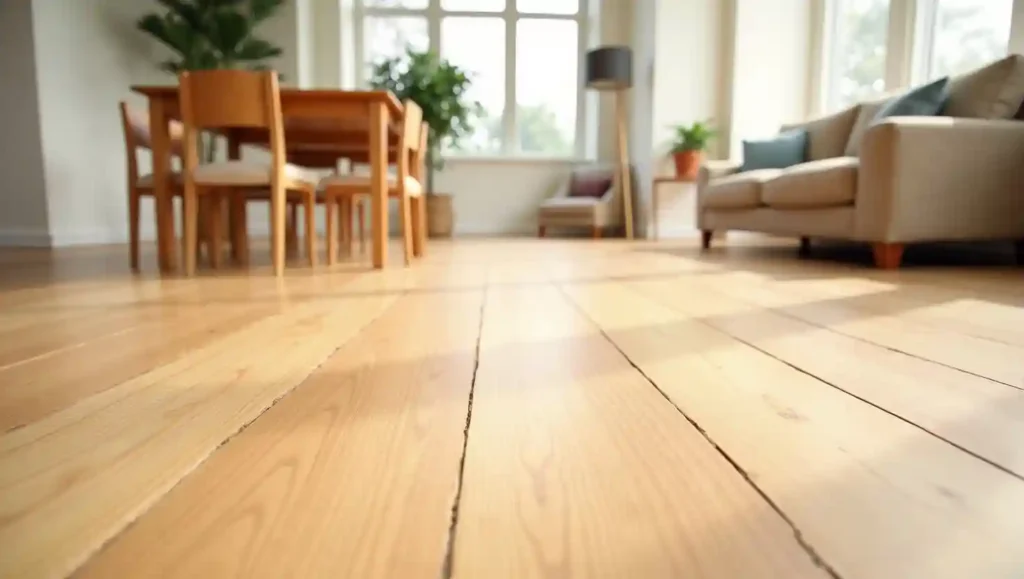
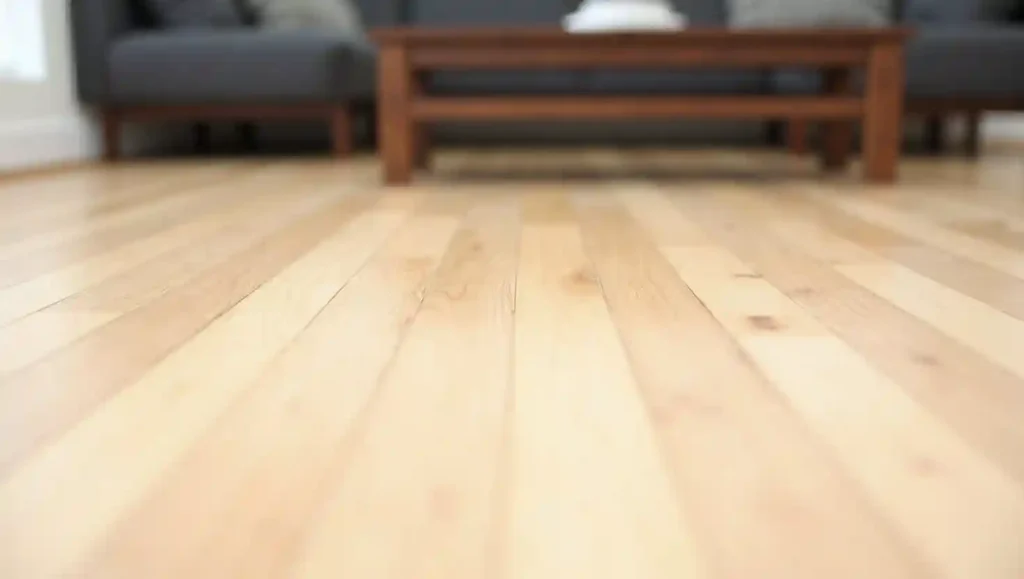
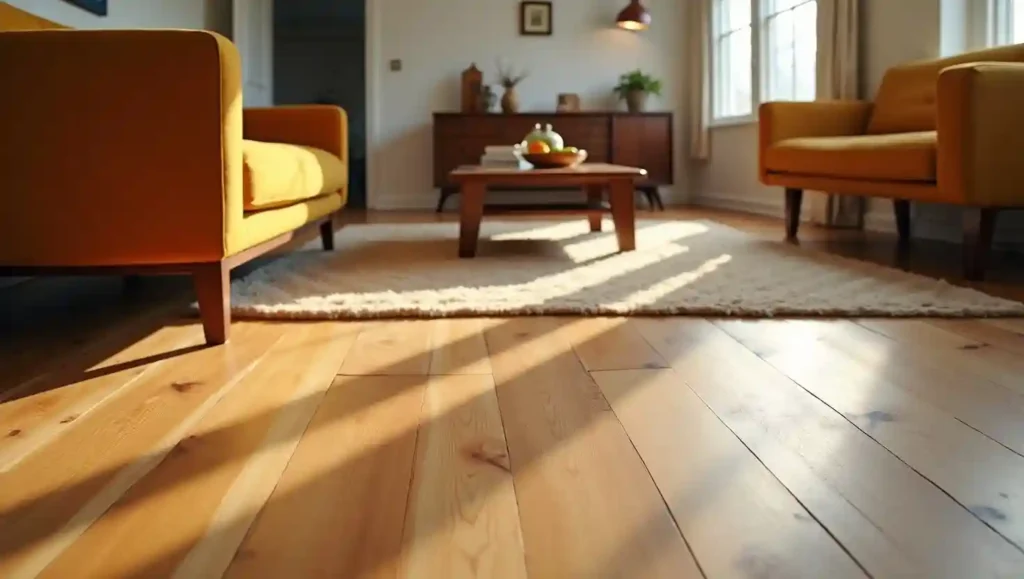
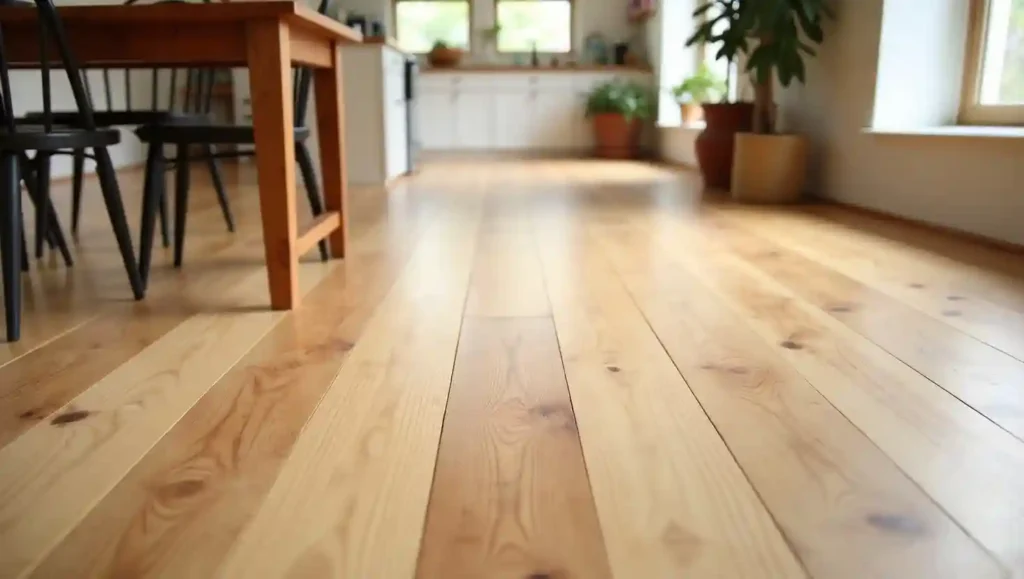
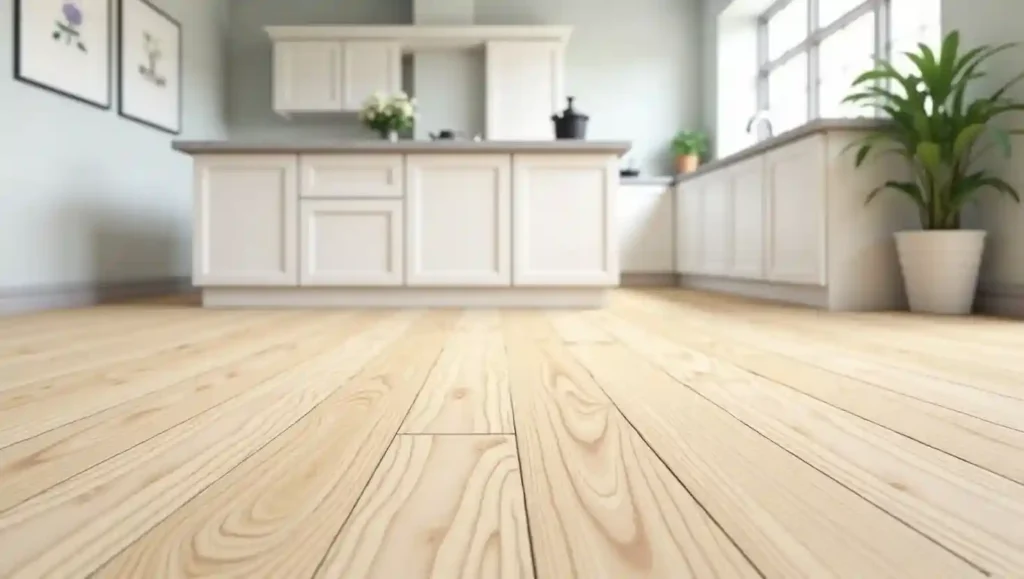
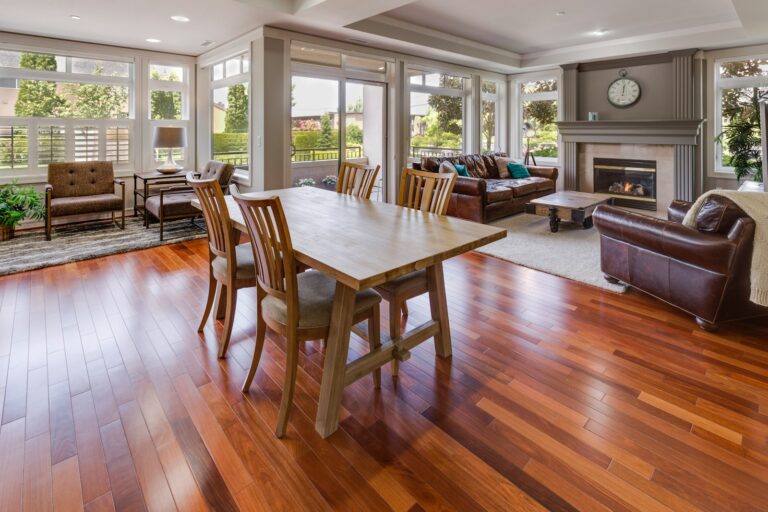
In a large, open-plan room, white oak with a matte finish creates a seamless visual plane that ties together the kitchen, dining, and living zones without any seam or interruption. The floor anchors the space while remaining subordinate to everything else — it does not demand attention, which is precisely what allows your sofa, your pendant lights, and your dining table to do their work. Pair this floor with white or warm greige walls, linen upholstery, and simple oak or walnut furniture legs. The restraint of the floor pays off in how cohesive the entire room feels.
White oak is also one of the most practical choices for this application. With a Janka hardness rating of 1,360, it handles daily foot traffic without excessive denting. It accepts a wide range of stains if you ever want to shift its tone, though most homeowners who choose this species prefer it untouched. It is available in both solid and engineered formats, and if you are working over a concrete subfloor or in a climate with significant humidity swings, engineered white oak will give you the same visual result with better dimensional stability.
For installation in a large open-plan space, consider running the boards parallel to the longest wall or in the direction of the home’s primary natural light source. Both approaches help elongate the space visually. Wide planks — five to seven inches — are especially effective here because they reduce the number of seams, which makes the floor feel more expansive and shows off the grain character of each board. If you are evaluating your subfloor options before installation, understanding which subfloor types are compatible with hardwood will help you plan the right prep work and avoid installation problems down the line.
Idea 2: Blonde Maple Flooring in a Minimalist Bedroom
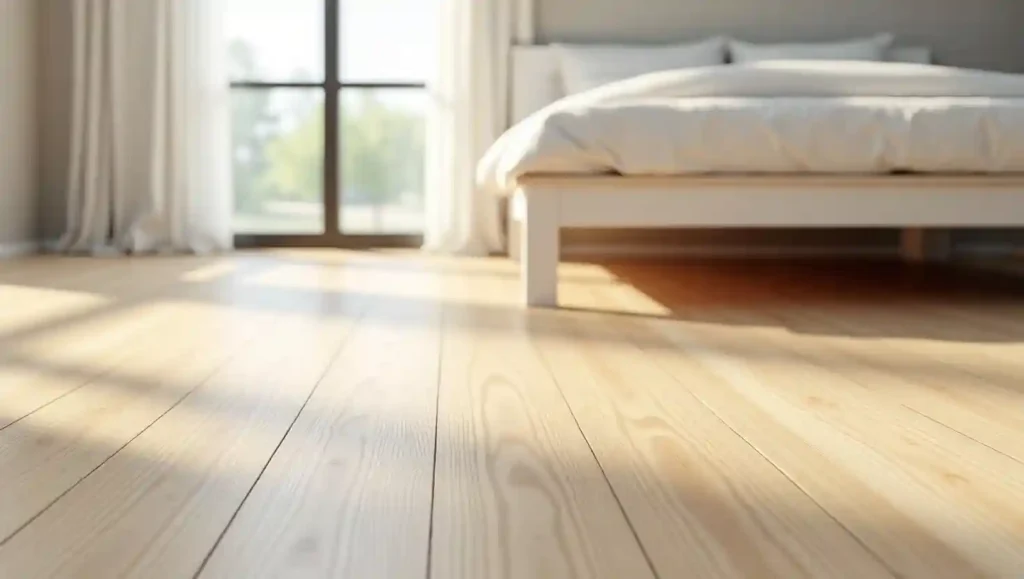
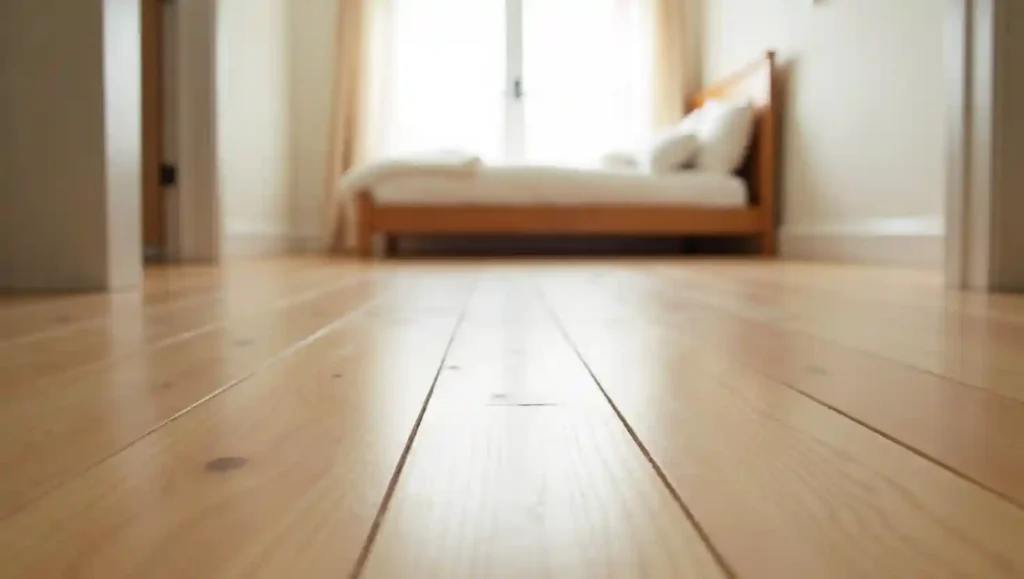
Hard maple is the lightest-toned domestic hardwood species available in North America. Its color sits between creamy white and pale gold, and its grain is so fine and consistent that individual boards look almost uniform from a distance. That uniformity is a feature, not a flaw — it creates a sense of calm and order that is particularly well-suited to bedrooms and other spaces where visual rest matters. If white oak has character and presence, maple is the quieter, more recessive choice.
Maple’s subtlety makes it ideal for minimalist design schemes. In a bedroom with clean architectural lines, low-profile furniture, and a restrained color palette — think muted whites, soft grays, and warm creams — the floor does not draw the eye. Instead, it dissolves into the room’s background and allows the overall atmosphere, rather than any single element, to make the impression. The result feels considered rather than decorated.
One practical advantage worth understanding: maple has a Janka hardness rating of 1,450, which makes it harder than white oak and significantly harder than softer light wood species like pine or birch. In a bedroom this matters less than in a kitchen, but it does mean the floor will resist dents from furniture legs and maintain its appearance for decades without refinishing. Maple also accepts clear coat finishes cleanly, though it can be challenging to stain evenly due to its closed grain structure, which is why most designers use it in its natural state with a water-based matte finish that preserves the pale tone without yellowing.
For a minimalist bedroom, a clean straight-lay installation running toward the main window works well. Plank widths of three and a quarter to four inches suit the scale of a bedroom better than extremely wide planks, which can feel oversized in a smaller room. Keep transitions simple and avoid complex patterns — the floor’s elegance comes from its consistency, not from visual complexity. Adding a natural fiber area rug in jute or undyed wool at the foot of the bed provides texture contrast without disrupting the floor’s tone.
If you are weighing whether solid maple or an engineered alternative makes more sense for your bedroom, a thorough comparison of solid versus engineered hardwood covers the key differences in stability, longevity, and installation requirements that will influence the right choice for your specific room and climate.
Idea 3: Wide-Plank White Oak in a Herringbone Pattern for a Dining Room
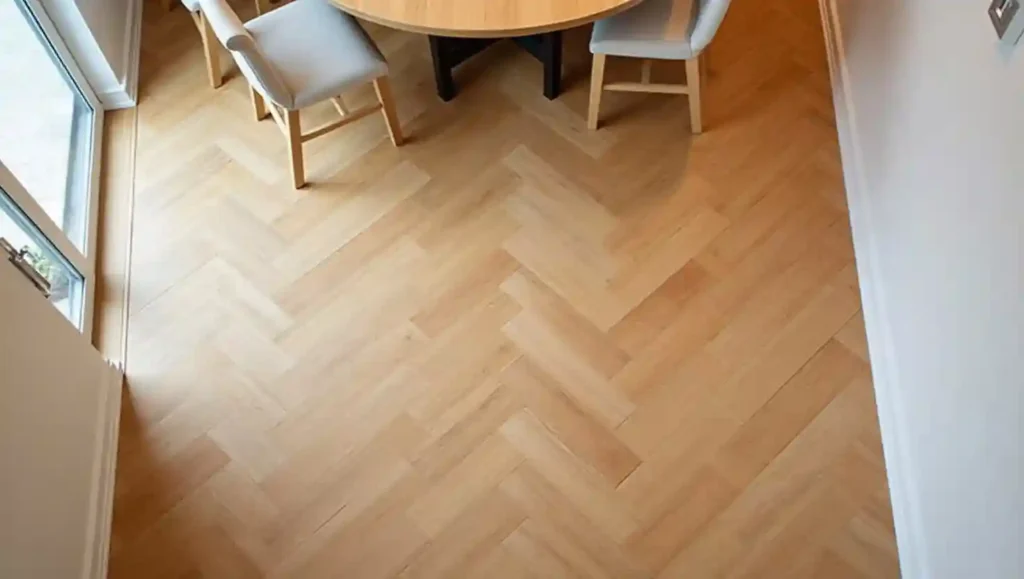
Herringbone is one of the oldest parquet patterns in European floor design, and yet it has never felt more current than it does right now. When executed in a light wood species — particularly white oak in its natural or lightly whitewashed state — herringbone transforms what might otherwise be a straightforward dining room floor into a room-defining architectural element. The pattern creates directional movement across the floor that draws the eye inward and gives the room a sense of formal intention without looking stiff or traditional.
The key to making herringbone feel modern rather than old-fashioned is species and finish selection. A herringbone pattern in dark-stained red oak with a glossy finish reads as traditional, almost Victorian. The same pattern in pale white oak with a matte finish reads as contemporary. The light color opens the pattern up, prevents the geometric complexity from feeling heavy, and keeps the overall room mood airy rather than enclosed. This is a floor that works especially well under a statement dining table and a dramatic pendant light — the pattern underscores the focal point of the room without competing with it.
Wide-plank herringbone — using boards five inches or wider — has a different visual weight than narrow-plank herringbone. Narrower planks create a finer, more intricate pattern that suits smaller rooms and more formal aesthetics. Wider planks produce bolder, more graphic chevrons that work in larger rooms and complement contemporary or transitional interiors. For a standard dining room, boards in the four-to-five-inch range provide excellent visual scale.
Herringbone installation requires more precision than standard straight-lay or diagonal installation. The individual pieces are cut at 45-degree angles and must be aligned with exceptional accuracy to prevent the pattern from drifting. Professional installation is strongly advised. The layout should start from the center of the room and work outward to ensure the pattern is symmetrical within the space. Material waste is typically higher — plan for a ten to fifteen percent overage in your material order. For more herringbone design inspiration, there is a range of ideas covering how this pattern performs across different rooms and style contexts.
Idea 4: Whitewashed Ash Flooring in a Coastal or Beach-Inspired Interior
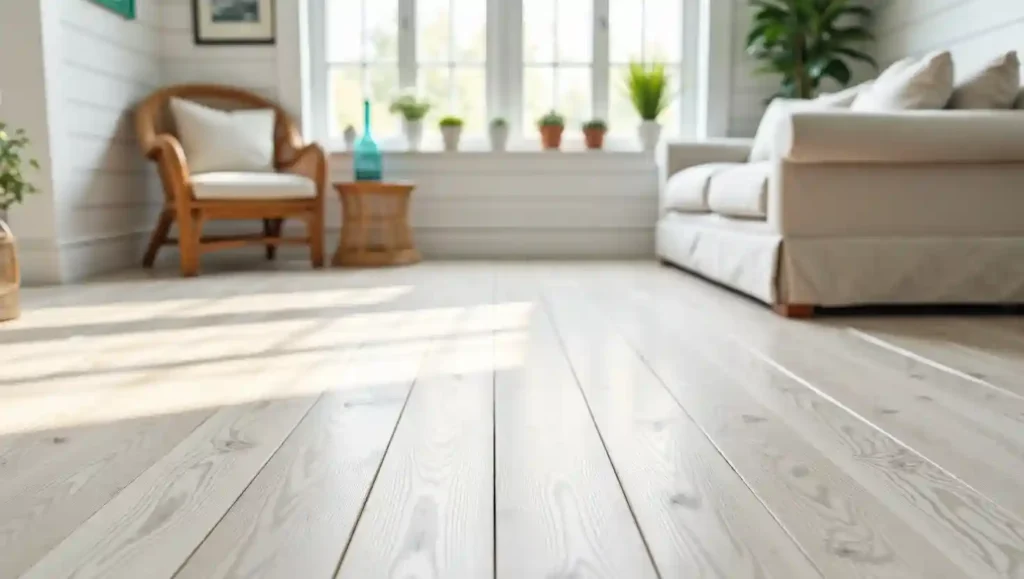
Ash hardwood is underutilized relative to white oak, which is a genuine missed opportunity for homeowners who want a light floor with more grain presence and texture. While white oak has a tight, relatively subtle grain, ash features a bold, open-grain pattern with wide spacing between the growth rings that creates visible linear texture across every board. That texture gives the floor depth and movement, and when ash is lightly whitewashed — treated with a diluted white wash finish that bleaches the surface pigment while allowing the grain to remain visible — the result is a floor that genuinely evokes weathered coastal timber, driftwood, and sun-bleached boardwalks.
This makes whitewashed ash particularly compelling for coastal and beach-inspired interiors: homes near the ocean, vacation properties, California-style residences with indoor-outdoor flow, and any space where the design goal is relaxed, natural, and effortlessly warm. The whitewashing process enhances the contrast between the lighter background of the wood and the darker valleys of the grain, making the floor’s texture more pronounced than it would be with a clear finish. The overall tone sits in a pale off-white to pale gray-beige range that works beautifully with linen upholstery, rattan furniture, sea-glass accents, shiplap walls, and the kind of casual, lived-in aesthetic that coastal interiors do best.
Ash has a Janka rating of 1,320, making it comparable in hardness to white oak and suitable for all high-traffic residential applications. One consideration: ash trees in North America have been significantly affected by the emerald ash borer pest, which has reduced availability in some regions and increased prices. Always source from a supplier who can confirm the origin and sustainability of their ash flooring. Engineered ash flooring, which uses a thin veneer of ash over a stable core, is widely available and provides the same visual character with better resistance to moisture-related expansion and contraction.
In a coastal home, run the boards parallel to the main views of the water or garden to reinforce the sense of visual connection between indoors and outdoors. Pair with white tongue-and-groove wall paneling, natural fiber rugs in jute or sisal, and furniture in bleached teak or whitewashed oak for a cohesive look. If you are planning this type of installation in a home that also has an outdoor deck or patio, understanding how different flooring materials handle UV exposure and humidity will influence both your species choice and your finish selection.
Idea 5: Light Oak Flooring Paired with Dark Furniture for High-Contrast Drama
One of the most compelling design moves you can make with light hardwood flooring is to deliberately contrast it against dark, heavy furniture. This is a technique borrowed from Scandinavian and Japanese design traditions, where the interplay between a pale, grounded floor and richly toned furniture creates a sense of visual tension that feels both sophisticated and alive. The floor does not fade into the background in this scenario — it becomes an active part of the composition, its lightness made more apparent by the darkness it supports.
The floor itself should be kept simple for this idea to work. Natural or lightly finished white oak in a straight-lay pattern with relatively narrow planks — three and a quarter to four inches — provides a disciplined, neutral base that allows the furniture to read clearly. The grain should be visible but subtle. A matte finish is essential here: a glossy floor would compete with the furniture for attention and create distracting reflections. The lighter the floor within the light-wood range, the more dramatic the contrast becomes — very pale, almost blonde-white oak against an ebony or dark walnut dining table creates an extraordinary visual effect that photographs exceptionally well and feels luxurious in person.
This pairing works in virtually every room type. In a living room, a pale oak floor under a deep charcoal sectional and a black walnut coffee table creates a layered, editorial look. In a bedroom, creamy maple floors under a dark-stained bed frame and ebony nightstands give the room a hotel-like polish. In a dining room, light ash under a matte-black metal table and black oak chairs makes a modern, industrial-influenced statement. The floor reads as the light anchor in every case, and the room feels balanced rather than visually heavy because the darkness is concentrated at furniture height, not throughout the room.
There is also a practical benefit to this approach: light hardwood shows dust and debris more readily than dark wood, but the high-contrast furniture means that any dust settling on the floor will be obvious against both surfaces, motivating more consistent cleaning habits. This is something to weigh when deciding whether the aesthetic is right for your lifestyle. If you want the look without the cleaning demands, a proper deep-cleaning routine for hardwood floors makes maintenance far more manageable regardless of the floor color you choose.
Idea 6: Pale Birch Flooring for a Warm Mid-Century Modern Look
Birch hardwood occupies a slightly different tonal space than white oak or maple. Its natural color is a warm honey-blonde with occasional amber and peach undertones, and its grain is fine and gently wavy, with subtle mineral streaks that appear as pale linear marks running across the boards. It reads warmer than maple and softer than oak, which makes it particularly well-suited to mid-century modern interiors — the design vocabulary of the 1950s and 1960s that emphasized organic forms, honest materials, functional beauty, and the integration of interior and exterior.
In a mid-century modern context, birch floors serve as the warm, grounded base for the classic design elements of that era: tapered wooden furniture legs, low-profile sofas in mustard or terracotta, ceramic pendant lights, patterned wool area rugs, and houseplants with broad leaves. The floor’s warm undertones reinforce the era’s palette without looking retro or costume-like. The subtlety of birch grain means the floor never overwhelms these design elements — it supports them. Modern reproductions of mid-century furniture, which are widely available and very popular right now, look exceptional against birch floors precisely because both share that warm, honest-material quality.
Yellow birch has a Janka hardness of 1,260, which places it slightly below white oak and maple but still solidly within the range suitable for all residential applications, including living rooms with significant foot traffic. One consideration with birch: it is more sensitive to moisture than denser hardwoods, and it can show expansion and contraction more noticeably in climates with dramatic seasonal humidity swings. In regions like San Diego where the climate is relatively stable and dry, this is less of a concern, but it is worth discussing with your installer if you are in a more variable climate. Engineered birch resolves this issue entirely.
Pair birch floors with warm white walls rather than cool white — a color in the creamy or linen range rather than pure white — to reinforce the warm character of the wood. Avoid cool grays and stark blacks, which clash with birch’s yellow undertones. Mid-century modern spaces benefit from lower furniture profiles, so the floor is always well-lit and visible, which makes the warmth of birch especially effective in these interiors. You can also explore how using area rugs on hardwood floors can add the layered, tactile quality that mid-century interiors are famous for without covering the floor entirely.
Idea 7: Light Pine Flooring in a Farmhouse or Rustic Interior
Pine is one of the oldest flooring materials in North American domestic architecture, and in the right context, it is one of the most beautiful. Unlike oak, ash, or maple, pine is a softwood, which means it dents and scuffs more readily. But that perceived weakness is, in a farmhouse or rustic interior, actually its greatest asset. Pine develops a patina over time that no harder wood can replicate. Every dent from a moved chair, every scratch from a dog’s claws, every subtle darkening where the sun hits the floor each morning — these marks accumulate into a record of the home’s life that gives old pine floors their extraordinary character.
New pine flooring, before it develops that patina, starts in a pale yellow to straw-gold range with a soft, open grain and occasional distinctive knots that add visual rhythm across the floor. The knots are part of the appeal in a farmhouse interior — they reinforce the natural, unpretentious quality of the material and connect the floor to its origin in the forest in a way that more refined hardwood species do not. Wide pine planks, traditionally twelve to fourteen inches or wider, are historically accurate and create a dramatic sense of openness in farmhouse-style great rooms, kitchens, and hallways.
For a modern farmhouse application — the design vocabulary that blends traditional agricultural American aesthetics with contemporary comfort and restraint — new pine in a clear matte oil finish is the right starting point. The oil protects the wood without sealing it in a way that prevents the patina from forming. Avoid polyurethane on pine if you want the floor to age naturally. White-painted shiplap walls, exposed ceiling beams, simple shaker cabinetry, and iron hardware all complement pine floors extraordinarily well, reinforcing the honest, handcrafted character that defines this style. For those considering installing pine flooring over a concrete slab, there are specific moisture management and installation method considerations that differ from a wood subfloor installation.
Idea 8: Engineered Light Hardwood Over Radiant Heat in a Kitchen
Kitchens and hardwood floors used to be an uneasy pairing. The combination of water, spills, humidity from cooking, and the thermal cycling of underfloor heating systems created conditions that solid hardwood handled poorly — expanding, contracting, cupping, and gapping in ways that made the floor look terrible within a few years. Engineered hardwood, which bonds a real-wood veneer of two to six millimeters over a cross-ply plywood or HDF core, changes that equation entirely. The core construction resists seasonal movement far more effectively than solid wood while the surface veneer provides the same visual experience.
Light hardwood species — white oak, ash, and maple in particular — are especially compelling in kitchens because of how they interact with kitchen lighting. Kitchen lighting is typically brighter and more multidirectional than living room lighting, and light hardwood surfaces pick up and distribute that light around the room in a way that darker floors cannot. A light oak kitchen floor paired with white or cream cabinetry creates an extraordinarily bright, welcoming space that feels clean and expansive. The floor reflects ambient light upward, which reduces the harsh shadows that can make a kitchen feel like a workspace rather than the warm center of the home it typically is.
For kitchens with radiant floor heating — an increasingly popular installation that provides even, comfortable warmth and eliminates cold floor surfaces — engineered light hardwood is the correct choice. The heating system causes the floor temperature to cycle over the course of each day, and solid wood cannot tolerate those temperature and humidity changes without moving excessively. A five-millimeter-veneer engineered white oak over a stable core handles this cycling without issue. The floor should be floated over the heating system rather than glued down to allow for any residual movement. The finish should be an oil or hard-wax oil rather than a thick surface polyurethane, as these penetrating finishes perform better under thermal cycling.
In a kitchen, the practical pairing for light hardwood is consistent: white or cream shaker cabinets, stone or quartz countertops in light gray or warm white, and subway tile backsplash in white or pale sage. This combination feels current, timeless, and exceptionally livable. For understanding the full range of considerations when pairing hardwood with heat systems, the relationship between hardwood flooring and underfloor heating covers everything from species selection to installation method, finish choice, and temperature control settings that protect the floor’s longevity.
Idea 9: Gray-Washed Light Hardwood for a Contemporary Urban Apartment
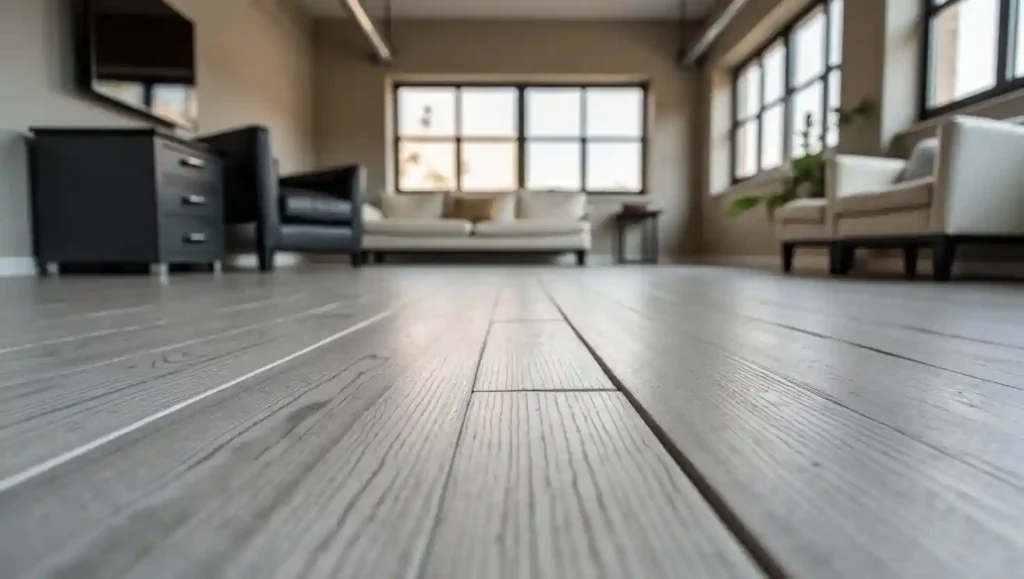
The gray-toned light hardwood floor occupies a specific and very useful tonal position: it is light enough to reflect and distribute light effectively, but its gray undertones prevent it from reading as warm or traditional. This makes it the ideal floor for contemporary urban interiors — apartments and condominiums with clean architectural lines, high ceilings, industrial material accents, and design sensibilities that lean toward the modern rather than the rustic. Where natural white oak feels warm and organic, gray-washed oak feels cool, sophisticated, and intentionally contemporary.
Gray-washing is typically achieved through a light whitewash or gray stain applied over white oak, ash, or maple before sealing. The result should be subtle: the goal is a cool-toned floor that still reads as wood rather than concrete. A heavy gray wash obscures the grain entirely and creates a floor that looks painted rather than stained. The best gray-washed floors maintain visible grain texture through the finish — the gray sits in the valleys of the grain while the ridges retain more of the wood’s natural tone, creating depth and visual interest that a uniform gray surface coat would eliminate.
In a contemporary urban apartment, this floor pairs naturally with concrete, glass, and matte metal — the industrial material palette that defines urban loft aesthetics. Polished concrete ceilings with exposed ductwork, oversized floor-to-ceiling windows, floating shelving in black steel, and furniture in charcoal, cream, or warm terracotta all look exceptional against a gray-washed hardwood floor. The floor’s gray tone is cool enough to harmonize with the industrial elements while its wood grain provides enough warmth and texture to prevent the space from feeling cold or clinical.
One important technical note: gray stains and washes on hardwood floors can fade unevenly over time, particularly in areas of high UV exposure. In apartments with large south- or west-facing windows, UV exposure can cause the gray tone to shift toward yellow or green as it breaks down certain pigments in the stain. A UV-stabilized finish coat helps mitigate this. If you are looking at a floor in a room with significant sunlight, understanding how to protect the floor’s finish from fading over time is worthwhile before committing to a color-treated floor.
For open-plan apartments, running the gray-washed boards throughout all rooms without transition strips creates the seamless flow that contemporary interiors depend on. Even a single transition strip can interrupt the visual continuity that makes an open-plan space feel unified. Consider how light hardwood performs across open-plan layouts in different design scenarios — the same floor reads differently depending on how the spaces around it are handled.
Idea 10: Light Hardwood on Stairs — Creating Visual Flow Through Multiple Levels
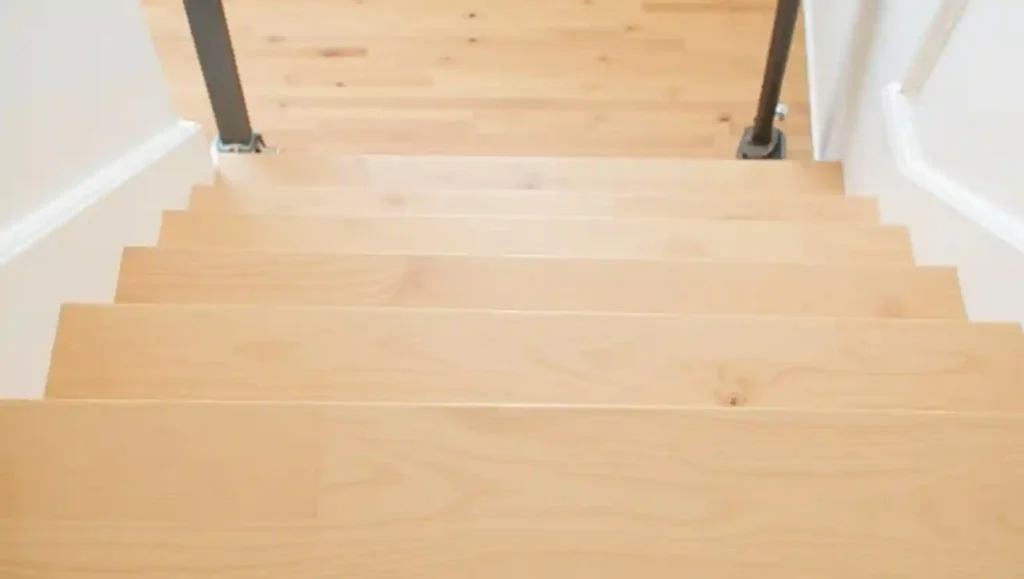
One of the most impactful and underutilized applications for light hardwood flooring is the staircase. Homes with light hardwood on the main floor often have carpet-covered stairs, and while carpet on stairs is practical, the transition between hardwood and carpet disrupts the visual flow between levels in a way that makes the home feel less cohesive. Matching the stair treads to the main floor hardwood species, color, and finish — or at minimum, selecting a complementary light hardwood — resolves that visual interruption and creates a sense of architectural continuity that elevates the entire home’s interior design.
Light hardwood on stairs does several things simultaneously. It reflects light upward from the treads, which brightens the stairwell and landing areas that are often the darkest parts of a home. It creates a visual pathway that draws the eye upward and makes the transition between levels feel deliberate rather than incidental. And in homes with open railings or glass balustrades, the pale wood treads become part of the home’s visual composition when seen from both above and below — a design element rather than purely a functional surface.
The practical requirements for stair hardwood differ from floor hardwood. Stair treads are horizontal, weight-bearing surfaces that experience concentrated, repetitive impact on the front edge with every footstep. Nosing — the rounded or beveled front edge of each tread — is both a safety feature and a wear point. Light hardwood treads for stairs should have a bullnose or capped nosing profile rather than a sharp edge, and the species should be at least as hard as white oak. Very soft woods like pine are beautiful on flat floors but wear poorly on stairs. White oak, ash, and maple are all excellent choices for treads.
Finish selection on stairs matters more than on flat floors. Matte oil finishes, while ideal for flat hardwood, wear faster on the nosing of stair treads due to concentrated abrasion. A hard-wax oil or a two-component polyurethane applied in a satin rather than high-gloss sheen provides better durability at the nosing while still maintaining a relatively natural appearance. The detail of how flooring is installed on stairs illustrates the precision required to achieve a clean, professional result — the methodology applies equally to hardwood stair installations and is worth reviewing before planning this type of project.
Idea 11: Light Hardwood Throughout Small Rooms — Making Every Square Foot Count
Small rooms are where the decision to use light hardwood flooring has the most visible and dramatic impact. The physics of how light-colored surfaces reflect light — both natural and artificial — are straightforward: a pale floor bounces light back upward into the room, making the ceiling feel higher and the space feel larger than it actually is. A dark floor absorbs that light and makes the ceiling feel lower and the room feel smaller. In rooms below two hundred square feet, the difference between a light floor and a dark floor can be perceptible enough to influence how much time occupants are comfortable spending in the space.
For small bedrooms, home offices, hallways, and bathrooms with wood-compatible installations, light hardwood flooring in a consistent, uninterrupted run — without transitions or changes in direction — maximizes this spatial-expansion effect. The key is to eliminate anything that visually interrupts the floor plane. Transition strips between rooms should be minimized or eliminated where possible. The floor should run in the same direction throughout, ideally parallel to the longest dimension of the space, which visually elongates the room. In a small bedroom, this means running the boards from the door toward the window — a layout that draws the eye forward and makes the room feel deeper than it is.
Species and plank width both matter in small spaces. For rooms under one hundred fifty square feet, narrower planks — three to four inches — create appropriate visual scale. Very wide planks in a small room can look proportionally awkward, with each board taking up too large a percentage of the floor’s total area. Maple and white oak are both excellent choices for small rooms: maple’s uniformity creates a clean, uninterrupted visual plane that maximizes the perceived space, while white oak’s subtle grain adds just enough texture to prevent the floor from looking flat under low ceilings.
Keep wall colors light and reflective to work with the floor rather than against it. A small room with a pale hardwood floor and cool white walls will feel dramatically more spacious than the same room with a pale floor and saturated wall color, which draws attention to the room’s boundaries. Minimizing furniture and keeping it low-profile protects the floor’s visual influence on the space. For small rooms that receive limited natural light, understanding how hardwood flooring choices interact with artificial lighting is as important as the color selection itself. Whether you are assessing flooring costs for a smaller project or planning a more comprehensive renovation, the hardwood flooring cost guide provides the pricing framework to budget appropriately for the species, format, and installation method that will best serve your space.
What Makes Light Hardwood Flooring Work Across All These Ideas
Looking across all eleven ideas, a few consistent principles emerge about why light hardwood flooring performs so well across such a wide range of design contexts.
The first is light behavior. Light floors are active participants in how a room manages its light — natural and artificial. They amplify light sources by reflecting rather than absorbing, which is why light hardwood floors look better photographed and in person than dark floors in most residential environments. This makes them particularly strong on Pinterest and in editorial photography, where the visual brightness of a space is as important as its design content.
The second is neutrality. Light hardwood floors in the natural, unfinished, or lightly finished range sit in a tonal zone that does not compete with other design decisions. They accommodate cool wall colors, warm wall colors, dark furniture, and light furniture without creating the tonal conflicts that a more strongly colored floor — dark walnut, heavily stained oak, or saturated cherry — would introduce. This neutrality means the floor is a long-term investment that survives style changes rather than locking you into a specific design moment.
The third is refinishability. Most solid light hardwood floors can be sanded and refinished multiple times over their lifetime. This means that if the floor develops significant wear, or if your design preferences shift, you can have the floor sanded back to bare wood and refinished in a new color, tone, or sheen without replacing the boards. This dramatically extends the value of the initial investment and makes hardwood one of the few flooring types that genuinely appreciates in value rather than depreciating. Understanding how to refinish hardwood floors gives you a full picture of what this process involves, how long it takes, and what to expect from a professional refinishing project.
The fourth is the species decision. Not all light hardwood floors are interchangeable. White oak’s warmth and ray flecking, maple’s clean uniformity, ash’s bold grain, birch’s peachy warmth, and pine’s knot-rich character all create meaningfully different visual results that suit different design styles. Choosing the right species for your specific interior context — rather than choosing simply based on price or availability — is the single most important design decision you will make in a light hardwood floor project. Understanding the different types of hardwood flooring available, from species to format to grade, ensures you are making that decision with the full picture in front of you.
Light hardwood flooring is not a trend. It has been the dominant aesthetic choice in residential interiors for long enough that it has transcended trend status and become a genuine design standard — one that is likely to remain relevant for the foreseeable future. The variety within it, from the nearly white maple bedroom floor to the bold whitewashed ash coastal installation, means there is a version of this idea that is exactly right for your home. The eleven ideas in this guide are starting points for that conversation.
James Miller is a seasoned flooring contractor with years of hands-on experience transforming homes and businesses with high-quality flooring solutions. As the owner of Flooring Contractors San Diego, James specializes in everything from hardwood and laminate to carpet and vinyl installations. Known for his craftsmanship and attention to detail, he takes pride in helping clients choose the right flooring that balances beauty, durability, and budget. When he’s not on the job, James enjoys sharing his expertise through articles and guides that make flooring projects easier for homeowners.
Your dog just skidded across the hallway and left a fresh trail of muddy paw prints. Your cat has been using the corner of the living room floor as a scratching post. Sound familiar? If you share your home with pets, you already know that not every floor is built to survive them. The good…
The bedroom is not a hallway. It is not a kitchen. It is the one space in your home where you wake up barefoot every single morning, where your feet make first contact with the floor before your brain fully loads. That specific use case changes everything about how you should evaluate carpet — and…
Small spaces come with big design challenges, and the floor beneath your feet plays a surprisingly powerful role in how large or cramped a room feels. The good news? Laminate flooring is one of the smartest, most budget-friendly tools you have for visually expanding a compact room. With the right color, plank direction, and pattern,…
Can You Use Vinyl for Gym Flooring? The Honest Answer Depends on Which Gym Zone You’re Talking About Vinyl flooring works in a gym. But that answer is only useful if you understand what “works” actually means in a gym context — because a cardio studio, a free-weight floor, and an Olympic lifting platform have…
Yes, vinyl flooring can be installed over existing tile in most situations — but whether it should be depends entirely on the condition of the tile underneath, the type of vinyl you are using, and how much floor height gain your doorways, baseboards, and transitions can tolerate. The answer is not a blanket yes or…
Most flooring failures in basements do not start with the flooring. They start with what is underneath it, and with the assumption that because something is labeled waterproof, the work is already done. Vinyl flooring is genuinely the most capable category for below-grade installations. That part is true. But the difference between a basement floor…