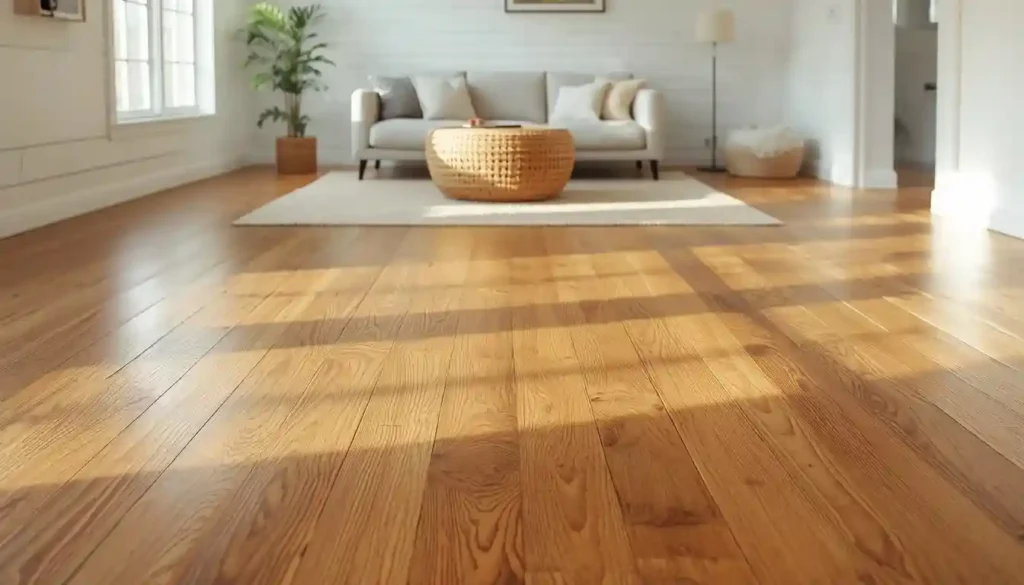
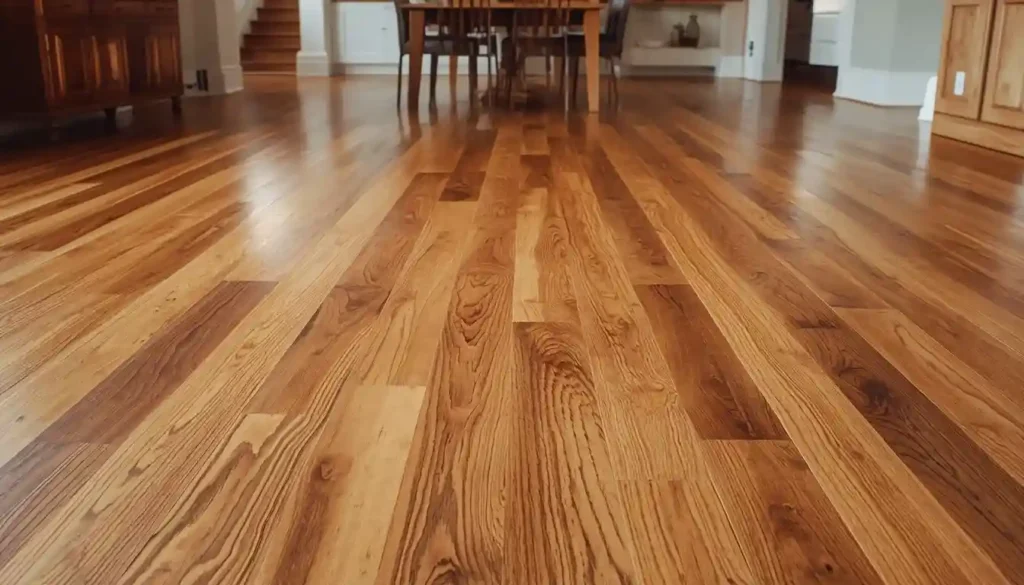
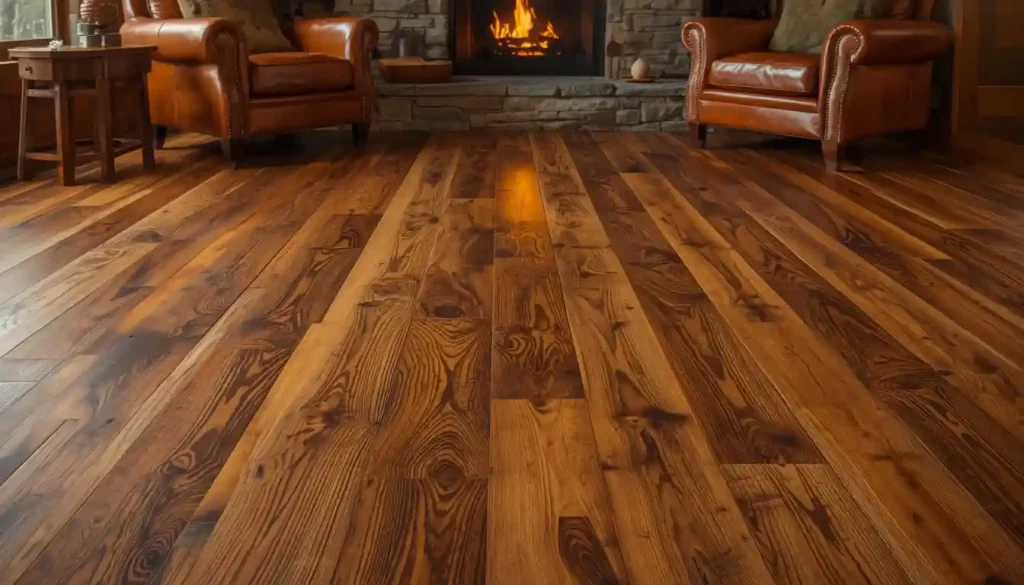
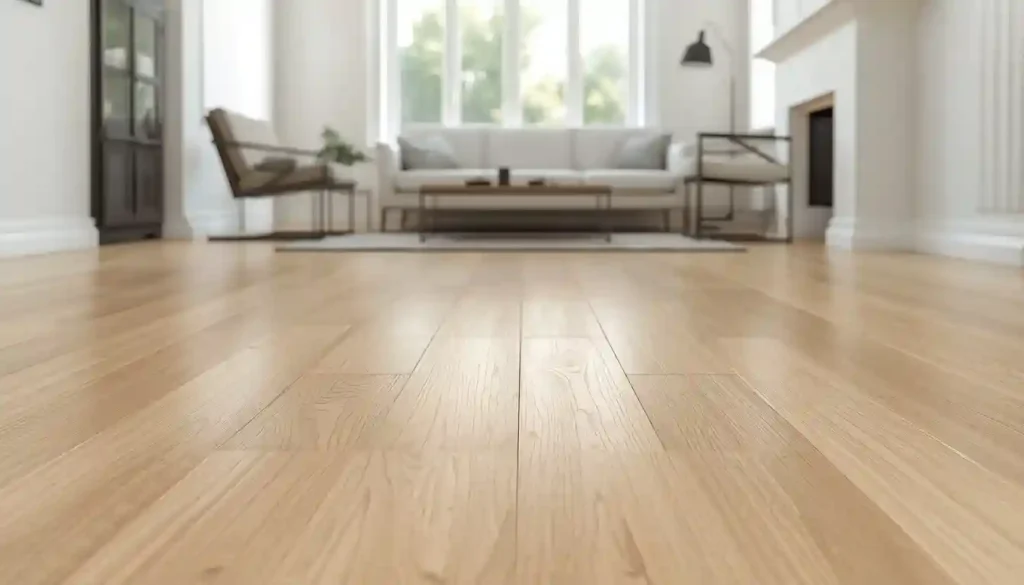
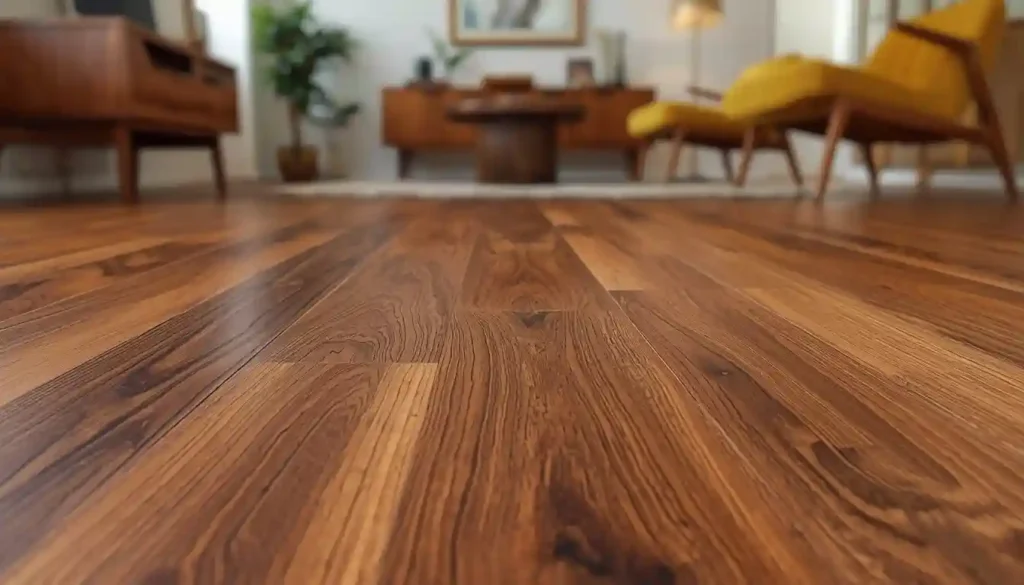
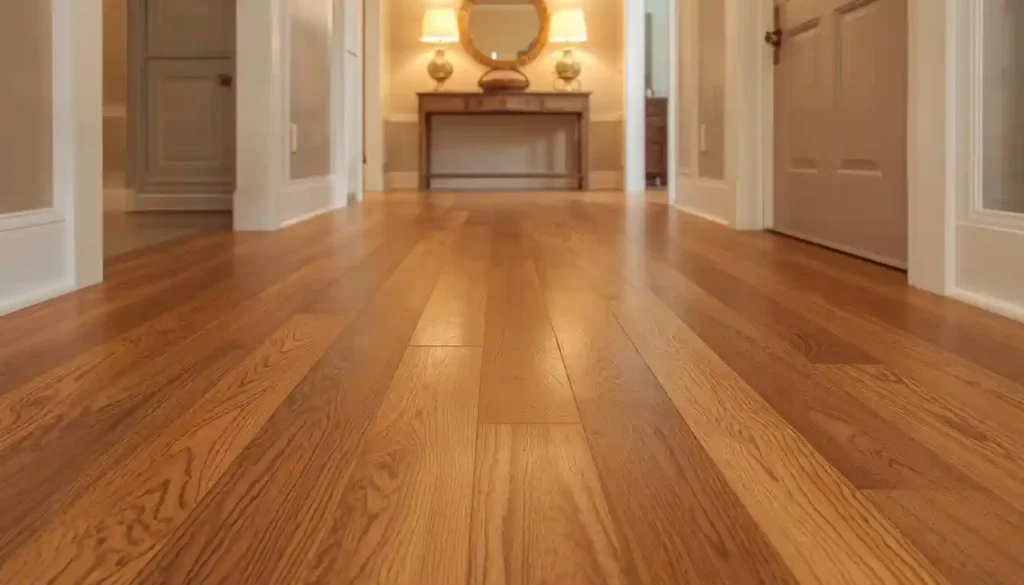
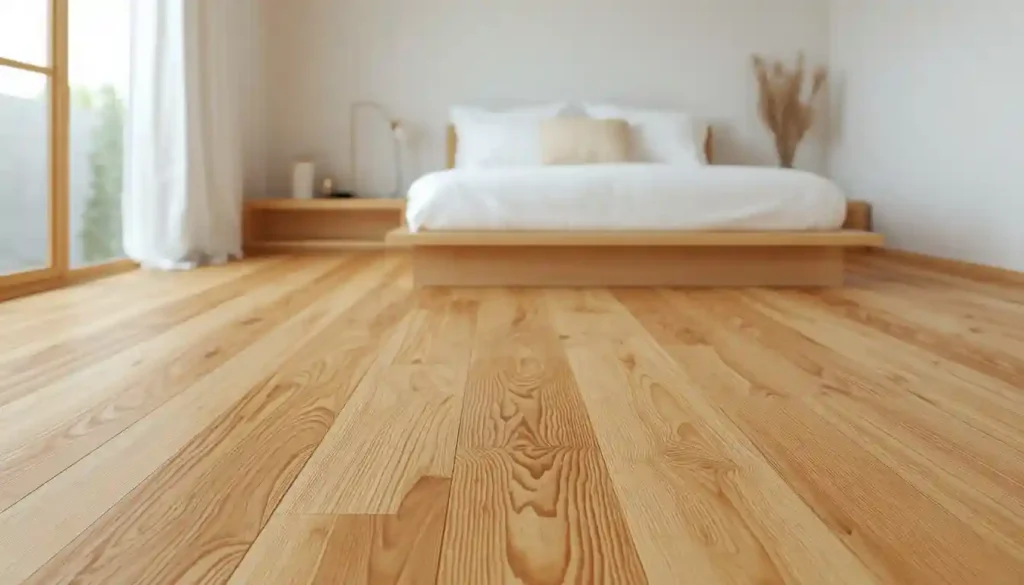
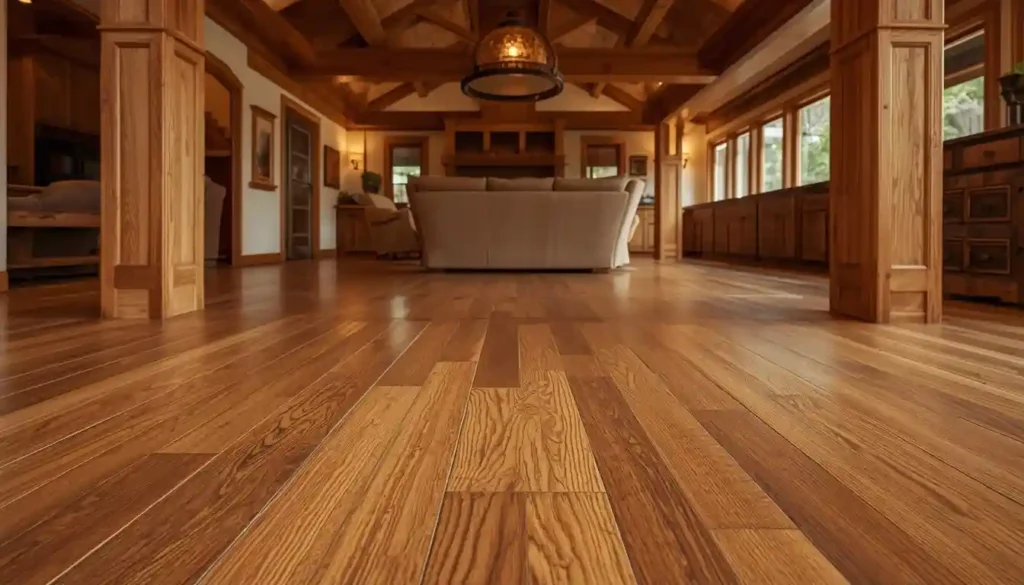
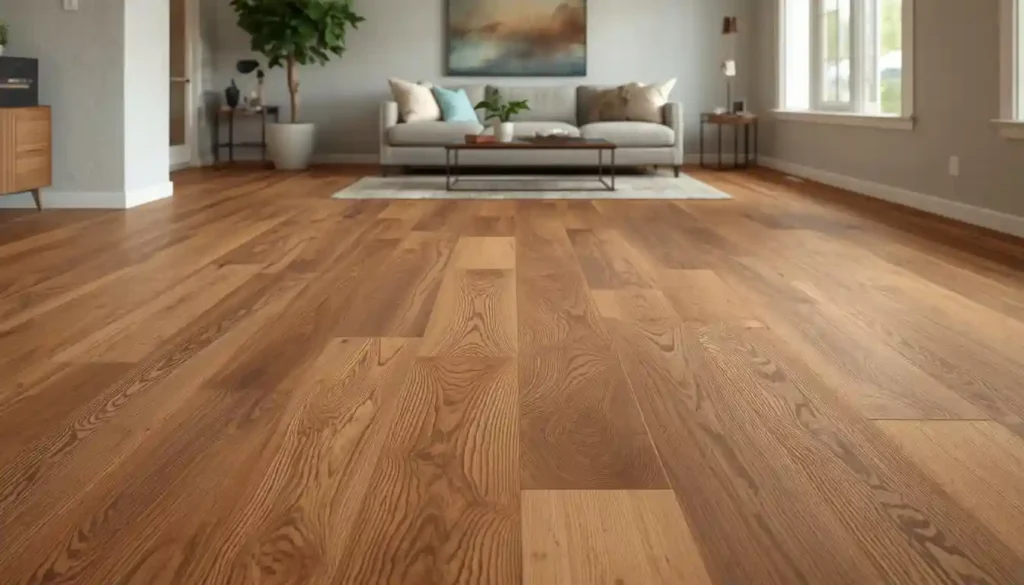
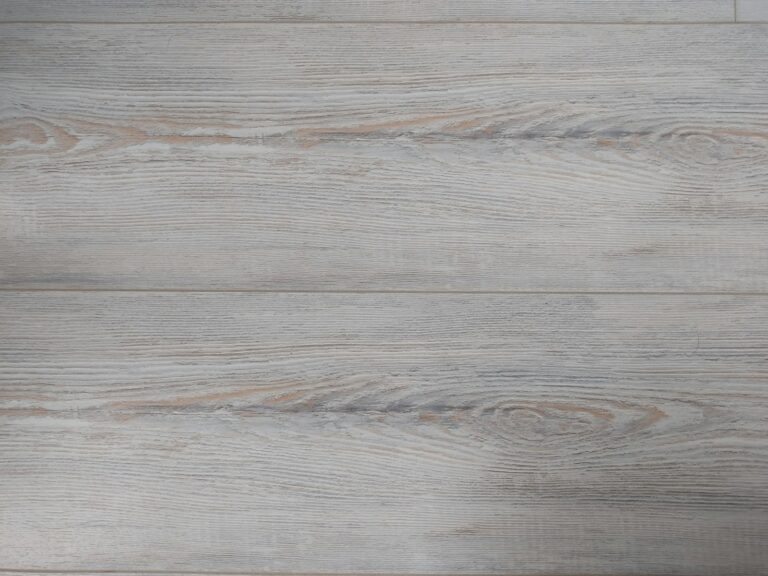
For the wood species, white oak with a honey stain is the most flexible choice because its grain pattern is tight and consistent, which prevents the floor from looking busy. Red oak with a natural finish is an alternative with more visible figure, which some homeowners find more characterful. Both hold up well in high-traffic living rooms when finished with a hardwearing matte or satin topcoat.
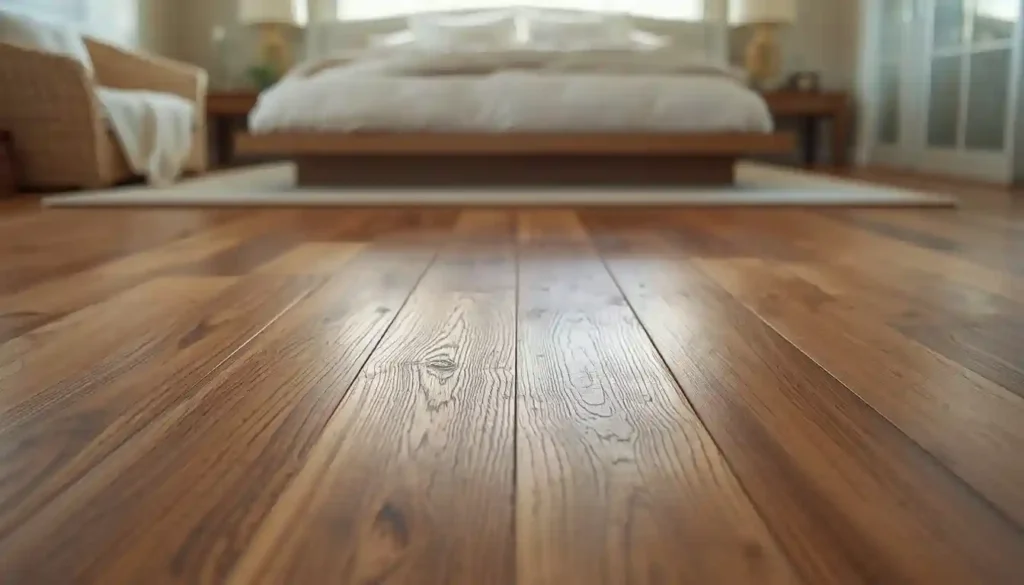
Bedrooms are arguably the room where warm flooring matters most. You step onto these floors first thing in the morning and last thing at night, and the psychological effect of cool versus warm underfoot is real. Amber walnut — a medium-dark walnut with pronounced amber and orange undertones — turns a bedroom into a sanctuary without requiring heavy textiles or complicated layering.
Wide planks, specifically anything from five inches up, are the right format for this application. Wider planks showcase the natural figure of walnut more generously: the swirling grain patterns, the variation from heartwood to sapwood, the subtle color shifts across individual boards. This variation is what gives warm walnut floors their organic, breathing quality that perfectly finished floors lack.
Pair amber walnut with warm white or soft cream walls, natural linen bedding, and iron or brushed bronze light fixtures. The red undertones in the walnut tie naturally into terracotta or dusty rose accents in throw pillows or artwork. Avoid using heavily patterned rugs over this kind of floor — the grain pattern in wide-plank walnut is already a visual feature worth letting show. A simple, solid-colored area rug placed at the foot of the bed is enough to define the sleeping zone without covering the star of the show.
3. Caramel Oak in a Farmhouse Kitchen
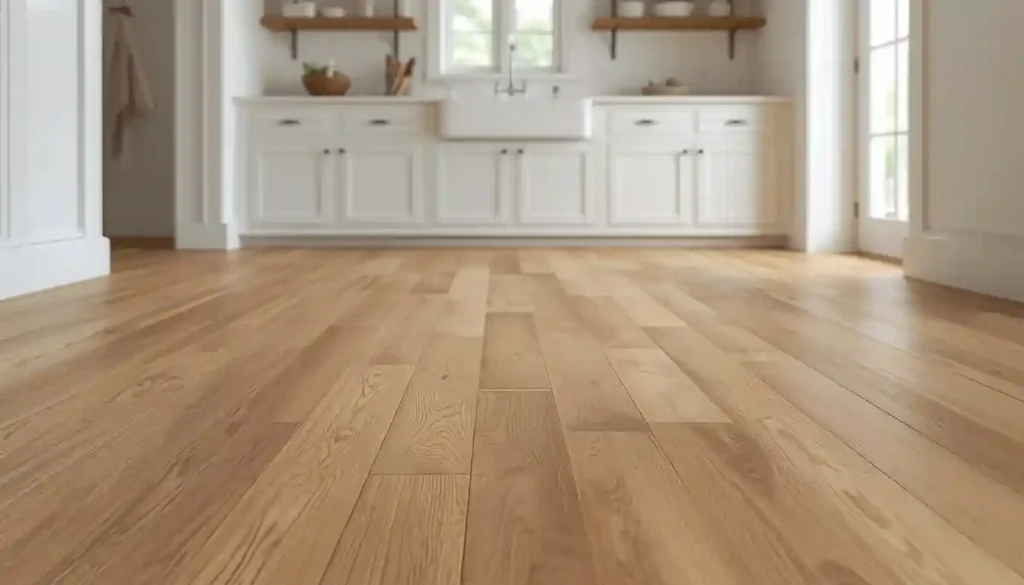
Kitchens and hardwood have a complicated relationship. Moisture, dropped utensils, chair scraping, pet traffic — the arguments against wood in a kitchen are practical and legitimate. But nothing creates the lived-in warmth of a farmhouse kitchen quite like caramel-toned hardwood underfoot. The key is choosing the right species and finish, then pairing the floor with a design scheme that acknowledges the floor’s working nature and lets it breathe.
Caramel oak — a medium tone sitting between light honey and deep amber — pairs beautifully with white shaker cabinets and either warm-toned or deep green countertops. The caramel floor prevents the white cabinetry from reading as sterile or cold, adding the color balance that keeps a white kitchen looking like a home rather than a showroom. Against deep green or navy cabinetry, caramel oak creates a jewel-box warmth that feels intentional and designed.
White oak with a mid-range caramel stain is the most practical species choice for kitchens because its grain is tighter and its Janka hardness rating is higher than softer species. A satin or semi-matte finish hides scuffs and surface marks better than a high-gloss coat while still giving the floor some sheen under kitchen task lighting. Engineered hardwood is worth serious consideration here, particularly if the kitchen sits over a concrete subfloor, since solid hardwood can be more reactive to the moisture fluctuations kitchens experience.
4. Rich Chestnut in a Traditional Dining Room
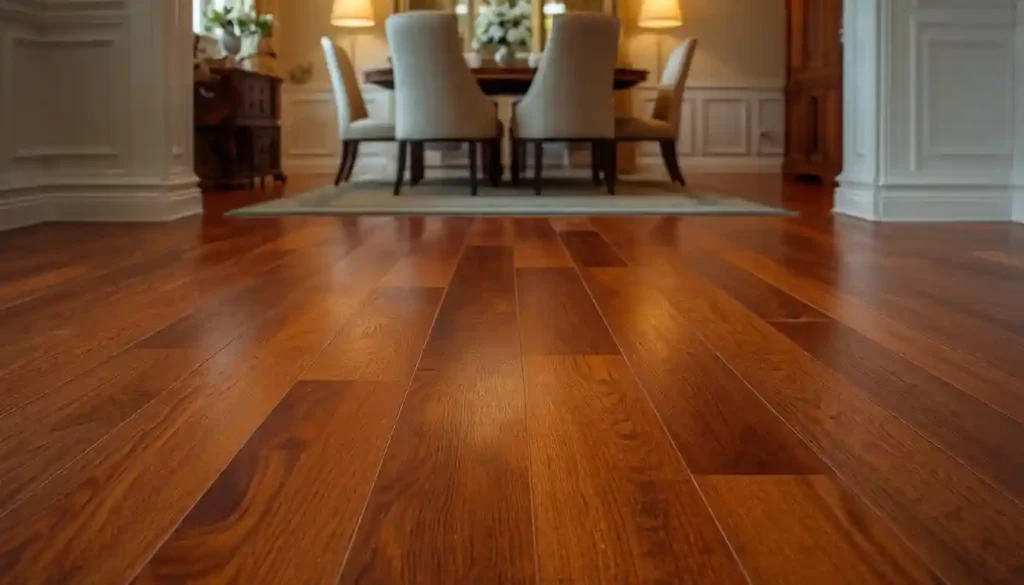
Chestnut tones occupy a specific emotional register that no other wood tone quite hits: they are warm without being orange, deep without being dark, and unmistakably connected to traditional craftsmanship. In a dining room — a space that functions as the stage for meals, conversations, celebrations, and ordinary Tuesday evenings — chestnut hardwood establishes a sense of occasion without requiring formality.
A traditional dining room with chestnut floors benefits from a design approach that leans into the warmth rather than fighting it. Cream or warm white walls with subtle architectural detail — crown molding, picture rail, wainscoting — frame the chestnut floor without competing with it. Furniture in darker-toned walnut or mahogany creates a tonal conversation with the floor. Upholstered dining chairs in velvet, leather, or linen in warm neutrals complete the picture.
The grain pattern in chestnut-stained oak or actual American chestnut (now rarely available as solid hardwood but stunning when sourced from reclaimed suppliers) has enough visual movement to anchor a large dining room without area rugs. Under the warm glow of a statement chandelier or pendant light, a chestnut floor in a dining room absorbs and radiates light in a way that elevates every meal served on its surface.
If you are exploring how different hardwood species compare in terms of grain character and tone depth, the overview of hardwood flooring types and species is a useful starting point for narrowing down your options before committing to a specific wood and stain combination.
5. Cognac-Stained White Oak in an Open-Plan Space
Open-plan living areas have a design challenge that room-by-room layouts do not: the floor must work across multiple functional zones simultaneously. It needs to anchor a kitchen, define a dining area, and tie together a living space, all without visual interruption. Cognac-stained white oak is one of the most successful solutions to this challenge because its medium-depth warmth reads as neither too light nor too dark at scale.
Cognac — a deep amber with brown and red warmth — gives white oak a richness that feels expensive but not heavy. In an open-plan space with twelve or fifteen feet of uninterrupted flooring, this tone creates a visual warmth that makes the space feel furnished even before a single piece of furniture is placed. The continuity of a warm floor across a large open area is one of the most powerful tools in residential interior design, and cognac oak delivers that continuity in a color that ages gracefully.
Furniture placement becomes the primary design tool in a cognac oak open-plan space. A large area rug in an earthy neutral defines the living zone. A dining table in darker walnut or with iron detailing marks the dining area. Kitchen islands or cabinetry in warm white, sage green, or charcoal create visual anchors that the cognac floor connects. The floor itself becomes the unifying thread that lets distinct zones feel intentionally related.
6. Hand-Scraped Hickory in a Rustic Living Room
Hand-scraped flooring is not for everyone, but for the right space, it is irreplaceable. The hand-scraping process — historically done by craftsmen pulling a cabinet scraper across individual boards — creates subtle, irregular surface texture that catches light differently across its width. Modern versions are milled to replicate this effect, but the visual result is the same: a floor that looks genuinely worked, genuinely old, and genuinely warm in a way that factory-smooth floors cannot replicate.
Hickory is one of the hardest domestic hardwood species available, making it an excellent candidate for hand-scraping. It also has the most pronounced grain figure of any common hardwood — dramatic swirling patterns, strong color variation between growth rings, and natural streaks of cream and amber through the brown base. In a rustic living room setting, hand-scraped hickory becomes more of an art installation than a floor. No two planks look alike, and the cumulative effect is a surface that rewards close attention.
Pair hand-scraped hickory with stone or brick architectural elements — a fireplace surround, an exposed stone accent wall — and let the textures in the floor converse with the rough surfaces in the room. Heavy timber furniture, leather upholstery, and wrought iron fixtures complete a rustic scheme without veering into country-kitsch territory. Keep textiles simple and let the floor carry the character load.
7. Natural Maple in a Scandinavian-Inspired Space
Maple sits at the lightest end of the warm hardwood spectrum. Its base color is a pale, creamy blonde with subtle pink and golden undertones that distinguish it from the purely neutral ash or the cooler birch. In a Scandinavian-inspired or Japandi interior, natural maple — sealed with a clear or very lightly amber-tinted oil — brings warmth without weight, creating the bright, airy quality that defines these design languages while remaining unmistakably warm rather than cold.
The grain in maple is fine and relatively consistent, which gives maple floors a clean, almost smooth visual quality that reads as calm and understated. This is precisely what makes it work in minimalist Nordic interiors: the floor does not compete with the carefully chosen furniture, the considered negative space, or the light streaming in from unobstructed windows. It simply provides a warm, luminous foundation that makes everything above it look considered and deliberate.
White walls — specifically a warm white rather than a blue-white — with natural linen textiles, black iron or dark wood furniture, and potted greenery complete the Scandinavian aesthetic. The interplay between the pale warm maple floor and the dark furniture creates the high-contrast, high-clarity visual language that makes these interiors so photogenic and so livable simultaneously.
Choosing the right wood species involves understanding both aesthetics and practical performance. The comparison of maple against other popular species like how maple performs as a hardwood floor in residential settings covers the durability, hardness, and finishing characteristics that matter in real-world use.
8. Warm Walnut in a Mid-Century Modern Setting
Mid-century modern interiors were practically built around walnut. The furniture of that era — credenzas, platform beds, lounge chairs — was overwhelmingly walnut, and the floors of the homes and apartments designed in that period followed suit. There is a historical authenticity to pairing warm walnut flooring with mid-century furniture that no other combination provides, and contemporary interpretations of the style recognize this.
Medium walnut — neither the lightest natural tone nor the darkest espresso stain — is the sweet spot for this application. It reads clearly as walnut, with its characteristic purple-brown warmth and the subtle ribbon-like grain figure that makes it immediately recognizable, but it is not so dark that it creates a heavy, cave-like quality in rooms with moderate natural light. Pair this tone with the low-slung furniture profiles, tapered legs, and organic curves that define mid-century design.
Color accents in mustard yellow, burnt orange, olive green, or teal — all authentic to the period — pop dramatically against warm walnut floors. The contrast is vibrant but never jarring because all of these accent colors share warm or earthy undertones that harmonize with the wood. Overhead lighting with an Arco-style arc lamp or a sculptural pendant ties the aesthetic together without introducing anything historically incongruent.
9. Amber Oak in a Transitional Entryway
The entryway is both the first and last impression of a home, and warm flooring in an entryway communicates welcome before a single piece of art or furniture says anything. Amber oak — a mid-range golden-brown that reads as both traditional and current — is exceptionally well-suited to transition spaces because its warmth bridges whatever comes before (the exterior, the street, the world) and whatever comes after (the interior aesthetic of the home).
Entryways present a specific practical consideration: traffic. This is where boots come off, bags get dropped, and the maximum number of footsteps per square foot occurs. White oak with an amber stain and a durable, low-sheen finish handles this reality better than softer species. A wire-brushed surface texture hides minor scuffs and surface marks without requiring constant attention, which makes wire-brushed amber oak an especially practical choice for entry-level applications.
The design approach for an amber oak entryway is about layering warmth purposefully. A console table in a darker tone, a round mirror in an antique gold or unlacquered brass frame, and a natural woven runner that defines the path from door to interior all build on the floor’s foundation without obscuring it. The goal is arrival — the moment a guest crosses the threshold and feels the quality of the space in their feet and in their eyes simultaneously.
10. Reclaimed Wood Tones in a Bohemian Living Room
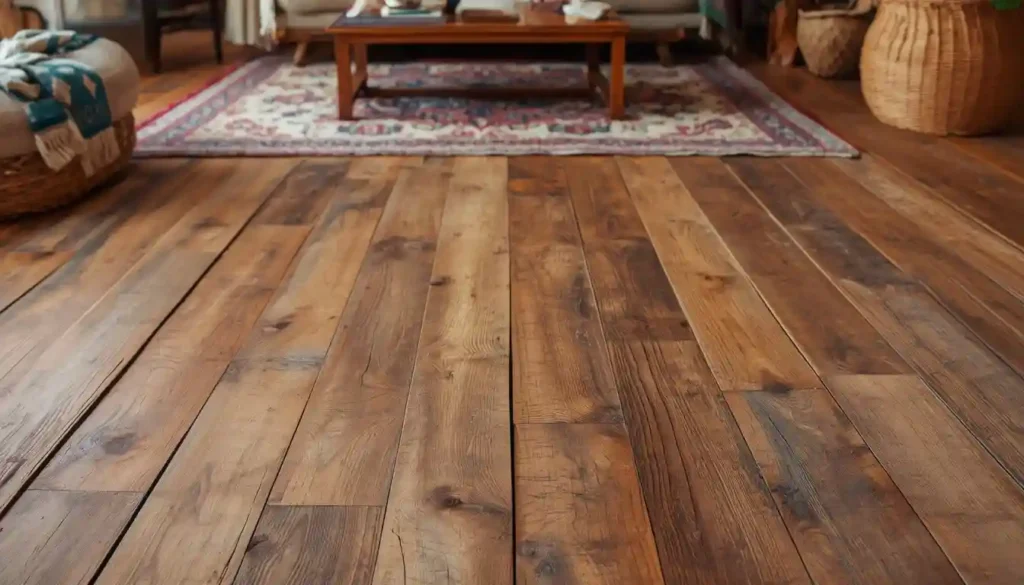
Reclaimed hardwood flooring occupies a category all its own when it comes to warm tones. Wood reclaimed from old barns, factories, warehouses, or demolished buildings carries decades or centuries of aging that produces color depth and surface character that new hardwood simply cannot replicate. The warm tones in reclaimed wood — browns, ambers, russets, and grays that have mellowed from their original color into something richer and more complex — are the result of time, and they show.
In a bohemian living room, this complexity is exactly what is called for. Bohemian interiors are built on layering, on collecting, on the visual richness that comes from mixing patterns, textiles, and objects with different origins. A reclaimed hardwood floor is the ideal foundation because it already contains that layered quality in its own surface: saw marks from a nineteenth-century mill, nail holes from previous installations, color variation from uneven exposure to light and air over decades.
Pair reclaimed warm-toned hardwood with globally sourced textiles — a Moroccan-style area rug, Indian block-print curtains, handwoven throw pillows — and furniture that mixes eras and materials. Rattan, iron, painted wood, and upholstered pieces in jewel tones all belong together on a reclaimed wood floor in a way that would look chaotic on a more polished surface. The floor’s imperfections give the room permission to be imperfect, layered, and alive.
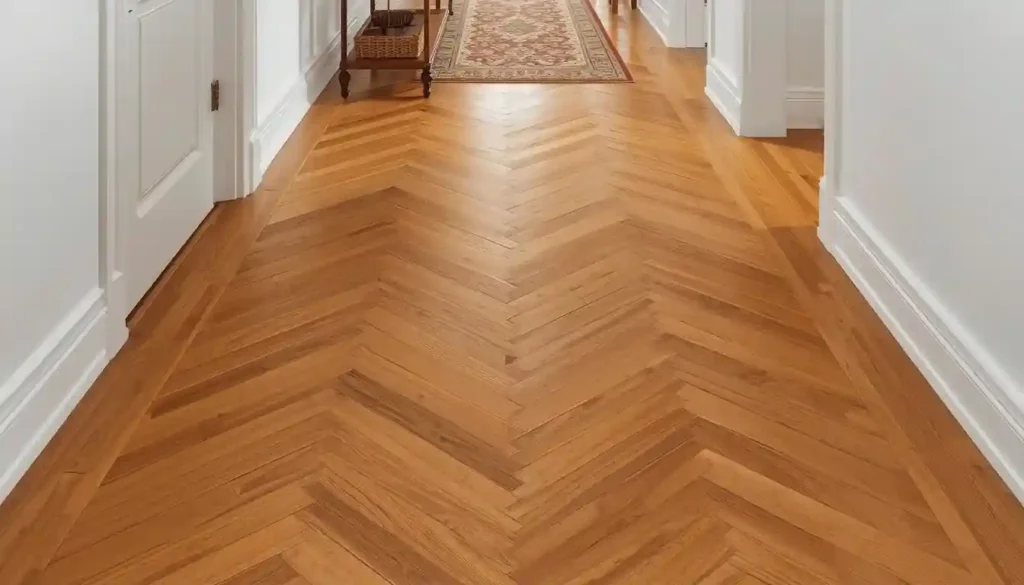
The herringbone pattern transforms warm hardwood from a material choice into a design statement. Laid in a herringbone configuration — each plank at 90 degrees to the adjacent plank, creating the classic V-shaped zigzag — warm toned oak or walnut becomes a dynamic visual feature that makes hallways feel intentional, crafted, and significantly more expensive than a straight-lay installation of equivalent material would.
Hallways benefit particularly from herringbone because the pattern creates the illusion of width. The diagonal visual movement of the zigzag pattern draws the eye perpendicular to the length of the hall, broadening the perceived space. In a warm amber or honey tone, the pattern also carries the eye forward along the length of the hall in a way that makes the journey through it feel purposeful rather than perfunctory.
The key to making warm herringbone work in a hallway is scale calibration. Narrower planks — two and a half to three inches — create a finer, more traditional herringbone grid that suits period homes and formal interiors. Wider planks — four to five inches — create a bolder, more contemporary herringbone that suits transitional and modern spaces. The same warm oak tone reads completely differently depending on which plank width you choose, so this decision deserves as much consideration as the color itself.
The herringbone pattern shares visual DNA with its close relative the chevron, and understanding the technical differences between these two layouts — as well as other installation patterns — helps inform the choice of which pattern best serves a specific hallway’s proportions. If you are comparing the merits of different installation approaches more broadly, the breakdown of different flooring installation methods offers useful context on what each approach requires in terms of skill, material, and time commitment.
12. Deep Espresso with Warm Undertones in a Library or Home Office
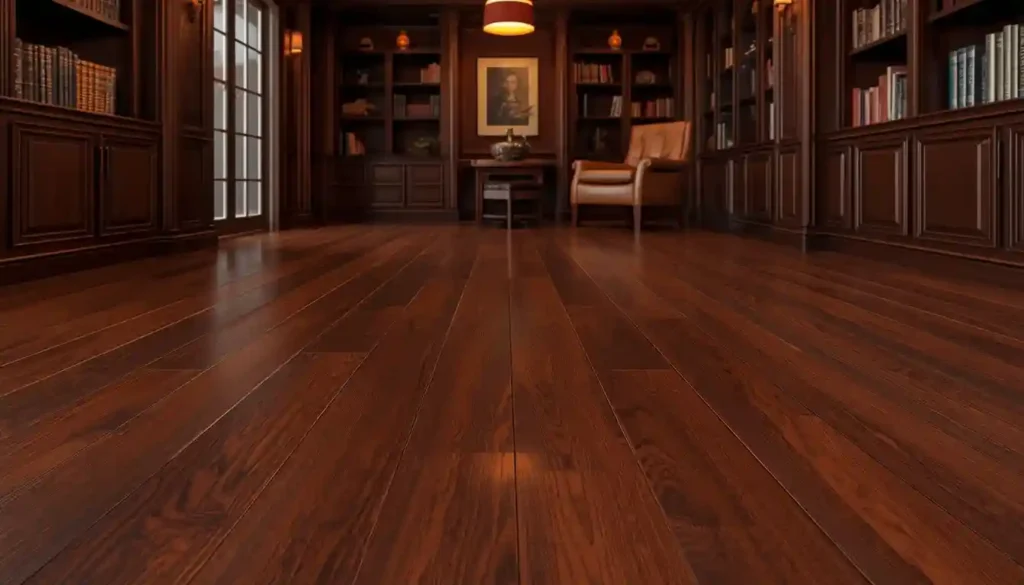
Dark floors carry associations with formality, seriousness, and permanence — qualities that suit a home library or office particularly well. But there is a significant difference between a cold dark floor and a warm dark floor. Cold dark floors — those with gray, blue, or ash undertones — can make a room feel heavy and dim. Warm dark floors — deep espresso or dark brown with red or amber undertones — create depth and richness that is simultaneously serious and inviting.
For a library or home office, a deep espresso walnut or dark-stained white oak with warm undertones anchors the space in a way that feels grounded and conducive to focus. Pair this floor with built-in shelving in a complementary dark wood or a painted finish in forest green, navy, or warm charcoal. Leather upholstery — a desk chair, a reading armchair — in cognac, deep burgundy, or warm brown ties directly into the floor’s tonal family while adding tactile richness.
Lighting management matters more with dark floors than with lighter ones. The floor will absorb rather than reflect ambient light, so the room needs layered lighting sources to prevent it from feeling like a cave. A combination of overhead ambient light, desk task lighting, and a floor lamp near the reading area ensures the warmth of the dark floor registers as sophisticated depth rather than oppressive darkness.
13. Soft Amber in a Japandi-Style Bedroom
Japandi — the design language that fuses Japanese minimalism with Scandinavian warmth — has a specific relationship with natural wood. The philosophy insists on wood that looks genuinely natural, that shows its grain and character without excessive finishing, and that exists in a palette of warm neutrals rather than cool or artificially tinted tones. Soft amber hardwood, finished with a natural oil rather than a polyurethane topcoat, is arguably the most authentic flooring choice for a Japandi interior.
The oil finish is critical here. Rather than sealing the wood surface behind a plastic film, an oil finish penetrates into the wood fibers, enhancing the natural color and grain while leaving the surface texture open and organic. The wood feels like wood underfoot — warm, slightly varied in texture — rather than like a surface that happens to look like wood. In a Japandi bedroom, where every material choice is made to feel as intentional and as close to nature as possible, this distinction is not a small detail.
Pair a soft amber oil-finished floor with platform furniture in a similarly pale warm wood — white oak or maple in a natural tone — and bedding in white, cream, or warm stone linen. The contrast between floor and walls should be minimal in a Japandi space: warm floor, warm-white walls, no hard transitions. Negative space is a design tool as important as any physical object in the room.
14. Warm Chestnut in a Craftsman-Style Home
Craftsman architecture and warm hardwood have been in conversation since the early 1900s, when Arts and Crafts movement designers reacted against Victorian excess with a philosophy of honest materials, visible joinery, and organic warmth. A Craftsman home — with its exposed beams, built-in cabinetry, board-and-batten walls, and generous use of natural wood throughout — finds its most authentic flooring expression in warm chestnut or medium-brown toned hardwood.
The grain pattern matters significantly in this context. Quartersawn oak — cut from the log in a way that produces a straight, medullary ray figure across the face of each board — was the preferred hardwood of Craftsman-era interiors and remains the most historically authentic choice. The distinctive ray fleck pattern in quartersawn oak is visually striking under warm, directional light and develops a beautiful patina over decades of use.
In warm chestnut-toned quartersawn oak, a Craftsman living room or dining room achieves the visual density and material honesty that the style demands. Pair with Mission-style furniture in complementary dark oak or walnut, hammered copper or iron light fixtures, and earthy textile colors — rust, sage green, warm gold — that echo the color palette of natural materials.
Warm chestnut floors in a Craftsman setting also pair naturally with area rugs in Arts and Crafts patterns — stylized floral, geometric, or nature-inspired motifs in the tradition of William Morris textiles. These rugs add pattern without disrupting the warmth of the floor, and they protect high-traffic zones while keeping the overall aesthetic coherent.
15. Mixed-Width Warm Oak Planks in a Contemporary Living Room
Mixed-width plank flooring — combining planks of two or three different widths in a single installation — is one of the most effective techniques for adding custom, artisanal character to a contemporary interior. When this approach is applied to warm oak in a medium to amber tone, the result is a floor that reads as both relaxed and deliberate: clearly designed, but not rigidly uniform.
The mixed-width approach draws on historical precedent — old farmhouse and mill floors were frequently laid with whatever-width planks were available, creating an organic irregularity that aged into something genuinely beautiful. Modern interpretations replicate this effect intentionally, typically mixing three plank widths in a ratio that prevents any one width from dominating. A common combination is three-inch, five-inch, and seven-inch planks arranged in a random or semi-random pattern across the floor.
In a contemporary living room, mixed-width warm oak in a natural to light amber tone creates a floor with enough visual movement to make the space interesting without overwhelming the clean lines of modern furniture. The warmth of the oak grounds the room while the plank variation adds a textural layer that keeps the eye moving across the surface. Pair with concrete-look or plaster walls, low-profile furniture with natural or matte metal detailing, and strategic use of potted plants to echo the organic quality of the floor.
If your project involves a contemporary space where you are weighing the merits of different flooring materials alongside hardwood, understanding how hardwood compares to laminate in terms of appearance, performance, and long-term value can sharpen that decision, particularly when warm tones are available in both categories and the visual similarity between them has grown significantly in recent years.
Image Prompt: A contemporary living room with mixed-width warm oak hardwood flooring as the featured element. The floor shows planks of varying widths — 3, 5, and 7 inches — in a warm amber-natural oak tone, filling the foreground and lower half of the image. The random-width pattern creates organic visual movement across the surface. Minimal contemporary furniture in the background, plaster-textured walls, and a potted fiddle-leaf fig. The mixed-width warm oak floor is the dominant feature, with its tonal warmth and plank variation clearly visible.
How to Choose the Right Warm Tone for Your Space
After running through fifteen specific ideas, a few principles emerge that apply broadly to any decision about warm hardwood flooring. The first is that room size and natural light are the primary filters. Lighter warm tones — honey, natural maple, soft amber — serve smaller rooms or rooms with limited windows because they reflect rather than absorb available light. Darker warm tones — deep chestnut, espresso walnut, rich cognac — work best in larger, well-lit rooms where their depth reads as anchoring richness rather than dimness.
The second principle is about undertones and their interaction with the rest of the room. Warm floors are not all warm in the same way. A golden honey oak has yellow undertones. A red oak in its natural state has pink and red undertones. A warm walnut has purple-brown undertones. Each of these interacts differently with wall colors, textile colors, and furniture finishes. Before committing to a floor color based on a small sample seen in a showroom, it is worth testing the sample in the actual room at different times of day and under the specific light conditions — natural, overhead, lamp — that the room will typically use.
The third principle is finish sheen. A matte or low-sheen finish makes warm tones look more natural and organic. A satin finish adds a gentle depth that makes colors look slightly richer. A high-gloss finish intensifies warm tones dramatically but also makes every surface imperfection visible. For most residential applications, a matte to satin finish is the practical and aesthetic sweet spot.
Beyond color and finish, the long-term performance of warm hardwood depends heavily on proper installation and subfloor preparation. The process of preparing the subfloor correctly before laying hardwood determines whether the floor stays flat, quiet, and gap-free over the years — and it is the step that most DIY installations get wrong.
Finally, consider what happens to the floor over time. Hardwood is one of the few flooring materials that genuinely improves with age. Warm tones develop patina — golden floors deepen toward amber, amber floors deepen toward honey brown, walnut tones soften from purple-brown toward a warmer, more purely brown hue. This aging is not a flaw. It is one of hardwood’s most compelling qualities, and it is worth choosing a tone that will grow more beautiful as it acquires the history of the home it lives in.
If you are still in the early stages of understanding what hardwood flooring involves as a material, a purchase, and a long-term investment, the comprehensive hardwood flooring buying guide walks through everything from species selection to installation options to warranty considerations in a way that makes the decision process significantly cleaner.
Warm toned hardwood is not a trend in the sense of something that will be replaced by the next preference cycle. It is a return to something that human beings have responded to for as long as wood has been used in building: the inherent warmth of natural material, honestly used, in a tone that makes a space feel inhabited rather than curated. Whatever room you are working on and whatever specific tone you choose from among these fifteen ideas, that quality — warmth that is felt as much as seen — is the through line that makes this category of flooring so enduringly compelling.
James Miller is a seasoned flooring contractor with years of hands-on experience transforming homes and businesses with high-quality flooring solutions. As the owner of Flooring Contractors San Diego, James specializes in everything from hardwood and laminate to carpet and vinyl installations. Known for his craftsmanship and attention to detail, he takes pride in helping clients choose the right flooring that balances beauty, durability, and budget. When he’s not on the job, James enjoys sharing his expertise through articles and guides that make flooring projects easier for homeowners.
Every carpet buying decision eventually arrives at one question: is the yarn looped or cut? That single manufacturing step — whether the fiber tips are sheared off or left intact — determines how your floor performs for the next decade. It affects softness, durability, maintenance, pet suitability, sound, and cost. Yet most people pick carpet…
Carpet bubbles — those raised, wavy sections that push up from the surface — are one of the most common and most misunderstood flooring problems homeowners deal with. They appear without warning. They worsen with foot traffic. And the first instinct most people have, which is to press them down and hope for the best,…
Laminate flooring has earned its reputation as one of the most cost-effective ways to completely transform a room, and in 2025 and 2026, the gap between affordable laminate and the real thing has never been smaller. Modern manufacturing has produced options that genuinely fool the eye, with realistic wood grain textures, embossed surfaces, and color…
A gap in laminate flooring is a visible separation between two adjacent planks — a space where the locking joints have either partially disengaged or failed to close flush. This is not a surface crack or a scratch. The gap runs along the seam between planks, and it can appear mid-floor, along rows, or near…
Most flooring guides will tell you laying wood over tiles is straightforward. Inspect the tiles, add underlayment, install the planks. Done. That framing skips most of the problem. It skips what happens when a single loose tile causes an engineered plank to delaminate six months later. It skips what happens when your tile floor has…
A teak shower floor sits at an interesting crossroads between practical engineering and bathroom aesthetics. It is not simply a flooring choice — it is a system decision, one that touches subfloor preparation, waterproofing assemblies, drain geometry, wood species behavior under constant moisture, and long-term maintenance chemistry. Most guides collapse all of that into a…