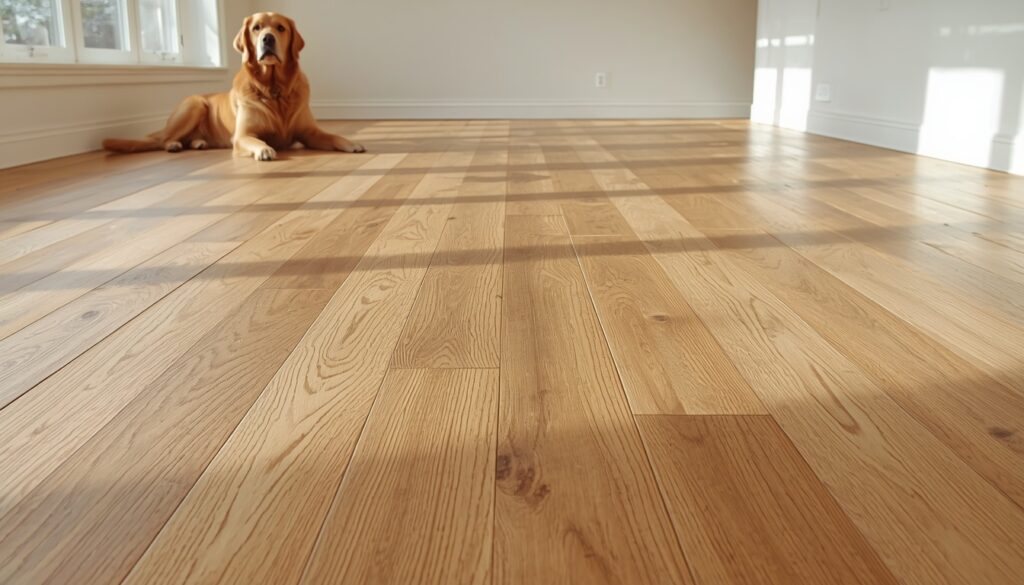
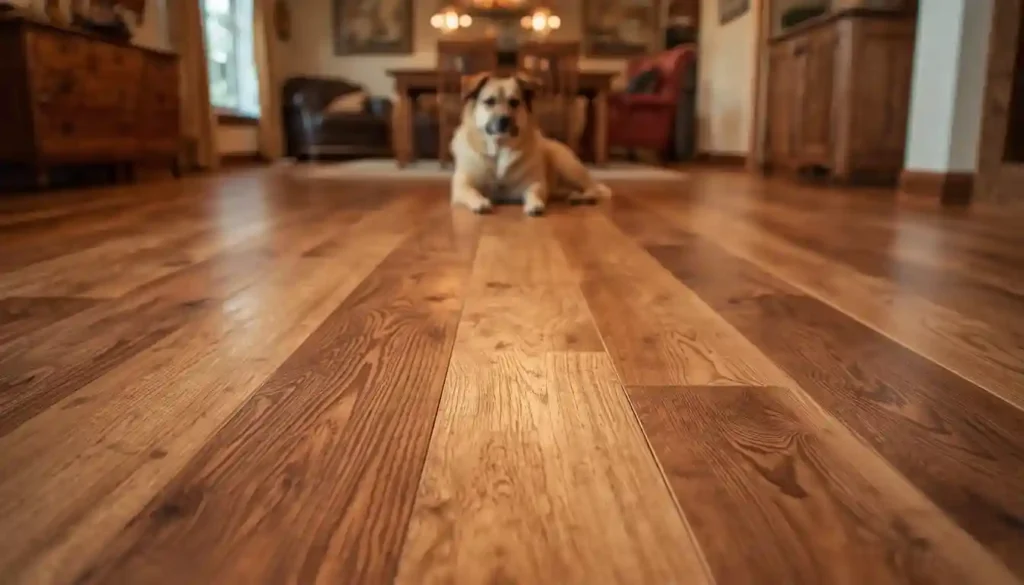
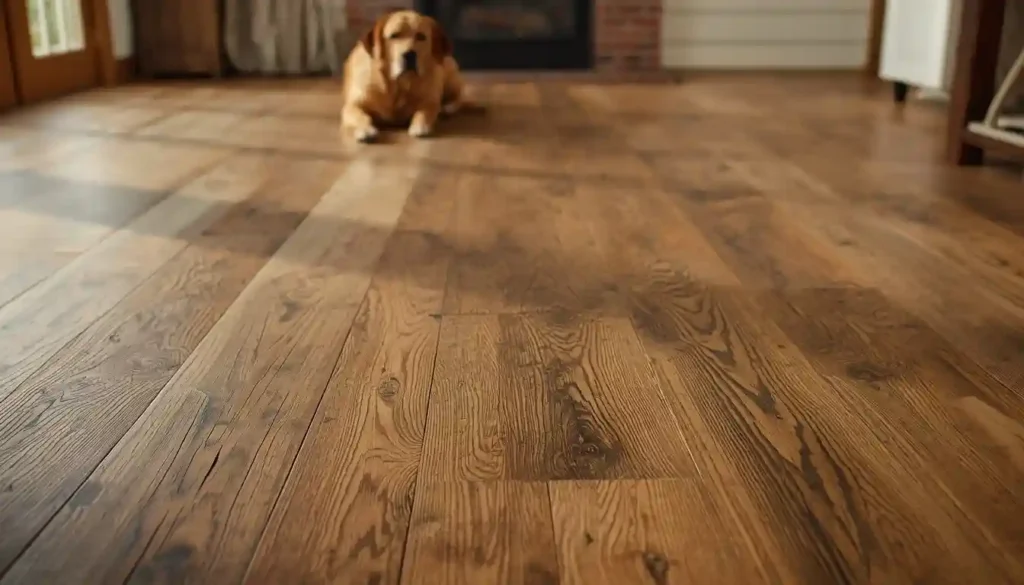
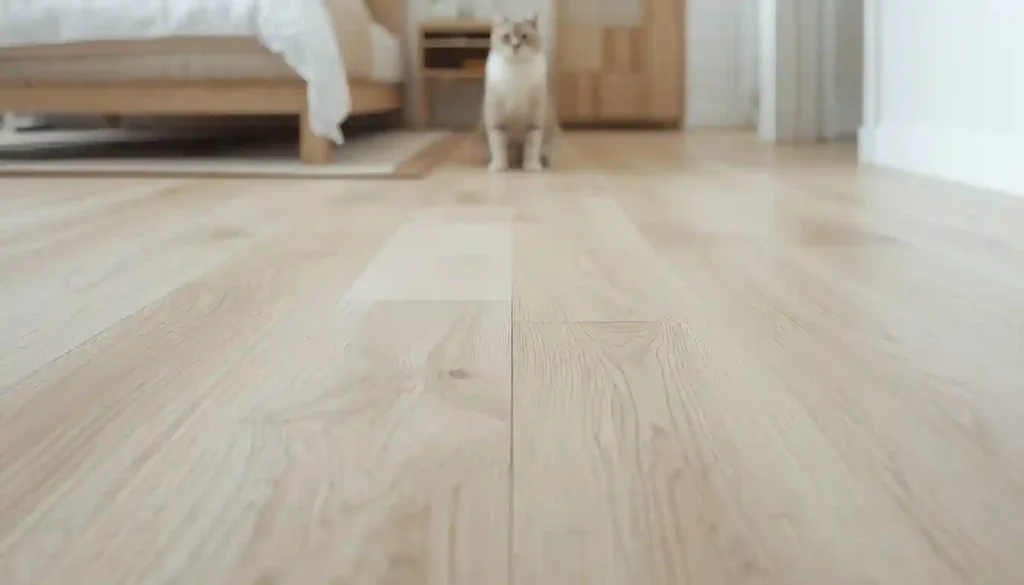
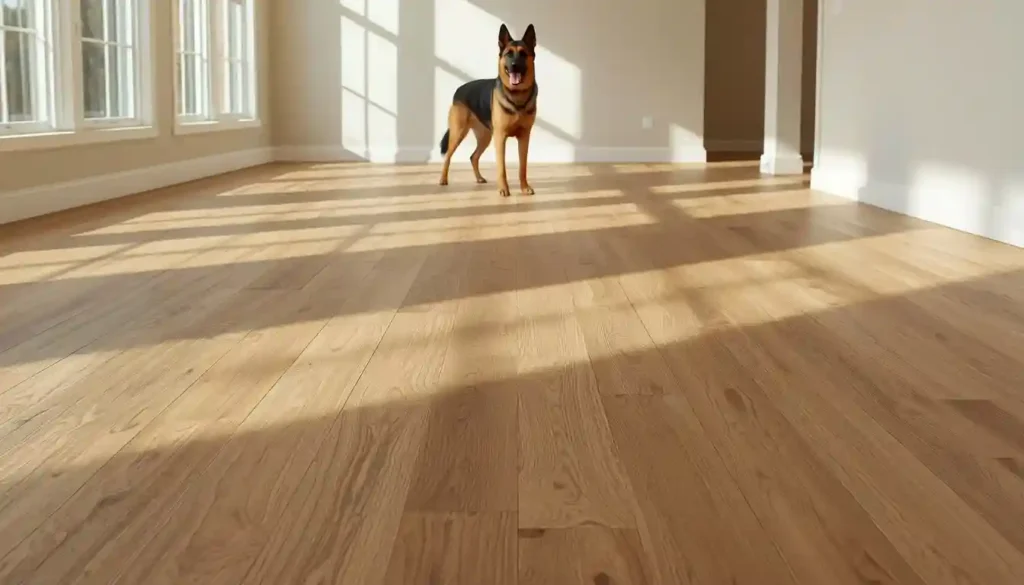
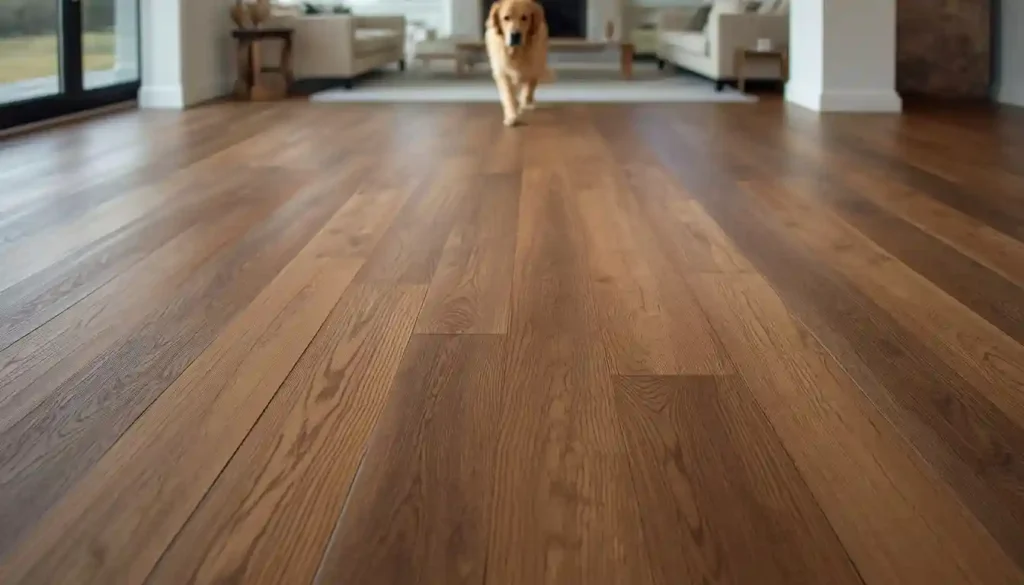
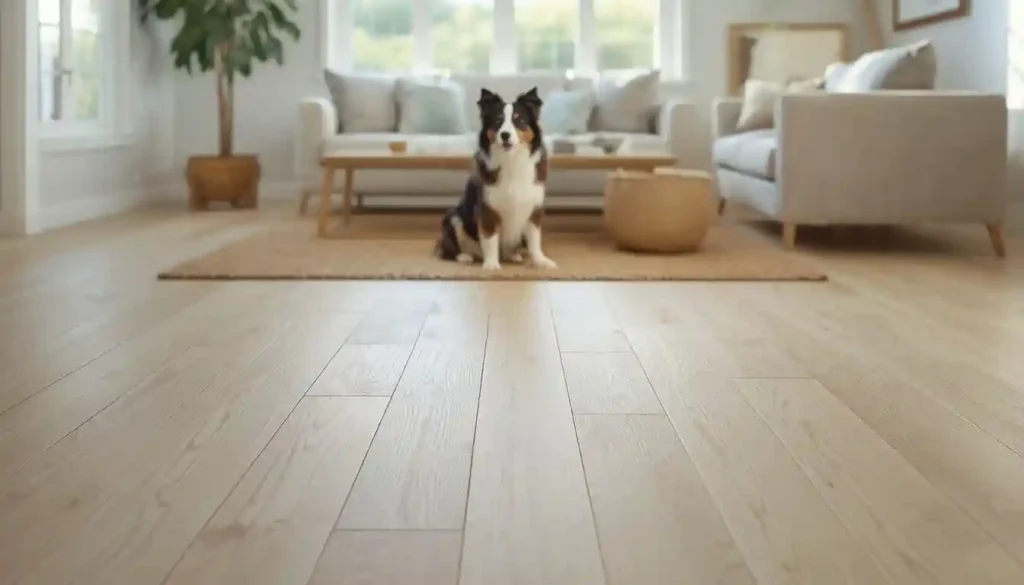
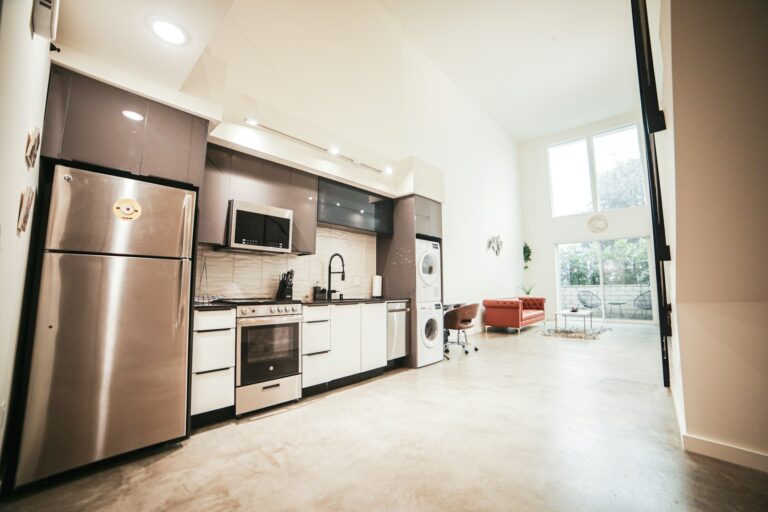
White oak itself has a Janka rating of 1,360 lbf, making it meaningfully harder than the red oak found in most older homes. Its closed grain structure is also tighter than red oak, which means it is less prone to absorbing moisture from pet accidents. The matte finish that works best on wire-brushed oak scatters light rather than reflecting it, and this dramatically reduces the visibility of claw marks. A medium natural tone — not too light and not too dark — sits in the sweet spot where both pet hair and scratches become far less visible.
If you are comparing your options before committing to oak, the full breakdown in our comparison of red oak versus white oak covers the specific differences in grain density, stain behavior, and how each species responds to moisture exposure.
Idea 2: Hickory Hardwood in a Hand-Scraped Finish
Hickory is the hardest of all domestic North American hardwoods at 1,820 lbf on the Janka scale, and that single fact makes it the most logical starting point for anyone with large, active dogs. It is not just hard — hickory’s naturally dramatic grain pattern features strong color variation within individual boards, shifting from pale cream to deep reddish-brown across the same plank. That built-in variation means the eye moves constantly across the surface, and a scratch has nowhere to stand out because the color transitions are already doing visual work everywhere.
A hand-scraped finish amplifies this effect considerably. Hand scraping simulates the look of antique flooring that has been aged by generations of use, creating gentle divots and ridges across the surface. When a dog’s nail causes a new mark, that mark reads as part of the floor’s existing character rather than fresh damage. This is a fundamentally different experience from watching the same mark appear on a smooth, glossy floor where it is immediately obvious. Hickory in a hand-scraped finish is also one of the most forgiving choices in a home with muddy paws, since the textured surface does not show pawprints the way a smooth high-gloss floor does.
The color variation in hickory can look bold and rustic, which makes it ideal for farmhouse aesthetics, open-plan spaces, and mountain lodge-style interiors. You can tone it down somewhat with a lighter stain applied over a natural or whitewash base, or lean into the contrast for a more dramatic effect.
Idea 3: Engineered Hardwood Over a Moisture-Resistant Core
Solid hardwood and moisture do not coexist well, and pet ownership inevitably involves moisture — whether from accidents, wet paws, or spilled water bowls. Engineered hardwood addresses this vulnerability directly. Rather than a single solid plank, engineered hardwood is built from three to nine layers of wood veneers with the grain direction alternating between layers, creating a cross-ply structure that resists the expansion and contraction that causes solid wood to gap, cup, and warp when exposed to moisture.
The top wear layer is real hardwood, so the appearance is identical to solid wood at walking height. For pet households, the most important specification is wear layer thickness — a wear layer of at least 2mm allows for refinishing if the floor eventually needs to be refreshed, and a factory-applied aluminum oxide or ceramic finish provides significantly better scratch resistance than site-applied finishes. Some manufacturers now produce engineered hardwood with waterproof cores, which means standing water from an accident can be cleaned up within several hours without causing permanent damage — a meaningful difference from what solid hardwood tolerates.
The species options for engineered hardwood are as broad as they are for solid wood. Hickory, white oak, and maple veneers give you the hardness of those species on the surface with the stability advantages of the engineered construction beneath.
For anyone who has hardwood floors and is curious about the difference in how solid and engineered products perform over time, the detailed guide on solid versus engineered hardwood covers dimensional stability, moisture response, and refinishing options in full.
Idea 4: Distressed Hardwood That Hides What Pets Leave Behind
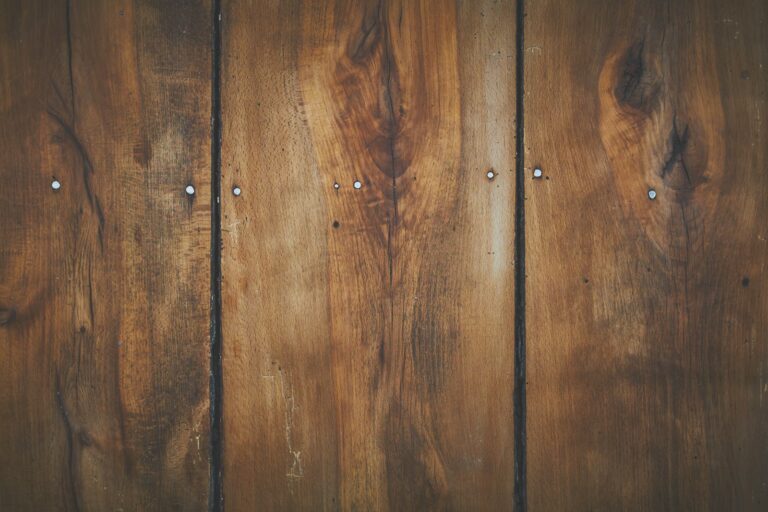
Pre-distressed hardwood takes a philosophical approach to the pet-scratch problem: instead of trying to prevent the floor from looking worn, it starts already looking worn, so nothing that pets add changes the overall appearance. Distressed hardwood is processed before installation using wire brushing, physical denting, and hand scraping to create a floor that looks like it has already lived through a century of use. When a new scratch appears, it genuinely cannot be distinguished from the distressing that was already there.
This approach works best when the distressing is done on a naturally hard species. Distressed oak, distressed hickory, and distressed ash all combine inherent hardness with surface camouflage. The finish applied over distressed wood is almost always matte, both because a higher sheen looks unnatural against a heavily textured surface and because matte finishes are better at hiding ongoing wear. The result is a floor that looks increasingly like a beautiful antique the longer you live with it, rather than a floor that accumulates visible damage over time.
Color choice with distressed wood affects how well it handles pet hair between cleanings. Medium-toned boards — warm browns, tawny golds, natural grays — show less shed hair than either very light or very dark floors. Dark distressed floors can be dramatic and beautiful, but they reveal light-colored pet fur almost immediately after sweeping.
If the aesthetic direction you are considering leans more rustic and characterful, our full collection of farmhouse hardwood flooring ideas covers how distressed and reclaimed-look wood works across different room types and color palettes.
Idea 5: White Oak in a Satin Finish for Active Cat Households
Cats present a slightly different challenge than dogs. A cat’s retractable claws are typically sharper per square millimeter of contact than a dog’s nails, and cats often run, jump, and land with sudden force on hardwood. The combination of sharp claws and impact stress means scratch resistance needs to be addressed both in species choice and finish type.
White oak in a satin finish addresses both concerns effectively. The closed grain structure of white oak means that even when a surface scratch does occur, moisture from an accident or wet paws cannot easily penetrate down into the wood fiber. A satin finish sits at the right point on the sheen spectrum — not so flat that it shows every scuff mark from normal use, but not so reflective that claw marks become immediately visible from any angle. Satin finishes also tend to be more durable than high-gloss alternatives in high-traffic areas because they are typically built up with more layers of protective coating.
For multi-cat households, wide-plank white oak in 5-inch or wider boards reduces the number of seams on the floor surface. Fewer seams means fewer places for cat hair and dander to accumulate between cleanings, which matters both for aesthetics and for household air quality.
Ash is one of the most underrated choices for households with large and heavy dogs. With a Janka rating of 1,320 lbf for white ash, it outperforms red oak by a meaningful margin and provides excellent resistance to the denting that comes from large paws landing hard after a jump. Ash has a very straight, consistent grain that runs in long parallel lines across the board, and this grain structure means that a claw scratch tends to run with the grain rather than across it, making it far less visible than a scratch that cuts across the wood’s natural lines.
Ash accepts stain evenly across its surface, which gives you a wide range of color options — from pale natural tones to darker chocolate browns — without the blotchiness that some species develop with certain stains. This predictability makes ash particularly good for achieving a specific design vision. Its open grain does require a proper sealer to ensure that moisture from pet accidents does not penetrate down into the wood fiber, so proper finishing is essential.
The detailed species-by-species comparison in our ash versus oak flooring guide walks through the specific differences in grain, hardness, staining behavior, and long-term performance between these two closely related species.
Idea 7: Medium-Toned Maple for Pet Hair Invisibility
Hard maple at 1,450 lbf is the second hardest domestic hardwood after hickory, and its very tight, fine grain structure makes it one of the most scratch-resistant options available. The grain in hard maple is so dense that claw marks tend to be much shallower on maple than they would be on a softer species — there is simply less space between fibers for a nail to push into.
The specific advantage of medium-toned maple for pet households is the hair problem. Every dog owner and cat owner knows the experience of sweeping and immediately seeing pet hair accumulate again within an hour. The color of the floor determines how visible that hair is between sweepings. Very light floors show dark hair; very dark floors show light hair; medium-toned floors in warm honey or natural tan hide the widest range of pet hair colors because the tone sits between the extremes. Maple in its natural or lightly stained form often lands exactly in this useful range.
Maple’s fine, consistent grain also means it does not have the dramatic color variation of hickory. If your design preference runs toward cleaner, more modern aesthetics with consistent color across the floor, maple delivers that without sacrificing the hardness that pet households need. Pair it with a satin or matte finish and the result is a floor that works quietly in the background of your home while standing up to serious daily punishment.
Idea 8: Wide-Plank Hardwood to Minimize Dirt-Trapping Seams
The width of individual hardwood planks affects pet-friendliness in a way that most homeowners do not consider until after installation. Narrow strip flooring — the traditional 2.25-inch width that was standard for most of the 20th century — creates a large number of seams per square foot. Every seam is a joint where pet hair, dirt, and dander can accumulate between cleanings. With a shedding dog or cat, narrow strip floors can collect a visible line of debris at every board edge within a day of sweeping.
Wide-plank hardwood in 5-inch, 6-inch, or 7-inch widths dramatically reduces the number of seams. The floor becomes simpler to sweep clean because there are fewer channels for hair to settle into, and the visual result is also more open and spacious — the long continuous planks reduce visual interruption and make rooms feel larger. Wide-plank floors suit virtually every aesthetic from rustic farmhouse to clean contemporary, depending on the species and finish chosen.
The trade-off with wide planks is dimensional stability. Wider boards have more wood mass expanding and contracting with humidity changes, so engineered wide-plank hardwood is often a better choice than solid wide-plank hardwood, particularly in climates with significant seasonal humidity swings or in homes with forced-air heating that creates dry winters. The engineered construction controls expansion and prevents gapping that would otherwise be a hair-collection problem of its own.
Our broader collection of wide-plank hardwood flooring ideas shows how different species and tones translate across various room types and interior styles.
Idea 9: Gray-Toned Hardwood for Camouflaging Dirt and Hair
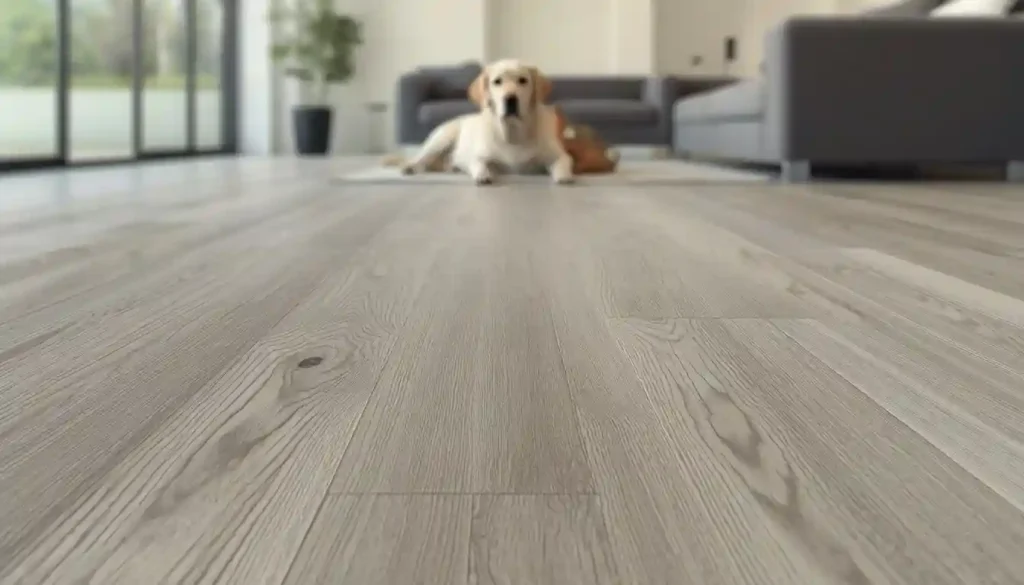
Gray hardwood floors have moved from trend to established staple over the past decade, and for pet households specifically, gray tones offer a genuine practical advantage beyond aesthetics. Gray-toned wood — whether achieved through fuming, gray staining, or the natural silvery tone of certain white oak and ash species — sits at a neutral mid-point that neither highlights dark dog hair nor reveals light cat fur the way black or white floors do. Muddy pawprints and tracked-in dirt also tend to be brown-gray in color, which means they read as less alarming against a gray floor than against a pale white or warm honey finish.
Wire-brushed gray oak has become a particularly popular choice for modern interiors because the brushing adds texture that further reduces the visibility of claw marks, and the gray tone keeps the floor from reading as cold or clinical — the wood grain remains warm and organic beneath the gray overlay. Gray hardwood pairs naturally with white trim, concrete accents, and the dark metal fixtures that characterize contemporary Scandinavian and industrial interior styles.
A full exploration of how different gray tones and textures work across room types is available in our collection of gray hardwood flooring ideas, which covers everything from pale silver-gray to deep charcoal finishes across multiple species.
Idea 10: Brazilian Walnut (Ipe) for Extreme Durability
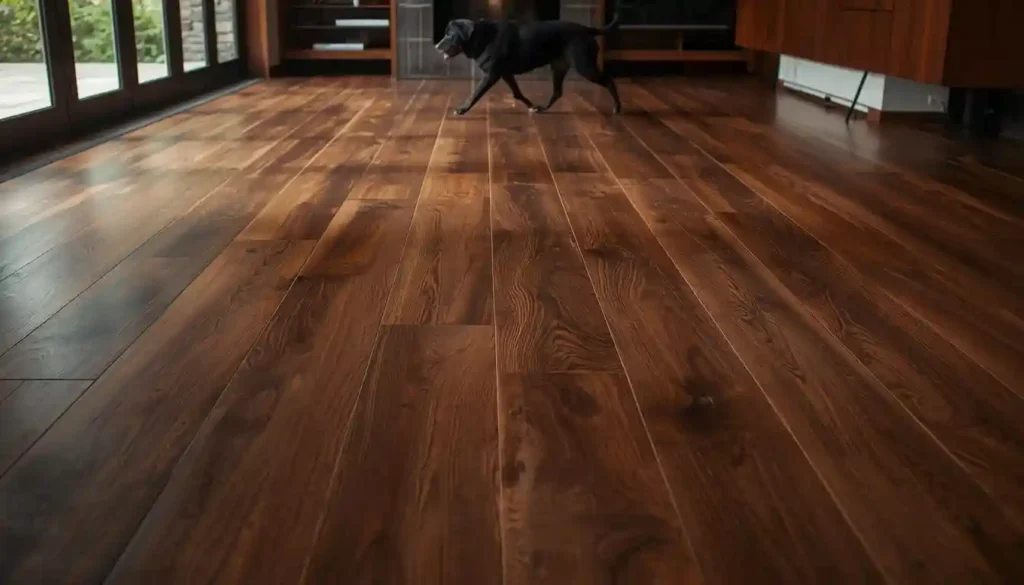
For households where durability is the absolute priority — large breeds, multiple dogs, or particularly rough-playing animals — Brazilian walnut, commonly called Ipe, represents the far end of the hardness spectrum among wood flooring options used in residential settings. Its Janka rating of approximately 3,680 lbf is more than twice that of hickory and nearly three times that of red oak. In practical terms, this means that even the largest, most energetic dogs will struggle to leave meaningful dents or scratches on an Ipe floor under normal conditions.
Ipe has a deep, rich brown color with subtle olive undertones and a very fine, consistent grain that gives it an almost stone-like visual density. It is naturally resistant to moisture, insects, and decay — properties developed because it grows in tropical environments with significant biological pressure. These same properties make it useful in pet households where the floor surface occasionally encounters standing moisture from accidents.
The challenges with Ipe are cost, workability during installation (the density that makes it hard also makes it demanding to cut and nail), and the fact that its extreme hardness can create a less comfortable surface for older dogs or animals with joint issues. Area rugs in a home with Ipe floors are both a practical and stylistic solution — they provide cushioning and traction in resting areas while the hardwood underneath handles all the traffic.
Idea 11: Light Natural Hardwood With Area Rugs Strategically Placed
Light natural hardwood — white oak in its unstained natural tone, maple in a pale finish, or ash in its characteristic creamy tan — creates some of the brightest, most open-feeling interiors possible with real wood floors. The challenge for pet households is that pale wood shows dark scratches more clearly than medium or dark tones. The strategic solution is layering area rugs in the specific zones where pets spend the most time and where claw impact is highest.
Entryways, spots in front of sofas and chairs where dogs land repeatedly after jumping up, and sleeping areas next to beds are the zones where most pet-related floor damage accumulates. Placing durable, washable rugs in those specific locations protects the floor where it needs it most while leaving the beautiful pale hardwood visible in the open traffic lanes where pets are moving rather than stopping. The contrast between the rug zones and the open floor actually works in your favor aesthetically — it adds visual interest and anchors furniture groupings in a way that bare floors do not.
Flat-woven rugs without a rubber backing are the safest choice on hardwood, as some rubber backing materials trap moisture and can react with certain finishes over time. A thin rug pad with a breathable weave underneath provides cushioning and prevents slipping without creating a moisture problem beneath.
The complete guide on choosing the best hardwood flooring for pets covers all the practical specifications — species hardness, finish type, wear layer thickness — that determine long-term performance in pet households.
Idea 12: Engineered Hickory in Dark Tones for Open-Plan Spaces
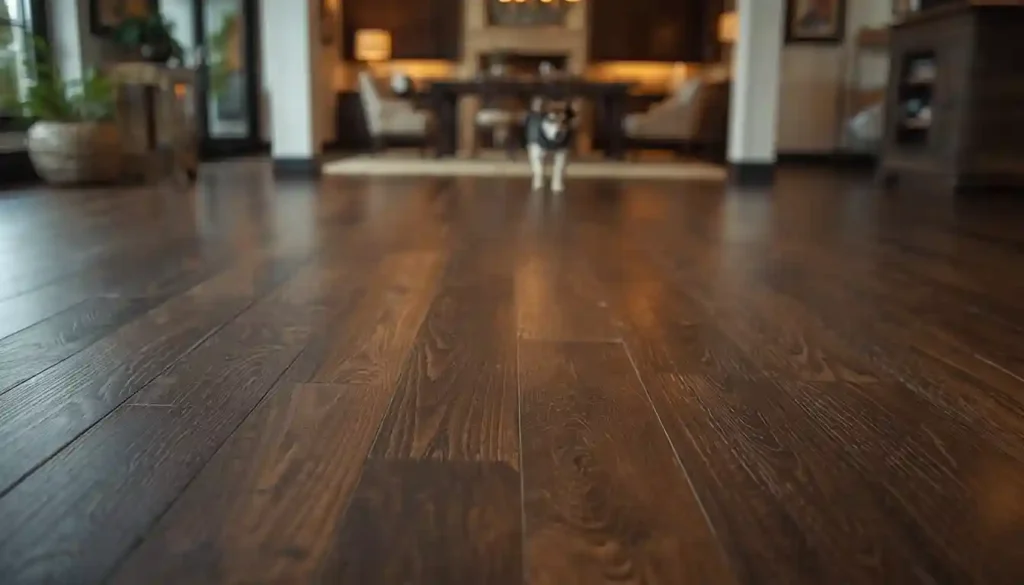
Dark hardwood floors have a reputation for being difficult in pet households because they reveal every strand of light-colored fur and every paw print. That reputation is earned in some contexts but overstated as a blanket rule. Dark engineered hickory — in tones like espresso brown, deep walnut, or charcoal gray — has a specific combination of properties that make it more manageable than its reputation suggests, provided the finish and texture are chosen carefully.
Because hickory’s grain is so varied and dramatic, the bold natural pattern in the wood breaks up the reflective surface in a way that works against scratch visibility. The color variation within individual hickory boards — shifting from pale streaks to deep brown within the same plank — means that a claw mark crossing multiple zones of color becomes nearly invisible, because the color contrast in the mark is smaller than the contrast already present in the grain. Wire brushing on dark hickory amplifies this further by adding surface texture that catches and absorbs minor marks.
In large open-plan living spaces, dark hardwood floors create a dramatic grounding effect that makes furniture feel anchored and rooms feel sophisticated. The practical management strategy is consistent sweeping with a microfiber mop — the soft electrostatic action picks up pet hair more effectively than a broom, and regular light cleaning prevents accumulation that would make even the best dark floor look tired.
If you are working with an open-plan layout and thinking about how to use hardwood consistently across different zones, our guide to open-plan hardwood flooring ideas covers directional layout, species consistency, and how to transition between areas without breaking the visual flow.
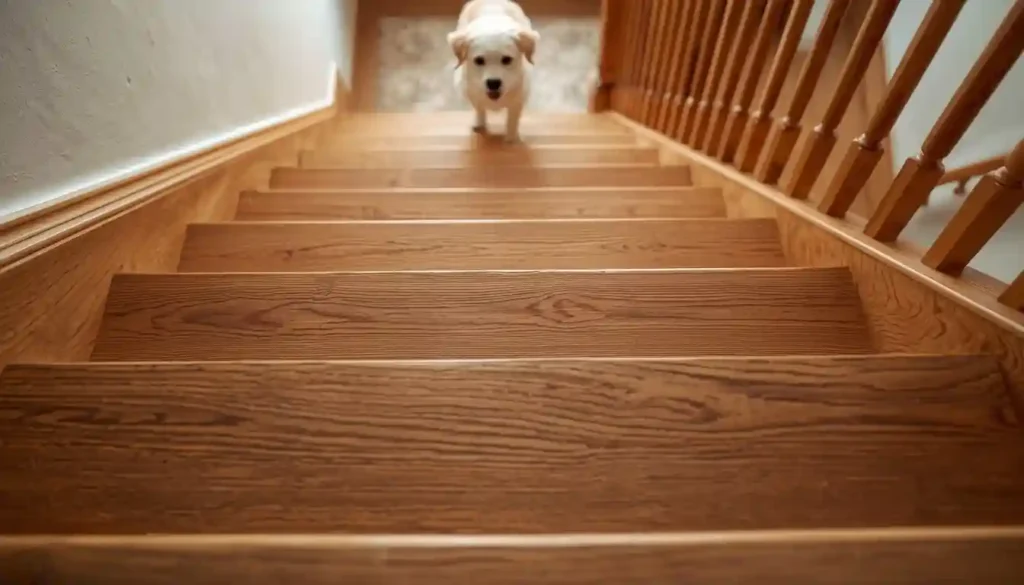
Idea 13: Hardwood on Stairs With Flush Nose Treads for Pet Safety
Stairs are often an afterthought in hardwood flooring plans, but they represent one of the most important zones for pet households. Dogs and cats use stairs dozens of times per day, and the traction and surface character of stair treads directly affects their safety and joint health. A smooth, high-gloss stair tread is genuinely dangerous for most dogs — the polished surface gives their paws nothing to grip on the descending step, and the repeated small slips on a daily basis put significant stress on hip and shoulder joints over months and years.
Hardwood stairs with flush nose treads in a textured, matte-finished species eliminate this problem. The flush nose profile — where the front edge of the tread sits flush against the riser rather than overhanging it — removes a trip point that can cause a running animal to catch a paw. A wire-brushed or hand-scraped surface on the tread itself provides meaningful traction even in bare paw contact. Stair runners or full carpet on the treads with hardwood risers is another common approach that provides maximum traction while maintaining the wood aesthetic on the visible vertical surfaces.
For the main floor areas connecting to those stairs, the relationship between the stair material and the floor material affects the visual coherence of the space. Matching the stair tread species and tone to the adjacent hardwood creates a seamless look, while a complementary but different material can be used intentionally as a design accent.
If your project involves laying hardwood through doorways and thresholds between zones, the specific installation techniques that create clean transitions are covered in the seven-step guide to laying flooring in doorways, which applies equally to hardwood threshold situations.
What to Know Before Choosing Pet-Friendly Hardwood
The thirteen ideas above cover a wide range of species, finishes, and design directions, but several cross-cutting principles apply regardless of which specific option you choose.
Always prioritize a Janka hardness rating above 1,300 lbf for pet households. Species below that threshold — pine, cherry, American walnut — are beautiful, but they will show pet-related wear in ways that harder species do not. This does not mean they are off-limits in every room, but for high-traffic zones where pets spend the most time, harder species perform significantly better over a ten- or twenty-year horizon.
The finish type affects daily maintenance as much as it affects scratch visibility. A factory-applied aluminum oxide finish provides a harder protective layer than most site-applied finishes, and some manufacturers have developed water-resistant sealed finishes specifically marketed at pet households. These finishes do not make the wood waterproof, but they extend the window for cleaning up accidents from a few minutes to several hours before the wood itself is affected.
Keeping pet nails properly trimmed is the single most effective maintenance step for preserving any hardwood floor. Long nails create significantly deeper scratch marks than nails that have been kept at an appropriate length, and the difference in floor wear between a well-trimmed pet and one with overgrown nails is substantial over months of daily use.
Understanding how your local climate affects wood behavior is also important for long-term satisfaction. Humidity swings cause all hardwood to expand and contract seasonally. If your home runs very dry in winter from heating systems, engineered hardwood handles those cycles better than solid wood. For advice on the full range of hardwood options available, the comprehensive hardwood flooring buying guide covers everything from species selection through installation and long-term maintenance in one place.
The idea that hardwood floors and pets cannot coexist is simply outdated. With the species knowledge, finish choices, and layout strategies covered in these thirteen ideas, the real question is not whether hardwood works in your pet household — it is which approach suits your design vision and your specific animals best.
James Miller is a seasoned flooring contractor with years of hands-on experience transforming homes and businesses with high-quality flooring solutions. As the owner of Flooring Contractors San Diego, James specializes in everything from hardwood and laminate to carpet and vinyl installations. Known for his craftsmanship and attention to detail, he takes pride in helping clients choose the right flooring that balances beauty, durability, and budget. When he’s not on the job, James enjoys sharing his expertise through articles and guides that make flooring projects easier for homeowners.
Herringbone laminate flooring is one of the most captivating flooring patterns you can bring into a home. The interlocking V-shaped arrangement of planks creates visual movement that feels both timeless and surprisingly fresh in modern interiors. What makes this layout especially exciting is that you can achieve this sophisticated look with laminate — a material…
The best rugs for laminate flooring are low-pile wool or polypropylene rugs with a felt or woven jute backing. These materials protect the floor surface without trapping moisture, without chemically reacting with the laminate wear layer, and without restricting the natural expansion movement of a floating floor system. If a rug does not have a…
What Is Cherry Wood, and Why Does It Come Up in Flooring Conversations? Cherry wood has been used in North American furniture and millwork for centuries. It machines cleanly, takes finish beautifully, and produces a warmth in a room that almost no other domestic species can replicate. When people start shopping for hardwood floors and…
Cutting carpet looks straightforward until you do it wrong. A dull blade through the face of a Berber loop. A straight-edge that slips two inches off-line right before a seam. Pile direction ignored across a double-cut join. These are the kinds of errors that announce themselves every single day for the life of the installation….
Wood floors and moisture have a relationship that only goes one direction — the more moisture that gets in, the more damage accumulates. Whether the source is a slow appliance leak, a flooded room, rising humidity from a concrete subfloor, or years of wet mopping, the consequence is always the same: the wood absorbs what…
Yes, scratches on laminate flooring can be repaired — but the repair method, and whether a repair will actually hold, depends entirely on what layer of the plank the scratch has reached. That distinction is not cosmetic. It determines whether you’re looking at a five-minute fix with a wax pencil or a full plank replacement….