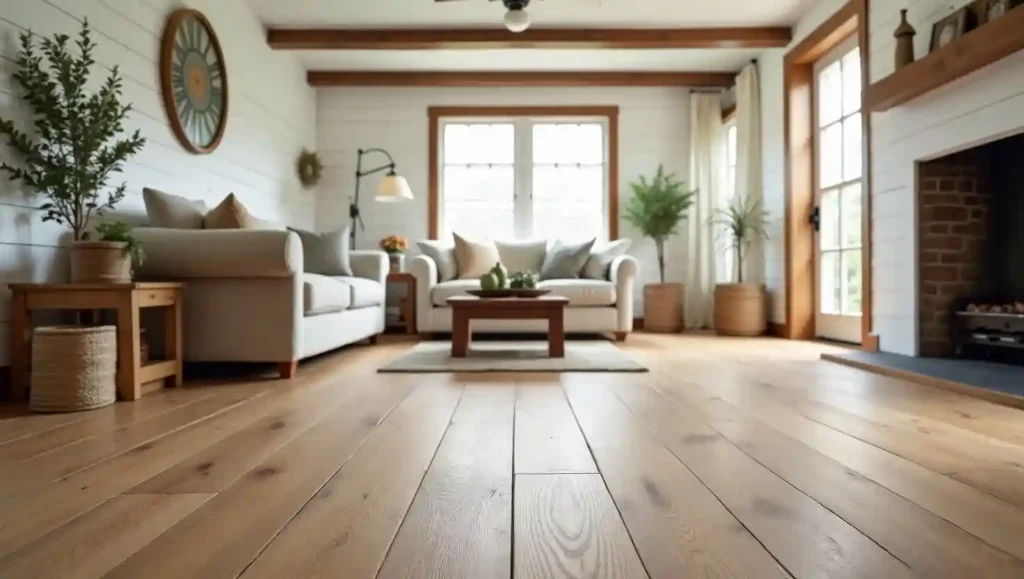
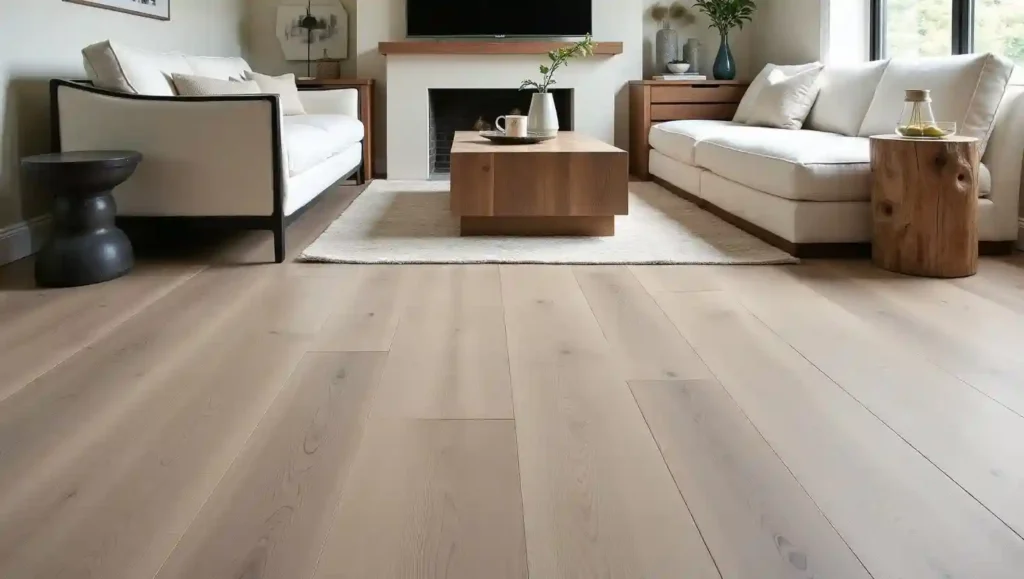
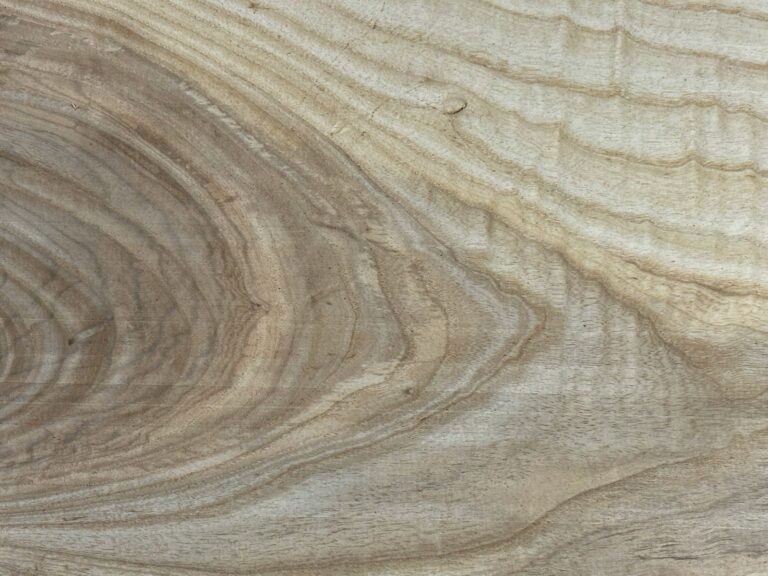
Wide planks are essential to making this work. Boards in the 5-inch to 8-inch range give the floor a sense of visual expansiveness. The fewer seams, the more each individual board gets to display its grain, and with white oak, that grain is worth showing. A matte finish rather than a glossy one absorbs light rather than reflecting it, which reads as more organic and less manufactured. Matte finishes also hide everyday scuffs and scratches far better than high-gloss options, which is a practical advantage in a home where kids, dogs, and muddy boots are part of the scenery.
This floor pairs beautifully with white shaker cabinets, black or dark bronze hardware, exposed wood beams on the ceiling, and simple linen window treatments. It works in open-plan spaces where it needs to carry visual continuity across a kitchen, dining area, and living room without fighting with any of the decor. It also holds up well in bedrooms, where the pale tone contributes to a calm, restful atmosphere. Understanding how white oak and red oak compare helps narrow down which species best fits the tone you are chasing.
2. Hand-Scraped Hickory for Maximum Grain Drama
Hickory is the most visually dramatic domestic hardwood available. Its grain swings wildly between pale cream and deep brown within a single board, creating a floor that is always moving, always interesting. This characteristic makes it a natural fit for traditional farmhouse interiors where the goal is maximum rustic character. The hand-scraped finish amplifies that character further. In hand scraping, the surface of each board is worked by tools or machinery to create shallow, irregular gouges that mimic the marks left by a draw knife on old-growth timber.
The result is a floor that looks genuinely aged from the moment it is installed. It has a roughed-up, tactile quality that high-gloss or smooth-finished floors can never replicate. Hand-scraped hickory is particularly effective in spaces with other rough or reclaimed materials, exposed brick, wrought iron, barnwood accent walls, rough-hewn furniture. It grounds those elements and ties them into a cohesive whole.
One of the real-world benefits of this floor is its durability. Hickory is one of the hardest domestic species, sitting above red and white oak on the Janka hardness scale. The hand-scraped surface hides new dents and scratches well because the floor already looks intentionally marked. This makes it a sensible choice for kitchens, mudrooms, hallways, and anywhere the foot traffic is relentless. If you are weighing hickory against oak for a farmhouse project, the differences between hickory and oak floors extend beyond just looks into long-term performance.
3. Reclaimed Barnwood Planks for Authentic History
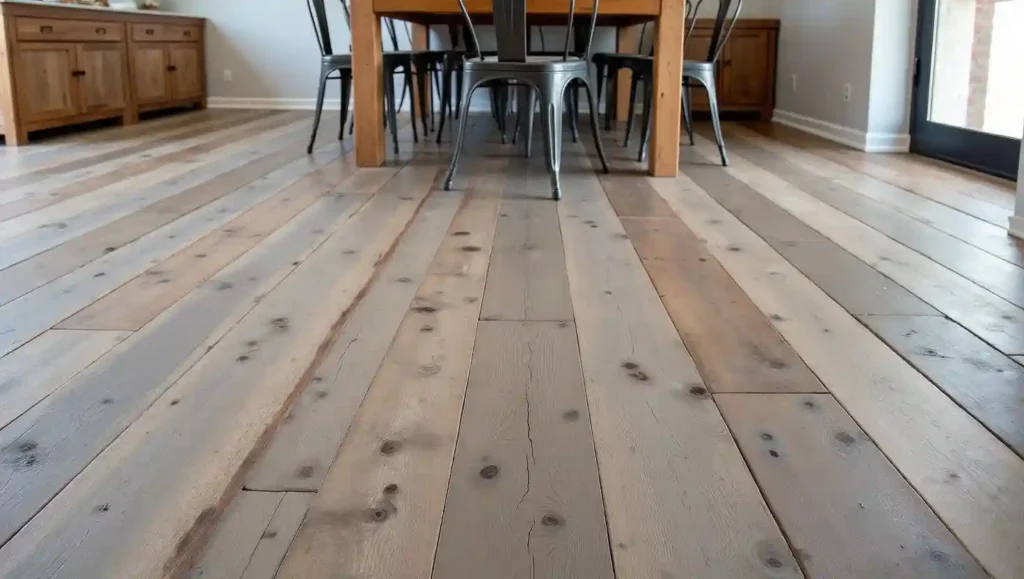
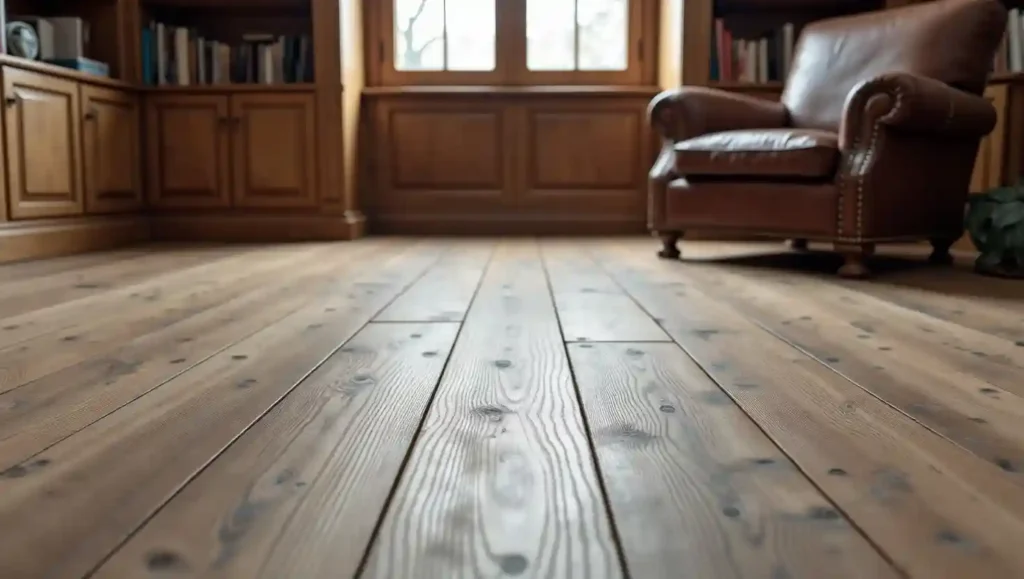
Nothing is more authentically farmhouse than wood that actually came from a farm. Reclaimed barnwood flooring uses timber salvaged from demolished barns, warehouses, factories, and old industrial structures. This wood is typically old-growth timber, meaning it comes from trees that grew slowly over many decades before being cut. Old-growth wood is denser and more dimensionally stable than today’s fast-grown timber, and it carries surface characteristics, nail holes, saw marks, weathering patterns, and color variation, that genuinely cannot be manufactured.
When this wood is cleaned, kiln-dried, and milled into flooring planks, the result is extraordinary. Every board is different. Every board has a story. The floor reads as a patchwork of time, which is precisely the aesthetic that traditional farmhouse design is after. Colors tend to run from silvery gray to deep weathered brown, often with traces of original paint, mineral staining, and beetle tracks in the wood. Plank widths are often irregular, which was historically a result of mills using every available cut from the tree.
Reclaimed barnwood is not a budget choice. The sourcing, salvage, processing, and grading that goes into making these planks safe and stable for interior use adds up. But the result is a floor with a visual depth and authenticity that new wood simply cannot achieve. It is also an environmentally responsible choice since it redirects material that would otherwise be discarded. This floor type is particularly powerful in older farmhouses being restored, where the reclaimed material reinforces the home’s actual history rather than simulating it.
4. Wire-Brushed White Oak in a Gray-Toned Stain
Wire brushing is a finishing technique where steel bristles are run across the surface of the wood to remove the softer early-growth wood fibers, leaving the harder, denser late-growth rings raised slightly above the surface. This creates a subtle linear texture that catches light differently depending on the angle of view. On white oak, this technique produces a floor that has both visual and tactile interest without going as far as hand-scraping.
When combined with a gray-toned stain, wire-brushed white oak produces one of the most versatile modern farmhouse floors available. The gray stain ranges from a barely-there cool taupe to a more deliberate pewter or driftwood gray, and at every point on that spectrum, the wire-brush texture stops the color from reading as flat or synthetic. The floor looks like it has depth and age even with a contemporary gray palette.
This combination works especially well in coastal farmhouse interiors, a design direction common in San Diego homes, where the gray tones reference driftwood, sea fog, and bleached coastal timber. It also works well in transitional spaces that blend farmhouse warmth with modern restraint. The matte or satin finish that typically accompanies wire-brushed floors helps the room feel grounded and quiet. White oak’s natural resistance to tannin reactions also makes it more predictable under gray stains than red oak, which can pull blue or green unexpectedly. Many homeowners find it useful to understand how matte and high-gloss hardwood finishes compare before settling on a sheen level for this type of floor.
5. Wide Plank Pine with a Honey-Toned Oil Finish
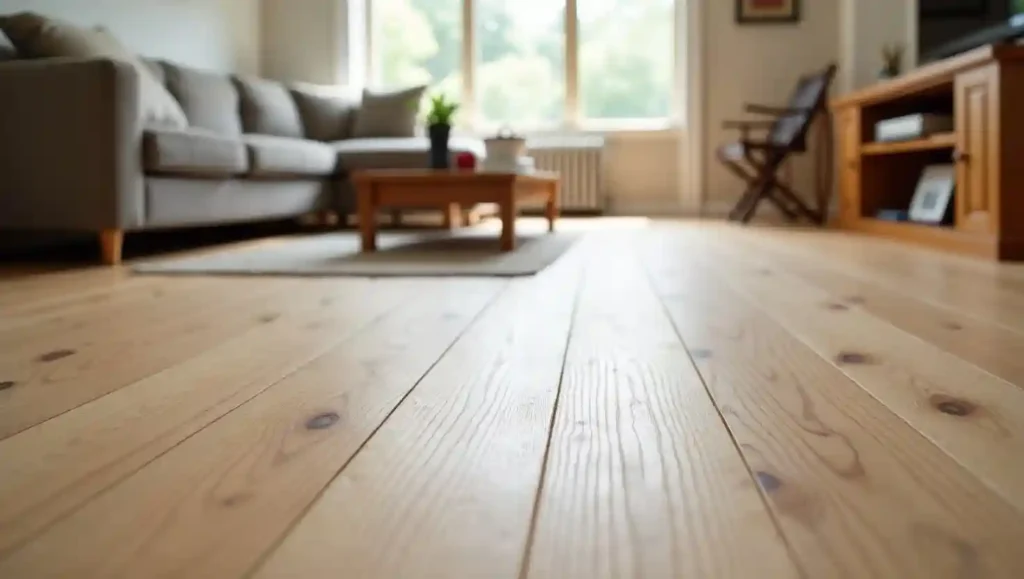
Pine flooring has been part of American homes since the colonial era. Wide-plank pine was the practical choice of builders who were surrounded by old-growth forests and needed an affordable, workable material for their floors. Today, that same wood is sought specifically for its old-house character, because old-growth pine floors in historic homes are genuinely irreplaceable. For new installations that chase the same aesthetic, reclaimed pine or wide-plank heart pine is the option to explore.
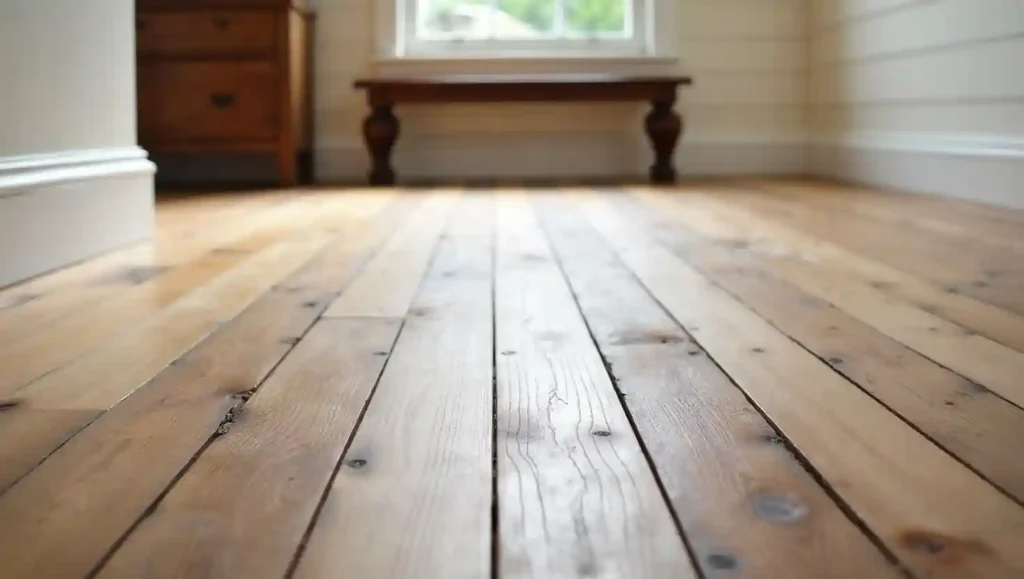
Wide-plank pine with an oil finish, rather than a polyurethane topcoat, gets particularly close to the historic look. Oil penetrates into the wood grain rather than sitting on top of it, which means the floor looks like the wood itself rather than like wood covered in plastic. The honey-toned oil warms the pine’s natural pale color and brings out the resin streaks and growth ring variation that give old pine its appeal. Pine is a soft species by hardwood standards, which means it dents and marks more readily, but many farmhouse enthusiasts embrace this as part of the character story. A dented pine floor in a family farmhouse is evidence of life, not failure.
Pine’s softness does require some attention to care and finish maintenance. Oil-finished floors need periodic re-oiling, typically every few years depending on traffic, to stay protected. They cannot be casually cleaned with anything too wet or too harsh. But properly maintained, they develop a patina over decades that cannot be manufactured. Understanding whether pine works as a practical flooring choice for your specific situation is worth doing before committing.
6. Herringbone Pattern in Medium Oak for Elevated Farmhouse Style
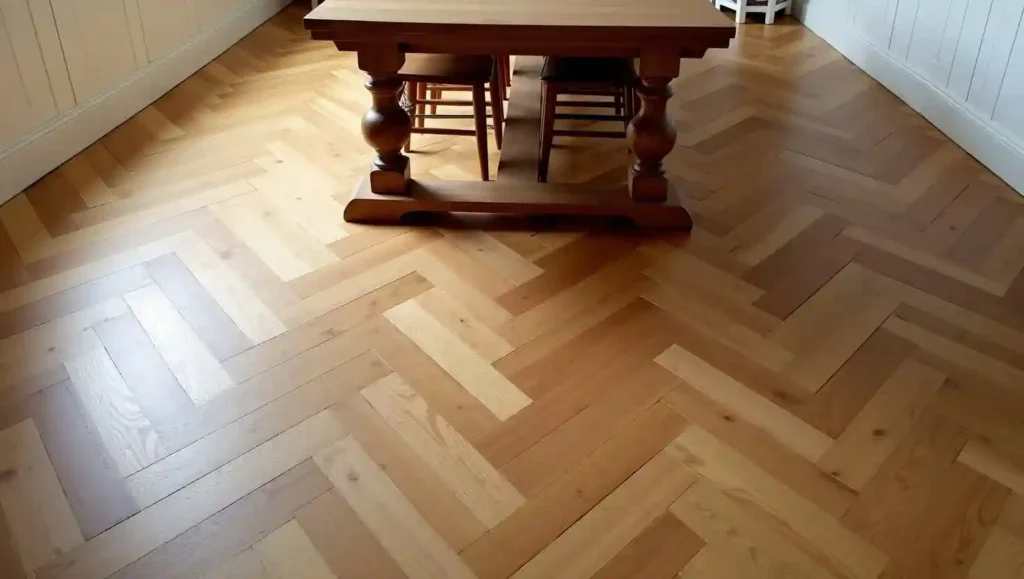
The herringbone pattern is older than the farmhouse style itself. It was used in European parquet floors for centuries before American farmhouses were even built. But it has found a home in elevated farmhouse interiors precisely because it pairs historical weight with visual sophistication. A herringbone oak floor in a farmhouse dining room or entryway brings the kind of quiet grandeur that the style can support when the rest of the room is kept simple.
Medium-toned oak, meaning boards that have been stained or chosen in a warm mid-brown or honey range, keeps the herringbone from feeling too formal or too French château. The warmth of the mid-tone grounds the geometric pattern in something organic and accessible. The herringbone itself, laid in shorter boards arranged at 45-degree angles to each other in a zigzag formation, creates movement and visual complexity that straight-laid planks cannot achieve.
In a farmhouse setting, herringbone works best when it is not overdone elsewhere. Keep walls simple, keep furniture honest and substantial rather than ornate, and let the floor do the decorative work. It is particularly powerful in entryways and dining rooms where it greets visitors and frames a gathering space. In open plans, it can also be used in a defined zone, say, beneath a dining table, to separate that area visually from the surrounding straight-laid floors. Those who love the elegance of patterned hardwood might also find inspiration in other herringbone hardwood flooring directions beyond the farmhouse context.
7. Dark Walnut Stained Oak for Dramatic Contrast
Modern farmhouse interiors love contrast, and nowhere is that contrast more powerful than when dark hardwood floors are paired with white painted walls, bright cabinets, and simple white trim. A dark walnut stain on oak creates a floor that grounds the room with visual weight, pulls furniture forward visually, and makes light walls feel luminous by comparison. The contrast between floor and walls is one of the defining visual moves in the modern farmhouse playbook.
White oak takes dark stains better than red oak because it lacks the strong yellow undertones that can push dark brown stains toward greenish or muddy territory. A properly stained white oak floor in a deep walnut or ebony range has rich, even color with visible grain movement underneath, which keeps it from looking flat or manufactured. Matte or satin finishes are the right choice here since a high gloss on dark floors will show every footprint and every speck of dust.
This approach works especially well in farmhouse kitchens with white shaker cabinets, subway tile backsplash, and stainless steel or matte black appliances. It also works in living rooms where a plush natural rug defines the seating area against the dark floor. The one practical consideration is that dark floors do show pet hair, light dust, and fine debris more readily than mid or light tones. Regular sweeping becomes important. Those interested in the full range of darker options for wood floors will find the dark hardwood flooring ideas collection useful for understanding the spectrum available.
8. Whitewashed or Cerused Oak for a Bright, Airy Feel
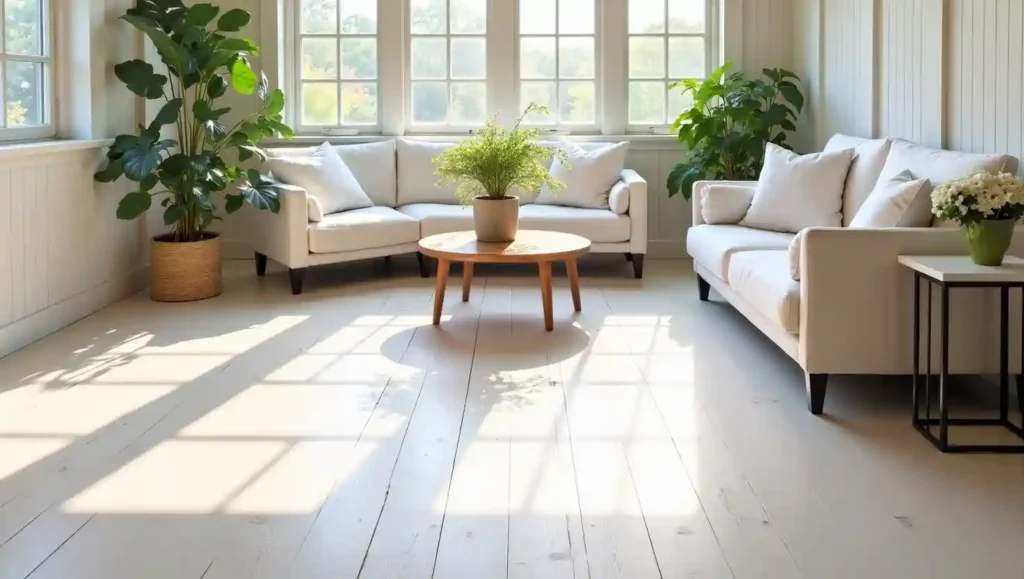
Whitewashing is one of the oldest treatments for wood floors, used in coastal European homes and American farmhouses alike for centuries. The technique involves applying a diluted white paint or lime wash to the bare wood surface, letting it soak into the grain, and then wiping the excess so that the grain remains visible while the overall surface reads significantly lighter and cooler. Cerusing is a related technique where white or gray pigment is worked into the open grain of wire-brushed oak, filling the low points with color while the raised grain stays more natural.
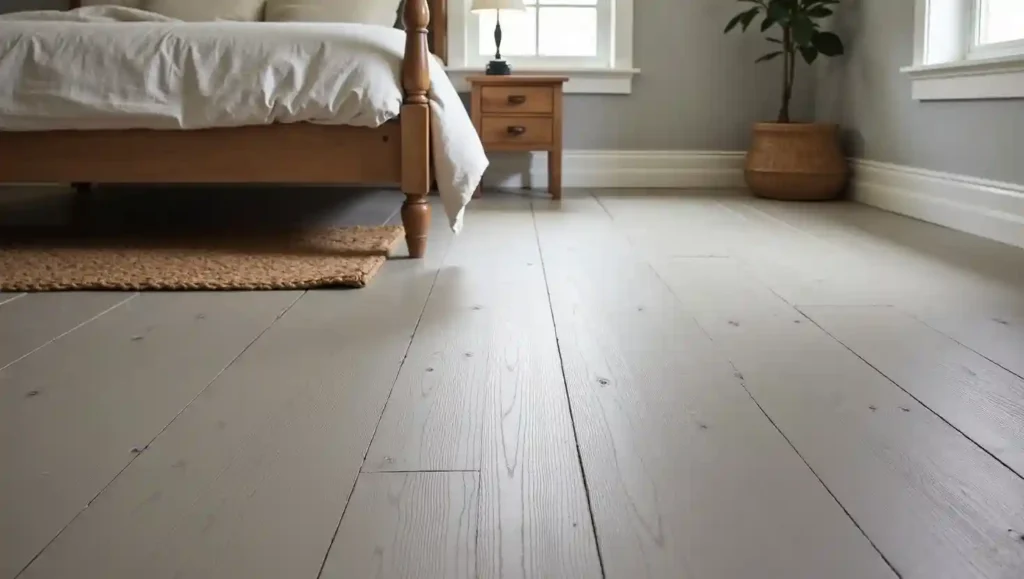
The result in either case is a floor with a bleached, sun-faded quality that reads as honest and relaxed. Whitewashed oak floors work particularly well in farmhouse interiors that lean toward a more feminine or coastal sensibility. They make rooms feel larger and airier, they reflect natural light more effectively than mid or dark tones, and they pair well with soft neutrals, natural linens, wicker and rattan furniture, and simple gathered curtains.
White and very light hardwood floors do require a mental shift in expectations around maintenance. They show dirt, spills, and scuffs very clearly, particularly in high-traffic areas. Many whitewashed floors use matte or flat finishes, which are more forgiving in hiding surface sheen but do require periodic re-coating over the years. The payoff is a floor that makes a room feel genuinely expansive and effortlessly relaxed, which is exactly what a farmhouse interior at its best should feel like. Light floors across all material types are explored in the light hardwood flooring ideas guide if you want to explore the full range of options in this direction.
9. Mixed-Width Plank Floors for Old-House Authenticity
Historic farmhouse floors were not built to a strict plank width. Early American builders used what the mill produced, which meant boards of varying widths laid side by side across the subfloor. This mixed-width approach was pragmatic, not decorative. But the visual result is one that modern eyes read as deeply authentic, because it genuinely reflects how those floors were made.
Installing a hardwood floor with mixed plank widths, typically combining three different widths such as 3-inch, 5-inch, and 7-inch boards in a repeating or random pattern, captures that old-house quality without requiring reclaimed material. White oak, red oak, and hickory all work well in mixed-width applications. The variation in board width naturally draws attention to the individuality of each plank and makes the floor feel more like something that grew rather than something that was manufactured.
This technique is particularly effective in rooms with traditional farmhouse decor elements: beadboard, turned stair spindles, apron sinks, and simple painted millwork. The mixed-width floor reinforces the hand-crafted, assembled-over-time quality that defines classic farmhouse character. Installation requires slightly more planning than a uniform-width floor because the layout of widths needs to be thought through so that it reads as natural rather than awkward. A skilled installer makes this look effortless. Those exploring wide plank directions across the full spectrum will find the wide plank hardwood flooring ideas worth reviewing for additional context.
10. Warm Honey Oak in an Open-Plan Kitchen and Living Room
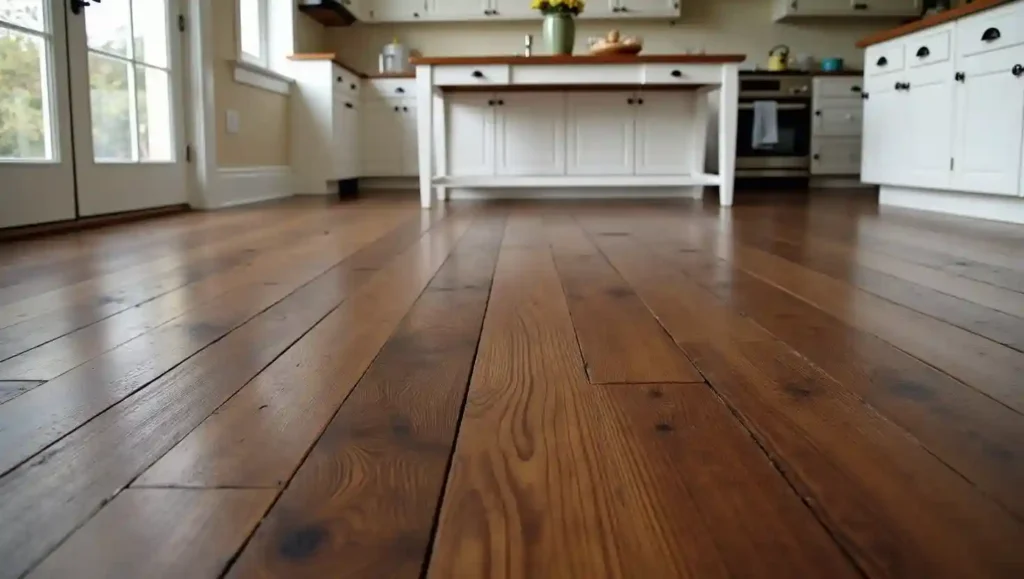
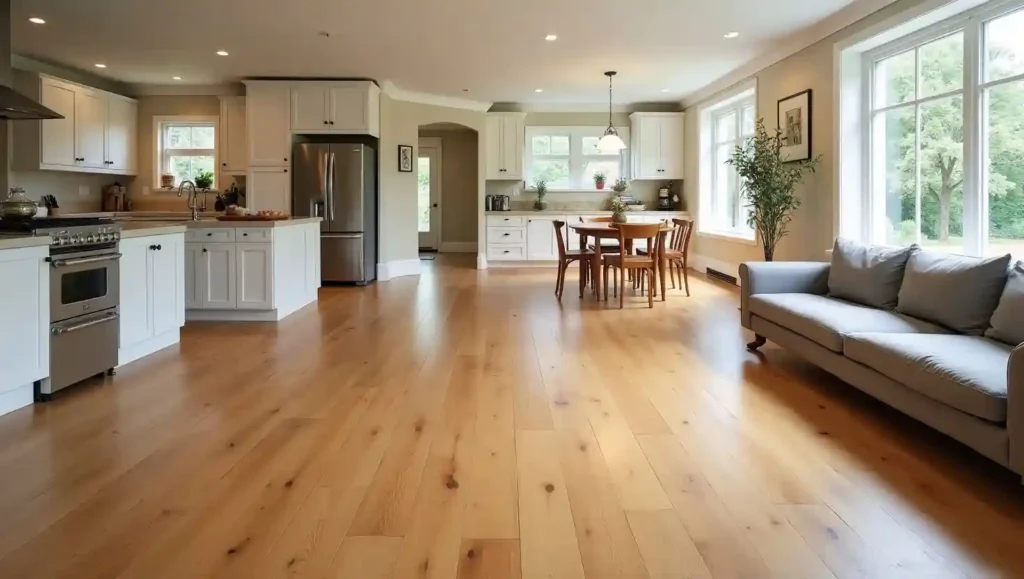
The open-plan farmhouse, where the kitchen flows directly into the dining and living areas without walls breaking the space, needs a floor that can carry visual continuity across multiple functional zones. A warm honey-toned oak is one of the most reliable choices for this role. The color sits in a mid-range that is neither too light to feel sterile nor too dark to feel heavy. The warmth of the tone, which reads as amber or golden-brown, connects the space to natural wood without polarizing the decor choices around it.
Honey-toned oak works with a wide range of cabinet colors including white, cream, sage green, navy, and natural wood. It also pairs well with a wide range of countertop materials from white quartz to butcher block to dark soapstone. This versatility makes it an especially practical choice in open plans where the flooring must navigate past both the kitchen and the living room without clashing with either set of furnishings.
The installation direction matters in open plans. Running boards lengthwise through the longest dimension of the space creates flow and makes the room feel larger. A satin or matte finish protects the floor from kitchen spills while still showing the wood’s natural depth. This floor is genuinely family-friendly. Honey-toned mid-range colors are among the most forgiving options for hiding everyday dirt and wear. For those thinking through the hardwood buying process for a project like this, a complete hardwood flooring buying guide helps clarify the decisions that go into species selection, grade, and finish choices before you commit.
11. Fumed or Smoke-Stained Oak for an Aged European Look
Fuming is a finishing technique where white oak, specifically, is exposed to ammonia vapor in a sealed chamber. The ammonia reacts with the tannins naturally present in white oak to produce a chemical color change rather than a surface stain. The result is a gray-brown tone with exceptional depth and complexity. Unlike regular stains, which sit on the surface and can sometimes look painted on, fumed oak looks like it has aged naturally from the inside out.
The color tends toward a warm taupe-gray with brown undertones, often described as resembling aged cognac barrels or old European chateau floors. This is a more sophisticated, quieter kind of farmhouse reference, one that looks less specifically American and more broadly Old World. It pairs beautifully with thick linen upholstery, antique iron fixtures, worn leather, and patinated stone surfaces. In a farmhouse setting, it reads as the floor of a centuries-old French or English country estate, elegant and lived-in without being precious.
Fumed oak’s unique character depends on the natural tannin content of each board, which means there can be slight variation between planks, particularly across wide boards where sapwood (lower tannin) and heartwood (higher tannin) are both present. Many designers consider this variation a feature since it reinforces the floor’s handmade, time-worn quality. Satin or oil finishes are typically used to preserve the color’s warmth and prevent it from looking overly shiny.
12. Engineered Hardwood in a Farmhouse Style for Challenging Spaces
Not every room in a farmhouse-style home is suited to solid hardwood installation. Basement spaces, over radiant in-floor heating, in rooms with significant humidity fluctuations, or in situations where the subfloor is concrete, solid hardwood can be problematic. Engineered hardwood, which uses a real hardwood veneer over a dimensionally stable plywood core, solves most of these problems while still delivering the authentic wood surface that farmhouse interiors require.
The top layer of an engineered hardwood plank is real wood, typically 2 to 6 millimeters thick, which can be wire-brushed, hand-scraped, stained, and finished in every way that solid hardwood can be. The result looks and feels identical to solid hardwood from above. The difference is in the construction below the surface, where the plywood layers resist expansion and contraction far better than a solid plank does. This means engineered hardwood can go where solid hardwood cannot, including below grade and over hydronic heating systems.
For farmhouse interiors, engineered hardwood opens up the possibility of running a consistent white oak, hickory, or walnut floor through the entire home, including basement family rooms and mudrooms, without compromise. The wide plank formats, distressed finishes, and species choices available in engineered hardwood today are extensive enough to satisfy any farmhouse aesthetic. The full comparison between solid and engineered hardwood covers the performance differences in depth, which is especially useful when deciding what works for specific rooms in a home.
13. Gray-Brown Hybrid Tones for the Modern Farmhouse Balance
One of the most consistent hardwood color trends in modern farmhouse interiors over the past several years is the gray-brown hybrid, sometimes called greige in the broader interior design world. These floors combine the warmth of brown with the modernity and restraint of gray, producing a tone that works with both the neutral whites and linens of modern farmhouse decor and the darker, richer earth tones that appear in traditional farmhouse settings.
Getting the right gray-brown tone requires careful species selection. White oak is the most reliable choice because its natural tone is already a warm gray-gold that can be pushed in either direction with stain. Red oak, with its stronger pink and orange undertones, can pull unpredictably under gray stain, sometimes producing a lavender or blue-gray that reads as cold and clinical rather than warm and welcoming. The gray-brown tones that work best in farmhouse settings tend to hover around driftwood, pewter, stone, and warm mushroom in the color story.
This floor type is genuinely versatile. It carries contemporary furniture cleanly, it supports the more ornate farmhouse decor elements without competing with them, and it does not date as quickly as more extreme color choices in either direction. A gray-brown oak floor installed well today will still look current in fifteen years, which matters significantly when talking about a permanent investment like flooring. Those curious about the full gray hardwood spectrum will find real value in exploring gray hardwood flooring ideas across a range of spaces and installation styles.
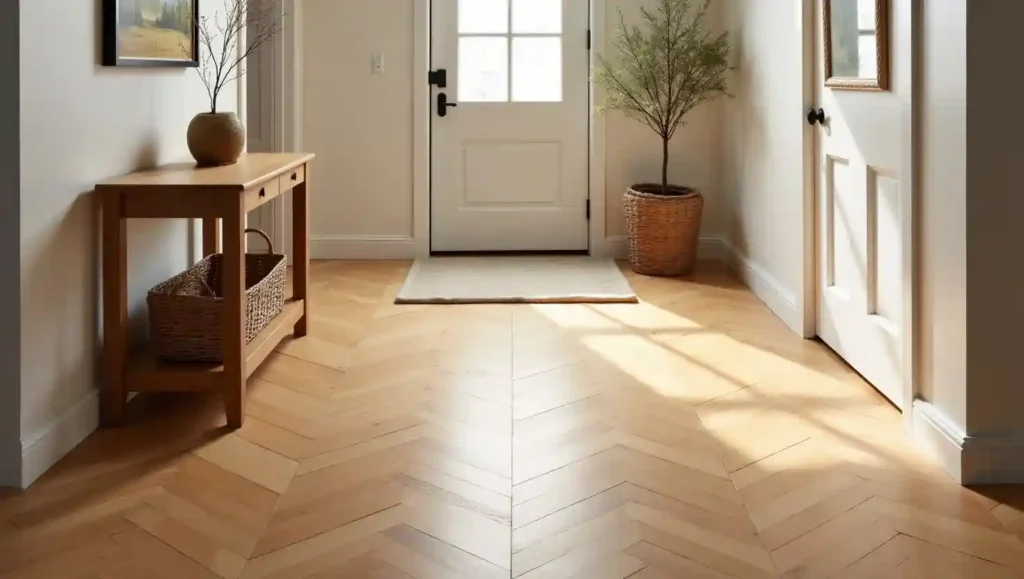
14. Chevron-Patterned Oak in a Farmhouse Entryway
The chevron pattern, where boards are cut at mitered angles so that the V-shape points in a single direction rather than alternating like herringbone, creates a more dynamic, directional movement. In a farmhouse entryway, this movement works in a specific functional way: it draws the eye forward, pulling visitors into the home and toward the main living spaces. The entryway is the first impression, and a chevron oak floor gives it presence without requiring any other decorative statement.
The species choice for a chevron installation matters because the angled cuts create more waste than straight-laid boards, so a more affordable species like red oak or a lower-grade white oak keeps the material cost manageable while still delivering the pattern’s visual impact. A warm mid-tone stain, something in the amber or honey range, keeps the entryway feeling welcoming rather than stark. The borders that some installations add around the perimeter of a chevron pattern, using the same wood or a contrasting species, bring in a formal European touch that elevates the farmhouse aesthetic without betraying it.
Chevron installations are more complex to lay than straight-board floors and require a skilled installer who understands the angular cuts and how to keep the apex of the V aligned perfectly down the room’s center axis. Any deviation in the layout reads as an error rather than as variation. When done well, however, a chevron entryway floor is one of the most memorable design decisions a farmhouse home can make.
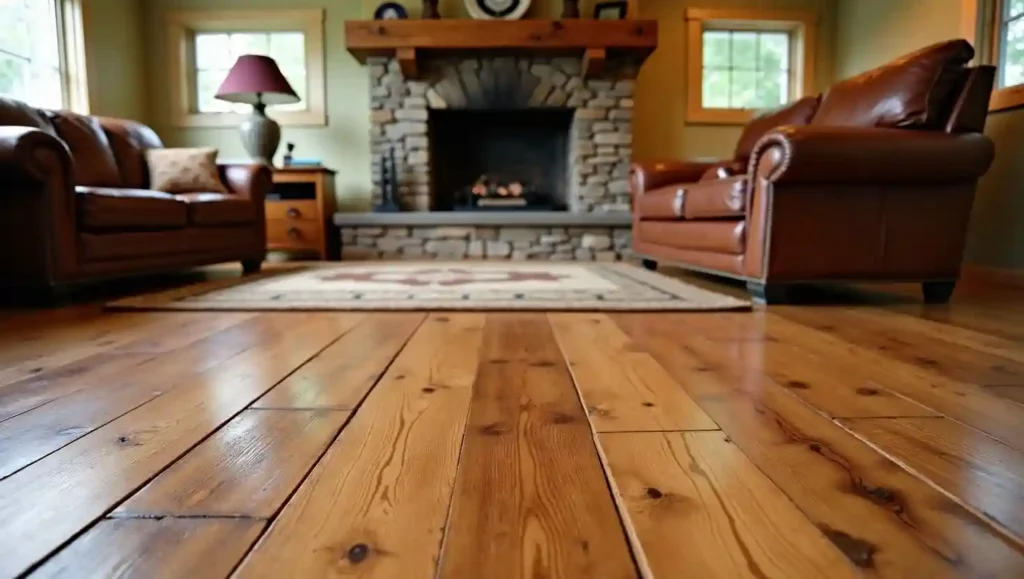
15. Distressed Red Oak with a Warm Amber Stain for Classic Farmhouse Warmth
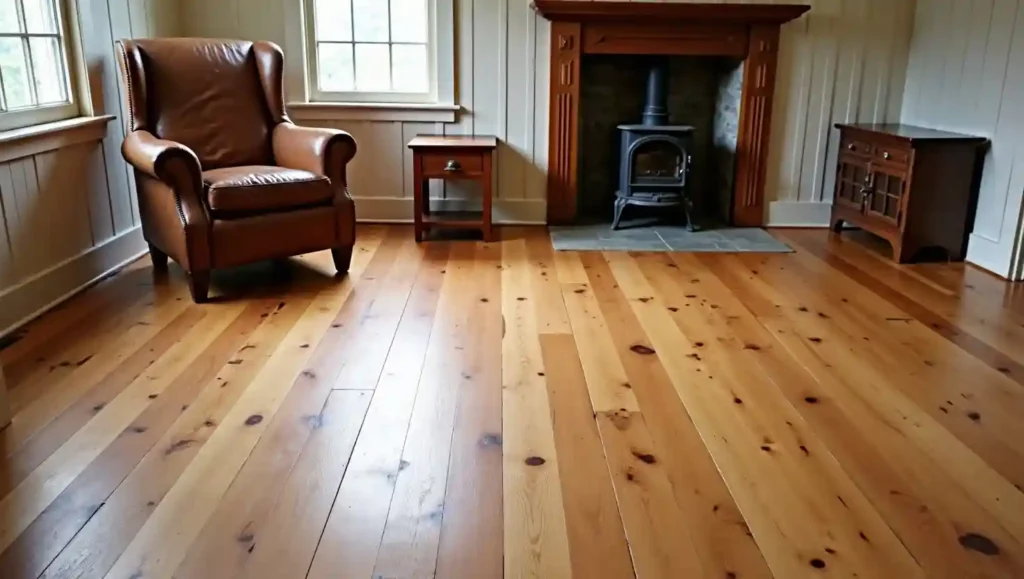
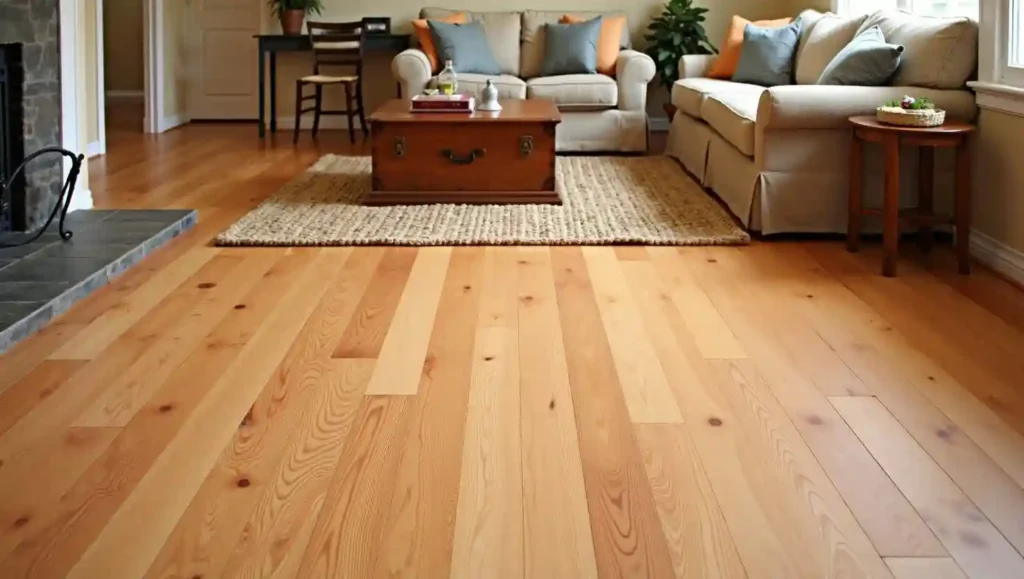
If the modern farmhouse pulls toward gray, white, and restraint, the traditional farmhouse pulls just as strongly in the other direction, toward warmth, richness, amber, and honey. Red oak with a warm amber stain and a distressed surface finish is the floor that belongs in that older, more deeply rooted version of the farmhouse aesthetic. This is the floor that looks right under a beamed ceiling, next to a stone fireplace, alongside furniture built from reclaimed timber and worn leather.
Red oak’s open grain and strong figuring, meaning the prominent pattern of rays and rings in the wood, respond well to amber stains, which warm the wood’s natural pink undertone into a rich, golden-brown. The distressing, whether through saw marks, skip planning, or deliberate surface beating, softens the newness of the floor and makes it read as something with history. Together, these elements produce the kind of floor that looks better the older it gets, because new marks and wear only add to the story rather than detracting from it.
This floor type is most at home in spaces with traditional farmhouse decor, beadboard walls, turned newel posts, cast iron hardware, painted furniture, and hand-hooked or braided rugs. It is not a subtle floor. It makes its presence felt and asks the room to rise to meet it. The payoff for rooms that do is a sense of warmth and rootedness that is genuinely difficult to achieve any other way. To understand how red oak stands against white oak in the broader context of farmhouse and traditional hardwood flooring choices, the red oak versus white oak comparison is a practical resource.
Choosing the Right Farmhouse Hardwood for Your Home
Across these fifteen ideas, several patterns emerge that are worth paying attention to when narrowing down the right choice for your specific home.
Species determines character more than any other single variable. White oak is the most versatile species across both modern and traditional farmhouse directions. Hickory delivers the most rustic drama. Pine connects most directly to early American farmhouse tradition. Red oak brings warmth but is more limited in how it handles gray or cool stain directions. Knowing which branch of the farmhouse aesthetic you are pursuing clarifies the species question significantly.
Finish level affects durability and maintenance as much as appearance. Matte and satin finishes are the practical and aesthetic choice for farmhouse floors in almost every situation. They hide wear better than high gloss, they read as more organic, and they are easier to spot-repair when refinishing becomes necessary. High-gloss finishes belong almost exclusively to contemporary and formal traditional interiors, not farmhouse spaces.
Plank width shapes the room’s scale. Wider planks, in the 5-to-8-inch range, make rooms feel larger and show more of each board’s individual character. Narrower planks in the 2-to-3-inch range read as more traditional and fine-grained, appropriate for certain historical reproductions. The wide plank direction is almost universally a good choice for farmhouse interiors regardless of which species or finish you choose.
Installation pattern adds a layer of design decision that goes beyond the floor itself. Straight-laid parallel boards are the most versatile and timeless. Herringbone and chevron bring pattern and sophistication. Mixed widths bring historical authenticity. The pattern choice should reinforce the overall design story of the room rather than work against it.
Budget shapes which of these options is realistic. Reclaimed barnwood and wide-plank solid hardwood in premium species are expensive. Engineered hardwood in similar aesthetic directions brings the cost down while maintaining the visual result. Understanding the full cost picture, including material, installation, and finish, helps make a decision you can live with for decades. A hardwood flooring cost guide provides the range of numbers involved across species and installation types.
Finally, the floor does not stand alone. Every farmhouse hardwood idea in this list depends on the rest of the room to complete it. The right floor paired with the wrong wall color, the wrong trim style, or the wrong furniture scale will underperform. The best farmhouse hardwood floors succeed because they are selected as part of a considered whole, where species, finish, pattern, and color all work together with every other material in the room to tell a coherent story. Starting with the floor and building outward from it is a reliable approach, because hardwood is one of the most permanent decisions in any interior, and it earns its place as the anchor from which everything else is calibrated.
James Miller is a seasoned flooring contractor with years of hands-on experience transforming homes and businesses with high-quality flooring solutions. As the owner of Flooring Contractors San Diego, James specializes in everything from hardwood and laminate to carpet and vinyl installations. Known for his craftsmanship and attention to detail, he takes pride in helping clients choose the right flooring that balances beauty, durability, and budget. When he’s not on the job, James enjoys sharing his expertise through articles and guides that make flooring projects easier for homeowners.
The bedroom floor does more quiet work than most people give it credit for. It is the first surface your feet touch each morning and the last thing you step across before bed. That repeated daily contact means comfort, noise, and visual tone all matter more here than in a hallway or kitchen. Vinyl flooring…
There is a persistent confusion between moisture barriers and vapor barriers in the flooring industry, and that confusion costs homeowners real money. They buy the wrong product, install it under their laminate, and six months later they are looking at bubbling planks, swollen edges, or a floor that smells like a wet basement. The terms…
What Is Birch Flooring? Birch is a domestic hardwood native to North America and parts of Northern Europe, and it has a long history in residential flooring. When people talk about birch as a flooring material, they are almost always referring to one of two commercially relevant species: yellow birch (Betula alleghaniensis) or sweet birch…
Choosing laminate flooring when you live with dogs is a different problem than choosing laminate for any other reason. The questions that matter — scratch resistance, moisture handling, surface traction — do not appear on most product pages in a usable form. Brands use marketing language. Retailers stack spec sheets. And pet owners end up…
Yes, waterproof laminate flooring still needs a moisture barrier in most installations — especially over concrete subfloors, below-grade rooms, crawl-space floors, and any space where vapor can rise from beneath. The “waterproof” label only describes the top surface of the plank, not the underside. The locking edges, the core, and the backing layer remain vulnerable…
Carpet stretching is one of those maintenance decisions that gets delayed until the problem is impossible to ignore. A ripple appears near the hallway, a bubble forms under the coffee table, and suddenly a floor that was perfectly installed years ago looks like something is living underneath it. What most homeowners do not realize is…